We remain fully operational. Our teams are working around the clock to ensure your deliveries continue safely.

Descargar la aplicación


Servicios al cliente
Sobre nosotros
Copyright © 2025 Desertcart Holdings Limited
Descargar la aplicación
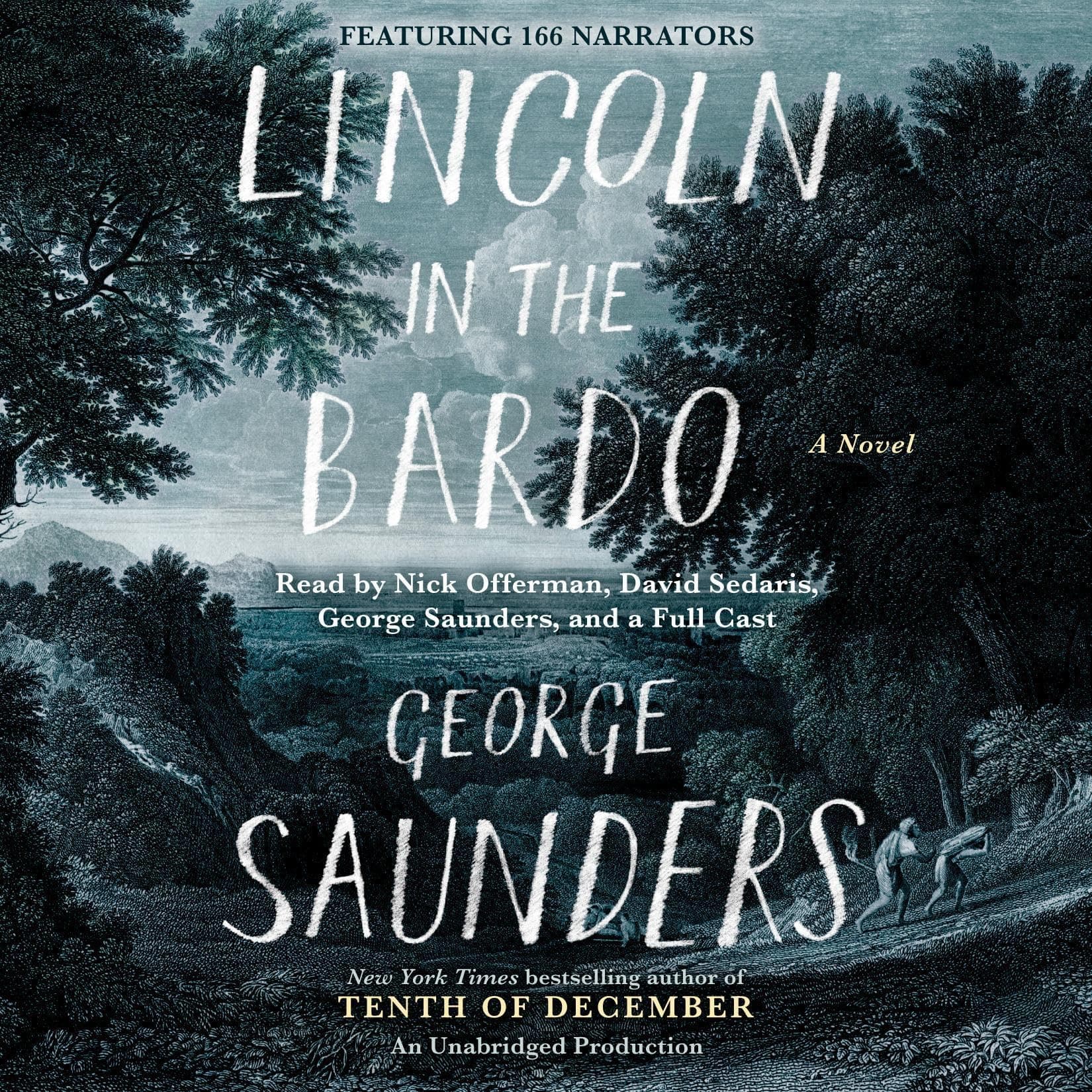
desertcart.com: Lincoln in the Bardo: A Novel (Audible Audio Edition): George Saunders, George Saunders, Nick Offerman, David Sedaris, Carrie Brownstein, Don Cheadle, Lena Dunham, Bill Hader, Kirby Heyborne, Keegan-Michael Key, Julianne Moore, Megan Mullally, Susan Sarandon, Ben Stiller, Various, Random House Audio: Books Review: THE NEITHER FISH NOR FOWL OF THE HUMAN CONDITION - BOOK REVIEW ARTICLE George Saunders, Lincoln in the Bardo (Random House, 2017) “All were in sorrow, or had been, or soon would be.” (Roger Bevins III, p. 304) Okay, so what happens when we die? Writers of fiction have been peering across into that unfathomable abyss from time out of mind. You might even say that this is what great fiction writers do: they look at the grand questions, and especially at immortality, or the lack thereof. George Saunders’ rather ironic take on the afterlife goes roughly like this: after death some of us get caught up in the fulgurant thing called “the bone-chilling firesound” of the “matterlightblooming phenomenon.” Amidst lots of explosions and smashing to smithereens—imagine something like the shoot-em-up-blow-em-up special effects of Hollywood—this phenomenon transports us off to . . . well, the author never tells us exactly where. Is it a nice place? That’s a good question. At times there are suggestions that it might be fine, but only for the better-behaved of human beings in their fleshy existence, and not even for all of them. Some of the deceased, so we’re told, resist the matterlightblooming, preferring to hang around in a limbo, neither fish nor fowl. Saunders uses the term “bardo” (borrowed, apparently, from Tibetan religious tradition) for that liminal state, although a better title for this book might be something like Lincoln in Liminality. Why? Because the novel is eminently American, it is anchored in American history; therefore, it might be better not to bring in an obscure term from an alien tradition. Sometimes it seems, at any rate, as if we were looking at some standard purgatory, as in the passage where a former hunter is forced to sit before an enormous heap of the animals he had killed over a lifetime, “each of which he must briefly hold, with loving attention, for a period ranging from several hours to several months” (127). The bardo of this book is Oak Lawn Cemetery in Georgetown, and most of the characters are sort of ghosts who, having been interred there, are now living out their liminality. Why do they resist what is apparently decreed by God’s law: the move on to the next stage in the universal progression? Mainly because they are still bound to the fleshy world from which they have departed. They have left things undone back in the world, and they have hopes of returning to flesh, so they delude themselves, pretending that they are merely ill, not really dead. They have made up euphemisms for unpleasant things. The coffin is a “sick-box,” the hearse is a “sick-cart.” To be dead is to be “unlovable” (70), and the ghosts of Oak Lawn, above all, crave love. The central plot of the book revolves around the death of Abraham Lincoln’s beloved son Willie in February of 1862. Although Lincoln remains alive, he too is in a state of liminality, stunned by bereavement, frozen by his refusal to accept the death of his son and his wish to believe that even after death father and son can find some sort of communion. Much to the delight of the ghosts of Oak Lawn, Lincoln returns to the cemetery, goes to the crypt of his son, even opens the coffin and holds the dead boy. Although the author gives the narration briefly to a multitude of narrators throughout the book, there are mainly three tellers of the tale, all of them ghosts. Roger Bevins III, a young homosexual who committed suicide when his lover decided to go straight; Hans Vollman, a forty-six-year-old man who was on the verge of consummating his marriage to a young wife when a ceiling beam fell on his head (consequently he ambles about the bardo with a perpetual erection); the Reverend Everly Thomas, who, unlike the other denizens of the bardo, has already taken a tentative step into the next stage and is terrified of going back there. In the background of the story is the theme of The War Between the States and the carnage. On the day that Willie is laid to rest the casualty lists from the Union victory at Fort Donelson are announced. “The dead at Donelson, sweet Jesus. Heaped and piled like threshed wheat, one on top or two on top of three. I walked through it after with a bad feeling. Lord, it was me done that, I thought” (152). In this semi-historical novel of sorts the above quote is attributed to “First Lieutenant Daniel Brower,” cited from “These Battle Memories.” The book is full of citations from historical sources. In addition to sources describing the war, there are others telling of the trauma in the Lincoln household as young Willie wastes away and dies. I have not checked the historical sources, but I strongly suspect that many of them come not out of books, but out of the creative mind of George Saunders. The sources often contradict each other. In one description of Willie’s final days a variety of different people describe the moon. For some it is full, for some a crescent, for others there was no moon at all in the sky that night. So how was it really? One effect that the author achieves by mixing real and fictional people is to suggest that even those alive in 1862 are now so long gone that they are as insubstantial as fictional characters. We come upon one “Prince Felix Salm-Salm, a Prussian nobleman and cavalry officer, who was serving on General Blenker’s staff” (11). Another source on the same page refers to him as “the dashing German Salum-Salum,” and we think, Ah, this is one of Saunders’ made-up characters. But a check on the internet reveals that Salm-Salm actually existed in the flesh. Never mind. He is chimerical now. A big theme of the novel (and of world literature in the age of postmodernism): who is really real and who is chimerical? And, given that we all begin dying on the day we are born, how really real can our lives in flesh be? But it’s the only thing we have, this temporary existence in flesh, and Saunders sometimes revels in lovely lyrical descriptions of the sensuous joys of life. Here is Roger Bevins, who, having slit his wrists, is having second thoughts: “saw that I was on the brink of squandering a wondrous gift, the gift of being allowed, every day, to wander this vast sensual paradise, this grand marketplace lovingly stocked with every sublime thing: swarms of insects dancing in slant-rays of August sun; a trio of black horses standing hock-deep and head-to-head in a field of snow; a waft of beef broth arriving breeze-borne from an orange-hued window on a chill autumn” (25-26). Here is Bevins again later, in the same mode: “such things as, for example: two fresh-shorn lambs bleat in a new-mown field; four parallel blind-cast linear shadows creep across a sleeping tabby’s midday flank; down a bleached-slate roof and into a patch of wilting heather bounce nine gust-loosened acorns” (140-41; this goes on for five more lines). Bevins’ best buddy in the bardo, Hans Vollman, later launches into a similar lyrical outburst: “the great beauty of the things of this world: waterdrops in the woods around us plopped from leaf to ground; the stars were low, blue-white, tentative; the wind-scent bore traces of fire, dryweed, rivermuck; the tssking drybush rattles swelled with a peaking breeze, as some distant cross-creek sleigh-nag tossed its neck-bells” (171). Near the end of the novel (334-35) Bevins gets going again: “a bloody roast death-red on a platter; a hedgetop under-hand as you flee late to some chalk-and-woodfire-smelling schoolhouse” (two whole pages of this). The muse of George Saunders is obviously in charge of the poetry here—for how would Vollman and Bevins, who have never written a line of poetry in their fleshy lives or bardo existence—come up with such stuff? Saunders the poet, it seems, is partial to hyphenated expressions. What do the semi-dead do with themselves in this particular purgatory, as they wait to get over being “sick” so that they can return to flesh and the carnate pleasures described above? They lead, mostly, a boring life. “We had sat every branch on every tree. Had read and re-read every stone. Had walked down (run down, crawled down, laid upon) every walk, path, and weedy trail, had waded every brook; possessed a comprehensive knowledge of the textures and tastes of the four distinct soil types here; had made a thorough inventory of every hair-style, costume, hair-pin, watch-fob, sock-brace, and belt worn by our compatriots; I had heard Mr. Vollman’s story many thousands of times, and had, I fear, told him my own at least as many times” (Bevins again, 124). One woman keeps herself busy collecting pebbles, twigs, and dead bird parts. Then again, the ghosts of the bardo, determined as they are to get their lives back, are obsessed with the preoccupations of those still in flesh. Class and race distinctions remain the same. The issue of slavery and abuse of slaves is a sub-theme of the narrative. There are poor white trash ghosts, aristocratic ghosts, racially oppressed ghosts and racist ghosts, all of them fighting for a bit of respect, insisting that the lives they led should be valued. No one, it seems, gets the credit he/she deserves in life, and in their liminal state the semi-dead go on bemoaning that fact. A former professor is still nursing his ego: “I made many discoveries previously unknown in the scientific pantheon, for which I was never properly credited.” A former pickle maker still boasts of the loveliness of his wares: “Say, did you ever taste one of my pickles?” (208-09) In the world of the flesh, apparently nothing ever changes: “things ‘out there’ were as they had been; i.e., eating, loving, brawling, births, binges, grudges, all still proceeded apace” (226). “We were at war, said Mr. Vollman. At war with ourselves.” The reference is to the Civil War, but the war within the bifurcated self is also implied. Human beastliness, so the narrative suggests, might well go on perpetuating itself into eternity, “unless some fundamental and unimaginable alteration of reality should occur” (321). But Saunders’ novel, deeply pessimistic at its core, never suggests that the reality of human existence can be altered. Since the world of the bardo is a place where everyone yearns to go back to being alive, the preoccupations of the bardo-dwellers mirror those of the fleshy world. When Abraham Lincoln shows up at the cemetery, to visit his dead son Willie in the crypt, the denizens of the bardo perk up. After all, most of those still in flesh shun the land of the semi-dead, but here is a man who embraces his dead boy in the coffin. The man, to boot, is the President, although they do not realize this at first, since many of them have departed the world under President Polk, say, or Buchanan. Some of the most touching scenes in the book are those in which Lincoln attempts to find communion with his dead son’s body—while that son’s shade hovers about, agonizes, unable to make contact with his beloved father. Lincoln comes across as a sympathetic character, bedeviled by countrymen who criticize his running of the war (see p. 232-34), depressed not only by the loss of his own son, but by the many sons of others who have perished in battle. Lincoln in the Bardo is a postmodernist novel; it presents a narrative that is skewed in harmony with the surrealistic, skewed plot about a world of purgatory. The story unfolds through bits and pieces, staccato bursts of action; the narrative does without the usual “he said” or “she said.” Readers not accustomed to this may find the going hard at first. Here’s a typical example of the way the story is laid out on the page. I, for one, was afraid of him. roger bevins iii I was not afraid of him. Exactly. But we had urgent business. Must not linger. hans vollman Lots of unused space here (more on the white space later). A normal novel would read as follows: “I, for one, was afraid of him,” said Roger Bevins III. “I was not afraid of him. Not exactly, but we had urgent business and must not linger,” said Hans Vollman. But Saunders, who is writing about a ghost world after death, does not want it done “normal.” This is something like a movie about the supernatural, which uses distortions on the screen, out of focus shots, fadings in and out, along with eerie music in the background, all for effect. Then again, there is the nineteenth century language used by the characters; nothing odd about that, since the book is set in 1862. But many characters also are shown speaking with misspelled, or even totally distorted words. This too adds to the weirdness effect for which the author strives. Sometimes the inarticulate dead struggle to find the right words. “who kome to ogle and mok me and ask me to swindle no, that is not the werd slender slander that wich I am doing” (39). Those whose existence seems in the final stages of dissipation, such as one Mr. Papers, of whom little is left except “a cringing gray supine line,” cry out for help in a language that dissipates along with them: “Cannery anyhelpmate? Come. To. Heap me? Cannery help? . . . . Place hepMay” (134). Although American readers these days seem to need a lot of pampering—see some of the complaints about this novel on the desertcart book reviews—the narrative line of the plot is not particularly difficult to follow. You want real difficulty, go back and give James Joyce a try. No contemporary American writer, it appears, would dare write the kind of demanding sentences that we find in his Ulysses or Finnegans Wake. Saunders is to be commended for daring even his modest (compared, say, to Joyce or Nabokov) stylistic innovations and literary devices. Risk taking is not a common thing in the present state of the American novel. Saunders here follows rather typical modernist conventions: preferring fragments over wholes, resisting any sort of “closure,” and bathing the whole thing in a subtle irony. Note that we are not talking satire here. Satire implies the possibility that evils can be overcome and life improved. Irony implies a certain light absurdity underlying everything. Given the postmodernist devices, you might assume that Lincoln in the Bardo is a hard, slow read, but nothing of the sort. It’s a fast read. The unique narrative method makes for few words on a page, and some pages are nearly empty. Here is page 9: “Willie was burning with fever on the night of the fifth, as his mother dressed for the party. He drew every breath with difficulty. She could see that his lungs were congested and she was frightened.” Then the attribution of the source, and that’s it; no more words on the whole page. Unless you want to stop and contemplate the meaning of all that empty space, you the reader quickly skip on to page ten. And this is not an isolated occurrence. There are plenty of such nearly empty pages in the book, and even the regular telling of the tale, split up between the many narrators, leaves globs of white space on every page. The novel in print has a total of 343 pages, but were it printed in a normal way, utilizing the space available on the pages, it would be hardly a novel at all, but a novella or long story of some 200-odd pages. In a book that is post-modernist in its narrative techniques and ironic stances, Lincoln in the Bardo is often quite conventional in its ethics and morality. What people have done in life very much matters in the afterlife. Judeo-Christian morality is ascendant, and the idea of a Judeo-Christian heaven and hell underlies the action. At one point former persons who have committed the worst sins of all—massacring an entire regiment, murdering loved ones with poison, having sexual congress with children—make their appearance as demons. They consist now of “thousands of writhing tiny bodies, none bigger than a mustard seed, twisting minuscule faces up at us” (267). When Bevins asks them if they are in Hell, one of them replies, “Not in the worst one.” There are many degrees of Hell, and in the worst one skulls are smashed against a series of clustered screwdrivers, or you are sodomized in perpetuity by a flaming bull. Vengeance is mine, saith the Lord. At several points in the novel, however, it is suggested that the universe of Judeo-Christian punishment and reward is somehow flawed. One woman, a rather comical character who has murdered her intolerable husband Elmer asks, “Was that my doing? Was that fair? Did I ask to be born licentious, greedy, slightly misanthropic, and to find Elmer so irritating? I did not. But there I was” (269). Here we touch lightly upon the age-old polemic of free will versus determinism. Lincoln in the Bardo rehashes, almost always in an ironic way, many of the major philosophical issues throughout the history of the Western literature. One of the most enigmatic characters is one of the three main narrators, the Reverend Everly Thomas. This character is different from the other ghosts of the bardo, for he does not delude himself. He knows that he is dead, and he has already once gone beyond the liminality and stood at the threshold of the next stage. What he finds there is another traditional Judeo-Christian scenario, the scene of the Last Judgment. For eight pages in the middle of the book (187-195) he describes what happens when you get to Judgment Day. Along with two others recently deceased he trudges up to the spot of the judgment. “Inside, a vast expanse of diamond floor led to a single diamond table at which sat a man I knew to be a prince; not Christ, but Christ’s direct emissary” (189). Quite businesslike in his demeanor, this emissary or double of Christ watches as two angels lead, in turn, the three men to be judged up to the table. One asks, “How did you live?” The other says, “Tell it truthfully.” Using a mirror and a scale, the angels look inside the man, remove his heart and weigh it on the scale. The emissary limits himself to two words, “Quick check.” The check is quickly made, although the results are puzzling. Apparently blameless individuals are summarily assigned to Hell. You have a feeling that the whole business is badly skewed, in need of a thorough revamping, particularly when the Reverend Thomas—whose life appears to have been almost entirely sinless—is summarily assigned to Hades. Before the angels manage to usher him into the Inferno, poor Thomas flees from the proceedings, somehow makes it back to the Oak Lawn Cemetery, and lives there in limbo, terrified to move on. He is reluctant to tell his fellow limbo-dwellers of the judgment awaiting them, and the angels have forbidden him to do so. Apparently assuming that children are largely sinless, or have not had time to build up a lengthy catalog of sins, Thomas, Vollman and Bevins make it their task to help Willie Lincoln move out of his liminality and on to the next stage. When they finally accomplish this task Willie is ushered into what is apparently a world of sublime loveliness. “Whatever that former fellow (willie) had, must now be given back (is given back gladly) as it never was mine (never his) and therefore is not being taken away, not at all! “As I (who was of willie but is no longer (merely) of willie) return “To such beauty” (301). What is the reader to make of all this? Well, nothing entirely coherent. Jesus is quoted as saying to his disciples, “What I do ye know not now, but ye shall know hereafter” (292). There’s the big question, not only of this novel, but of many more in Western literature: are we ever really going to know what it’s all about? We do know, so the story tells us, what we ought to do. We “must try to remember that all were suffering (none content; all wronged, neglected, overlooked, misunderstood), and therefore one must do what one could to lighten the load of those with whom one came into contact; that his [Lincoln’s] current state of sorrow was not uniquely his, not at all, but, rather, its like had been felt, would yet be felt by scores of others, in all times, in every time . . . . . . All were in sorrow, or had been, or soon would be” (303-04). Such is the liminal state of humanity. Let’s face it: we’re all in a bardo. Not knowing where we came from. Not knowing what we’re doing here. Not knowing where we’re bound. At times—as in the scene of the Last Judgment—Saunders implies that God and Christ, in their standard Judeo-Christian guise, have not done a very good job at organizing the whole affair. Here is Lincoln, musing on toward the end, over the many dead and the carnage of the war. “I will go on. I will. With God’s help. Though it seems killing must go hard against the will of God. Where might God stand on this? He has shown us. He could stop it. But has not. We must see God not as a Him (some linear rewarding fellow) but an IT, a great beast beyond our understanding, who wants something from us, and we must give it, and all we may control is the spirit in which we give it and the ultimate end which the giving serves. What end does IT wish served? I do not know. . . (310). This goes on for several more lines, but the wishes of IT are never established. And never will be. Pondering over the issue of human mortality never really gets us anywhere. Here is Lincoln, going round and round in circles again. “Trap. Horrible trap. At one’s birth it is sprung. Some last day must arrive. When you will need to get out of this body. Bad enough. Then we bring a baby here. The terms of the trap are compounded. That baby also must depart. All pleasures should be tainted by that knowledge. But hopeful dear us, we forget. “Lord, what is this? All of this walking about, trying, smiling, bowing, joking? This sitting-down-at-table, pressing-of-shirts, tying-of-ties, shining-of-shoes, singing-of-songs-in-the-bath?” (155-56) A good question, and the central question of the book: what is all this? Suffering people scream it out on a daily basis, but no philosopher, theologian, or writer of novels has ever come up with a good answer. Near the end of the novel it is suggested that people can move on out of purgatory when we are no longer sustained by “some lingering, dissipating belief in our own reality” (329-330). What is our own reality? That is what writers of literary fiction are trying to get at. Tolstoy concludes one of the greatest works in world literature on the subject of mortality, “The Death of Ivan Ilyich,” with the demise of his main character. As he passes into eternity, Ivan Ilyich, finally suffering his way past the cancer that kills him, muses, “’But death? Where is it?’ He sought for his former usual fear of death and did not find it. Where is death? What death? There was no fear at all, because neither was there any death. Instead of death there was a light. ‘So that’s how it is!’ he suddenly exclaimed aloud. ‘What joy!’” Critics have sometimes disparaged this death-bed revelation that the author gives to his character at the end of the story. You cannot legitimately have Ivan Ilyich suddenly seeing what’s out there after his death—finding the fulgurant light of joy. Because seeing what’s out there is beyond the ken of any mortal being. Then again, George Saunders knows that the scenario he has invented, his take on what is out there post mortem, has no basis in truth. Is at times based on rather facile re-imaginings of scenarios long current in world literature and the Western religious tradition. But imagining, as Mary Todd Lincoln does, that her dead son is somewhere—“Musn’t he yet be somewhere?” (182), something more than “a passing, temporary energy-burst” (244)—that imagining gives human beings the strength to go on living. To me there is good reason for all the empty white space on the pages of Saunders’ book. That space tangibly suggests the emptiness, the wretched void against which people go on struggling in order to live: the possibility, ever unacceptable, that there is nothing out there but white noise. Review: Lincoln in the Bardo - amazing, but not without flaws. - George Saunders’ new novel, “Lincoln in the Bardo” is a unique work of historical fiction. It uses a series of accounts, some real, some fictional, all revolving around once singular, true occurrence. While the staccato placement of accounts may have felt sort of jarring on the page it served its particular purpose, in some areas, beautifully. Saunders’ use of contrasting accounts is particularly interesting. Two consecutive accounts on one page describe the moon as incredibly clear, and completely obfuscated. I can’t quite place his intention surrounding those conflicts (but then, unlike George Saunders, I don’t have a genius grand) but it seriously underscores the human capacity for error which was so prominently displayed in the era of the Civil War. George Saunders, ever a fan of the strange, hilarious, and terrifying, managed to create an equivalent of purgatory both calm and incredibly frightening; a “bardo” or inbetween state that its inhabitants are consciously unaware of. To admit one’s own death is embrace it, and to disappear forever. Rather than admit their deaths, the inhabitants of the cemetery in which most of the book’s occurrences unfold emerge from their “sick boxes” each evening, wandering aimlessly within the cemetery grounds, unable to effect any change in the outside world, and waiting endlessly for family that never comes. In the world of the living, meanwhile, Lincoln had spent weeks believing his son was going to recover, when in fact, he only got weaker. While his son suffered through his final hours, Lincoln held a feast. Some of the accounts featured in the book judge Lincoln quite harshly for this, but can it really be blamed? He was, after all, the president, and was expected to hold dinners at the white house, although the merriment may well have been in excess. His son had been ill for weeks, how was he to know this was poor Willie’s final day? All of these accounts of his faults, and the imagined thoughts in his head serve one, perfectly executed purpose - to paint Abraham Lincoln as human. He was imperfect. In his early days his handling of the Civil War was clumsy and purposeless. He held a loud, raucous party while his boy suffered. But he loved his son. No account Saunders created could demonstrate that more than the truth of history - the first night Willie Lincoln was interred, Abraham Lincoln was absent from the Whitehouse. The president was seen by the gatekeeper of the cemetery, entering late in the evening, and not leaving until morning. This emotional momentum is echoed by the voices of the chorus of ghosts present in the cemetery, who come to terms with their own death largely by witnessing the purity of sorrow felt by Lincoln, but they do get tedious. The purposeful repetition was overused quite often throughout the novel, and I think a more judicious editor would have done the book some good. Additionally, I think that the utter lack of standard prose detracts from George Saunders's greatest asset - his voice. His capacity to display people at their barest, simplest, most childlike emotional state was largely absent from the novel, replaced by an editorial echo of the loss felt by the nation during the civil war. Either way, Saunders presents an incredibly introspective story - one where missed opportunity, loss, and a deep sense of mourning overpower any of the books faults. Personal notes - I would rank George Saunders amongst the greatest fiction writers who have ever lived, and as perhaps the greatest ever American fiction writer (high praise considering there is a Kurt Vonnegut quote eternally present on my chest.) His transition from the short story to the novel underscores a new potential for him to exercise his voice. One I hope he will make ample use of.
R**E
THE NEITHER FISH NOR FOWL OF THE HUMAN CONDITION
BOOK REVIEW ARTICLE George Saunders, Lincoln in the Bardo (Random House, 2017) “All were in sorrow, or had been, or soon would be.” (Roger Bevins III, p. 304) Okay, so what happens when we die? Writers of fiction have been peering across into that unfathomable abyss from time out of mind. You might even say that this is what great fiction writers do: they look at the grand questions, and especially at immortality, or the lack thereof. George Saunders’ rather ironic take on the afterlife goes roughly like this: after death some of us get caught up in the fulgurant thing called “the bone-chilling firesound” of the “matterlightblooming phenomenon.” Amidst lots of explosions and smashing to smithereens—imagine something like the shoot-em-up-blow-em-up special effects of Hollywood—this phenomenon transports us off to . . . well, the author never tells us exactly where. Is it a nice place? That’s a good question. At times there are suggestions that it might be fine, but only for the better-behaved of human beings in their fleshy existence, and not even for all of them. Some of the deceased, so we’re told, resist the matterlightblooming, preferring to hang around in a limbo, neither fish nor fowl. Saunders uses the term “bardo” (borrowed, apparently, from Tibetan religious tradition) for that liminal state, although a better title for this book might be something like Lincoln in Liminality. Why? Because the novel is eminently American, it is anchored in American history; therefore, it might be better not to bring in an obscure term from an alien tradition. Sometimes it seems, at any rate, as if we were looking at some standard purgatory, as in the passage where a former hunter is forced to sit before an enormous heap of the animals he had killed over a lifetime, “each of which he must briefly hold, with loving attention, for a period ranging from several hours to several months” (127). The bardo of this book is Oak Lawn Cemetery in Georgetown, and most of the characters are sort of ghosts who, having been interred there, are now living out their liminality. Why do they resist what is apparently decreed by God’s law: the move on to the next stage in the universal progression? Mainly because they are still bound to the fleshy world from which they have departed. They have left things undone back in the world, and they have hopes of returning to flesh, so they delude themselves, pretending that they are merely ill, not really dead. They have made up euphemisms for unpleasant things. The coffin is a “sick-box,” the hearse is a “sick-cart.” To be dead is to be “unlovable” (70), and the ghosts of Oak Lawn, above all, crave love. The central plot of the book revolves around the death of Abraham Lincoln’s beloved son Willie in February of 1862. Although Lincoln remains alive, he too is in a state of liminality, stunned by bereavement, frozen by his refusal to accept the death of his son and his wish to believe that even after death father and son can find some sort of communion. Much to the delight of the ghosts of Oak Lawn, Lincoln returns to the cemetery, goes to the crypt of his son, even opens the coffin and holds the dead boy. Although the author gives the narration briefly to a multitude of narrators throughout the book, there are mainly three tellers of the tale, all of them ghosts. Roger Bevins III, a young homosexual who committed suicide when his lover decided to go straight; Hans Vollman, a forty-six-year-old man who was on the verge of consummating his marriage to a young wife when a ceiling beam fell on his head (consequently he ambles about the bardo with a perpetual erection); the Reverend Everly Thomas, who, unlike the other denizens of the bardo, has already taken a tentative step into the next stage and is terrified of going back there. In the background of the story is the theme of The War Between the States and the carnage. On the day that Willie is laid to rest the casualty lists from the Union victory at Fort Donelson are announced. “The dead at Donelson, sweet Jesus. Heaped and piled like threshed wheat, one on top or two on top of three. I walked through it after with a bad feeling. Lord, it was me done that, I thought” (152). In this semi-historical novel of sorts the above quote is attributed to “First Lieutenant Daniel Brower,” cited from “These Battle Memories.” The book is full of citations from historical sources. In addition to sources describing the war, there are others telling of the trauma in the Lincoln household as young Willie wastes away and dies. I have not checked the historical sources, but I strongly suspect that many of them come not out of books, but out of the creative mind of George Saunders. The sources often contradict each other. In one description of Willie’s final days a variety of different people describe the moon. For some it is full, for some a crescent, for others there was no moon at all in the sky that night. So how was it really? One effect that the author achieves by mixing real and fictional people is to suggest that even those alive in 1862 are now so long gone that they are as insubstantial as fictional characters. We come upon one “Prince Felix Salm-Salm, a Prussian nobleman and cavalry officer, who was serving on General Blenker’s staff” (11). Another source on the same page refers to him as “the dashing German Salum-Salum,” and we think, Ah, this is one of Saunders’ made-up characters. But a check on the internet reveals that Salm-Salm actually existed in the flesh. Never mind. He is chimerical now. A big theme of the novel (and of world literature in the age of postmodernism): who is really real and who is chimerical? And, given that we all begin dying on the day we are born, how really real can our lives in flesh be? But it’s the only thing we have, this temporary existence in flesh, and Saunders sometimes revels in lovely lyrical descriptions of the sensuous joys of life. Here is Roger Bevins, who, having slit his wrists, is having second thoughts: “saw that I was on the brink of squandering a wondrous gift, the gift of being allowed, every day, to wander this vast sensual paradise, this grand marketplace lovingly stocked with every sublime thing: swarms of insects dancing in slant-rays of August sun; a trio of black horses standing hock-deep and head-to-head in a field of snow; a waft of beef broth arriving breeze-borne from an orange-hued window on a chill autumn” (25-26). Here is Bevins again later, in the same mode: “such things as, for example: two fresh-shorn lambs bleat in a new-mown field; four parallel blind-cast linear shadows creep across a sleeping tabby’s midday flank; down a bleached-slate roof and into a patch of wilting heather bounce nine gust-loosened acorns” (140-41; this goes on for five more lines). Bevins’ best buddy in the bardo, Hans Vollman, later launches into a similar lyrical outburst: “the great beauty of the things of this world: waterdrops in the woods around us plopped from leaf to ground; the stars were low, blue-white, tentative; the wind-scent bore traces of fire, dryweed, rivermuck; the tssking drybush rattles swelled with a peaking breeze, as some distant cross-creek sleigh-nag tossed its neck-bells” (171). Near the end of the novel (334-35) Bevins gets going again: “a bloody roast death-red on a platter; a hedgetop under-hand as you flee late to some chalk-and-woodfire-smelling schoolhouse” (two whole pages of this). The muse of George Saunders is obviously in charge of the poetry here—for how would Vollman and Bevins, who have never written a line of poetry in their fleshy lives or bardo existence—come up with such stuff? Saunders the poet, it seems, is partial to hyphenated expressions. What do the semi-dead do with themselves in this particular purgatory, as they wait to get over being “sick” so that they can return to flesh and the carnate pleasures described above? They lead, mostly, a boring life. “We had sat every branch on every tree. Had read and re-read every stone. Had walked down (run down, crawled down, laid upon) every walk, path, and weedy trail, had waded every brook; possessed a comprehensive knowledge of the textures and tastes of the four distinct soil types here; had made a thorough inventory of every hair-style, costume, hair-pin, watch-fob, sock-brace, and belt worn by our compatriots; I had heard Mr. Vollman’s story many thousands of times, and had, I fear, told him my own at least as many times” (Bevins again, 124). One woman keeps herself busy collecting pebbles, twigs, and dead bird parts. Then again, the ghosts of the bardo, determined as they are to get their lives back, are obsessed with the preoccupations of those still in flesh. Class and race distinctions remain the same. The issue of slavery and abuse of slaves is a sub-theme of the narrative. There are poor white trash ghosts, aristocratic ghosts, racially oppressed ghosts and racist ghosts, all of them fighting for a bit of respect, insisting that the lives they led should be valued. No one, it seems, gets the credit he/she deserves in life, and in their liminal state the semi-dead go on bemoaning that fact. A former professor is still nursing his ego: “I made many discoveries previously unknown in the scientific pantheon, for which I was never properly credited.” A former pickle maker still boasts of the loveliness of his wares: “Say, did you ever taste one of my pickles?” (208-09) In the world of the flesh, apparently nothing ever changes: “things ‘out there’ were as they had been; i.e., eating, loving, brawling, births, binges, grudges, all still proceeded apace” (226). “We were at war, said Mr. Vollman. At war with ourselves.” The reference is to the Civil War, but the war within the bifurcated self is also implied. Human beastliness, so the narrative suggests, might well go on perpetuating itself into eternity, “unless some fundamental and unimaginable alteration of reality should occur” (321). But Saunders’ novel, deeply pessimistic at its core, never suggests that the reality of human existence can be altered. Since the world of the bardo is a place where everyone yearns to go back to being alive, the preoccupations of the bardo-dwellers mirror those of the fleshy world. When Abraham Lincoln shows up at the cemetery, to visit his dead son Willie in the crypt, the denizens of the bardo perk up. After all, most of those still in flesh shun the land of the semi-dead, but here is a man who embraces his dead boy in the coffin. The man, to boot, is the President, although they do not realize this at first, since many of them have departed the world under President Polk, say, or Buchanan. Some of the most touching scenes in the book are those in which Lincoln attempts to find communion with his dead son’s body—while that son’s shade hovers about, agonizes, unable to make contact with his beloved father. Lincoln comes across as a sympathetic character, bedeviled by countrymen who criticize his running of the war (see p. 232-34), depressed not only by the loss of his own son, but by the many sons of others who have perished in battle. Lincoln in the Bardo is a postmodernist novel; it presents a narrative that is skewed in harmony with the surrealistic, skewed plot about a world of purgatory. The story unfolds through bits and pieces, staccato bursts of action; the narrative does without the usual “he said” or “she said.” Readers not accustomed to this may find the going hard at first. Here’s a typical example of the way the story is laid out on the page. I, for one, was afraid of him. roger bevins iii I was not afraid of him. Exactly. But we had urgent business. Must not linger. hans vollman Lots of unused space here (more on the white space later). A normal novel would read as follows: “I, for one, was afraid of him,” said Roger Bevins III. “I was not afraid of him. Not exactly, but we had urgent business and must not linger,” said Hans Vollman. But Saunders, who is writing about a ghost world after death, does not want it done “normal.” This is something like a movie about the supernatural, which uses distortions on the screen, out of focus shots, fadings in and out, along with eerie music in the background, all for effect. Then again, there is the nineteenth century language used by the characters; nothing odd about that, since the book is set in 1862. But many characters also are shown speaking with misspelled, or even totally distorted words. This too adds to the weirdness effect for which the author strives. Sometimes the inarticulate dead struggle to find the right words. “who kome to ogle and mok me and ask me to swindle no, that is not the werd slender slander that wich I am doing” (39). Those whose existence seems in the final stages of dissipation, such as one Mr. Papers, of whom little is left except “a cringing gray supine line,” cry out for help in a language that dissipates along with them: “Cannery anyhelpmate? Come. To. Heap me? Cannery help? . . . . Place hepMay” (134). Although American readers these days seem to need a lot of pampering—see some of the complaints about this novel on the Amazon book reviews—the narrative line of the plot is not particularly difficult to follow. You want real difficulty, go back and give James Joyce a try. No contemporary American writer, it appears, would dare write the kind of demanding sentences that we find in his Ulysses or Finnegans Wake. Saunders is to be commended for daring even his modest (compared, say, to Joyce or Nabokov) stylistic innovations and literary devices. Risk taking is not a common thing in the present state of the American novel. Saunders here follows rather typical modernist conventions: preferring fragments over wholes, resisting any sort of “closure,” and bathing the whole thing in a subtle irony. Note that we are not talking satire here. Satire implies the possibility that evils can be overcome and life improved. Irony implies a certain light absurdity underlying everything. Given the postmodernist devices, you might assume that Lincoln in the Bardo is a hard, slow read, but nothing of the sort. It’s a fast read. The unique narrative method makes for few words on a page, and some pages are nearly empty. Here is page 9: “Willie was burning with fever on the night of the fifth, as his mother dressed for the party. He drew every breath with difficulty. She could see that his lungs were congested and she was frightened.” Then the attribution of the source, and that’s it; no more words on the whole page. Unless you want to stop and contemplate the meaning of all that empty space, you the reader quickly skip on to page ten. And this is not an isolated occurrence. There are plenty of such nearly empty pages in the book, and even the regular telling of the tale, split up between the many narrators, leaves globs of white space on every page. The novel in print has a total of 343 pages, but were it printed in a normal way, utilizing the space available on the pages, it would be hardly a novel at all, but a novella or long story of some 200-odd pages. In a book that is post-modernist in its narrative techniques and ironic stances, Lincoln in the Bardo is often quite conventional in its ethics and morality. What people have done in life very much matters in the afterlife. Judeo-Christian morality is ascendant, and the idea of a Judeo-Christian heaven and hell underlies the action. At one point former persons who have committed the worst sins of all—massacring an entire regiment, murdering loved ones with poison, having sexual congress with children—make their appearance as demons. They consist now of “thousands of writhing tiny bodies, none bigger than a mustard seed, twisting minuscule faces up at us” (267). When Bevins asks them if they are in Hell, one of them replies, “Not in the worst one.” There are many degrees of Hell, and in the worst one skulls are smashed against a series of clustered screwdrivers, or you are sodomized in perpetuity by a flaming bull. Vengeance is mine, saith the Lord. At several points in the novel, however, it is suggested that the universe of Judeo-Christian punishment and reward is somehow flawed. One woman, a rather comical character who has murdered her intolerable husband Elmer asks, “Was that my doing? Was that fair? Did I ask to be born licentious, greedy, slightly misanthropic, and to find Elmer so irritating? I did not. But there I was” (269). Here we touch lightly upon the age-old polemic of free will versus determinism. Lincoln in the Bardo rehashes, almost always in an ironic way, many of the major philosophical issues throughout the history of the Western literature. One of the most enigmatic characters is one of the three main narrators, the Reverend Everly Thomas. This character is different from the other ghosts of the bardo, for he does not delude himself. He knows that he is dead, and he has already once gone beyond the liminality and stood at the threshold of the next stage. What he finds there is another traditional Judeo-Christian scenario, the scene of the Last Judgment. For eight pages in the middle of the book (187-195) he describes what happens when you get to Judgment Day. Along with two others recently deceased he trudges up to the spot of the judgment. “Inside, a vast expanse of diamond floor led to a single diamond table at which sat a man I knew to be a prince; not Christ, but Christ’s direct emissary” (189). Quite businesslike in his demeanor, this emissary or double of Christ watches as two angels lead, in turn, the three men to be judged up to the table. One asks, “How did you live?” The other says, “Tell it truthfully.” Using a mirror and a scale, the angels look inside the man, remove his heart and weigh it on the scale. The emissary limits himself to two words, “Quick check.” The check is quickly made, although the results are puzzling. Apparently blameless individuals are summarily assigned to Hell. You have a feeling that the whole business is badly skewed, in need of a thorough revamping, particularly when the Reverend Thomas—whose life appears to have been almost entirely sinless—is summarily assigned to Hades. Before the angels manage to usher him into the Inferno, poor Thomas flees from the proceedings, somehow makes it back to the Oak Lawn Cemetery, and lives there in limbo, terrified to move on. He is reluctant to tell his fellow limbo-dwellers of the judgment awaiting them, and the angels have forbidden him to do so. Apparently assuming that children are largely sinless, or have not had time to build up a lengthy catalog of sins, Thomas, Vollman and Bevins make it their task to help Willie Lincoln move out of his liminality and on to the next stage. When they finally accomplish this task Willie is ushered into what is apparently a world of sublime loveliness. “Whatever that former fellow (willie) had, must now be given back (is given back gladly) as it never was mine (never his) and therefore is not being taken away, not at all! “As I (who was of willie but is no longer (merely) of willie) return “To such beauty” (301). What is the reader to make of all this? Well, nothing entirely coherent. Jesus is quoted as saying to his disciples, “What I do ye know not now, but ye shall know hereafter” (292). There’s the big question, not only of this novel, but of many more in Western literature: are we ever really going to know what it’s all about? We do know, so the story tells us, what we ought to do. We “must try to remember that all were suffering (none content; all wronged, neglected, overlooked, misunderstood), and therefore one must do what one could to lighten the load of those with whom one came into contact; that his [Lincoln’s] current state of sorrow was not uniquely his, not at all, but, rather, its like had been felt, would yet be felt by scores of others, in all times, in every time . . . . . . All were in sorrow, or had been, or soon would be” (303-04). Such is the liminal state of humanity. Let’s face it: we’re all in a bardo. Not knowing where we came from. Not knowing what we’re doing here. Not knowing where we’re bound. At times—as in the scene of the Last Judgment—Saunders implies that God and Christ, in their standard Judeo-Christian guise, have not done a very good job at organizing the whole affair. Here is Lincoln, musing on toward the end, over the many dead and the carnage of the war. “I will go on. I will. With God’s help. Though it seems killing must go hard against the will of God. Where might God stand on this? He has shown us. He could stop it. But has not. We must see God not as a Him (some linear rewarding fellow) but an IT, a great beast beyond our understanding, who wants something from us, and we must give it, and all we may control is the spirit in which we give it and the ultimate end which the giving serves. What end does IT wish served? I do not know. . . (310). This goes on for several more lines, but the wishes of IT are never established. And never will be. Pondering over the issue of human mortality never really gets us anywhere. Here is Lincoln, going round and round in circles again. “Trap. Horrible trap. At one’s birth it is sprung. Some last day must arrive. When you will need to get out of this body. Bad enough. Then we bring a baby here. The terms of the trap are compounded. That baby also must depart. All pleasures should be tainted by that knowledge. But hopeful dear us, we forget. “Lord, what is this? All of this walking about, trying, smiling, bowing, joking? This sitting-down-at-table, pressing-of-shirts, tying-of-ties, shining-of-shoes, singing-of-songs-in-the-bath?” (155-56) A good question, and the central question of the book: what is all this? Suffering people scream it out on a daily basis, but no philosopher, theologian, or writer of novels has ever come up with a good answer. Near the end of the novel it is suggested that people can move on out of purgatory when we are no longer sustained by “some lingering, dissipating belief in our own reality” (329-330). What is our own reality? That is what writers of literary fiction are trying to get at. Tolstoy concludes one of the greatest works in world literature on the subject of mortality, “The Death of Ivan Ilyich,” with the demise of his main character. As he passes into eternity, Ivan Ilyich, finally suffering his way past the cancer that kills him, muses, “’But death? Where is it?’ He sought for his former usual fear of death and did not find it. Where is death? What death? There was no fear at all, because neither was there any death. Instead of death there was a light. ‘So that’s how it is!’ he suddenly exclaimed aloud. ‘What joy!’” Critics have sometimes disparaged this death-bed revelation that the author gives to his character at the end of the story. You cannot legitimately have Ivan Ilyich suddenly seeing what’s out there after his death—finding the fulgurant light of joy. Because seeing what’s out there is beyond the ken of any mortal being. Then again, George Saunders knows that the scenario he has invented, his take on what is out there post mortem, has no basis in truth. Is at times based on rather facile re-imaginings of scenarios long current in world literature and the Western religious tradition. But imagining, as Mary Todd Lincoln does, that her dead son is somewhere—“Musn’t he yet be somewhere?” (182), something more than “a passing, temporary energy-burst” (244)—that imagining gives human beings the strength to go on living. To me there is good reason for all the empty white space on the pages of Saunders’ book. That space tangibly suggests the emptiness, the wretched void against which people go on struggling in order to live: the possibility, ever unacceptable, that there is nothing out there but white noise.
A**.
Lincoln in the Bardo - amazing, but not without flaws.
George Saunders’ new novel, “Lincoln in the Bardo” is a unique work of historical fiction. It uses a series of accounts, some real, some fictional, all revolving around once singular, true occurrence. While the staccato placement of accounts may have felt sort of jarring on the page it served its particular purpose, in some areas, beautifully. Saunders’ use of contrasting accounts is particularly interesting. Two consecutive accounts on one page describe the moon as incredibly clear, and completely obfuscated. I can’t quite place his intention surrounding those conflicts (but then, unlike George Saunders, I don’t have a genius grand) but it seriously underscores the human capacity for error which was so prominently displayed in the era of the Civil War. George Saunders, ever a fan of the strange, hilarious, and terrifying, managed to create an equivalent of purgatory both calm and incredibly frightening; a “bardo” or inbetween state that its inhabitants are consciously unaware of. To admit one’s own death is embrace it, and to disappear forever. Rather than admit their deaths, the inhabitants of the cemetery in which most of the book’s occurrences unfold emerge from their “sick boxes” each evening, wandering aimlessly within the cemetery grounds, unable to effect any change in the outside world, and waiting endlessly for family that never comes. In the world of the living, meanwhile, Lincoln had spent weeks believing his son was going to recover, when in fact, he only got weaker. While his son suffered through his final hours, Lincoln held a feast. Some of the accounts featured in the book judge Lincoln quite harshly for this, but can it really be blamed? He was, after all, the president, and was expected to hold dinners at the white house, although the merriment may well have been in excess. His son had been ill for weeks, how was he to know this was poor Willie’s final day? All of these accounts of his faults, and the imagined thoughts in his head serve one, perfectly executed purpose - to paint Abraham Lincoln as human. He was imperfect. In his early days his handling of the Civil War was clumsy and purposeless. He held a loud, raucous party while his boy suffered. But he loved his son. No account Saunders created could demonstrate that more than the truth of history - the first night Willie Lincoln was interred, Abraham Lincoln was absent from the Whitehouse. The president was seen by the gatekeeper of the cemetery, entering late in the evening, and not leaving until morning. This emotional momentum is echoed by the voices of the chorus of ghosts present in the cemetery, who come to terms with their own death largely by witnessing the purity of sorrow felt by Lincoln, but they do get tedious. The purposeful repetition was overused quite often throughout the novel, and I think a more judicious editor would have done the book some good. Additionally, I think that the utter lack of standard prose detracts from George Saunders's greatest asset - his voice. His capacity to display people at their barest, simplest, most childlike emotional state was largely absent from the novel, replaced by an editorial echo of the loss felt by the nation during the civil war. Either way, Saunders presents an incredibly introspective story - one where missed opportunity, loss, and a deep sense of mourning overpower any of the books faults. Personal notes - I would rank George Saunders amongst the greatest fiction writers who have ever lived, and as perhaps the greatest ever American fiction writer (high praise considering there is a Kurt Vonnegut quote eternally present on my chest.) His transition from the short story to the novel underscores a new potential for him to exercise his voice. One I hope he will make ample use of.
H**I
I found this novel a bit difficult to follow at first, but once I understood who the characters were and how the dynamics worked, I found myself deeply involved with the story and characters. It's probably one of the most moving novels I have read in the past year. The Bardo is place between life and death, where people have to come to terms (or not) with mortality. I don't want to say more because I don't want to spoil the story, but I found it quite a human and humane story. Definitely worth reading.
J**N
This novel is probably not for everyone, but I loved it. I enjoyed the chaotic dialogue of the 'sick' characters, their interrupting each other, the disorderly descriptions of each other, sort of stream of consciousness inner thinking. I also can't say why, but having each character 'sign' his/ her contribution also really worked. It didn't read like a play, exactly, but rather like testimony. I am sure there are better comparisons which I haven't read, but it reminded me of 'Under Milkwood' and naturally 'Our town'. I enjoyed the historical accounts (be they true or false) of Lincoln in those terrible days, their variety reminding the reader of how difficult it is to pin down the reality of things, but also to reflect on history in general, and on what we have accepted as true. I have never considered how Lincoln's personal loss might have altered the way in which he approached his presidency and the war, so I was glad for that new perspective as well. The letters damning Lincoln for the war, for the deaths it incurred, articulate the voices, the victims of war, that make you ask the old question why does history repeat itself? Why don't we learn? Saunder's rendering of the slave 'shards' inner-thinking and reactions also convinced me, as did the image of Abe Lincoln accompanied by the spirit of a former slave seeking the everyday, taken-for-granted freedom enjoyed by whites. Lincoln's words to his dead son are heart-breaking, as is the exploration of guilt feelings traversed by the bereft parents. I begged another reader I know not to tell me her impressions, as I was just starting the book, reading it with great enthusiasm, and alarmed by her poorly hidden disgust with the work. I think she (Greek, old school communist) didn't care for an American story in which Lincoln was a tarnished character, found (as a doting grandma to lively twin boys) the death of Willie abhorrant, and had no patience with occasional transmogrification.
J**D
I had been slightly resistant to reading George Saunders' Booker Prize-winning Lincoln In The Bardo, because I'd seen quite a lot of slightly smug comments about it on social media in which people said 'Of course, it's challenging - but so rewarding' as if reading an experimental novel is somehow like getting your Duke of Edinburgh Gold Award or volunteering in Chad, and everyone should congratulate you for it. And also, while I've no problem with novels that experiment with form, I don't think it should come at the expense of plot and character. Fortunately, though, Lincoln In The Bardo is really not a particularly difficult read. It's told through the voices of over 100 characters, who will sometimes speak for several pages, sometimes only for a few words. Sometimes sentences are split between two characters, with one breaking off halfway through to handover to another. However, the characters with the most to say are so immediately engaging that the unusual way in which the narrative is constructed very soon starts to feel perfectly natural. The story is set during the American Civil War and deals with the death at the White House of Abraham Lincoln's 11-year-old son, Willie, while his parents host an extravagant party downstairs. Distraught, Lincoln visits the cemetery crypt alone at night to visit his son's body. Unbeknownst to him, the cemetery is inhabited by spirits trapped in the 'bardo', which appears to be akin to some sort of limbo between this world and the next and from which they are reluctant or unable to move on due to a sort of denial that they are dead at all. Coffins to them are only 'sick-boxes' and dead bodies are 'sick-forms', while the spirits themselves take on bizarre and grotesque appearances that the living cannot see. Concerned for poor Willie Lincoln and fearing that he too will be trapped in the bardo - a terrible fate for a child - if his father can't achieve some sort of closure and let him go, the spirits take it upon themselves to help Lincoln come to terms with Willie's death and therefore to help Willie's soul move on and find peace. Interspersed with all this are the personal testimonies of the spirits themselves and brief digressions in which they talk about their own lives and experiences. Our primary narrators are Vollman, a printer killed in a workplace accident before he could finally consummate his marriage to his much younger wife; Bevins, a gay man who took his own life after being rejected by his lover; and the Reverend Everly Thomas, who is convinced he will be damned if he leaves the bardo but can't - for reasons unclear - articulate why. Vollman and Bevins are a charming double act, while the Reverend is an altogether more ambiguous but fascinating figure, and the myriad voices of the other spirits add many extra layers of perspective and historical detail to the story - soldiers, slaves, paupers, society beauties, they're all here. Also scattered through the story are short extracts from biographies, eyewitness accounts, letters and histories of Lincoln, some real, some created by Saunders. Some are enlightening, some contradictory, some judgmental (sometimes heartbreakingly so) and I felt they also provided a break from the intensity of the voices of the spirits and gave the story some grounding beyond the supernatural realm of the main narrative. What you won't get from this book, though, is much detail about Lincoln himself; this isn't a biographical novel at all and Lincoln as a character is actually a peripheral one. Dealing as it does with the death of a child, a grieving father and some characters with some deeply troubled backgrounds, Lincoln In The Bardo is sometimes deeply sad, although never sentimental. But it's also far more funny than you might expect, and some of the most touching moments don't involve Lincoln and Willie at all. This is an unusual novel, and it certainly won't be to everyone's taste - reader reviews seem very much divided regarding the style and structure - but it is absolutely not the challenging slog some have suggested it to be. In fact, it's a simple story, but cleverly and unusually told, and the realm of the bardo and its inhabitants are so vividly rendered, the voices of each character so personal and immediate, that I found this an immersive and genuinely gripping read.
G**O
Com estrutura diferente de qualquer outro romance e narrado por vozes diversas, essa é uma história profundamente tocante (e por vezes muito divertida) sobre amor e perda, sobre aceitação da própria finitude e da finitude de quem amamos. Uma leitura deliciosa e impactante.
D**D
Lincoln in the Bardo by George Saunders is a daring, emotionally restrained, and quietly profound novel about grief, responsibility, and moral endurance. It's set over a single night in 1862, when President Abraham Lincoln visits the crypt of his young son Willie, who has died during a typhoid outbreak while the American Civil War is entering its bloodiest phase. From this spare historical premise, Saunders constructs a chorus of voices (spirits lingering in the “bardo”, a Tibetan Buddhist concept of an in-between state) who observe, interrupt, misremember, and refract Lincoln’s private sorrow. The novel is part historical fiction, part metaphysical meditation. Quotations from 19th-century sources (some authentic, some invented) are woven into a fragmented, almost documentary structure. The dead narrate the living; the marginal speak more than the powerful. Lincoln himself appears only intermittently, yet his presence dominates the book. His grief isn't theatrical. It is heavy, restrained, and morally consequential. Saunders’ style places the novel in conversation with writers like William Faulkner (polyphonic voices), Virginia Woolf (interiority), and Thornton Wilder (the dead reflecting on the living). Yet Lincoln in the Bardo is distinctly his own book: compassionate without sentimentality, experimental without obscurity, and morally serious without preaching. Set in early 1862, the novel captures a nation at its breaking point. Lincoln’s personal loss mirrors a collective catastrophe in which hundreds of thousands of young men will die. The book implicitly asks a harrowing question: how does a leader continue to send other men’s sons into war while mourning his own child? Saunders never answers this directly; but the tension is the novel’s moral engine... The portrait of Lincoln here is strikingly countercultural. He isn't defined by bravado, dominance, or emotional suppression. Instead, Saunders presents masculinity as grounded in duty, compassion, self-command, and moral endurance. Pro-social traits on display include: - Emotional honesty without self-indulgence: Lincoln allows himself to grieve deeply, but he doesn't make his pain the centre of the world. - Burden-bearing responsibility: He absorbs sorrow so that the work (preserving the Union, ending slavery) can continue. - Empathy extended outward: Even in grief, Lincoln’s concern is not only for his son, but for the countless other sons who will die. - Restraint and dignity: His masculinity is quiet, internal, and oriented toward service rather than recognition. For men and boys, Lincoln in the Bardo offers a powerful corrective to both emotional repression and performative vulnerability. It models a mature masculinity that: => Accepts suffering as part of responsibility, not as an excuse to withdraw. => Treats grief as something to be carried with meaning, not broadcast for validation. => Places private pain in service of a larger moral purpose. => Understands leadership as sacrifice rather than self-expression. This isn't a book about winning, conquering, or posturing. It's about endurance, conscience, and love under unbearable weight. In an era that often caricatures masculinity as either toxic or fragile, this novel reminds us that some of the most admirable male virtues are quiet ones: steadfastness, compassion, and the willingness to carry sorrow so others may live. Lincoln in the Bardo is a demanding novel, but also a humane and deeply instructive one.
Trustpilot
Hace 1 semana
Hace 1 día