We remain fully operational. Our teams are working around the clock to ensure your deliveries continue safely.

Descargar la aplicación


Servicios al cliente
Sobre nosotros
Copyright © 2025 Desertcart Holdings Limited
Descargar la aplicación

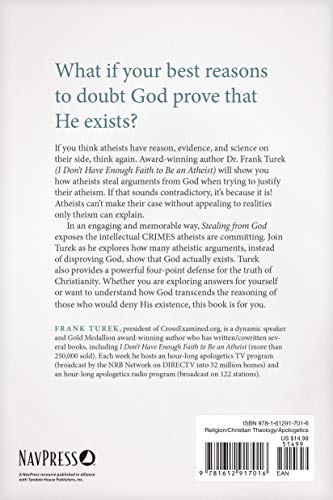
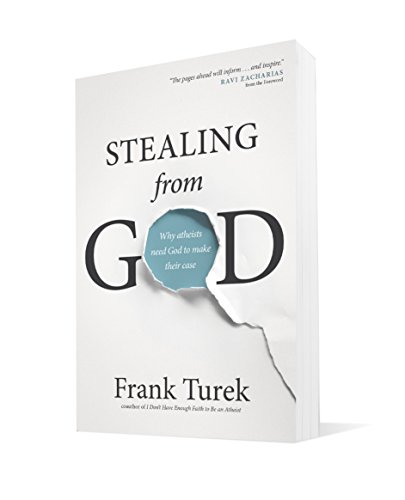

Stealing from God: Why Atheists Need God to Make Their Case [Turek, Frank] on desertcart.com. *FREE* shipping on qualifying offers. Stealing from God: Why Atheists Need God to Make Their Case Review: My favorite book on Christian apologetics also on Audible - Dr. Frank Turek’s Stealing from God: Why Atheists Need God to Make Their Case is a powerful exposé of the fallacies atheists use to prove God doesn’t exist. To argue against God, Turek says that atheists are using aspects of reality that wouldn’t exist if atheism were true, i.e., if God didn’t exist. The first chapter is “Causality,” which is available free at his CrossExamined website. It begins with the cosmological argument: 1. Everything that has a beginning has a cause. 2. The universe had a beginning. 3. Therefore, the universe had a cause. In chapter one, Turek demolishes physicist Lawrence Krauss’ book A Universe from Nothing: Why There Is Something Rather than Nothing. The “nothing” Krauss uses to explain where the universe came from is made up of quantum fluctuations, which are something, so Krauss misleads the reader. He says ‘nothing’ became unstable and produced everything! Atheists are materialists who believe everything consists of interconvertible matter and energy. In order to prove atheism is true, atheists have to steal from the nature of God in order to argue against Him. Turek uses the acrostic C.R.I.M.E.S. to explain the atheists’ fallacy that everything consists of matter. All the following things “are immaterial and rooted in God’s nature:” Causality Reason Information Morality Evil Science Atheists use most of these same qualities to prove atheism, but if God didn’t exist these qualities wouldn’t exist either and that’s why atheists’ arguments backfire on them. Turek explains why. He says his preferred debate question is “What better explains reality: atheism or theism?” He states, “Atheists can’t just identify what they think are deficiencies in theism. They must make a compelling case that everything has been caused by materials and consists only of materials, including the laws of nature, mathematics, and logic, morality and evil, among other immaterial entities, which he discusses. None of those are material. The beginning of the universe had to be immaterial if the Bord Guth Vilenkin theorem is true. Dr. Turek’s most potent point is “Since nature had a beginning, nature can’t be its own cause. The cause must be beyond nature, which is what we mean by the term ‘supernatural.’” According to Wikipedia, “Nature, in the broadest sense, is the natural, physical, or material world or universe.” Thus, nature is synonymous with the universe (see law of identity below). Because atheists are materialists, they accept only material explanations for everything that exists. However, there are many immaterial things whose source cannot be explained by material causes. The fine-tuning of the universe is immaterial Many features of the universe are fine-tuned. Stephen Hawking said, “If the rate of expansion one second after the Big Bang had been smaller by even one part in a hundred thousand million million [10^17], the universe would have collapsed before it ever reached its present size.”—A Brief History of Time p. 121 Frank says, “If the gravitational force were different by one part in 10^40, our sun would not exist and neither would we. How precise is one in 10^40? It’s one part in 1 followed by 40 zeros. That’s one inch over a scale as wide as the entire known universe.” [p. 20] Dr. Turek does not list all fine-tuned features of the universe, such as strong and weak nuclear forces. It’s homework for us to discover them. The fine-tuning of the universe shows that its Creator must be supremely intelligent in addition to being spaceless, timeless, personal, and immaterial. The laws of nature are immaterial Turek wonders how material causes produce immaterial things like morality, evil, and the laws of causality, physics, logic, and mathematics. How could a godless cosmos bring such things into existence? The laws of nature would include the laws of physics and chemistry as well as the law of causality—something cannot begin to exist unless something causes it to exist. Laws of logic and mathematics are immaterial Frank includes the laws of logic in his list of immaterial things. They would exist even if the universe didn’t. For instance, the law of non-contradiction does not require the universe to exist. It exists because God does. God is not the author of confusion (1 Cor. 14:33), which is what would exist if the law of non- contradiction didn’t. Turek doesn’t list the three laws of logic, but J.P. Moreland does: The law of identity: P is P. The law of non-contradiction: P is not non-P. The law of the excluded middle: Either P or non-P. You may not realize it but we often use the law of identity. I have a friend who considers “the dragon, the serpent of old, who is the devil and Satan” (Rev. 12:9, 20:2) to be four separate individuals. When someone persists in breaking a law of logic, it might be impossible to convince them otherwise. Morality is immaterial Objective morality exists because God is the absolute standard of morality. Atheism has no standard on which to base morality, although some atheists, such as Sam Harris, have tried to establish an argument for objective morality. Frank sums up what the existence of objective morality tells us: God exists. He gives this syllogism to clarify his conclusion: 1. Every law has a lawgiver 2. There is an objective moral law 3. Therefore, there is an objective moral lawgiver The conclusion of this argument must be true if the argument is both sound and valid. As Frank did, could we make a similar argument for the existence of God from the laws of nature? Let’s see: 1. Every law requires a lawgiver 2. The 2nd law of thermodynamics is a natural law 3. Therefore, the 2nd law of thermodynamics requires a lawgiver Theists identify the lawgiver in both arguments as God. When someone constructs a syllogism, as in the above examples, both premises must be true, and the premises must have a causal relationship with the conclusion. Dr. Turek gives an excellent example of how the law of causality applies to the immaterial realm. It can’t be that easy That’s really scary. It can’t be that easy, or can it? That reminds me of something Norman Geisler and Frank Turek included in their book, I Don’t Have Enough Faith to Be an Atheist on p. 61: "In a philosophy class I (Norm) was teaching, I pointed out the flaws in Kant’s philosophy this way. I said, “First, if Kant claims that he can’t know anything about the real world (the thing in itself) then how does he know the real world is there? And second, his view is self-defeating because he claims that you can’t know anything about the real world while asserting that he knows that the real world is unknowable!” One student blurted out, “No! It can’t be that easy, Dr. Geisler. You can’t destroy the central tenet of the last hundred-plus years of philosophical thought in just a couple of simple sentences!” Quoting my favorite source— The Reader’s Digest— I responded, “‘ That’s what happens when a beautiful theory meets a brutal gang of facts.’” So, is logic really that easy? Follow the laws of logic to their brutal end to find out. Immanuel Kant broke the law of non-contradiction. Evolution devalues human life Hey Roger, this is God! Frank recounts reading atheist Roger’s remarks online. Roger said that he would believe in God if he looked up in the sky right now and saw written in the sky, “Hey Roger, this is God. I certainly do exist! Now stop all your whining down there!” When William Lane Craig dialogued with Lawrence Krauss, Krauss said “If I looked up tonight, if the sky is clear and the stars rearrange themselves to say in Aramaic, Hebrew or English… ‘I am here,’ then it would be worth thinking about.” That’s as far as it would go with most atheists. Frank explains in several places that atheism is an irrational superstition. If clouds were arranged to say, “Hey Roger!” or if the stars spelled out, “I am here,” because of their presupposition of naturalistic materialism, atheists would have to suppose that there is a natural explanation for those heavenly messages and never admit that God caused it. They might suggest that either crafty humans or aliens were responsible but would never admit God had done it. They simply cannot “allow a divine foot in the door” as Richard Lewontin remarked. Stealing from God is an excellent place to begin building a library of well-informed apologetics (defenses). As Peter wrote, “Sanctify Christ as Lord in your hearts, always being ready to make a defense to everyone who asks you to give an account for the hope that is in you, yet with gentleness and reverence;” (1 Peter 3:15, NASB95). The rest of Stealing from God includes these topics: Reason Information and Intentionality Morality Evil Science Four Points of Mere Christianity God Will Not Force Unbelievers into Heaven Reason The chapter on reason begins with the question, “Bad Religion or Bad Reason?” The main point of this chapter is “not to show that all arguments for atheism fail,” but rather “to show that all arguments for anything fail if atheism is true.” At the University of Wisconsin in Madison, Turek was confronted by someone who wanted to refute his argument that a spaceless, timeless, immaterial God created the universe. He wanted to know if anything else was spaceless, timeless, and immaterial. The answer was the laws of logic. His challenger then said that the laws of logic don’t really exist. Frank pointed out that the challenger was using one of the laws of logic to prove him wrong—the law of non-contradiction, which says that opposite ideas cannot both be true at the same time in the same sense. Information and Intentionality The gist of chapter 3 is, “God’s signature is not just in the cell, it’s in all of creation. God is as necessary to the universe as a band is to music. Once the band stops playing, the music is over.” Bill Gates, the founder of Microsoft, said that human DNA is like a computer program, but far more advanced than any existing software. In Signature in the Cell, Stephen Meyer states that the origin of the DNA code cannot be explained naturally. Where did the information in DNA come from? Among other things, DNA codes for 20,000-25,000 different proteins. Meyer points out that the abiotic development of DNA, RNA, and proteins is a “chicken or the egg” conundrum. DNA needs RNA and proteins to replicate and to be transcribed into messenger RNA and other regulatory RNAs. RNA needs DNA for its source code and proteins to produce DNA, RNA, and other proteins. Proteins need proteins, DNA and RNA for their production. Additionally, messenger RNA must be translated to produce proteins, and this requires proteins to aid in the process. How these three interdependent systems could have developed by time and chance is a major problem for evolutionists. “The discovery of ribozymes supported a hypothesis, known as the RNA World Hypothesis, that earlier forms of life may have relied solely on RNA to store genetic information and to catalyze chemical reactions….Although the ribosome is made up of both RNA and protein components, structural and biochemical analyses revealed that the mechanisms central for translation (the process of assembling a peptide chain based on a RNA sequence) is catalyzed by RNA, not protein. This suggests that the use of RNA by early lifeforms to carry out chemical reactions preceded the use of proteins.” (from a well known website) Meyer gives a fuller explanation and refutation of this hypothesis in Signature in the Cell. The probability of such a system’s developing by chance, however, is vanishingly small – another issue Meyer covers. If you’re interested in his arguments, much of his material is available online at his website, and on YouTube, see the four-part series “Intelligent Design under Fire.” Morality – stealing rights from God Dr. Turek begins chapter 4 with, “You can know what a book says while denying there’s an author. But there would be no book to know unless there was an author. Likewise, atheists can know objective morality while denying God exists, but there would be no objective morality unless God exists.” Turek puts the issue of morality in a nutshell: “… if justice doesn’t exist, then neither does injustice. After all, something can’t be not right unless something really is right. If God doesn’t exist, and we’re merely the mindless, purposeless products of biological evolution, then morality is subjective. Which means that the rape and murder of your child isn’t really unjust. If you think it is, then that’s just your opinion.” Atheists have to steal free will and morality from God in order to hold people responsible for their evil behavior. Our society once adhered to the moral absolutes revealed in the Bible, but has since drifted away to nearly amoral judgment. It has become increasingly difficult to find anyone at fault for any criminal act, no matter how heinous. Our civilization is crumbling. Mass killings and suicide seem to be on the increase. I believe aberrant sexual behavior is becoming the norm, e.g. NAMBLA, the North American Man/Boy Love Association is currently on the edge of our society, but just like same-sex marriages, this deviant behavior is now acceptable to a small, but growing, minority because morality is no longer based on God’s unchanging character. The rule of law is turning into situational ethics. What was once considered evil is now called good and vice versa. (Isaiah 5:20) Still, Turek informs us, there are certain things some atheists find unacceptable, and atheist writers such as Sam Harris are trying to establish absolute morality based on what is the ultimate good for our species. Who decides that? Based on Darwinian presuppositions of what is superior and inferior racial stock, in the 1920s and 30s undesirable people were sterilized. Hitler accepted this idea and believed the Jewish race had to be obliterated because he thought it was inferior and interbreeding with them would negate many generations of evolution. Humans are created with an inborn sense of right and wrong (Romans 2). Even most atheists would agree that raping children is wrong. Evil: Does Evil Prove Atheism? Turek’s main point for this section is, “Good reason provides all the information we need to see that the very existence of evil is a contradiction for atheism. If evil is real, then atheism is false.” Atheists often raise the issue of evil as evidence that God does not exist, but exactly the opposite is the case. The existence of evil shows that God does exist. Dr. Turek used to doubt the existence of God because of evil. Evil was a problem for Augustine too, because he reasoned thus: 1. God created all things 2. Evil is a thing 3. Therefore, God created evil Augustine eventually realized the second premise is false. Evil certainly exists, but not on its own. It exists as a lack of good. “Evil is like rust in a car: If you take all of the rust out of a car, you have a better car; if you take the car out of the rust, you have nothing.” Evil is an intractable problem for atheists, however. There are two types of evil. There is moral evil where humans hurt others, and there is the evil of natural events that bring about suffering and death, e.g. earthquakes and tornadoes. Christians are not the only ones who have to explain both types of evil; every worldview has to explain the existence of evil. Some world religions deny evil exists, saying it’s just an illusion. Other religions try to explain how evil and God can coexist. Atheists tend to deny there is good or evil, using the “illusion” argument. Then “they are outraged by the great injustices and evil done by religious people in the name of God.” Atheists, however, can’t espouse both opinions. Either evil and good exist, or neither exists. If good and evil exist, then God must exist because the standard for what is good must be absolute, otherwise it’s just human opinion. In that case, anything can be considered good or evil, and that’s exactly where our society is today, deciding what is good and what is evil based on the shifting sands of human opinion. Is what Hitler did good or evil? If there is no absolute good based on God’s character, then anyone’s opinion is valid. What is good one day can be considered evil the next. In other words, if evil and good are what an individual or society says they are; there is no objective, immutable standard—such as God. Turek says, “Well, atheists can’t have it both ways. Either evil exists or it doesn’t. If it doesn’t exist, then atheists should stop complaining about the “evil” religious people have done because they haven’t really done any. They’ve just been ‘dancing to the music’ of their DNA [as Richard Dawkins points out]. If atheism is true, all behaviors are merely a matter of preference. On the other hand, if evil actually does exist, atheists have an even bigger problem. The existence of evil actually establishes the existence of God.” He also says there can be good without evil, but there can’t be evil without good; and there can’t be objective good without God. C.S. Lewis was once an atheist who thought evil disproved the existence of God. As he thought it through, he realized he was stealing from God to argue against Him. Lewis wrote, “…My argument against God was that the universe seems so cruel and unjust. But how had I got this idea of just and unjust? A man does not call a line crooked unless he has some idea of a straight line. What was I comparing this universe with when I called it unjust?” This is true of all atheists. In order to complain against evil, they have to steal from God’s character, apart from which their argument makes no sense. Science: Science Doesn’t Say Anything, Scientists Do “To say that a scientist can disprove the existence of God is like saying a mechanic can disprove the existence of Henry Ford. While there is certainly evidence from science to support theism, the most important point for this chapter is not that science supports theism, but that theism supports science. In other words, theism makes doing science possible. We wouldn’t be able to do science reliably if atheism were true,” explains Turek. People, including scientists, gather information and interpret it according to their worldview, which can be faulty. For an example, he reviews the evidence that was raised by the prosecution during the O.J. Simpson trial: Simpson’s blood found at the murder scene; Ron Goldman’s and Nicole Brown’s blood found in Simpson’s bronco; the bloody gloves – one found at the scene, the other found at Simpson’s house; the bloody footprints found at the scene and in Simpson’s Bronco. Despite this evidence, the jury decided that Simpson was not guilty. Turek recounts this evidence to show that science doesn’t say anything, scientists do. Scientists gather data and interpret it. Science doesn’t do that, scientists, do. The worldview of the jurors is what produced the not guilty verdict for Simpson. Because of their experience with police bigotry, most Blacks polled in the U.S. felt that prejudiced cops manipulated the evidence. Therefore the black jurors’ worldview led to their conclusion that Simpson was not guilty. Because of their worldviews, atheists and theists interpret information concerning the origin of the universe, the origin of life, and the origin of new life forms differently. They start with opposing philosophical assumptions, therefore they come to opposite conclusions about origins based on the same evidence. Atheists and theists don’t have differing theories about many other scientific issues. There are not atheist and theist theories about electricity or gasoline engines. It’s easy to verify these theories by observation and repetition. However, the topic of origins is more controversial because origins cannot be observed and cannot be repeated in the lab. Review: It is great to see the script flipped - Stealing from God is a masterclass in flipping the script. Frank Turek takes the arguments of atheism and turns them inside out with logic, clarity, and a bit of wit. He doesn’t just poke holes—he shows how many objections to God actually depend on the very framework they seek to reject. Whether you're a believer, skeptic, or somewhere in between, this book will challenge how you think. It’s not just apologetics—it’s strategy, philosophy, and sharp storytelling in one. Read it with an open mind. Then read it again.


| Best Sellers Rank | #62,757 in Books ( See Top 100 in Books ) #167 in Christian Apologetics (Books) |
| Customer Reviews | 4.8 4.8 out of 5 stars (1,599) |
| Dimensions | 5.4 x 0.9 x 8 inches |
| ISBN-10 | 1612917011 |
| ISBN-13 | 978-1612917016 |
| Item Weight | 2.31 pounds |
| Language | English |
| Print length | 304 pages |
| Publication date | January 1, 2015 |
| Publisher | NavPress |
D**N
My favorite book on Christian apologetics also on Audible
Dr. Frank Turek’s Stealing from God: Why Atheists Need God to Make Their Case is a powerful exposé of the fallacies atheists use to prove God doesn’t exist. To argue against God, Turek says that atheists are using aspects of reality that wouldn’t exist if atheism were true, i.e., if God didn’t exist. The first chapter is “Causality,” which is available free at his CrossExamined website. It begins with the cosmological argument: 1. Everything that has a beginning has a cause. 2. The universe had a beginning. 3. Therefore, the universe had a cause. In chapter one, Turek demolishes physicist Lawrence Krauss’ book A Universe from Nothing: Why There Is Something Rather than Nothing. The “nothing” Krauss uses to explain where the universe came from is made up of quantum fluctuations, which are something, so Krauss misleads the reader. He says ‘nothing’ became unstable and produced everything! Atheists are materialists who believe everything consists of interconvertible matter and energy. In order to prove atheism is true, atheists have to steal from the nature of God in order to argue against Him. Turek uses the acrostic C.R.I.M.E.S. to explain the atheists’ fallacy that everything consists of matter. All the following things “are immaterial and rooted in God’s nature:” Causality Reason Information Morality Evil Science Atheists use most of these same qualities to prove atheism, but if God didn’t exist these qualities wouldn’t exist either and that’s why atheists’ arguments backfire on them. Turek explains why. He says his preferred debate question is “What better explains reality: atheism or theism?” He states, “Atheists can’t just identify what they think are deficiencies in theism. They must make a compelling case that everything has been caused by materials and consists only of materials, including the laws of nature, mathematics, and logic, morality and evil, among other immaterial entities, which he discusses. None of those are material. The beginning of the universe had to be immaterial if the Bord Guth Vilenkin theorem is true. Dr. Turek’s most potent point is “Since nature had a beginning, nature can’t be its own cause. The cause must be beyond nature, which is what we mean by the term ‘supernatural.’” According to Wikipedia, “Nature, in the broadest sense, is the natural, physical, or material world or universe.” Thus, nature is synonymous with the universe (see law of identity below). Because atheists are materialists, they accept only material explanations for everything that exists. However, there are many immaterial things whose source cannot be explained by material causes. The fine-tuning of the universe is immaterial Many features of the universe are fine-tuned. Stephen Hawking said, “If the rate of expansion one second after the Big Bang had been smaller by even one part in a hundred thousand million million [10^17], the universe would have collapsed before it ever reached its present size.”—A Brief History of Time p. 121 Frank says, “If the gravitational force were different by one part in 10^40, our sun would not exist and neither would we. How precise is one in 10^40? It’s one part in 1 followed by 40 zeros. That’s one inch over a scale as wide as the entire known universe.” [p. 20] Dr. Turek does not list all fine-tuned features of the universe, such as strong and weak nuclear forces. It’s homework for us to discover them. The fine-tuning of the universe shows that its Creator must be supremely intelligent in addition to being spaceless, timeless, personal, and immaterial. The laws of nature are immaterial Turek wonders how material causes produce immaterial things like morality, evil, and the laws of causality, physics, logic, and mathematics. How could a godless cosmos bring such things into existence? The laws of nature would include the laws of physics and chemistry as well as the law of causality—something cannot begin to exist unless something causes it to exist. Laws of logic and mathematics are immaterial Frank includes the laws of logic in his list of immaterial things. They would exist even if the universe didn’t. For instance, the law of non-contradiction does not require the universe to exist. It exists because God does. God is not the author of confusion (1 Cor. 14:33), which is what would exist if the law of non- contradiction didn’t. Turek doesn’t list the three laws of logic, but J.P. Moreland does: The law of identity: P is P. The law of non-contradiction: P is not non-P. The law of the excluded middle: Either P or non-P. You may not realize it but we often use the law of identity. I have a friend who considers “the dragon, the serpent of old, who is the devil and Satan” (Rev. 12:9, 20:2) to be four separate individuals. When someone persists in breaking a law of logic, it might be impossible to convince them otherwise. Morality is immaterial Objective morality exists because God is the absolute standard of morality. Atheism has no standard on which to base morality, although some atheists, such as Sam Harris, have tried to establish an argument for objective morality. Frank sums up what the existence of objective morality tells us: God exists. He gives this syllogism to clarify his conclusion: 1. Every law has a lawgiver 2. There is an objective moral law 3. Therefore, there is an objective moral lawgiver The conclusion of this argument must be true if the argument is both sound and valid. As Frank did, could we make a similar argument for the existence of God from the laws of nature? Let’s see: 1. Every law requires a lawgiver 2. The 2nd law of thermodynamics is a natural law 3. Therefore, the 2nd law of thermodynamics requires a lawgiver Theists identify the lawgiver in both arguments as God. When someone constructs a syllogism, as in the above examples, both premises must be true, and the premises must have a causal relationship with the conclusion. Dr. Turek gives an excellent example of how the law of causality applies to the immaterial realm. It can’t be that easy That’s really scary. It can’t be that easy, or can it? That reminds me of something Norman Geisler and Frank Turek included in their book, I Don’t Have Enough Faith to Be an Atheist on p. 61: "In a philosophy class I (Norm) was teaching, I pointed out the flaws in Kant’s philosophy this way. I said, “First, if Kant claims that he can’t know anything about the real world (the thing in itself) then how does he know the real world is there? And second, his view is self-defeating because he claims that you can’t know anything about the real world while asserting that he knows that the real world is unknowable!” One student blurted out, “No! It can’t be that easy, Dr. Geisler. You can’t destroy the central tenet of the last hundred-plus years of philosophical thought in just a couple of simple sentences!” Quoting my favorite source— The Reader’s Digest— I responded, “‘ That’s what happens when a beautiful theory meets a brutal gang of facts.’” So, is logic really that easy? Follow the laws of logic to their brutal end to find out. Immanuel Kant broke the law of non-contradiction. Evolution devalues human life Hey Roger, this is God! Frank recounts reading atheist Roger’s remarks online. Roger said that he would believe in God if he looked up in the sky right now and saw written in the sky, “Hey Roger, this is God. I certainly do exist! Now stop all your whining down there!” When William Lane Craig dialogued with Lawrence Krauss, Krauss said “If I looked up tonight, if the sky is clear and the stars rearrange themselves to say in Aramaic, Hebrew or English… ‘I am here,’ then it would be worth thinking about.” That’s as far as it would go with most atheists. Frank explains in several places that atheism is an irrational superstition. If clouds were arranged to say, “Hey Roger!” or if the stars spelled out, “I am here,” because of their presupposition of naturalistic materialism, atheists would have to suppose that there is a natural explanation for those heavenly messages and never admit that God caused it. They might suggest that either crafty humans or aliens were responsible but would never admit God had done it. They simply cannot “allow a divine foot in the door” as Richard Lewontin remarked. Stealing from God is an excellent place to begin building a library of well-informed apologetics (defenses). As Peter wrote, “Sanctify Christ as Lord in your hearts, always being ready to make a defense to everyone who asks you to give an account for the hope that is in you, yet with gentleness and reverence;” (1 Peter 3:15, NASB95). The rest of Stealing from God includes these topics: Reason Information and Intentionality Morality Evil Science Four Points of Mere Christianity God Will Not Force Unbelievers into Heaven Reason The chapter on reason begins with the question, “Bad Religion or Bad Reason?” The main point of this chapter is “not to show that all arguments for atheism fail,” but rather “to show that all arguments for anything fail if atheism is true.” At the University of Wisconsin in Madison, Turek was confronted by someone who wanted to refute his argument that a spaceless, timeless, immaterial God created the universe. He wanted to know if anything else was spaceless, timeless, and immaterial. The answer was the laws of logic. His challenger then said that the laws of logic don’t really exist. Frank pointed out that the challenger was using one of the laws of logic to prove him wrong—the law of non-contradiction, which says that opposite ideas cannot both be true at the same time in the same sense. Information and Intentionality The gist of chapter 3 is, “God’s signature is not just in the cell, it’s in all of creation. God is as necessary to the universe as a band is to music. Once the band stops playing, the music is over.” Bill Gates, the founder of Microsoft, said that human DNA is like a computer program, but far more advanced than any existing software. In Signature in the Cell, Stephen Meyer states that the origin of the DNA code cannot be explained naturally. Where did the information in DNA come from? Among other things, DNA codes for 20,000-25,000 different proteins. Meyer points out that the abiotic development of DNA, RNA, and proteins is a “chicken or the egg” conundrum. DNA needs RNA and proteins to replicate and to be transcribed into messenger RNA and other regulatory RNAs. RNA needs DNA for its source code and proteins to produce DNA, RNA, and other proteins. Proteins need proteins, DNA and RNA for their production. Additionally, messenger RNA must be translated to produce proteins, and this requires proteins to aid in the process. How these three interdependent systems could have developed by time and chance is a major problem for evolutionists. “The discovery of ribozymes supported a hypothesis, known as the RNA World Hypothesis, that earlier forms of life may have relied solely on RNA to store genetic information and to catalyze chemical reactions….Although the ribosome is made up of both RNA and protein components, structural and biochemical analyses revealed that the mechanisms central for translation (the process of assembling a peptide chain based on a RNA sequence) is catalyzed by RNA, not protein. This suggests that the use of RNA by early lifeforms to carry out chemical reactions preceded the use of proteins.” (from a well known website) Meyer gives a fuller explanation and refutation of this hypothesis in Signature in the Cell. The probability of such a system’s developing by chance, however, is vanishingly small – another issue Meyer covers. If you’re interested in his arguments, much of his material is available online at his website, and on YouTube, see the four-part series “Intelligent Design under Fire.” Morality – stealing rights from God Dr. Turek begins chapter 4 with, “You can know what a book says while denying there’s an author. But there would be no book to know unless there was an author. Likewise, atheists can know objective morality while denying God exists, but there would be no objective morality unless God exists.” Turek puts the issue of morality in a nutshell: “… if justice doesn’t exist, then neither does injustice. After all, something can’t be not right unless something really is right. If God doesn’t exist, and we’re merely the mindless, purposeless products of biological evolution, then morality is subjective. Which means that the rape and murder of your child isn’t really unjust. If you think it is, then that’s just your opinion.” Atheists have to steal free will and morality from God in order to hold people responsible for their evil behavior. Our society once adhered to the moral absolutes revealed in the Bible, but has since drifted away to nearly amoral judgment. It has become increasingly difficult to find anyone at fault for any criminal act, no matter how heinous. Our civilization is crumbling. Mass killings and suicide seem to be on the increase. I believe aberrant sexual behavior is becoming the norm, e.g. NAMBLA, the North American Man/Boy Love Association is currently on the edge of our society, but just like same-sex marriages, this deviant behavior is now acceptable to a small, but growing, minority because morality is no longer based on God’s unchanging character. The rule of law is turning into situational ethics. What was once considered evil is now called good and vice versa. (Isaiah 5:20) Still, Turek informs us, there are certain things some atheists find unacceptable, and atheist writers such as Sam Harris are trying to establish absolute morality based on what is the ultimate good for our species. Who decides that? Based on Darwinian presuppositions of what is superior and inferior racial stock, in the 1920s and 30s undesirable people were sterilized. Hitler accepted this idea and believed the Jewish race had to be obliterated because he thought it was inferior and interbreeding with them would negate many generations of evolution. Humans are created with an inborn sense of right and wrong (Romans 2). Even most atheists would agree that raping children is wrong. Evil: Does Evil Prove Atheism? Turek’s main point for this section is, “Good reason provides all the information we need to see that the very existence of evil is a contradiction for atheism. If evil is real, then atheism is false.” Atheists often raise the issue of evil as evidence that God does not exist, but exactly the opposite is the case. The existence of evil shows that God does exist. Dr. Turek used to doubt the existence of God because of evil. Evil was a problem for Augustine too, because he reasoned thus: 1. God created all things 2. Evil is a thing 3. Therefore, God created evil Augustine eventually realized the second premise is false. Evil certainly exists, but not on its own. It exists as a lack of good. “Evil is like rust in a car: If you take all of the rust out of a car, you have a better car; if you take the car out of the rust, you have nothing.” Evil is an intractable problem for atheists, however. There are two types of evil. There is moral evil where humans hurt others, and there is the evil of natural events that bring about suffering and death, e.g. earthquakes and tornadoes. Christians are not the only ones who have to explain both types of evil; every worldview has to explain the existence of evil. Some world religions deny evil exists, saying it’s just an illusion. Other religions try to explain how evil and God can coexist. Atheists tend to deny there is good or evil, using the “illusion” argument. Then “they are outraged by the great injustices and evil done by religious people in the name of God.” Atheists, however, can’t espouse both opinions. Either evil and good exist, or neither exists. If good and evil exist, then God must exist because the standard for what is good must be absolute, otherwise it’s just human opinion. In that case, anything can be considered good or evil, and that’s exactly where our society is today, deciding what is good and what is evil based on the shifting sands of human opinion. Is what Hitler did good or evil? If there is no absolute good based on God’s character, then anyone’s opinion is valid. What is good one day can be considered evil the next. In other words, if evil and good are what an individual or society says they are; there is no objective, immutable standard—such as God. Turek says, “Well, atheists can’t have it both ways. Either evil exists or it doesn’t. If it doesn’t exist, then atheists should stop complaining about the “evil” religious people have done because they haven’t really done any. They’ve just been ‘dancing to the music’ of their DNA [as Richard Dawkins points out]. If atheism is true, all behaviors are merely a matter of preference. On the other hand, if evil actually does exist, atheists have an even bigger problem. The existence of evil actually establishes the existence of God.” He also says there can be good without evil, but there can’t be evil without good; and there can’t be objective good without God. C.S. Lewis was once an atheist who thought evil disproved the existence of God. As he thought it through, he realized he was stealing from God to argue against Him. Lewis wrote, “…My argument against God was that the universe seems so cruel and unjust. But how had I got this idea of just and unjust? A man does not call a line crooked unless he has some idea of a straight line. What was I comparing this universe with when I called it unjust?” This is true of all atheists. In order to complain against evil, they have to steal from God’s character, apart from which their argument makes no sense. Science: Science Doesn’t Say Anything, Scientists Do “To say that a scientist can disprove the existence of God is like saying a mechanic can disprove the existence of Henry Ford. While there is certainly evidence from science to support theism, the most important point for this chapter is not that science supports theism, but that theism supports science. In other words, theism makes doing science possible. We wouldn’t be able to do science reliably if atheism were true,” explains Turek. People, including scientists, gather information and interpret it according to their worldview, which can be faulty. For an example, he reviews the evidence that was raised by the prosecution during the O.J. Simpson trial: Simpson’s blood found at the murder scene; Ron Goldman’s and Nicole Brown’s blood found in Simpson’s bronco; the bloody gloves – one found at the scene, the other found at Simpson’s house; the bloody footprints found at the scene and in Simpson’s Bronco. Despite this evidence, the jury decided that Simpson was not guilty. Turek recounts this evidence to show that science doesn’t say anything, scientists do. Scientists gather data and interpret it. Science doesn’t do that, scientists, do. The worldview of the jurors is what produced the not guilty verdict for Simpson. Because of their experience with police bigotry, most Blacks polled in the U.S. felt that prejudiced cops manipulated the evidence. Therefore the black jurors’ worldview led to their conclusion that Simpson was not guilty. Because of their worldviews, atheists and theists interpret information concerning the origin of the universe, the origin of life, and the origin of new life forms differently. They start with opposing philosophical assumptions, therefore they come to opposite conclusions about origins based on the same evidence. Atheists and theists don’t have differing theories about many other scientific issues. There are not atheist and theist theories about electricity or gasoline engines. It’s easy to verify these theories by observation and repetition. However, the topic of origins is more controversial because origins cannot be observed and cannot be repeated in the lab.
B**Y
It is great to see the script flipped
Stealing from God is a masterclass in flipping the script. Frank Turek takes the arguments of atheism and turns them inside out with logic, clarity, and a bit of wit. He doesn’t just poke holes—he shows how many objections to God actually depend on the very framework they seek to reject. Whether you're a believer, skeptic, or somewhere in between, this book will challenge how you think. It’s not just apologetics—it’s strategy, philosophy, and sharp storytelling in one. Read it with an open mind. Then read it again.
J**N
This book faithfully tackles the issues about atheism head-on
This book was right on target. I found it so compelling I could not put it down. In it he tackles the six areas that atheists "steal" from God. By "steal" I mean they use concepts that are ONLY valid if there is a God, and cancel themselves out and become meaningless when trying to prove there is no God. The areas Frank tackles are Causality, Reason, Information and Intentionality, Morality, Evil, and Science. He discusses each of these areas and how in many areas those who believe that God does not exist must yet use ideas that can only exist because God does exist. Frank Turek is able to see through many of the arguments of atheists who make statements that must be challenged in order to keep them intellectually honest. For example, when a person says that there is no such thing as truth (in some of the videos I've seen with Frank), Frank always asks them if that statement they just made saying there is no such thing as truth is true, and is that the one exception to the person's declaration there there is no truth. Why do they get exceptions to the very statements they make that are, to them, universally true? They are usually shocked to realize they just said a self-refuting statement! You and I might let a statement that is self-contradictory slide, and then we'd get cornered because we did not see the sleight of hand they used to fool us into thinking their universal statement was true then in fact it cancelled itself out! Frank does not let such self-cancelling statements slide by because he knows that one cannot argue against God using concepts that are only valid if and only if there is a God. It is like a human being insisting that human beings don't exist. Hello? Anybody home? If you are skeptical about our origins, this book will challenge you, and perhaps even frustrate you because Frank does not allow self-cancelling statements to slide by unchallenged. But it will make you think. If you are a believer, then this book will encourage you and give you some tools that you can use when discussing whether God exists with acquaintances or coworkers. It will help you recognize self-cancelling phrases and assertions, and diplomatically challenge the people making them to not use self-cancelling ideas when trying to make their point. His chapter on evil was especially good in that I often hear today, "If there is a God, why does He allow evil in the world?" A valid question that Frank takes head-on. In fact, he says, "The problem of evil certainly seems to be the strongest argument the atheists have." And then he proceeds to address it. Frank does not run and hide from the "tough questions" about God's existence and atheism, but rather grabs them, explains them, and then resolves them. Some will still maintain their atheistic beliefs after hearing what Frank says about their issues, but at least Frank makes a great case why we can know there is a God, and that is about all we can expect from anyone who is dealing with persons firmly entrenched in their own views, set in concrete no matter what. As a believer, I found the book uplifting and encouraging in my belief in God and Jesus Christ as His Son. In a world that is increasing hostile to ideas that there is a God and He is worthy of our worship, this book is a blessing and can give me the wisdom to witness to those around me who still believe in the self-cancelling ideas upon which they base their beliefs.
J**.
Frank is simply smart and logical and really good at dumbing it down so I can wrap my head around the concepts.
A**O
Te abre los ojos con sus argumentos.
A**V
This is insightful book and refute fallacious claims of atheism
J**.
Aufschlussreich und gut verständlich!
B**N
Very well written and covers a multitude of important points about why belief in God and Jesus is not for the foolish. Great book!
Trustpilot
Hace 1 mes
Hace 3 semanas