We remain fully operational. Our teams are working around the clock to ensure your deliveries continue safely.

Descargar la aplicación


Servicios al cliente
Sobre nosotros
Copyright © 2025 Desertcart Holdings Limited
Descargar la aplicación
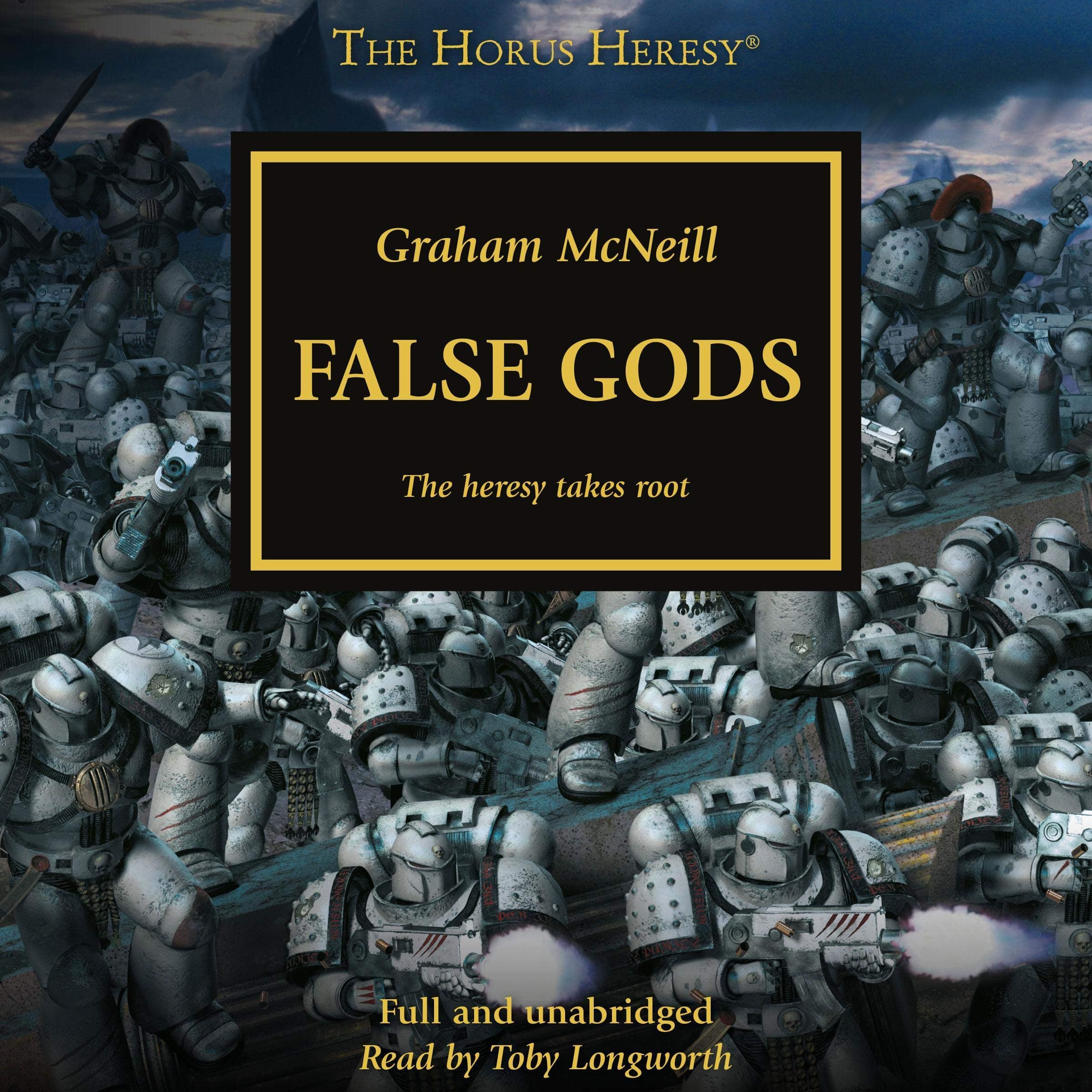
desertcart.com: False Gods: The Horus Heresy, Book 2 (Audible Audio Edition): Graham McNeill, Toby Longworth, Black Library: Books Review: Read this book. Horus heresy!!! - Great book. Really does well to tell it's part of the story of the beginning of the heresy. Read it with horus rising and galaxy in flames. You will get hooked. Review: Godlike - Great book! Will satisfy what you’re looking for and you know why your here.
D**S
Read this book. Horus heresy!!!
Great book. Really does well to tell it's part of the story of the beginning of the heresy. Read it with horus rising and galaxy in flames. You will get hooked.
M**N
Godlike
Great book! Will satisfy what you’re looking for and you know why your here.
S**R
Action-Packed Mid-Tale
The second book of the Horus Heresy series, this time penned by Graham McNeill, is a ripping adventure tale that continues the story of Horus' inevitable fall. Garviel Lorken, the Company Captain of the Sons of Horus Legion and main protagonist from the first novel, now shares the stage with Horus himself in roughly equal measure. The supporting cast is too numerous to list here, but suffice to say, it includes many other canonical characters from Games Workshop's Warhammer 40K universe: Horus, Angron, Fulgrim, Magnus, Kharn, Abaddon, Fabius, and others. M. McNeill does an excellent job capturing the feel of the 40K background, excels at action scenes, and captures the epic scope of the Crusade and subsequent Heresy. You really feel the ground tremor as titans stride into battle, and quail before Angron's savagery as he charges into the fray. The enemies of the Imperium fight intelligent campaigns that reflect well thought out strategy, making them worthy foes. Gone, however, is the subtlety and delicate moral quandary of M. Abnett. Lorken's character growth, and that of some of the other characters, takes a back seat to Horus' tale and larger-scale conflict. This brings me to the two weaker points of the novel: 1 - M. McNeill uses some clumsy plot devices at key points in the work. The Mournival (Horus' council of Captains) and some of the senior Sons of Horus act stupidly or ignorantly from time to time, even though it's been firmly established that they are neither. There are a few other instances where Marines "regress" from extremely wily to easily misled. 2 - The biggest difficulty, however, is in the representation of the change in Horus. There are no slippery moral slopes filled with the excuses of expediency or necessity. There is no gradual or subtle descent, such as those displayed by M. Abnett's Inquisitor Eisenhorn. Instead, Horus takes the Warp induced visions of a man he admittedly doesn't even trust, and makes a decision without even checking the veracity of these mirages. As it's really one of the pivotal moments of the entire epic, it's disappointing that it doesn't receive the attention it deserves. These - although fairly significant - detractors aside, the book is a very engaging read, and M. McNeill's writing style holds the reader's attention throughout. The plot flows well, and one can't wait to begin the next chapter after finishing the previous. In short: a generally solid work with a few troubles for more discerning readers. However, any fan of 40K will easily get his money's worth on this ride.
J**1
The turning point
This is a a compelling tale that builds on the first. The battles (at least physical) are the least meaningful part of the tale - in the best way. This novel digs deep into the character of each character in a way that is more than just blind good/evil but one of degree. It’s these gray areas that move the story along and made me, the reader think about my own beliefs of humanity and it’s nature. A well crafted tale that after writing the review moves my rating higher.
K**N
the treachery is palpable
The first book felt so feel good and normal, this one illuminates the beginning of the grimdark. I keep wanting to reach into the story and change the course of this outcome but I know I can’t! Almost hard to read when you realize it’s meant to happen, that this is a prologue to the 40k Universe as we know it. Great read, can’t wait to pick up the next book!
Y**O
Mejor, imposible
¡Excelente!
R**C
Grim dark sci-fi at its best.
As many of the older Horus Heresy and 40k books seem to be tough to get now, it was great to see the first three still readily available. It should be said that these reprints have a nice small crease in the covers put onto these new printings. None of my older Black Library have it and I had not bought any in a while so that was a nice little change to see. I like that. I always really liked the 40k prose, though there are authors I like more than others, Graham McNeill is one of the best at it. False God's doesn't disappoint at all. I remember the first time I read this book in 2009 when I had bought my first copy and I've gone through it five times since. It floored me honestly. Grim dark stories of a far flung future. Blood and guts, chop you in the throat and axe kick you when you're down violence. Betrayal on a scale to rival any other eternal universal doom inspired series. May not be for some but that's fine. If you like the prospect of diving into a universe that's brutally uncaring and will probably remind you all too often of the true nature of humankind in the best and worst ways, then pick up the series. TL:DR - Blood for the Blood God. Skulls for the skull throne. Khorne for the Khorne flakes. Buy this.
K**Y
Diamond in the Rough
Graham McNeill is one of the major innovators at The Black Library. His books are always filled with the kind of "fluff" that excites Warhammer enthusiasts and I consider him the speartip of Warhammer creativity. For the most part I am thrilled by his creative inventions. His descriptions of the various planets and societies are inspired and his descriptions of Chaos rituals are among the best in the Warhammer universe. I would have given this novel five stars but for some niggling complaints, which I am going to enumerate out of a certain frustration. My frustration arises from the following: (1) he usually employs multiple points of view (a practice endemic in Warhammer writing). This is not bad in itself but he employs short passages that break the flow of the writing and slows the narrative. Tolstoy uses multiple points of view but he lets the narrative develop and flow, allowing the reader to become involved in the narrative. Frankly, I want to be unaware of the change in point of view; I want to sink so deeply into the novel that I am living it. If a novelist shifts back and forth in short machine gun like bursts, it disrupts the narrative flow. This works in a movie; it doesn't work well in a novel. (2) He tends to use anachronistic expressions that distract from the narrative. For instance, twice Horus, the great Warmaster, says to his Mournival- "You are a sight for sore eyes." (3) Horus acts child-like over and over again (but so did Hitler and Stalin, you say), even spilling his guts to a journalist in an attempt to immortalize himself in print, when he thinks he is going to die. In addition, certain plot choices confused me. More particularly, I didn't understand the motivations behind the invasion of the Davin moon. For instance, why would the Legion transport Titans to the moon to battle an army of the undead, which they dispatch with a blow to the head? Was Horus' hubris such that he saw every battle as an insult to his pride and honor? Was it necessary to display the almost incalculable strength of the Legion against a rebellious brother? Or was it necessary to introduce the Titans into the plot? Additionally, at the end of the novel,why does Horus abandon the crusade to attack a potentially friendly world? Does he seek their technology or has Chaos already taken hold of him and he wants simply to kill and maim? Irrespective of these criticisms, I say bravo to McNeill. He took the threads of the Horus Rising and substantially raised the level of discourse.
Trustpilot
Hace 1 mes
Hace 2 meses