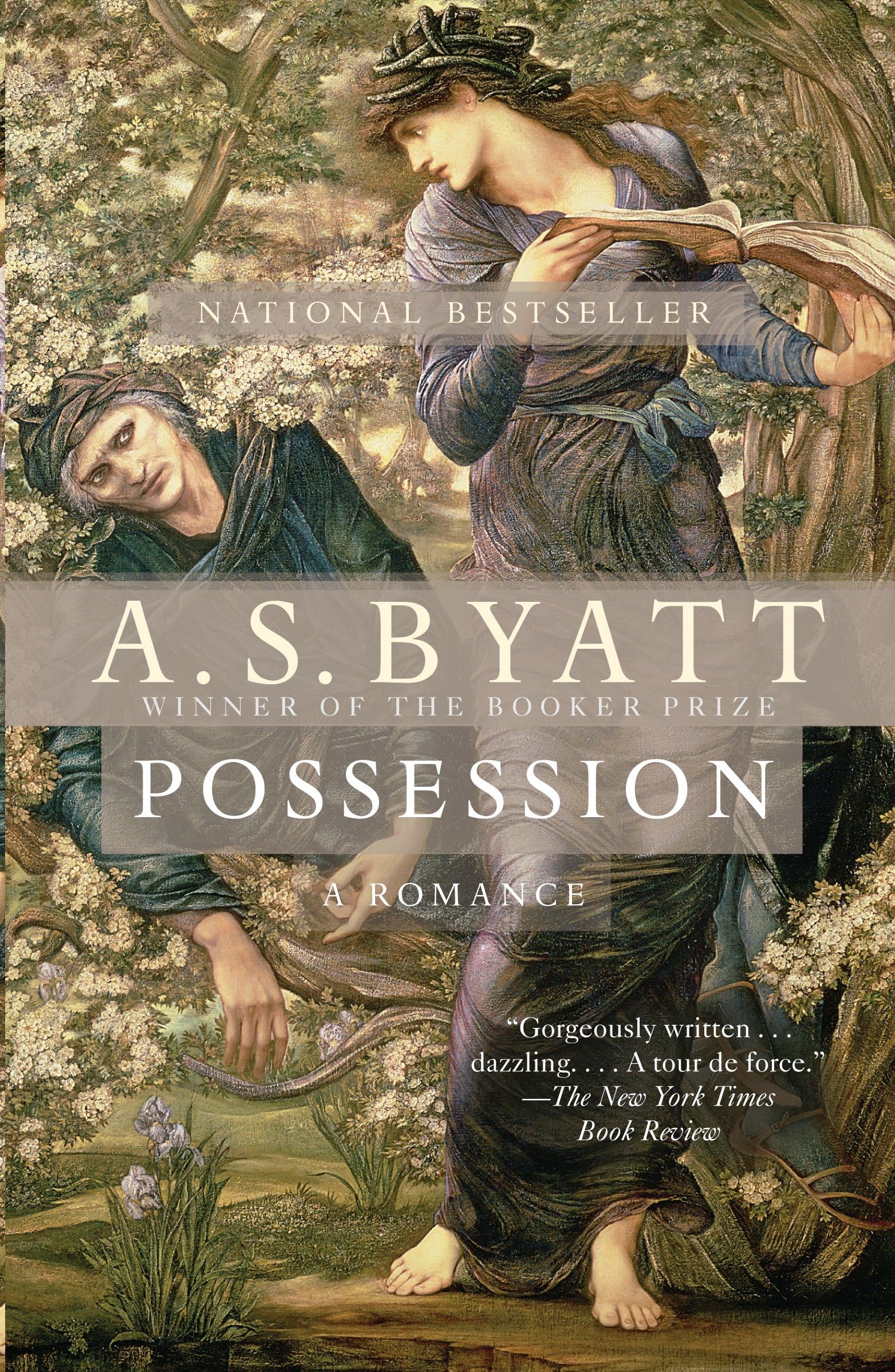
Possession [Byatt, A. S.] on desertcart.com. *FREE* shipping on qualifying offers. Possession Review: Intricate literary romance - 'A written work that is regarded as having artistic merit'. That is how my dictionary describes 'literature'. This book is a literary romance - and a novel, too. 'Possession' by A S Byatt is one of my very favourite books, which I have read perhaps five or six times. It is one of the few books that I prefer in its printed form - for visual reasons. I have recently bought and read it on my Kindle - and am glad to have it available even on my mobile phone: but I prefer my dog-eared paperback copy. It's the layout of the poetry that does it. A few of the times I have read the whole book; some of the times I have skated over the long poems and sagas that Miss Byatt has written in the style of her Victorian hero, the eminent poet Professor Randolph Henry Ash. To me, there is no doubting the artistic merit of this double love story, which is so crafted that one is driven through with impatience, fascinated to know the final outcome(s). Shortlisted for the Booker Prize in 1990, I wondered why it had not won but my conclusion was that the judges felt that the author indulged herself by not thinning out so much apparently irrelevant but beautiful prose. As a practised reader of this romance, I now know what to leave out - and still end up by enjoying the brilliant plots and passionate love stories. A S Byatt quotes Nathaniel Hawthorne, in the preface to his 'The House of the Seven Gables' as saying that 'When a writer calls his work a Romance, it need hardly be observbed that he wishes to claim a certain latitude, both as to its fashion and material, which he would not have felt himself entitlted to assume, had he professed to be writing a Novel. The latter form of composition is presumed to aim at a very minute fidelity, not merely to the possible, but to the probable and ordinary course of man's experience.' The author gives me no reason to dispute her facts and I am convinced that Randolph Ash and his virginal lover both existed. Equally real are the humble academic, Roland Mitchell (who discovered the draft letters by Prof Ash that no one knew about) and the formidable Dr Maud Bailey, feminist and expert on women poets of the same period, (around the 1860s). It is definitely romantic, convincing and artistic. So, from me five stars because 'I love it!' And I conclude it's a true example of modern literature. Review: A man may be in as just possession of truth as of a city, and yet be forced to surrender it - This is the second time that I use a Thomas Browne quote taken from the reviewed book as headline for a book review here. First time was for Sebald's Rings of Saturn. That book has with this one more things in common than Browne: both contain extensive walks through English countrysides. (Maybe it is time for me to look at Browne himself; if others keep quoting him, there must be something.) Byatt's labyrinthine Possession is of comparable erudition and of amazing versatility. I was tempted to call it excessively versatile. I am still considering to find this book too much of a `head birth' (the German Kopfgeburt may not quite work in direct translation, so maybe I should just say: too brainy). It is the kind of book that I enjoy reading, but that does not rock my boat in the way that my recent first encounters with writers like Kis, Sebald, Oe, Murakami did. The author invents 2 Victorian poets, complete with life and works, some of it integrated into the narration, and an affair. And the whole is told us by following modern day lit-historians working as history sleuths in their scramble for the bits and pieces from the lives of their objects of study. The detection work leads to historical mysteries and to romance in different time zones. Protagonists are two unlikely couples: the first consists of an unemployed postgraduate researcher in London, who starts the chain of events with a sensational (?) find of a manuscript of a letter draft in a library archive, and a wealthy aristocratic attractive lecturer in Lincoln (England), who gets drawn into this, because her specialty is the poetess who seems to have had a fling with the poet who is the specialty of our poor researcher. Whether they become a real couple as opposed to two people is one of the questions that keeps suspense open. The two poets of the past are the other couple. Also there: were they really a couple? Wasn't she a Lesbian? Wasn't he a devoted and loyal husband? Deep and rare questions. The time of the historical couple is insufficiently described as Victorian. One needs to specify that it is post-`Origin of Species' Victorian. Poet Ash is a rationalist whose world view is coming to grips with new paradigms; he is a fighter against quackeries like Mesmerism and the spiritism which was so popular in those days. His target of affection is more on the religious side of looking at things, and the two dance around the involved problems and potential conflicts with admirable sensitivity. Other people add color. There is the surprisingly named Professor Blackadder. The professor is however far away from his inspirational namesake, the man impersonated by Mr.Bean in a TV series that used to amuse me when I still watched TV. This Blackadder is a false trail. More amusing is Professor Cropper, a gentleman researcher from the US. His texts contribute a lot to the story. He is amusingly dislikable, as are some other personalities of the literary scene. Watching these professional literature analyzers at work, as they are shown by Byatt, I am so happy that I decided long ago not to choose this profession. And a footnote to all Vikings around here: a part of the imaginary world of this complex text is set in Iceland! One of poet Ash's major works is a verse epos called Ragnaroek. Just as a teaser for fans of things Nordic.


| Best Sellers Rank | #43,935 in Books ( See Top 100 in Books ) #1,726 in Literary Fiction (Books) #5,181 in Genre Literature & Fiction #15,037 in Romance (Books) |
| Customer Reviews | 4.3 4.3 out of 5 stars (2,102) |
| Dimensions | 5.2 x 0.9 x 8 inches |
| ISBN-10 | 0679735909 |
| ISBN-13 | 978-0679735908 |
| Item Weight | 1 pounds |
| Language | English |
| Print length | 576 pages |
| Publication date | October 1, 1991 |
| Publisher | Vintage |
G**N
Intricate literary romance
'A written work that is regarded as having artistic merit'. That is how my dictionary describes 'literature'. This book is a literary romance - and a novel, too. 'Possession' by A S Byatt is one of my very favourite books, which I have read perhaps five or six times. It is one of the few books that I prefer in its printed form - for visual reasons. I have recently bought and read it on my Kindle - and am glad to have it available even on my mobile phone: but I prefer my dog-eared paperback copy. It's the layout of the poetry that does it. A few of the times I have read the whole book; some of the times I have skated over the long poems and sagas that Miss Byatt has written in the style of her Victorian hero, the eminent poet Professor Randolph Henry Ash. To me, there is no doubting the artistic merit of this double love story, which is so crafted that one is driven through with impatience, fascinated to know the final outcome(s). Shortlisted for the Booker Prize in 1990, I wondered why it had not won but my conclusion was that the judges felt that the author indulged herself by not thinning out so much apparently irrelevant but beautiful prose. As a practised reader of this romance, I now know what to leave out - and still end up by enjoying the brilliant plots and passionate love stories. A S Byatt quotes Nathaniel Hawthorne, in the preface to his 'The House of the Seven Gables' as saying that 'When a writer calls his work a Romance, it need hardly be observbed that he wishes to claim a certain latitude, both as to its fashion and material, which he would not have felt himself entitlted to assume, had he professed to be writing a Novel. The latter form of composition is presumed to aim at a very minute fidelity, not merely to the possible, but to the probable and ordinary course of man's experience.' The author gives me no reason to dispute her facts and I am convinced that Randolph Ash and his virginal lover both existed. Equally real are the humble academic, Roland Mitchell (who discovered the draft letters by Prof Ash that no one knew about) and the formidable Dr Maud Bailey, feminist and expert on women poets of the same period, (around the 1860s). It is definitely romantic, convincing and artistic. So, from me five stars because 'I love it!' And I conclude it's a true example of modern literature.
H**R
A man may be in as just possession of truth as of a city, and yet be forced to surrender it
This is the second time that I use a Thomas Browne quote taken from the reviewed book as headline for a book review here. First time was for Sebald's Rings of Saturn. That book has with this one more things in common than Browne: both contain extensive walks through English countrysides. (Maybe it is time for me to look at Browne himself; if others keep quoting him, there must be something.) Byatt's labyrinthine Possession is of comparable erudition and of amazing versatility. I was tempted to call it excessively versatile. I am still considering to find this book too much of a `head birth' (the German Kopfgeburt may not quite work in direct translation, so maybe I should just say: too brainy). It is the kind of book that I enjoy reading, but that does not rock my boat in the way that my recent first encounters with writers like Kis, Sebald, Oe, Murakami did. The author invents 2 Victorian poets, complete with life and works, some of it integrated into the narration, and an affair. And the whole is told us by following modern day lit-historians working as history sleuths in their scramble for the bits and pieces from the lives of their objects of study. The detection work leads to historical mysteries and to romance in different time zones. Protagonists are two unlikely couples: the first consists of an unemployed postgraduate researcher in London, who starts the chain of events with a sensational (?) find of a manuscript of a letter draft in a library archive, and a wealthy aristocratic attractive lecturer in Lincoln (England), who gets drawn into this, because her specialty is the poetess who seems to have had a fling with the poet who is the specialty of our poor researcher. Whether they become a real couple as opposed to two people is one of the questions that keeps suspense open. The two poets of the past are the other couple. Also there: were they really a couple? Wasn't she a Lesbian? Wasn't he a devoted and loyal husband? Deep and rare questions. The time of the historical couple is insufficiently described as Victorian. One needs to specify that it is post-`Origin of Species' Victorian. Poet Ash is a rationalist whose world view is coming to grips with new paradigms; he is a fighter against quackeries like Mesmerism and the spiritism which was so popular in those days. His target of affection is more on the religious side of looking at things, and the two dance around the involved problems and potential conflicts with admirable sensitivity. Other people add color. There is the surprisingly named Professor Blackadder. The professor is however far away from his inspirational namesake, the man impersonated by Mr.Bean in a TV series that used to amuse me when I still watched TV. This Blackadder is a false trail. More amusing is Professor Cropper, a gentleman researcher from the US. His texts contribute a lot to the story. He is amusingly dislikable, as are some other personalities of the literary scene. Watching these professional literature analyzers at work, as they are shown by Byatt, I am so happy that I decided long ago not to choose this profession. And a footnote to all Vikings around here: a part of the imaginary world of this complex text is set in Iceland! One of poet Ash's major works is a verse epos called Ragnaroek. Just as a teaser for fans of things Nordic.
B**S
I don’t read romances but a friend who also does not read them highly recommended this book for content, style, sheer enjoyment.
J**S
Possession to put it simply is about two modern day academics who investigate a possible previously unknown love story between two well known Victorian poets. The story constantly jumps from between the modern setting to a Victorian love story and is told in the various forms of letters, poems, essays, and straightforward narrative. Possession is certainly not what you would describe as a light read but the combination of the weaving story-lines and the detective part of the plot kept my interest and I ended up finishing this rather weighty book quicker than anticipated. The poetry I didn't really give my full attention, in fact I skimmed read them. I just didn't enjoy the poems very much, perhaps I would have gotten more out of the novel by fully reading the poems but I don't feel as though my overall enjoyment was too much affected. The love story set in the Victorian era was more convincing than the modern day one but both time-lines in their own way kept me turning the pages. I do have one minor quibble with the novel which I feel I have to mention. Firstly the `villain' was (I felt) badly drawn. The character was an American collector who had to possess any of the Victorian poet's memorabilia and he was throughout the novel painted as a two dimensional `evil rich American'. Why not just make this character an avid rich collector? Why make him an evil, prostitute visiting, grave robbing almost cartoonist villain? I half expected him to have an evil chuckle to boot. But this is a very minor quibble; it just bothered me. Overall though this is a novel I thoroughly enjoyed and in which I could immerse myself in. The settings are great as are in particular the Victorian characters and I would recommend this. Being quite a multi-layered novel this would benefit from a second read.
C**D
J'ai choisi cette note pour un roman qui est d'une originalité extrême, qui rend hommage à la poésie, à son pouvoir magnétique, à la beauté de sa musique, qui déploie une intrigue qui unit passé et présent, folklore, ethnologie et spiritisme, trois courants du XIXe siècle, avec les tensions académiques d'aujourd'hui, plongeant le lecteur dans deux époques contrastées, le puritanisme victorien (et la force de la transgression) et la libéralisation des mœurs aujourd'hui. Un roman que tout collectionneur doit lire, recommandé aussi aux chercheurs passionnés. Evidemment il faut être sensible à la poésie. Il est très bien écrit. L'ayant lu en anglais je ne peux rien dire sur la traduction française. Ce roman m'a fait penser à celui, remarquable, de Wilkie Collins, "The moon stone".
A**R
I read this novel many moons ago and remember enjoying it very much. Recently I read two novels which were also fascinating Ava Reid’ A theory of Dreaming and its sequel. In the afterward the author indicated she had been inspired by Possession. With that reminder, I decided to reread it. At first, I wondered why I had enjoyed it so much but by mid novel, I was once more entranced. This is one of the most beautifully written novels I have read and illuminates the power of the written word to inspire, to persuade and to reveal the truths hidden in plain sight. Loved it again.
F**0
Seller is excellent... The book is same too. Thanks intertrade india
Trustpilot
Hace 3 días
Hace 4 días