
Descargar la aplicación


Servicios al cliente
Sobre nosotros
Copyright © 2025 Desertcart Holdings Limited
Descargar la aplicación
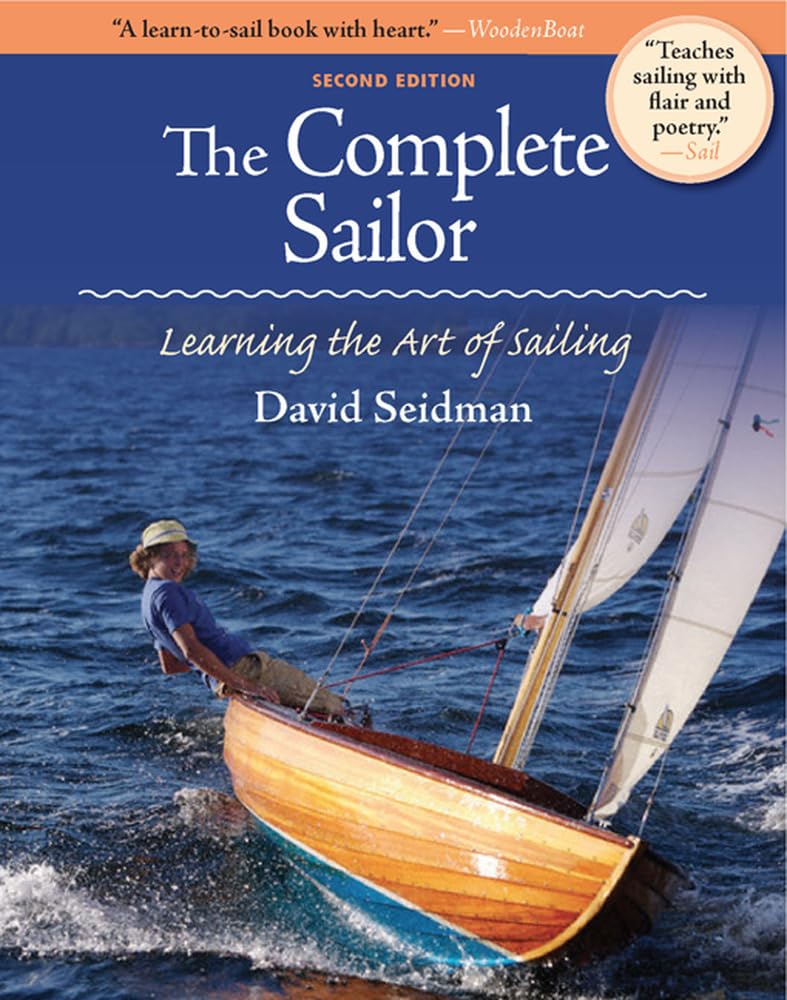
The Complete Sailor, Second Edition [Seidman, David] on desertcart.com. *FREE* shipping on qualifying offers. The Complete Sailor, Second Edition Review: Simply the best book for learning to sail. - This is the book I used to learn to sail eight years ago, and I still carry a tattered, highlighted, dog-eared copy aboard for reference. Concepts and nomenclature are explained clearly and with back story (how to pronounce 'mainsail' like a sailor, for example). The writing has a familiar humor while remaining concise. The illustrations are excellent - detailed and easy to understand. Everything you need is in here, from learning about wind, points of sail, parts of the sailboat, essential sailing knots, right-of-way, anchoring, (I could go on). I've purchased about a dozen copies of this book over the years to give to friends and family members who have asked me about learning to sail. I just bought two more copies today for some work colleagues. The other books like Annapolis Book of Seamanship and the hefty Chapman's Piloting are worth reading, too, but not as your first book. Once you're ready to get your bareboat charter certification or go for your captain's license, you can read those. The US Sailing series of books is also very good. I would stay away from the ASA books which are very poorly organized. Start with The Complete Sailor. You'll be glad you did. Review: Beginner Sailor's Bible - I received the first edition of this book over ten years ago as a gift and after giving it away to another aspiring sailor I decided I wanted the second edition because I liked it so much. The main difference between the first and second edition is added chapters on GPS and racing. Of all the learning to sail books I have read over the years this is the one I always find myself coming back to. While it may lack extensive details it touches base on many different subjects and is written in a clear, easy to understand way that makes learning simple without being opinionated on what the author believes is the "correct" way for something to be done. As I only sail a small boat on a local lake some of the book doesn't necessarily apply to me (such as tide tables) however as I find myself wanting to learn more and more about every aspect of sailing I go back to reread chapters and always learning more each time. Overall for a beginner that's just starting to sail or maybe only just becoming interested in sailing this book is a must have.


| Best Sellers Rank | #76,674 in Books ( See Top 100 in Books ) #12 in Boating (Books) #14 in Sailing (Books) |
| Customer Reviews | 4.7 4.7 out of 5 stars (565) |
| Dimensions | 7.4 x 0.56 x 9.2 inches |
| Edition | 2nd |
| ISBN-10 | 0071749578 |
| ISBN-13 | 978-0071749572 |
| Item Weight | 13.8 ounces |
| Language | English |
| Print length | 240 pages |
| Publication date | April 14, 2011 |
| Publisher | International Marine/Ragged Mountain Press |
P**K
Simply the best book for learning to sail.
This is the book I used to learn to sail eight years ago, and I still carry a tattered, highlighted, dog-eared copy aboard for reference. Concepts and nomenclature are explained clearly and with back story (how to pronounce 'mainsail' like a sailor, for example). The writing has a familiar humor while remaining concise. The illustrations are excellent - detailed and easy to understand. Everything you need is in here, from learning about wind, points of sail, parts of the sailboat, essential sailing knots, right-of-way, anchoring, (I could go on). I've purchased about a dozen copies of this book over the years to give to friends and family members who have asked me about learning to sail. I just bought two more copies today for some work colleagues. The other books like Annapolis Book of Seamanship and the hefty Chapman's Piloting are worth reading, too, but not as your first book. Once you're ready to get your bareboat charter certification or go for your captain's license, you can read those. The US Sailing series of books is also very good. I would stay away from the ASA books which are very poorly organized. Start with The Complete Sailor. You'll be glad you did.
B**H
Beginner Sailor's Bible
I received the first edition of this book over ten years ago as a gift and after giving it away to another aspiring sailor I decided I wanted the second edition because I liked it so much. The main difference between the first and second edition is added chapters on GPS and racing. Of all the learning to sail books I have read over the years this is the one I always find myself coming back to. While it may lack extensive details it touches base on many different subjects and is written in a clear, easy to understand way that makes learning simple without being opinionated on what the author believes is the "correct" way for something to be done. As I only sail a small boat on a local lake some of the book doesn't necessarily apply to me (such as tide tables) however as I find myself wanting to learn more and more about every aspect of sailing I go back to reread chapters and always learning more each time. Overall for a beginner that's just starting to sail or maybe only just becoming interested in sailing this book is a must have.
S**R
Great for wanabe sailors
I have purchased and distributed a dozen of these books. My family and I rented a 35' Island Packet out of Burnt Store Florida two years ago. I provided these books to four family members going with. I suggested to all that they read it over prior to boards. I think they did a lot of scanning prior but every little bit helps. My daughter recently began sailing 420's next to Navy Pier in Chicago. She asked me for her book that I gave her two years ago. It is an easy read with all of the relevant info any sailor could need. In the beginning there is a good discussion about wind. This is by far the best place to start with prospective sailors. Once this concept is absorbed, everything else falls into place. I started on a sea snark at 12 years of age, purchased a new 17' O'Day Day Sailor II in 85, still have it. Owned a Macgregor 26' with my brother for 10 years and now have the pleasure of sailing and racing his Alerion Express 28 on Lake Geneva in Wisconsin. "The Complete Sailor" needs to be on every sailor's shelf. Whether you are new or an ole salt to sailing, TCS will provide great incites to the world of sailing.
C**R
Superbly written, for a novice-intermediate skill level
This book offers straightforward and concise advice about the core skills of seamanship, which apply to virtually any vessel you sail. Like most sailing books, it is skewed noticeably toward the Bermudan/Marconi (triangle) rig, though not to the same severe degree as most other books. Unlike most other sailing books, its focus on core skills (interpreting the wind, shaping a sail, anchoring, approaching a dock, etc.) are fairly easily translated to other rigs, such as the cat ketch rig that I sail, and Seidman does pay passing attention to other rigs like the gaff, as well as offering some historical background on a number of early rigs (proas, junks, etc.). Some parts will be of little or no use if you don't use the rig in question (the sections on tending the jib, for example, won't apply if your boat doesn't have a jib), but most concepts are universally applicable to sailing. There is superb advanced-introductory level information about right-of-way, navigation lights, audible signals, etc. which are among the clearest, most concise explanations I've seen... not densely technical or constantly digressing about exceptions-to-the-rule. The author assumes a captain of a small boat (under 30') and so gives no-nonsense advice that applies to most any small sailing vessel (and could readily be applied to larger vessels to, in the case of the core skills addressed). Where the book really shines is in the beautiful hand-sketch-style illustrations that complement the text, proving the old axiom that "a picture is worth a thousand words." There are thoughtfully-conceived diagrams, for example, of how the wind pours across varying terrain, spilling out across water in the form of puffs, gusts, baffling winds, etc. These illustrations are matched by occasional moments in the text where the author's passion for the art of sailing really pours across the page and fills you with a palpable enthusiasm to go sailing. Not every moment in the text reads beautifully, but all of it reads clear, and the passionate sections are every bit as evocative and exciting as any I've encountered in a sailing book. You really get the feel that Seidman is trying to write about the zen of sailing, not just the practical aspects, and trying to distinguish the true "sailor" from the far more common "guy with a boat." For a true beginner--someone with little or no sailing experience--this book is not ideal because it has some noticeable gaps or assumes a little too much knowledge on the part of the reader. For example, when describing how to trim sails for efficiency, the author moves without warning between the Bermuda/Marconi rig and Gaff rig, and thus, a reader not already aware of the various terms that denote those rigs (peak halyard, etc.) might not notice the subtle shift in focus on rigs and become confused. It would be nice to see the treatment of sails divided into rig types, but that would almost certainly ruin some of the free-and-easy tone the author is attempting to maintain as he discusses concepts which are usually dense and intimidating. That is the main benefit of this book (besides the thrilling passionate sections about the joys and art of sailing): it inspires confidence by applying a keep-it-simple philosophy in which the competent sailor need only understand the basic core tenets of what moves and affects the boat. To this, Seidman also adds some interesting but non-essential information on hull shapes, ballast, keel types, etc. Intermediate sailors will already likely understand this stuff, but may still appreciate the concise summary format by which Seidman moves so swiftly through concepts that usually occupy many pages in other books--usually in a "Choosing the right boat" section. Thankfully, Seidman does not address how to choose a boat, nor attempt to identify the essential characteristics of a "seaworthy" craft, nor ponder the relative merits of trailer-sailors versus live-aboards, inboards versus outboards, etc. (the stuff that most sailing books waste a full third of their pages on). Instead, he assumes you already own (or have access to) a boat and want to improve your skills. My personal sailing skill level is difficult to describe since I am entirely self-taught, and have only sailed 2 boats, both of which I built myself (the first was a 14' cat gaff sharpie; the second was a 20' cat ketch sharpie). However, I would characterize myself as a novice-intermediate sailor with an unusually advanced knowledge of sailing jargon (boat-building teaches you how to name all the boat parts). Very little in Seidman's book felt entirely new to me, but all of it felt very well presented and focused on exactly the sorts of things that have been making me (and will continue to make me) a better sailor. This is my favorite book on sailing out of the many dozens I have read. It has a real gift for conciseness, clarity, and confidence-building with its sometimes-passionate, sometimes-nonchalant tone. If you have at least a few dozen hours of sailing time under your belt, or have already read a very basic introduction like Sailing for Dummies, this is the book for you. If you're still totally new and have not yet picked a boat or attempted much sailing, this book will not be very helpful at that stage because Seidman's concise descriptions definitely require some experience to appreciate fully. If you are an intermediate or advanced sailor, you may find Seidman repeating concepts you already know, but you will appreciate how well, concisely, and sometimes beautifully he states them, to the point of making this an ideal quick-reference for general advice on improving your skills. I highly recommend this book, and rated it at 4 stars (not 5) only because its title "The Complete Sailor" is slightly misleading: It is NOT a complete guide for the total novice, who would need to supplement it with other sources of information in order to avoid many of the common problems a brand new sailor encounters at the beginning of his/her initiation into the sport. KINDLE USERS: I read this book on the Kindle 2, which is fine, but small text in a few of the terrific illustrations or charts are unreadable on the Kindle 2's screen. It might be wise to buy the book in paperback since it really is a beautiful book. Kindle DX users might find that the illustrations are fine on the larger DX screen, but I don't know.
C**O
Llegó a tiempo.
P**A
What a fantastic book. I could it read it several times through and keep learning/memorizing more of the tons of useful info. Very practical, with a functional flow. For example, the ordering of topics is not necessarily from most simple to most complex, but kind of back and forth between topics, getting more in-depth each time. And this info is as applicable to dinghy sailing as to ocean cruising. My favorite part is the cool-as-all-get-out hand-illustrations that absolute line this beautiful book with inspired visual flare. Helps us keep in mind the playfulness of sailing, the adventure of it! And all the awesome quotes remind me that sailing is an age-old adventure, from which many idiomatic expressions have drawn their metaphors for the finer philosophies for life. This works as a personal learning book, as well as a visually pleasing coffee table book with cool pictures and quotes.
V**.
Exatamente o o que esperava, trouxe as informações adicionais que eu buscava.
C**C
If I were to pick one book on sailing this would be the one. I have read various books on sailing, most are very "dry" something like reading an instruction maual. The Complete Sailor is the best book on sailing I've read. David Seidman combines a wealth of sailing knowledge and tips along with excellent illustrations into an easy and enjoyable book to read. If you are a beginning sailor or more advanced this is the book you want.
C**S
Quaintly appealing in a 1930’s way. Yet buried buried in the folksy narrative is a decent dollop of commonsense for newbies and old-hands alike.
Trustpilot
Hace 1 semana
Hace 1 día