We remain fully operational. Our teams are working around the clock to ensure your deliveries continue safely.

Descargar la aplicación


Servicios al cliente
Sobre nosotros
Copyright © 2025 Desertcart Holdings Limited
Descargar la aplicación
![[2 Pack] DC-DC 5A Buck Converter 4-38V to 1.25-36V Step-Down Voltage Regulator High Power Module with LED Display](/_next/image?url=https%3A%2F%2Fm.media-amazon.com%2Fimages%2FI%2F81B5cVzimsL.jpg&w=3840&q=75)
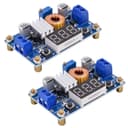
⚡ Power your projects like a pro—precision voltage, zero compromise!
This 2-pack DC-DC buck converter delivers a robust 5A output with a wide 4-38V input range and finely adjustable 1.25-36V output. Engineered with thickened PCBs, high-Q inductors, and solid capacitors, it ensures low noise and stable voltage for demanding electronics. Compact and user-friendly, it features an LED display for real-time voltage monitoring and a precision potentiometer for easy tuning—perfect for millennial makers and tech managers who demand reliability and control in their power solutions.
| ASIN | B085T73CSD |
| Best Sellers Rank | #89,026 in Tools & Home Improvement ( See Top 100 in Tools & Home Improvement ) #315 in Power Converters |
| Date First Available | March 12, 2020 |
| Is Discontinued By Manufacturer | No |
| Item Weight | 1.13 ounces |
| Item model number | VA-0189 |
| Manufacturer | Valefod |
| Product Dimensions | 2.44 x 1.5 x 0.55 inches |
| Specification Met | RoHS |
| UPC | 722453988321 |
R**.
As good as an LM2596 breakout board gets
This is about as good as an LM2596 breakout board gets. The LM2596 in the TO-263 package is designed to dissipate heat through the metal tab on the opposite end of the 5 terminals. Hence heat sinking to a copper sink embedded to the board is the optimal heat dissipation methodology. This board seems to incorporate that primary means of heat dissipation rather well. When I power a Unify Pro32 HV FPV transmitter (0.4 A low power/1.0 A highh power) using my basic LM2596 breakout boards, the LM2596 chip and inductor get pretty hot at high power so I really don't trust those boards much past half of the rating of the LM2596 chip (2A/3A peak). This board, however, performs admirably. At around 1A the board starts to get slightly warm and the upper heat sink is still cool to the touch, unlike my other cheaper LM2596 chip breakout boards which are rather hot at 1 amp. The LED light has input/output/and off modes so once installed in a project, you can turn it off and it stays off on the next power up.
B**B
Solid. Good buy for stepping down power, in my case, two 18650s to 5v.
These things work amazingly well. I thought the first one didn't work because I had been pressing all kinds of buttons and turning the adjustment screw. If you ever get out of whack, read the input voltage on your multimeter and then the input meter of the buck. They should be the same. Take a voltage test reading at the output and set the digital meter to output, and then adjust the screw until the display matches the multimeter reading. I can't recommend these enough for microcontroller projects where you may want the full voltage of your lipos for motors and only a solid 5V going to the MCU. This does that.
S**R
Good Value Step Down Voltage convertor
My #1 complaint about Asian modules is the complete specifications are not readily available. They usually use the chip maker's reference circuit, so you can sometimes get close by looking up the device datasheet, the module is built from (XL4015E1). XLSEMI was not too helpful in this case. The duty cycle is 100%. The total design power (?) They don't say, but it is "Internally Limited". Cooling requirements (?) They don't say, but it has "Thermal Shutdown". How fast does the output voltage react to load changes (?) There is no chart. The efficiency exceeds 80% . Value wise, these are great. You could not make anything like it for $7 each, if you made it yourself, because your time is worth something. I am using these to supply power to a solar array, remote monitoring hardware. The AC inverter could do it easily, but running the instrumentation from the batteries allows the inverter to be placed in standby, saving energy. One suggestion to the manufacturer, would be to raise the LED display 6 mm above the current location, so it would be easier to put the device in a protective enclosure. Cheap way to get the voltage from what you have, to what you need.
B**T
Nailed it!!!
This DC voltage regulator is absolutely spot on! I have a 24vDC source, and I needed to step down to a pretty precise 7.6vDC for 1 component, and I was able to dial it right in! And the display matches my Fluke DMM EXACTLY! I am extremely excited about how great this works for this price!!
C**S
Generally unsafe
Both of the buck converters I received failed almost immediately on the bench. One had a non-functioning the trim pot with insane heat generation and the second one melted a cap at 24V.
K**R
A good purchase
I recently purchased the DC-DC 5A Buck Converter, and I couldn’t be more satisfied with its performance. This step-down voltage regulator works exactly as described, providing a reliable and efficient way to manage my power needs. The output voltage remains stable even under varying load conditions, ensuring that your connected devices receive the power they need without fluctuations. The build quality is good, nice solder connections and digital display visibility. This module is a reliable choice that combines accuracy, ease of use, and a user-friendly display.
A**P
Cool little things to have around
I have a bunch of old laptop chargers lying around. But they are all sorts of DC output volts (18.5, 19.5, 20 etc) depending on the brand and model. Most electronics however work on either 12 or 5 volts these days. These little guys helped me convert them to nice power supplies for my projects. I use these for situations when I am developing/experimenting. Once I’m happy with my project, I replace these with their cheaper cousins (the ones without the display). One of the two however had a strange issue (which I ultimately was able to fix). It just wouldn’t change the output voltage no matter how much I turned the setting. After scratching my head with it for a while (somehow convinced it was not DOA :), I noticed that the component pins under the board were not trimmed and some were too long. One set was bent just enough to short out one of the components. Luckily nothing was permanently damaged and as soon as I straightened the pins (and trimmed them off), it sprang to life. A little better quality control probably would be a better ideas but overall still happy with the product. Haven’t tested its performance yet for max amps.
C**.
Works good
I had previously ordered the 3Amp version but it wasn't quite enough. This 5Amp unit worked perfectly. I have two 12volt batteries in series on my gate opener. I use this buck converter to regulate the 24 volts down to 13 volts. This allows my gate to open and stop in the sane place everytime day and night.
C**E
I was going to make a low current power supply for a project, then I decided to try this instead. I use it to run a couple of low current motors for a clock mechanism I’m building for a theatre play. I removed the small potentiometer and replaced it with a bigger one for adjustment purposes
T**T
I have a drawer full of old chargers with various output voltages. I use these modules to connect to the old chargers and reuse them for my projects. The output voltage can be accurately adjusted using the multi-turn potentiometer providing good vernier control. The unit appears to have good stability. An optional heat sink is provided. For convenience, there are terminal blocks and also holes in the PCB to connect input and output. The onboard switches also provide handy on/off control. I am very happy with these units as they allow me to re-purpose old chargers. I will buy more.
M**T
I got a pair to try them out as glow plug drivers for starting RC glow engines. They typically need a 1.5V source and pull 2-3A, so a 5A regulator seemed suitable. I checked one out today using a 3S Lipo battery - set the output on the big cool looking LED display, hooked up a glow plug and voila, perfect! So I bench ran a couple of engines today using the new driver and it does exactly what I hoped it would. Now mounting one in a small field box with battery and outpiut jacks etc. After 1.5 minutes continuous operation (which is not normal usage in this situation) while I took photos an dadmired it, it did get warm, but.. I have not fit the supplied self-stick heat sink yet. With intermittent (normal) use today on the bench, no temp change worth noting was observed.
M**N
The adjusting resistance is a 52k resistance and it changes 1k per spin. It means at low voltage, like 8v you have to spin the adjusting screw many times to achieve the voltage you want. I bought this and i though it's not working, but I checked all components and figured it out how it works. Spin the screw counter clock wise, about 40 times then you will see the voltage starts to drop, then you can adjust slowly.
K**B
Good quality but i needed up order the same thing, i had, make sure u know the difference between buck, and booster they look the same but do differeenly
Trustpilot
Hace 3 días
Hace 1 mes