


desertcart.com: Solaris: 9780156027601: Stanislaw Lem, Joanna Kilmartin, Steve Cox: Books Review: Solaris, a philosophical - science fiction book. My interpretation - The space race has given us, not only technological advances, but it also had an impact on other fields such as literature and movies. It has helped man to know himself better in the permanent quest of trying to understand the universe. The stimulus of getting to the moon before the other, pushed advancements in technology. At the same time it inspired writers and the film industry. This is the case of Solaris, which was first a book and then was the inspiration for at least two movies. The book is excellent in many respects and it deals mainly with philosophy, my own interpretation. The movies based on this book are a good intention of grabing some of the essential themes of the book. I liked more the Russian version since it tries to stay closer to the book. Solaris, the movie, is always compared to Kubrick's movie 2001, a Space Odysee. It seems that most people favour the Kubrick work mainly for the special effects. 2001 tries to trascend science fiction with something deeper, however the message is abstract. A 2nd movie called 2010, tries to explain the mistery, but I don't think it was succesful, sometimes is better to leave the mistery and let people imagine the end. Solaris surpasses 2001 in this respect since philosophical ideas are expressed more clearly and heavily in the book, and even gets to the movies. The polish author, Stalisnaw Lem, has included problems of morality, and religious exploration as well, which from my point of view makes it more interesting, since it makes us ponder about man and its destiny. There are lots of conversations in the book and in the movies. The philosophical questions are frequent and there is even an insinuation of an imperfect god, something like the Greek gods. Neither of the movies dwells on the description of Solaris, which is fantastic. The mile long plasma structures that grow and collapse and the colors of the two suns are something only described in the book. The author's imagination helps us discover that we have a universe in our own minds with limitless potential of uderstanding, I don't think I'm exagerating, but we may need minds like S. Lem to realize this. And there is also a love story, which may be the part that is most well known about this book, and it could be the bait to many people since this aspect touches most of them. Here we have a psychological-moral aspect that is troublesome as the rest of the book. The suicide of a person and a guilty feeling makes wonder if a second opportunity could make a person to be better this time, and transform him in the defender, to the end, of this second chance. And even though, there are many subjects in this book, the love story remains there, in the front and in the background. There is mention of the lost woman in the last paragraph of the book. Another interesting fact is the description of the ship and the items within it. The book was written at the very beginning of the space race and for this reason it uses what the author knows and is familiar with. The description of the library is interesting since he describes it in the same way a library on earth can be described. We may see a problem here, since a library, as we know it, may not be practical in space due to the fact that, nowadays, computers have taken the place of entire encyclopedias and archives. However, in this book, we could just consider a library as a symbol for a place of meetings, where the knowdledge could be so close as to pass its science through osmosis. The 1972 movie has an interesting library where there are more than books, but decoration with chandeliers, old paintings (by Bruegel) and even a Bolivian folk mask of a devil, whose meaning may not be important, but it shows that the whole movie had special details as well as music that was chosen not to be more than the movie. What is important is the depiction of the ocean which, to my eyes, could be compared to the paintings of Monet. Also, this movie has moments in the snow which are painting-like. Other special details are the clothes that Rheya wears, which are a work of art and are ageless as well as a texture that looks soft to the touch. And Tarkovsky, the Russian director, used time as a tool which I like to compare it to the time you could spend looking at pictures of Monet. For this reason, this is not a movie for everybody since action and hyperactive pictures are preferred by the common folks, who will be dissapointed with the slow pace of this movie. One of the most important of the philosophical questions, from my point of view, is when one of the scientists makes a comment about what is accomplished with the space flights, and then he says that we are looking for mirrors. The main idea behind this statement is that the scientists are forced to change the focus and scope of its work and ask themselves if they can understand the universe before they can understand themselves. This, for me, is a contribution to the eternal quest of who am I? What lays beyond our solar system? What is in the distant stars? What about God? Do I know myself? What are we looking for? given by Stalisnaw Lem, all around the space race, reflected in his book and movie. Review: Fine, fine translation of a very good, thought-provoking novel. - First, the translation (by Bill Johnston): Excellent. I have read other translations before and thought that they were probably obstacles to truly appreciating the novel. I frequently found myself questioning whether or not Lem’s ideas and characterizations were truly coming through (especially when character names were changed!) and how much of the content was *truly* his. That is no longer an issue. This translation makes me, as an English language consumer, feel as though I have finally actually read the novel for the first time. (I desperately hope this translator will also be commissioned to do _His Master’s Voice_ as soon as possible.) Second, the novel: Very, very good. I only rate it four stars, overall, because certain technical issues and psychological studies were glossed over that would have added a great deal of verisimilitude to a quite gripping story. Most readers would probably find these technical details nonessential to the core of the story, but they do open a couple of plot holes that bothered me as someone trying to complete the setting and round out the characters in my mind’s eye. The *essence* of the story is a great one, and I have found myself revisiting the questions raised ever since I first read the novel in another translation many years ago. Very few authors seem to have Lem’s ability to see beyond human biases in order to illustrate what an alien intelligence might be like. (See also: _His Master’s Voice_) I would not hesitate to recommend this translation to any English language readers who might want to read the novel in support of, or in lieu of, seeing any of the film adaptations that have been attempted. I have enjoyed the original Soviet-era film and the later Steven Soderburgh remake, but neither is thoroughly representative of the novel as presented in this new translation. Do read it. And think about it.


| Best Sellers Rank | #15,042 in Books ( See Top 100 in Books ) #120 in Hard Science Fiction (Books) #249 in Classic Literature & Fiction #1,456 in Literary Fiction (Books) |
| Customer Reviews | 4.1 4.1 out of 5 stars (6,262) |
| Dimensions | 5.31 x 0.66 x 8 inches |
| ISBN-10 | 0156027607 |
| ISBN-13 | 978-0156027601 |
| Item Weight | 2.31 pounds |
| Language | English |
| Print length | 224 pages |
| Publication date | November 20, 2002 |
| Publisher | Harper Voyager |
M**G
Solaris, a philosophical - science fiction book. My interpretation
The space race has given us, not only technological advances, but it also had an impact on other fields such as literature and movies. It has helped man to know himself better in the permanent quest of trying to understand the universe. The stimulus of getting to the moon before the other, pushed advancements in technology. At the same time it inspired writers and the film industry. This is the case of Solaris, which was first a book and then was the inspiration for at least two movies. The book is excellent in many respects and it deals mainly with philosophy, my own interpretation. The movies based on this book are a good intention of grabing some of the essential themes of the book. I liked more the Russian version since it tries to stay closer to the book. Solaris, the movie, is always compared to Kubrick's movie 2001, a Space Odysee. It seems that most people favour the Kubrick work mainly for the special effects. 2001 tries to trascend science fiction with something deeper, however the message is abstract. A 2nd movie called 2010, tries to explain the mistery, but I don't think it was succesful, sometimes is better to leave the mistery and let people imagine the end. Solaris surpasses 2001 in this respect since philosophical ideas are expressed more clearly and heavily in the book, and even gets to the movies. The polish author, Stalisnaw Lem, has included problems of morality, and religious exploration as well, which from my point of view makes it more interesting, since it makes us ponder about man and its destiny. There are lots of conversations in the book and in the movies. The philosophical questions are frequent and there is even an insinuation of an imperfect god, something like the Greek gods. Neither of the movies dwells on the description of Solaris, which is fantastic. The mile long plasma structures that grow and collapse and the colors of the two suns are something only described in the book. The author's imagination helps us discover that we have a universe in our own minds with limitless potential of uderstanding, I don't think I'm exagerating, but we may need minds like S. Lem to realize this. And there is also a love story, which may be the part that is most well known about this book, and it could be the bait to many people since this aspect touches most of them. Here we have a psychological-moral aspect that is troublesome as the rest of the book. The suicide of a person and a guilty feeling makes wonder if a second opportunity could make a person to be better this time, and transform him in the defender, to the end, of this second chance. And even though, there are many subjects in this book, the love story remains there, in the front and in the background. There is mention of the lost woman in the last paragraph of the book. Another interesting fact is the description of the ship and the items within it. The book was written at the very beginning of the space race and for this reason it uses what the author knows and is familiar with. The description of the library is interesting since he describes it in the same way a library on earth can be described. We may see a problem here, since a library, as we know it, may not be practical in space due to the fact that, nowadays, computers have taken the place of entire encyclopedias and archives. However, in this book, we could just consider a library as a symbol for a place of meetings, where the knowdledge could be so close as to pass its science through osmosis. The 1972 movie has an interesting library where there are more than books, but decoration with chandeliers, old paintings (by Bruegel) and even a Bolivian folk mask of a devil, whose meaning may not be important, but it shows that the whole movie had special details as well as music that was chosen not to be more than the movie. What is important is the depiction of the ocean which, to my eyes, could be compared to the paintings of Monet. Also, this movie has moments in the snow which are painting-like. Other special details are the clothes that Rheya wears, which are a work of art and are ageless as well as a texture that looks soft to the touch. And Tarkovsky, the Russian director, used time as a tool which I like to compare it to the time you could spend looking at pictures of Monet. For this reason, this is not a movie for everybody since action and hyperactive pictures are preferred by the common folks, who will be dissapointed with the slow pace of this movie. One of the most important of the philosophical questions, from my point of view, is when one of the scientists makes a comment about what is accomplished with the space flights, and then he says that we are looking for mirrors. The main idea behind this statement is that the scientists are forced to change the focus and scope of its work and ask themselves if they can understand the universe before they can understand themselves. This, for me, is a contribution to the eternal quest of who am I? What lays beyond our solar system? What is in the distant stars? What about God? Do I know myself? What are we looking for? given by Stalisnaw Lem, all around the space race, reflected in his book and movie.
H**S
Fine, fine translation of a very good, thought-provoking novel.
First, the translation (by Bill Johnston): Excellent. I have read other translations before and thought that they were probably obstacles to truly appreciating the novel. I frequently found myself questioning whether or not Lem’s ideas and characterizations were truly coming through (especially when character names were changed!) and how much of the content was *truly* his. That is no longer an issue. This translation makes me, as an English language consumer, feel as though I have finally actually read the novel for the first time. (I desperately hope this translator will also be commissioned to do _His Master’s Voice_ as soon as possible.) Second, the novel: Very, very good. I only rate it four stars, overall, because certain technical issues and psychological studies were glossed over that would have added a great deal of verisimilitude to a quite gripping story. Most readers would probably find these technical details nonessential to the core of the story, but they do open a couple of plot holes that bothered me as someone trying to complete the setting and round out the characters in my mind’s eye. The *essence* of the story is a great one, and I have found myself revisiting the questions raised ever since I first read the novel in another translation many years ago. Very few authors seem to have Lem’s ability to see beyond human biases in order to illustrate what an alien intelligence might be like. (See also: _His Master’s Voice_) I would not hesitate to recommend this translation to any English language readers who might want to read the novel in support of, or in lieu of, seeing any of the film adaptations that have been attempted. I have enjoyed the original Soviet-era film and the later Steven Soderburgh remake, but neither is thoroughly representative of the novel as presented in this new translation. Do read it. And think about it.
B**S
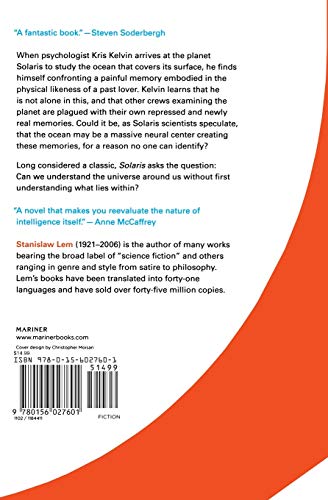
Solaris was first published in 1961. It is older than most of its readers, but the story has not aged in the least. It is perhaps because it doesn't rely on trickery, gadgets and mimicry. Its concept is utterly original and reaches beyond the confines of its sci-fi genre. A psychologist, Kris Kelvin arrives at the space station on the planet of Solaris shortly after one of the scientists based there takes his own life. Immediately upon his arrival, strange things begin to happen. He sees a naked, athletic black woman who cannot possibly be there. Soon, Rheya, his long gone lover, makes an appearance, and will not leave his side. She too cannot be real but all his senses, and his memories, tell him that she is. Two other resident-scientists experience similar ... hallucinations? encounters? relationships? It's difficult to define. This "resurrection" of the long-dead lovers can only be attributed to the planet of Solaris, and more specifically to the ocean that inhabits it. The ocean covers the entire surface of the planet. It appears to be a living, organic form which has evolved to such an extent that it is capable of thinking, creating, understanding and probably penetrating into man's mind to retrieve his memories and to use them to recreate people from his past. This doesn't seem entirely innocent - it may be that those "visitors" are spies or even assassins, although they claim to be benign and act innocently enough. They cannot be killed and sent away - they keep coming back. And more importantly their personalities evolve and they are able to form genuine relationships with "their" humans. "Solaris" explores not only the depths of the universe and the diversity of matter/creation, but even more intriguingly the depths of human mind, its secrets, memories and its self-awareness. The book is about the new and unexplored frontiers, our soul being the most remote and the hardest to comprehend. Brilliant, intelligent book!
D**S
Bom Livro, clássico que deu origem ao filme Solaris de 1972.
た**ま
ふたつの太陽を周る惑星ソラリス、その表面は不思議にうごめく海に覆われている。この海全体は意思を持った有機体のようにも見え研究者の意識にも何らかの影響を与えてるらしい。惑星上のステーションにいる研究者の前には彼らの記憶の中にしかいないはずの人があたかも現実の人としてゲストとして現れ生活を共にする。彼らは何なのか?人間、人間の意識、人間を取り巻く巨大な何か、それらは一体何で相互の関連はどうなっているのか、。難解なSFです。聞きなれない科学用語や造語が多用されていて、内容も哲学的で読むのが大変なのですが不思議な魅力に取りつかれて最後まで読んでしまいました。まだ著者の意図の理解は不十分だと思いますがしばらく反芻して味わいたいと思います。
S**O
Awesome, not like the movie and better for it. Dense and well written. Not without thrills and nice Scifi themes, but more a psychologic exploration of the MC and humanity’s eternal themes.
N**R
Considering it was published in 1960/61 when the space race between the US and Russian governments was just beginning, the author slipped in a lot of warnings that no one heeded. LOVED it! Read it in 1970, when I was still a teenager! Thought it was time for a second reading, and it was just as delightful the second time around!
Trustpilot
Hace 1 día
Hace 1 semana