We remain fully operational. Our teams are working around the clock to ensure your deliveries continue safely.

Descargar la aplicación


Servicios al cliente
Sobre nosotros
Copyright © 2025 Desertcart Holdings Limited
Descargar la aplicación
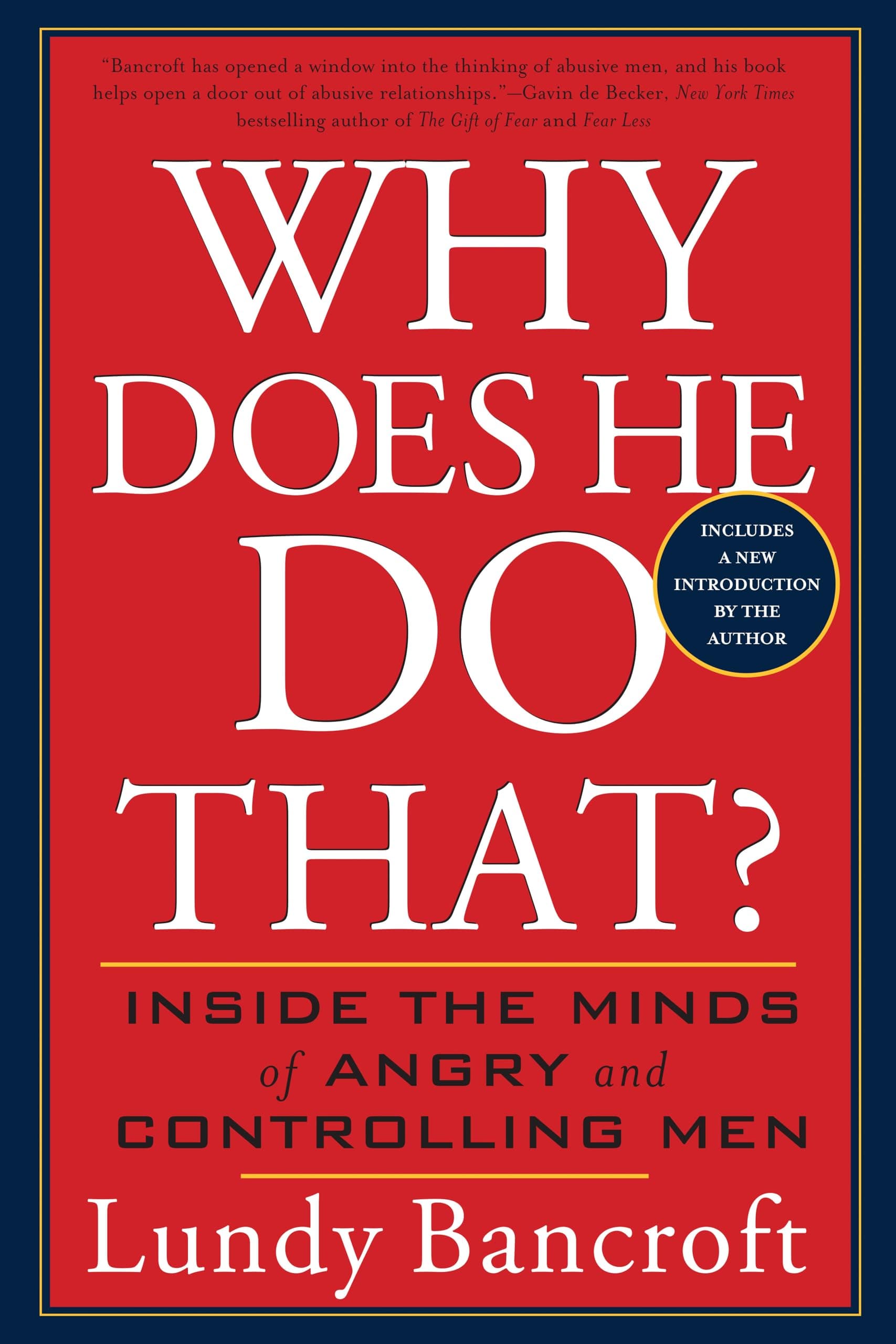
desertcart.com: Why Does He Do That?: Inside the Minds of Angry and Controlling Men: 8601300264479: Bancroft, Lundy: Books Review: If the word abuse affects your life in any way - READ THIS BOOK! - Even though I grew up in a violently abusive home in which physical, emotional, and psychological abuse dominated every day, and I thought I knew a good bit about the subject from both personal experience and prior studies, I was profoundly surprised that I learned so much from Bancroft's book. Although not a Christian, the author's non-spiritual perspective nonetheless had clearer vision than many Christians, supposedly with eyes wide open. The author's professional career and lifetime of familiarity with abusers and their victims gives him a rare authority and insight. My theory is that Bancroft's shrewd, laser-like focus might not have been quite as sharp had he been trying to write a book that also captured spiritual realities. The author offers in spades a between-the-eyes, perspicuous, and relentless expose from cover to cover -- every word of which was welcome music for my ears as someone who has wrestled for a lifetime with analyzing, challenging, and overcoming his experiences with abuse. Throughout the reading, in addition to filling in personal gaps, I was able to use the book to help sort out details of the present tense abuse of someone I know well. The two are in process of divorcing and she has turned to me for counsel and understanding of situations that are intensely confusing and painful for her. The book could not have been more timely, and I found detail after detail that perfectly captured the many nuances of the sour relationship and enabled me to present a more accurate, comprehensive, and holistic counseling presence to her. Such is the enormous potential of the book for both Christians and non-Christians. It is one thing to view abusers through victim's eyes; it is quite another to view things through an abuser's eyes. Bancroft literally has seen and heard it all -- or more accurately, seen and heard through it all. Only someone who has been in the trenches with the worst of the worst for the long haul, and who has spent serious time with every type and level of abuser, could write with such explicit alacrity and utter lack of ambiguity. His perceptions have an X-ray quality, and his penetrating apprehension of the abuser's state of mind is irrefutable. One can imagine his clients suffering system shock as he deftly dismantles excuse after excuse, efficiently returning each and every attempt at blame-mongering to its rightful owner (them), and stopping in their tracks the most devious, manipulative attempts to excuse, justify, and minimize patterns and incidents of abuse. At first, I objected to the profanity in the testimonies, including the "f" word, until I thought through the matter further and realized that the worst in the book was by far the lightest I have experienced. From both the abuser's and victim's perspectives, a sanitized book might not have nearly the impact of this one. I thought at first that the author's exclusive focus on male abusers might be lopsided, but in several places he clearly included and acknowledged the more rare female abusers and male victims. Other than this and another minor criticism (not relevant here), I already have been recommending the book to others, including my friend above. In fact, I believe it should be required reading for all those in positions of influence, especially pastors and counselors. This is a highly practical, truth-packed, utterly reliable manual for understanding and helping both abusers and their victims come to terms with the ugly realities of domestic violence. The book offers distilled, spot-on advice at every turn, helping victims find their way out of the tangled web of the abuser's control, and helping abusers face the whole truth about their deep-seated entitlements in relationships and their heavily distorted views of the role and purpose of having a spouse. The author has wonderful, Robin Hood accurate sarcasm that absolutely nails the abusers often incredibly self-absorbed myopia. Nothing is funny, however, with abusers' often-deadly desire to completely control every aspect of another human being. Fully aware of the potential for escalating violence for many victims just to talk about the situation at home, Bancroft never blinks as he urgently confronts, exposes, teaches, and warns about this insidious evil. Not only is he able to see through every layer of abusers' cons, but he comprehensively and systematically unmasks their every move and motive. I found myself cheering the author on with each new page and chapter, so thankful that people exist with this rare insight and wisdom. At the same time, I experienced a wave of nausea, knowing how many countless abusers will never seek or be forced into treatment -- and what that will mean for their countless victims, many of whom are so thoroughly conned and wound into the abuser's web of control, that they likely will suffer interminably on a daily basis, possibly for the rest of their lives. This is a must read for anyone in any way involved in the life of even a single victim or abuser. The final chapters especially spoke to me. The following says it all: "Abusiveness is like poison ivy, with its extensive and entrenched root system. You can't eradicate it by lopping off the superficial signs. It has to come out by the roots, which are the man's attitudes and beliefs regarding partner relationships" (366). Another statement brings back my own childhood: "Partner abuse is a cyclone that leaves a swath of destruction behind it as it rips through the lives of women and children" (367). Bancroft sums his own work with a directive to abusers, for which I add a hearty amen to each volume-speaking point, which should be broadcast from rooftops: "Abuse is wrong; you are responsible for your own actions; no excuse is acceptable; the damage you are doing is incalculable; your problem is yours alone to solve" (376). Review: Best book out there on emotional abuse - not just violence, not just domestic abuse - Words like "domestic violence" sprinkled all over this desertcart page (editorial review, keywords) might make you think this book is only written for victims of physical violence. You might think "maybe this book is not for me, he is not THAT bad." No. This book is primarily about recognizing patterns of emotional abuse and how to respond to them. If you think you are being emotionally abused - by your spouse, by your supervisor or boss, by anyone who has power over you - consider reading this book. This book is NOT just about physical abuse. Quite the opposite, the author says it focuses on emotional abuse. After Bancroft describes the ten types of abusers, he does single out two (the drill sergeant and the terrorist) as especially likely to become dangerous: "I have focused on the emotionally abusive styles of these different kinds of abusers, any of them may also use physical violence, including sexual assault. Although the Terrorist and Drill Sergeant are especially likely to become dangerous, they are not the only ones who may do so." However emotional abuse can still be severely damaging, whether or not he is also physically abusive. The key to whether this book is for you is not whether he is physically violent, the key is: does he fit these characteristics of an angry and controlling abuser? If he (or she) does, read this book. #1 He is controlling #2 He feels entitled #3 He twists things into their opposites (makes it sound you like you are abusing him) #4 He disprespects his partner and considers himself superior to her #5 He confuses love and abuse ("I was sick of watching her ruining her life. I care too much about her to sit back and do nothing about it") #6 He is manipulative #7 He strives to have a good public image #8 He feels justified ("she pushed me too far, she knows how to push my buttons, there's only so much a man can take") #9 Abusers deny and minimize their abuse #10 Abusers are possessive ("why is he so insanely jealous?") This book can be very helpful in a lot of situations that are not domestic abuse too. Due to a change in management I ended up with a controlling and manipulative boss. I read a couple other books on manipulative persons and verbal abuse, however in some ways this book - supposedly focused only on domestic abuse of women - went much deeper and did a far better of describing my boss's behavior and thinking than the more "general" books on verbal abuse and manipulation. I only discovered this book because I saw it on the bookshelf of someone who volunteered at a domestic abuse shelter. The Gentle Art of Verbal Self Defense was also practical and useful, however it was Bancroft's book that convinced me there was no changing this guy and no middle ground, that the longer anyone stayed around the more he would savagely sabotage people's reputations to keep them from finding jobs elsewhere and escaping him. This book helped me understand his tactics and defend myself (and my career) while I looked for another job and made my plan to leave. As a single person, this book could be very helpful to read BEFORE you end up in a potentially abusive situation. Bancroft has a whole chapter on how abuse begins. Far too often single women assume that the man who acts most jealous and pays them the most attention is also the one who loves them most strongly and cares for them most. Bancroft sounds a vital warning here that real love has to include respect. A person who genuinely loves you wants what is best for you and supports your self-esteem and independence. Hey, no one pays more attention to you, has stronger feelings for you, and is more jealous of you than an angry and controlling abuser. But a strong desire to possess and control you like an object isn't love. Bancroft gives many of the early warning signs to look for: the abuser has double standards, he speaks disrespectfully about his former partners, he is disrespectful toward you, he puts on such a show of generousity that he makes you feel uncomfortable and does favors you don't want (so you will feel you owe him), he is controlling and possessive, nothing is ever his fault, he intimidates you when he's angry, he treats you differently (better) around other people, he appears to be attracted to vulnerability. He writes that the central and key personality trait of an angry and controlling abuser is a sense of entitlement. An abuser is neither a monster or a victim - the core problem with any type of abuser is that he has a distorted sense of right and wrong (p. 35). "Abuse grows from atittudes and values, not feelings. The roots are ownership, the trunk is entitlement, and the branches are control." I believe the author is right when he says most physically abusive partners are men. However there are plenty of emotionally-abusive women out there too. After reading this book I was able to almost instantly recognize the key patterns of angry and abusive partners in a bizarre woman who took an instant strong interest on me, a woman who went on to behave like a stalker in her attempts to follow me around to get me to ask for her number and ask her out, and try to drive away "competition." The key to stopping her was to recognize her tactics AND be able to calmly and clearly describe them to others so they could clearly see what she was really doing. When I did this, she just as suddenly dropped out of sight, even resigning an officer's position in one of the many groups she joined in her attempts to follow me around. There is not just one type of abuser. Based on his seventeen years working with abusers and victims, Bancroft lists ten types of abusive men and while some of them are very obviously abusers, other types can be very insidious and subtle: 1. The Demand Man - It's your job to do things for me. If I'm unhappy it's your fault. 2. Mr. Right - I know better than you do, when you disagree with me that is mistreatment of me. 3. The Water Torturer - I know how to get under your skin, you are crazy and fly off the handle, as long as I'm calm nothing I do is abuse no matter how cruel 4. The Drill Sergeant - I need to control your every move or you'll do it wrong, he criticizes your every move, you shouldn't have anyone else in your life but me, I will watch you like a hawk to keep your from developing strength or independence, I love you but you disgust me (!!) 5. Mr. Sensitive - I'm against "macho men" so I couldn't be abusive, I control you by analyzing how your mind and emotions work, I can get inside your head, I use psychobabble such that no one will believe I am abusing you, you should be grateful I'm not like those "macho men." 6. The Player - if you could meet my sexual needs I wouldn't have to turn to other women, women were put on this earth to have sex with men, women who want the nonsexual aspects of themselves appreciated are b****es 7. Rambo - strength and aggressiveness are good, femininity is inferior, women are here to serve men and be protected by them, you belong to me like a trophy. 8. The Victim - everybody has done me wrong, I've had it so hard I'm not responsible for my actions, it's justifiable for me to do whatever I feel you are doing to me and even worse to make sure you get the message, women who claim they are mistreated are anti-male 9. The Terrorist - I would rather die than accept your right to independence, women are evil and have to be terrified to keep that evil in check, seeing you terrified is exciting and satisfying, you have no right to defy me or leave me 10. The Mentally Ill or Addicted Abuser - I'm not abusive - I'm just (alcoholic/drug-addicted/manic depressive, etc.), I am not responsible for my actions because of psychological or abuse problems, if you challenge me about abusiveness you are being mean to me and don't understand my problems, when you challenge me it triggers my illness and you are responsible for what I do Still not sure if this book is for you? Bancroft answers questions like "when is it abuse?" Is there a distinct line that I can keep my eye on so I know when he has crossed it? Since nobody's perfect, how do I know the difference between a bad day when he's just being a jerk and a pattern that adds up to something more certain. Remember, this book is not just for victims of domestic violence. If you think you might be emotionally abused, read this book.

| Best Sellers Rank | #3,077 in Books ( See Top 100 in Books ) #1 in Domestic Partner Abuse (Books) #1 in Abuse Self-Help #5 in Codependency (Books) |
| Customer Reviews | 4.7 4.7 out of 5 stars (8,646) |
| Dimensions | 5.98 x 0.91 x 8.98 inches |
| Edition | Reprint |
| ISBN-10 | 0425191656 |
| ISBN-13 | 978-0425191651 |
| Item Weight | 14.4 ounces |
| Language | English |
| Print length | 448 pages |
| Publication date | September 2, 2003 |
| Publisher | Berkley Books |
K**N
If the word abuse affects your life in any way - READ THIS BOOK!
Even though I grew up in a violently abusive home in which physical, emotional, and psychological abuse dominated every day, and I thought I knew a good bit about the subject from both personal experience and prior studies, I was profoundly surprised that I learned so much from Bancroft's book. Although not a Christian, the author's non-spiritual perspective nonetheless had clearer vision than many Christians, supposedly with eyes wide open. The author's professional career and lifetime of familiarity with abusers and their victims gives him a rare authority and insight. My theory is that Bancroft's shrewd, laser-like focus might not have been quite as sharp had he been trying to write a book that also captured spiritual realities. The author offers in spades a between-the-eyes, perspicuous, and relentless expose from cover to cover -- every word of which was welcome music for my ears as someone who has wrestled for a lifetime with analyzing, challenging, and overcoming his experiences with abuse. Throughout the reading, in addition to filling in personal gaps, I was able to use the book to help sort out details of the present tense abuse of someone I know well. The two are in process of divorcing and she has turned to me for counsel and understanding of situations that are intensely confusing and painful for her. The book could not have been more timely, and I found detail after detail that perfectly captured the many nuances of the sour relationship and enabled me to present a more accurate, comprehensive, and holistic counseling presence to her. Such is the enormous potential of the book for both Christians and non-Christians. It is one thing to view abusers through victim's eyes; it is quite another to view things through an abuser's eyes. Bancroft literally has seen and heard it all -- or more accurately, seen and heard through it all. Only someone who has been in the trenches with the worst of the worst for the long haul, and who has spent serious time with every type and level of abuser, could write with such explicit alacrity and utter lack of ambiguity. His perceptions have an X-ray quality, and his penetrating apprehension of the abuser's state of mind is irrefutable. One can imagine his clients suffering system shock as he deftly dismantles excuse after excuse, efficiently returning each and every attempt at blame-mongering to its rightful owner (them), and stopping in their tracks the most devious, manipulative attempts to excuse, justify, and minimize patterns and incidents of abuse. At first, I objected to the profanity in the testimonies, including the "f" word, until I thought through the matter further and realized that the worst in the book was by far the lightest I have experienced. From both the abuser's and victim's perspectives, a sanitized book might not have nearly the impact of this one. I thought at first that the author's exclusive focus on male abusers might be lopsided, but in several places he clearly included and acknowledged the more rare female abusers and male victims. Other than this and another minor criticism (not relevant here), I already have been recommending the book to others, including my friend above. In fact, I believe it should be required reading for all those in positions of influence, especially pastors and counselors. This is a highly practical, truth-packed, utterly reliable manual for understanding and helping both abusers and their victims come to terms with the ugly realities of domestic violence. The book offers distilled, spot-on advice at every turn, helping victims find their way out of the tangled web of the abuser's control, and helping abusers face the whole truth about their deep-seated entitlements in relationships and their heavily distorted views of the role and purpose of having a spouse. The author has wonderful, Robin Hood accurate sarcasm that absolutely nails the abusers often incredibly self-absorbed myopia. Nothing is funny, however, with abusers' often-deadly desire to completely control every aspect of another human being. Fully aware of the potential for escalating violence for many victims just to talk about the situation at home, Bancroft never blinks as he urgently confronts, exposes, teaches, and warns about this insidious evil. Not only is he able to see through every layer of abusers' cons, but he comprehensively and systematically unmasks their every move and motive. I found myself cheering the author on with each new page and chapter, so thankful that people exist with this rare insight and wisdom. At the same time, I experienced a wave of nausea, knowing how many countless abusers will never seek or be forced into treatment -- and what that will mean for their countless victims, many of whom are so thoroughly conned and wound into the abuser's web of control, that they likely will suffer interminably on a daily basis, possibly for the rest of their lives. This is a must read for anyone in any way involved in the life of even a single victim or abuser. The final chapters especially spoke to me. The following says it all: "Abusiveness is like poison ivy, with its extensive and entrenched root system. You can't eradicate it by lopping off the superficial signs. It has to come out by the roots, which are the man's attitudes and beliefs regarding partner relationships" (366). Another statement brings back my own childhood: "Partner abuse is a cyclone that leaves a swath of destruction behind it as it rips through the lives of women and children" (367). Bancroft sums his own work with a directive to abusers, for which I add a hearty amen to each volume-speaking point, which should be broadcast from rooftops: "Abuse is wrong; you are responsible for your own actions; no excuse is acceptable; the damage you are doing is incalculable; your problem is yours alone to solve" (376).
A**R
Best book out there on emotional abuse - not just violence, not just domestic abuse
Words like "domestic violence" sprinkled all over this Amazon page (editorial review, keywords) might make you think this book is only written for victims of physical violence. You might think "maybe this book is not for me, he is not THAT bad." No. This book is primarily about recognizing patterns of emotional abuse and how to respond to them. If you think you are being emotionally abused - by your spouse, by your supervisor or boss, by anyone who has power over you - consider reading this book. This book is NOT just about physical abuse. Quite the opposite, the author says it focuses on emotional abuse. After Bancroft describes the ten types of abusers, he does single out two (the drill sergeant and the terrorist) as especially likely to become dangerous: "I have focused on the emotionally abusive styles of these different kinds of abusers, any of them may also use physical violence, including sexual assault. Although the Terrorist and Drill Sergeant are especially likely to become dangerous, they are not the only ones who may do so." However emotional abuse can still be severely damaging, whether or not he is also physically abusive. The key to whether this book is for you is not whether he is physically violent, the key is: does he fit these characteristics of an angry and controlling abuser? If he (or she) does, read this book. #1 He is controlling #2 He feels entitled #3 He twists things into their opposites (makes it sound you like you are abusing him) #4 He disprespects his partner and considers himself superior to her #5 He confuses love and abuse ("I was sick of watching her ruining her life. I care too much about her to sit back and do nothing about it") #6 He is manipulative #7 He strives to have a good public image #8 He feels justified ("she pushed me too far, she knows how to push my buttons, there's only so much a man can take") #9 Abusers deny and minimize their abuse #10 Abusers are possessive ("why is he so insanely jealous?") This book can be very helpful in a lot of situations that are not domestic abuse too. Due to a change in management I ended up with a controlling and manipulative boss. I read a couple other books on manipulative persons and verbal abuse, however in some ways this book - supposedly focused only on domestic abuse of women - went much deeper and did a far better of describing my boss's behavior and thinking than the more "general" books on verbal abuse and manipulation. I only discovered this book because I saw it on the bookshelf of someone who volunteered at a domestic abuse shelter. The Gentle Art of Verbal Self Defense was also practical and useful, however it was Bancroft's book that convinced me there was no changing this guy and no middle ground, that the longer anyone stayed around the more he would savagely sabotage people's reputations to keep them from finding jobs elsewhere and escaping him. This book helped me understand his tactics and defend myself (and my career) while I looked for another job and made my plan to leave. As a single person, this book could be very helpful to read BEFORE you end up in a potentially abusive situation. Bancroft has a whole chapter on how abuse begins. Far too often single women assume that the man who acts most jealous and pays them the most attention is also the one who loves them most strongly and cares for them most. Bancroft sounds a vital warning here that real love has to include respect. A person who genuinely loves you wants what is best for you and supports your self-esteem and independence. Hey, no one pays more attention to you, has stronger feelings for you, and is more jealous of you than an angry and controlling abuser. But a strong desire to possess and control you like an object isn't love. Bancroft gives many of the early warning signs to look for: the abuser has double standards, he speaks disrespectfully about his former partners, he is disrespectful toward you, he puts on such a show of generousity that he makes you feel uncomfortable and does favors you don't want (so you will feel you owe him), he is controlling and possessive, nothing is ever his fault, he intimidates you when he's angry, he treats you differently (better) around other people, he appears to be attracted to vulnerability. He writes that the central and key personality trait of an angry and controlling abuser is a sense of entitlement. An abuser is neither a monster or a victim - the core problem with any type of abuser is that he has a distorted sense of right and wrong (p. 35). "Abuse grows from atittudes and values, not feelings. The roots are ownership, the trunk is entitlement, and the branches are control." I believe the author is right when he says most physically abusive partners are men. However there are plenty of emotionally-abusive women out there too. After reading this book I was able to almost instantly recognize the key patterns of angry and abusive partners in a bizarre woman who took an instant strong interest on me, a woman who went on to behave like a stalker in her attempts to follow me around to get me to ask for her number and ask her out, and try to drive away "competition." The key to stopping her was to recognize her tactics AND be able to calmly and clearly describe them to others so they could clearly see what she was really doing. When I did this, she just as suddenly dropped out of sight, even resigning an officer's position in one of the many groups she joined in her attempts to follow me around. There is not just one type of abuser. Based on his seventeen years working with abusers and victims, Bancroft lists ten types of abusive men and while some of them are very obviously abusers, other types can be very insidious and subtle: 1. The Demand Man - It's your job to do things for me. If I'm unhappy it's your fault. 2. Mr. Right - I know better than you do, when you disagree with me that is mistreatment of me. 3. The Water Torturer - I know how to get under your skin, you are crazy and fly off the handle, as long as I'm calm nothing I do is abuse no matter how cruel 4. The Drill Sergeant - I need to control your every move or you'll do it wrong, he criticizes your every move, you shouldn't have anyone else in your life but me, I will watch you like a hawk to keep your from developing strength or independence, I love you but you disgust me (!!) 5. Mr. Sensitive - I'm against "macho men" so I couldn't be abusive, I control you by analyzing how your mind and emotions work, I can get inside your head, I use psychobabble such that no one will believe I am abusing you, you should be grateful I'm not like those "macho men." 6. The Player - if you could meet my sexual needs I wouldn't have to turn to other women, women were put on this earth to have sex with men, women who want the nonsexual aspects of themselves appreciated are b****es 7. Rambo - strength and aggressiveness are good, femininity is inferior, women are here to serve men and be protected by them, you belong to me like a trophy. 8. The Victim - everybody has done me wrong, I've had it so hard I'm not responsible for my actions, it's justifiable for me to do whatever I feel you are doing to me and even worse to make sure you get the message, women who claim they are mistreated are anti-male 9. The Terrorist - I would rather die than accept your right to independence, women are evil and have to be terrified to keep that evil in check, seeing you terrified is exciting and satisfying, you have no right to defy me or leave me 10. The Mentally Ill or Addicted Abuser - I'm not abusive - I'm just (alcoholic/drug-addicted/manic depressive, etc.), I am not responsible for my actions because of psychological or abuse problems, if you challenge me about abusiveness you are being mean to me and don't understand my problems, when you challenge me it triggers my illness and you are responsible for what I do Still not sure if this book is for you? Bancroft answers questions like "when is it abuse?" Is there a distinct line that I can keep my eye on so I know when he has crossed it? Since nobody's perfect, how do I know the difference between a bad day when he's just being a jerk and a pattern that adds up to something more certain. Remember, this book is not just for victims of domestic violence. If you think you might be emotionally abused, read this book.
R**R
One of the finest books on domestic abuse WRITTEN BY MALE FOR FEMALE. This will help you MUCH MORE than talking to relatives/family members... Incase you want to resolve your married/relationship problems especially if it involves children. This is best book to look out for if you are undergoing divorce/custody of children or simply wonder if you are in abusive husband/boy friend. Though this book might look bit costly it's every bit cheaper considering the trauma & expenses you go through to figure out your suitation. Buy it. PS: This is even good for girls who are planning to get married soon and if they come from family which is almost always at cold war/nuke war. It will help you to know if the partner you have choose is worth YOUR life or not. Along this book I recommend the following books if you thoroughly want to live a life without unnecessary drama: 1) Co-dependent No More 2) Women Who love too much 3) Adult children of emotionally immature parents 4) Will I be good enough 5) Toxic parents 6) Controlling people This book is even worth reading for MEN if they want to be a better husband/son/father/brother/guardian. As they say "Make your own luck". Good luck.
A**ー
Why don’t we enlighten ourselves?
T**A
I have recently got out of a damaging relationship which I now can clearly see was abusive. My ex was incredibly clever at psychologically manipulating me to believe that I was the problem and he tried really hard to convince me that his treatment was my fault - including all sorts of different tactics. He was like two entirely different people - one minute he could be the most loving, wonderful, amazing boyfriend whom I genuinely believed adored me... then with no warning he would suddenly change into a monster who frightened, confused and intimidated me. I was tiptoeing on eggshells around him trying to predict and avoid saying or doing anything that might set him off. Other times it felt like we were passionately in love and we would talk about the wonderful things we would do together in the future. It was incredibly confusing. I didn't know which one was the real him. His demeanour could change in an instant. I was so lucky that I happened to meet a lady who works for Women's Aid and she encouraged me to take his behaviour seriously and seek help. In the 3 weeks since breaking up with him, I have been tempted to get back in contact with him so many times and I have to fight to stay strong and not give in to that urge. It is almost a craving, like breaking an addiction. What I've learned is that I was caught in a trap of 'trauma bonding' which essentially explains why abused women go back to their abusive partners telling themselves he will change. You become emotionally dependent on the one who flies into a rage and terrifies you one minute, then makes you believe it was all your fault and makes YOU feel guilty so you end up being the one to apologise (for something you haven't done), to calm him down and because you are so upset and emotionally raw you cling to him because he's the one you have become emotionally dependent on. You are addicted to the good feelings of when he chooses to be loving and kind to you. Unfortunately, over time, you have to work harder and harder to try to win back that love and affection which he once showered you with. Once he has worn you down he starts to punish you more and more often, making you feel more and more insecure but, crazily you feel like you couldn't cope without him. I know it sounds messed up but there is real science behind how this happens. It is very similar to Stockholm Syndrome in which hostages become attached to their captors. This book has helped me and is continuing to help me to stay strong every day. When I have weak moments of missing my ex, I turn back to this book. I know eventually I will build myself back up and become strong again and that over time the urge to go back to this man will lessen. Although I have done many, many hours of my own research and already consider myself well informed, this book has lifted a veil and shown me SO much more than I could ever have discovered for myself online. Reading it is like a string of massive 'Aha' moments when all the different jigsaw pieces finally fit together and you finally start to see the overall picture. This book has been a total revelation to me. Don't be put off by the size of this book - it is very easily readable and the information is presented in a very clear and easy to follow format. It also works well as a book to just dip in and out of as there are gems on every page! It has been a real shock to me as it has gradually dawned on me that the man I believed truly adored me and only wanted to make me happy (as he claimed over and over), and who treated me like a princess in the beginning, was perhaps not the man I thought he was. I made excuses for his behaviour as I believed he was the one suffering and traumatised as a result of having experienced the traumatic, violent childhood he described to me. I did everything I could to always give him the benefit of the doubt, to try to rationalise and understand why he acted the way he did, and I tried so hard to make the relationship work as if it were my job and my job alone. I stuck with him for as long as I did because I thought that was what you do when you love someone and I believed that in time he would get better. In fact he never took any responsibility for his behaviour and the effect it had on me as he was never interested in listening to me - he was only interested in forcing me to listen to him over and over whilst whenever I tried to speak he shut me down. Had I not found this book I don't know whether I would have had the strength not to go back to him and allow the cycle of abuse to go on and get worse. Perhaps I might have fallen back into the trap of listening to the manipulative and clever lies he fed me and coming round to believing his story and invalidating my own. Unfortunately women such as myself make the easiest targets; we are typically very sensitive to others' needs, extremely compassionate, caring, usually we seek to understand the motivation behind another's behaviour instead of to judge and we tend to give others the benefit of the doubt over and above honouring our own needs. We also have a tendency to doubt ourselves and we frequently have low self-esteem which can be born out of having had to try to please our primary caregivers as children to try to win their approval and love and never having experienced enough love and affection as children. Unfortunately, getting into a relationship with a man who turns out to be an abuser lowers our self-belief and self-esteem further, making it harder and harder to get out. I advise anyone and everyone to read this book - men and women alike. I am impressed by how the author never slips into the pitfall of demonising abusive men or implying that they are bad or evil people - which would be an easy thing to do. He points out that while of course they are human too, that doesn't mean that are ever *any* excuses for their behaviour. He reveals how men who fall into this category are very seldom willing to take responsibility for their behaviour and its terribly damaging effect on those who fall victim to it, instead they make excuses and usually choose to blame the other person. I feel the most enlightening part of all is that he reveals that deep down, the causal factor behind most of this abuse is the culture some men have grown up in: a culture of masculine entitlement and belittling of women. They think they are entitled to have *their* needs met by women, to the point of almost objectifying them, and not to consider her needs or feelings. Some of them are even devoid of empathy. But they are not born that way. Overall it's these deeply ingrained cultural attitudes that need to change - and each of us has an important role to play in doing something about it.
M**Z
So many "self help" books I find are so vague and offer no real insight on how to interact with an abusive partner. It's so refreshing to see a male author write his knowledge about this kind of interaction since he works daily with this type of abusers! A must read to everyone, not only if you are in a relationship. This book will help you establish boundaries with the people in your life and to see reality for what it really is.
E**A
Having difficulties accepting that the relationship was emotional abuse, I did a lot of research which included reading this book. The book is insightful for all intimate partner relationships, but also for those who are in abusive relationships between parents and adult children. It outlines the fundamental ingredients of what abuse is, the various retaliation that occurs if you try to ask them to stop and why abusers do it, even when they know it is wrong. The basics doesn't change no matter the situation. Some wasn't relevant to me, but about 70% of the rest was. It was very insightful, and also helped create a solution about what I needed to do, accept that I cannot be responsible for other people's behaviour, abuse is not respect and self healing and self preservation is important. Forgiving yourself is OK. It has been a hard period of realization for me and this book helped. I like his comment of the 'wait and see' approach that many recipients do in a relationship and that we should not wait for a black eye before we separate and then we can call it abuse. I do wish he had a worksheet to confirm if it is likely indicators of abuse. This was missing, but not a big deal as there are other resources that can give you that validation. He did include a series of questions which I answered yes to all except for one and he does go into great detail of what abuse looks like. It helped validate numerous other points of assessments which included my doctor's. If you are looking for a resource and healing....especially when trying to move forward and decide what to do while going through counselling/therapy....really read this book. And like another reviewer below, I would 100% recommend to have your children read this book before they start dating. The inexperience of what a heathy relationship looks like can be an contributing factor that allows abuse to escalate and making it difficult to leave.
Trustpilot
Hace 1 mes
Hace 1 mes