We remain fully operational. Our teams are working around the clock to ensure your deliveries continue safely.

Descargar la aplicación


Servicios al cliente
Sobre nosotros
Copyright © 2025 Desertcart Holdings Limited
Descargar la aplicación
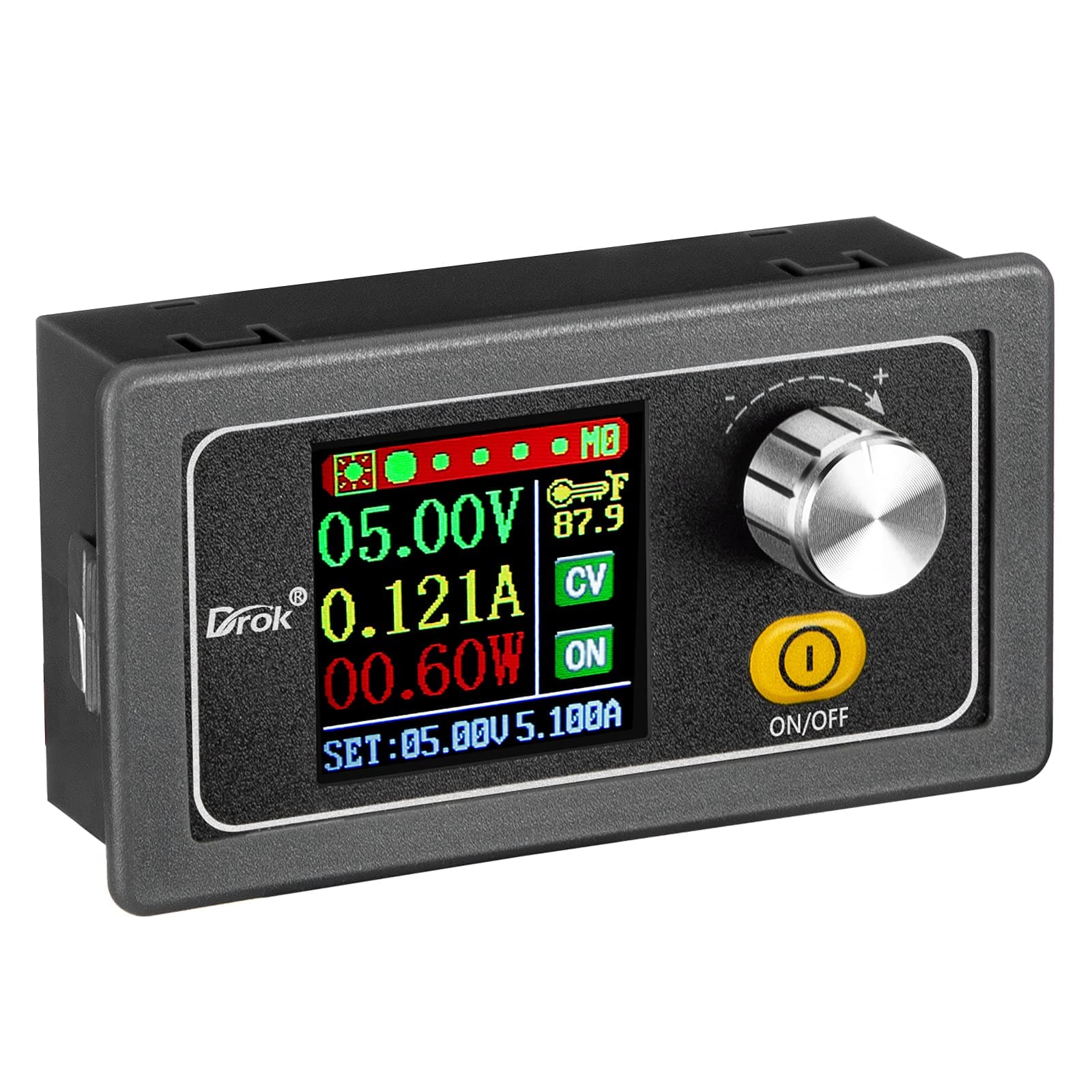
🔌 Power your projects with precision and confidence — never settle for less!
The DROK Adjustable Voltage Regulator is a compact, panel-mount buck-boost converter supporting input/output voltages from 6.0V to 36V and delivering up to 5A current with 80W max power. Featuring a high-resolution digital display, memory presets, and comprehensive hardware/software protections, it’s ideal for portable power supplies, LED drivers, and DIY electronics testing. Its low RF noise output makes it perfect for sensitive applications like ham radios, ensuring clean, stable power on the go.
| ASIN | B089ND7PTH |
| Best Sellers Rank | #81,966 in Tools & Home Improvement ( See Top 100 in Tools & Home Improvement ) #305 in Power Converters |
| Brand | DROK |
| Brand Name | DROK |
| Current Rating | 5 Amps |
| Customer Reviews | 4.2 out of 5 stars 280 Reviews |
| Item Weight | 0.11 Kilograms |
| Manufacturer | DROK |
| Model | 200517 |
| Mounting Type | Panel Mount |
| Part Number | 200517 |
| Power Source | Battery Powered, Corded Electric |
| Specification Met | CE, UL |
J**S
Very Cool Mini Power Supply Built For Portability
I used this in a customized portable power supply pack I built. I placed it on top of a battery adapter for a Dewalt battery (18 to 20 volts), and the adapter also has USB outputs too. This little power supply can supply voltages from an input voltage range DC 6.0-36V, with an output voltage range DC 0.6-36V, max output current 5A, max output power 80W. The unit allows you to set the volts and limit the current, power on off (NOT a master power on off, just the output voltage on off) and an accurate voltage setting return after power down. It has memory locations for presetting the voltages at those locations. So you can quickly pull up a voltage setting from memory. I used a switch on the side of my project to turn on and off the master power to the device, so I could still keep it on the battery without discharging the battery by having the display on. The black box was purchased from another source, though the contacts didn't work very well for the battery connections and thus I needed to adapt it to another adapter itself. All in all, a very handy device to use for testing various circuits by using a simple battery pack that can supply a multitude of voltages and set currents too. Input or output voltage, current, temperature, power, electric capacity, electric quantity, running time, voltage and current curve, system and power parameters. Very nifty.
D**S
Clean power and low RF noise with both the buck and boost features
The ham radio in my Jeep is powered by a 6 Amp-hour LIFE battery and this buck-boost module is used to recharge the LIFE battery. And since it's used around a two-way radio, I've been pleased to find that it emits negligible amounts of RF noise, which is a problem for most other other buck converters. I've tried three other types of power supplies and only this one can be used around my radios. It also powers two banana jacks so I can recharge any device that requires an input voltage between 1 and 36 volts. Therefore, I recharge handheld radios, cordless drill and saw batteries, and even the batteries for the electric chainsaw and air compressor that I keep in the vehicle when I go off roading. Overall, it's an excellent product that provides clean and stable power over a wide range of voltage and current needs.
S**N
Does what it said it could do
This is a good product. It did what it said it could do. Needed to adjust a bloweer for my motorhome refrigerator and it worked perfectly. Vendor was on time
R**S
Incredible value and flexibility excuse the slightly cumbersome controls and terrible user manual
First, the value for the money is exceptional. Twenty-something bucks for a power supply that can boost/drop voltage to anywhere from less than a volt to over 30 volts it so cheap that I am fine with buying extras and just leaving them in my projects rather than bothering with building custom voltage/current regulation hardware to swap out for it when I'm done prototyping. There is an active cooling fan for when loads demand it, but I've yet to drive it hard enough to trigger it and if you don't want to use their little fan, you can unplug it and take responsibility for the job of keeping the chip cool. The enclosing plastic frame doesn't seem to be too inefficient about leaving empty space inside to make the case a useful shape, and it sufficiently protects the hardware against my careless slinging of conductors near it, as well as the occasional drop onto hardwood floors. The screw-down terminals for connecting source and output wires are excellent. They are physically secure and won't wiggle against their solder just because you are tightening the screws securely plus they accept nice, large-gauge wire (I'm pretty sure all the wires I have in there are a 12 gauge or thicker). They are all right in a row, though, so be sure you tin the ends and cut them to have no exposed wire visible outside the terminals or a stray strand of wire could short something. Speaking of safety, you can manually adjust the live current/voltage settings in use (with a delay) but switching modes automatically turns off the output to protect against accidental frying of hardware. It might be annoying, but without it on my previous voltage converter, I burned up a whole LED array by accident. However, the user interface is barely acceptable, with numerous quirks: Current limiting is always on, but the "CC" (constant current) indicator only signals when the current drawn exceeds the setting and the power supply is holding it down to the set value. Setting values is done digit by digit with the knob, but sometimes the largest digit is only set by adjusting the second largest by enough to carry over. Many settings are unexplained and most require good acronym guesswork to decode. The memory can have 9 saved presets, but only the 1 and 2 numbered presets are able to be quickly recalled with the power button. Making changes is a process that usually forces me to cycle through setting digits at least twice before the value is what I want, and changing the live voltage or current limits has a two second delay before being applied, making the process of zeroing in on an optimal voltage by trial and error much slower than necessary and leaves accidentally-too-high voltages pumping through your hardware for two seconds (more than enough time to damage LEDs with even moderate excess voltages. Overall, the quirks I am happy to put up with in exchange for the many strengths and excellent price for this very useful module.
E**G
Good constant current and voltage, poor interface and heat dissipation
I’m pretty satisfied with this so far. I did get it to successfully boost a 12V battery to about 26V. A lot of these so called “buck-boost” converters are in fact only “buck” converters and will not boost the voltage. I bought this specifically to manually charge a small sealed lead acid battery (think dirt bike battery) at the required 14.8V. My problem was that the battery I have calls for 2.1 amps initial current which most battery chargers for a car battery cannot achieve (they’ll be much higher). This little thing had no problem boosting my car’s 13.8V up to 14.8V at 2 amps max current. The set up is kind of finicky however. I somehow accidentally “locked” the screen and literally have no idea how unlocked it. It seems to have some memory so even when I disconnected it from power and then reconnected it was still “locked”. Just don’t go playing in all the features on its my suggestion. There is a whole menu screen full of things that are not explained in the little manual. Just adjust the relevant parameters. It’s interesting that you can turn on “protections” for all types of things, like over-current, source under-voltage etc. They throw “codes” if tripped which will briefly display on the screen, but sometimes they are so fast you cannot read them. In my case, I set the “over-current” protection too close to the set current and it kept tripping over and over again. Just use a wide margin of error to avoid it tripping over and over again without you being able to determine which “limit” the unit is tripping over. I had to decrease the set current to 1.9 amps or so, keep “over current” set at 2.1 amps, and turn off “source under voltage” limit. There was voltage drop on the cigarette outlet which caused it to be lower than anticipated so just keep all that in mind. Also, the unit overheats quite easily. I could not push 3 amps at 12V through it. Maybe if you install a fan or put in front of AC duct. You can override the 120°F protection to make it higher but I didn’t want to do that. So I guess you may realistically be limited to 25 watts (I got just 2 amps at 12V) or so. I have to take off one star for the lower than expected heat dissipation, and another for almost locking myself out and the poor user interface and manual. What I have used it for is probably about as much as one could hope for it. I suppose you could also use it to trickle charge a normal flooded lead acid battery from a higher voltage AGM battery, especially if the AGM battery was on a higher voltage charger you wouldn’t normally charge a flooded lead acid battery with. You could also trickle charge a 24V battery in the same way with the boost function. You would not want to connect this unit directly downstream from a solar charge controller or a battery charger, but with a functioning battery between them, this unit could let you charge a battery of different voltage from a charger not suited for that battery.
S**Y
Great for the price
I also purchased a Ryobi battery adapter to create a portable adjustable power supply with this. Used it on a couple small motors and it worked well. I like some of the extra data feedback provided by the device.
J**E
trash. cant do what specs say
cant run at specs described in product section. misleading and not applicable for needs. even with a huge heat sink and upgraded fan it still cant pass 12v 2.5 without eventually overheating. garbage.
N**T
Versitile voltage and current regulator - great deal at a great price.
Lots of useful features, easy to use if you read the instructions - the controls make sense and are logical, good voltage regulation (have not tested current limiting), and 9 sets of "permanent" settings with one temp that can be changed or overwritten by any of the 9 permanent sets. Powers up to the last set of settings. The one thing to know is that designed to be in a panel. You can't easily set it on a table as the fan is on the bottom.
Trustpilot
Hace 2 meses
Hace 2 semanas