
Descargar la aplicación


Servicios al cliente
Sobre nosotros
Copyright © 2025 Desertcart Holdings Limited
Descargar la aplicación


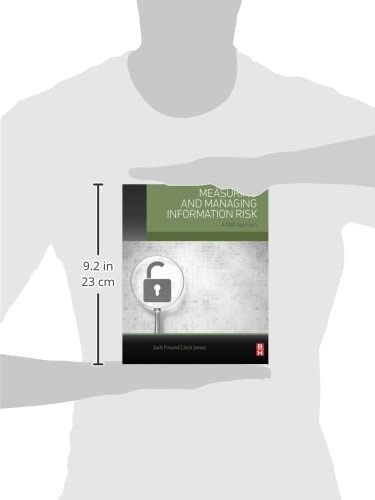
Buy Measuring and Managing Information Risk: A FAIR Approach by Freund, Jack, Jones, Jack online on desertcart.ae at best prices. ✓ Fast and free shipping ✓ free returns ✓ cash on delivery available on eligible purchase. Review: Great way to break down InfoSec Risks into tangible impacts and provide credible articulations of risk. A much needed move away from pure prescriptive best practice controls (implicit risk management) to focused controls to assets that matter most. (Explicit risk management). Review: In a world where seemingly everything is oversold, this is the rare exception that is undersold. The title succinctly states, without drama, the authors’ broad ambit. They over-deliver. The book is nothing less than a manifesto for quantitative management of information security risk. Consider how radical it is to promise a truly quantitative approach to cyber risk management in a world dominated by numerous qualitative “frameworks,” red-yellow-green heat maps, thousand-item one-size-fits-all questionnaires, subjective and qualitative scales of likelihood and impact, and fake math like “red times green equals yellow”. And then consider how transformational it is to deliver on the promise. Other reviewers have nicely discussed the book’s coverage of the FAIR taxonomy. Suffice it to say that MMIR is your best friend in understanding the Open Group FAIR standards. Freund and Jones bring a potentially dry subject alive with many “Talking About Risk” sidebars that tell of their experience with FAIR methods in practice. These war stories make the content accessible and relevant. I especially appreciate the authors’ informal style that is conversational without being verbose and humorous without being patronizing or cute. What the war stories leave out chapter 8 fills in with numerous example analyses. A worked example is better than a thousand war stories. If giving a thorough rationale for and introduction to FAIR were all that MMIR did, it would be worth its weight in gold. But wait! There’s more! It’s the “managing” part, chapters 11-14, that constitutes another breakthrough beyond FAIR. There Freund and Jones begin laying out (one senses it is a work in progress) a risk management ontology, built on the FAIR risk measurement ontology. In rethinking the classification of controls in the context of threat event frequency, vulnerability, and loss mitigation, they provide ways to assess and – yikes! – quantify the potential value of control improvements, in isolation or in combination. This gives the CISO the beginning of a way to manage the control environment, not just the threats. But controls not consistently adhered to are both false comfort and all too common. Therefore F&J suggest that variance in the application of controls is perhaps the single most important set of infosec management metrics. As the old saw goes, if you cannot measure it you cannot manage it, and if you do not know how well your controls are operating on a continuing basis, then what confidence can you have in the millions of dollars invested in technology and staff? Which brings us to metrics. It is perhaps not surprising that a methodology based on quantitative analysis lends itself to meaningful metrics. F&J offer many concrete suggestions far superior to the grab-bag of metrics found in vendor dashboards (measure what’s cheap and looks cool) and other books. These are real metrics that the CISO can use to … manage risk. And managing risk is really why we do all this stuff. Making good decisions on both operational and strategic levels requires good data derived from reliable instruments and methods. It is in managing risk that MMIR is truly seminal and profound. If they do another edition Freund and Jones should consider adding a subtitle, “The CISO’s Bible,” because CISOs will find themselves coming back to it time and again. Or maybe that is the next book.
| Best Sellers Rank | #183,546 in Books ( See Top 100 in Books ) #135 in Business Information Management #394 in Computer Security & Encryption #2,269 in Business Leadership & Motivation |
| Customer reviews | 4.5 4.5 out of 5 stars (171) |
| Dimensions | 19.05 x 2.36 x 23.5 cm |
| Edition | Standard Edition |
| ISBN-10 | 0124202314 |
| ISBN-13 | 978-0124202313 |
| Item weight | 853 g |
| Language | English |
| Print length | 408 pages |
| Publication date | 26 August 2014 |
| Publisher | Butterworth-Heinemann |
W**W
Great way to break down InfoSec Risks into tangible impacts and provide credible articulations of risk. A much needed move away from pure prescriptive best practice controls (implicit risk management) to focused controls to assets that matter most. (Explicit risk management).
S**E
In a world where seemingly everything is oversold, this is the rare exception that is undersold. The title succinctly states, without drama, the authors’ broad ambit. They over-deliver. The book is nothing less than a manifesto for quantitative management of information security risk. Consider how radical it is to promise a truly quantitative approach to cyber risk management in a world dominated by numerous qualitative “frameworks,” red-yellow-green heat maps, thousand-item one-size-fits-all questionnaires, subjective and qualitative scales of likelihood and impact, and fake math like “red times green equals yellow”. And then consider how transformational it is to deliver on the promise. Other reviewers have nicely discussed the book’s coverage of the FAIR taxonomy. Suffice it to say that MMIR is your best friend in understanding the Open Group FAIR standards. Freund and Jones bring a potentially dry subject alive with many “Talking About Risk” sidebars that tell of their experience with FAIR methods in practice. These war stories make the content accessible and relevant. I especially appreciate the authors’ informal style that is conversational without being verbose and humorous without being patronizing or cute. What the war stories leave out chapter 8 fills in with numerous example analyses. A worked example is better than a thousand war stories. If giving a thorough rationale for and introduction to FAIR were all that MMIR did, it would be worth its weight in gold. But wait! There’s more! It’s the “managing” part, chapters 11-14, that constitutes another breakthrough beyond FAIR. There Freund and Jones begin laying out (one senses it is a work in progress) a risk management ontology, built on the FAIR risk measurement ontology. In rethinking the classification of controls in the context of threat event frequency, vulnerability, and loss mitigation, they provide ways to assess and – yikes! – quantify the potential value of control improvements, in isolation or in combination. This gives the CISO the beginning of a way to manage the control environment, not just the threats. But controls not consistently adhered to are both false comfort and all too common. Therefore F&J suggest that variance in the application of controls is perhaps the single most important set of infosec management metrics. As the old saw goes, if you cannot measure it you cannot manage it, and if you do not know how well your controls are operating on a continuing basis, then what confidence can you have in the millions of dollars invested in technology and staff? Which brings us to metrics. It is perhaps not surprising that a methodology based on quantitative analysis lends itself to meaningful metrics. F&J offer many concrete suggestions far superior to the grab-bag of metrics found in vendor dashboards (measure what’s cheap and looks cool) and other books. These are real metrics that the CISO can use to … manage risk. And managing risk is really why we do all this stuff. Making good decisions on both operational and strategic levels requires good data derived from reliable instruments and methods. It is in managing risk that MMIR is truly seminal and profound. If they do another edition Freund and Jones should consider adding a subtitle, “The CISO’s Bible,” because CISOs will find themselves coming back to it time and again. Or maybe that is the next book.
M**R
Reading the book is a start, but it is not really helpful. Yes, certain information are supplemented to the free material that can be found on the internet. Here are my main points, why the book is just partially useful: 1. Ok, it is a good point that it is not a book supposed to teach Monte-Carlo-simulations. I get this part. There are good study materials that do the job. But, and this is the big but, there is no explanation or any kind of useful information on how the variables interact from a mathematical viewpoint. Knowing this would allow to program it yourself, for example with python or r. Of course, understanding the math behind Monte-Carlo-simulations and how they work, it is possible to come with a solution (your solution). But that is my point, you must came up with the (your) solution, it is no shown or descripted in the book. Therefore you cannot be sure whether you “solution” on how you have interpreted the FAIR model is somewhat right or not. 2. The book is just to “hook” you up. In order to go further you need the FAIR training. Many information bits are missing in the book, preventing you to actually using it. I know that because of my “aha” moments during “a product” presentation by a certain company, offering there FAIR “Tool”. During the presentation, certain aspects on how to use FAIR become clearer. Reading the book is not helpful to actually use FAIR in a useful manner. In order to do that (well guess what, yes that’s right!) you need the offered training, provided (guess again) by the same company, that is behind FAIR (yes a company, check out who is behind the training and FAIR, too!). The book is therefore only partially useful, more to hook you up, even if you do understand Monte-Carlo-simulations, so do not expect too much from the book.
K**N
A great book! I bought this after hearing Jack Jones speak at a conference in October, and it has changed the way I look at risk, for our own company and those we help
D**E
This is more a branding exercise for a lexicon set and RiskLens software than a real treatise on how to quantify cyber risk. The only mention of probability distributions gives a perplexing description. The principle is good - leading people through the things they should consider when evaluating risk, but after that it turns to a very prescriptive method that does not allow for non-financial risks, or mitigations, etc.
Trustpilot
Hace 1 día
Hace 5 días