We remain fully operational. Our teams are working around the clock to ensure your deliveries continue safely.

Descargar la aplicación


Servicios al cliente
Sobre nosotros
Copyright © 2025 Desertcart Holdings Limited
Descargar la aplicación
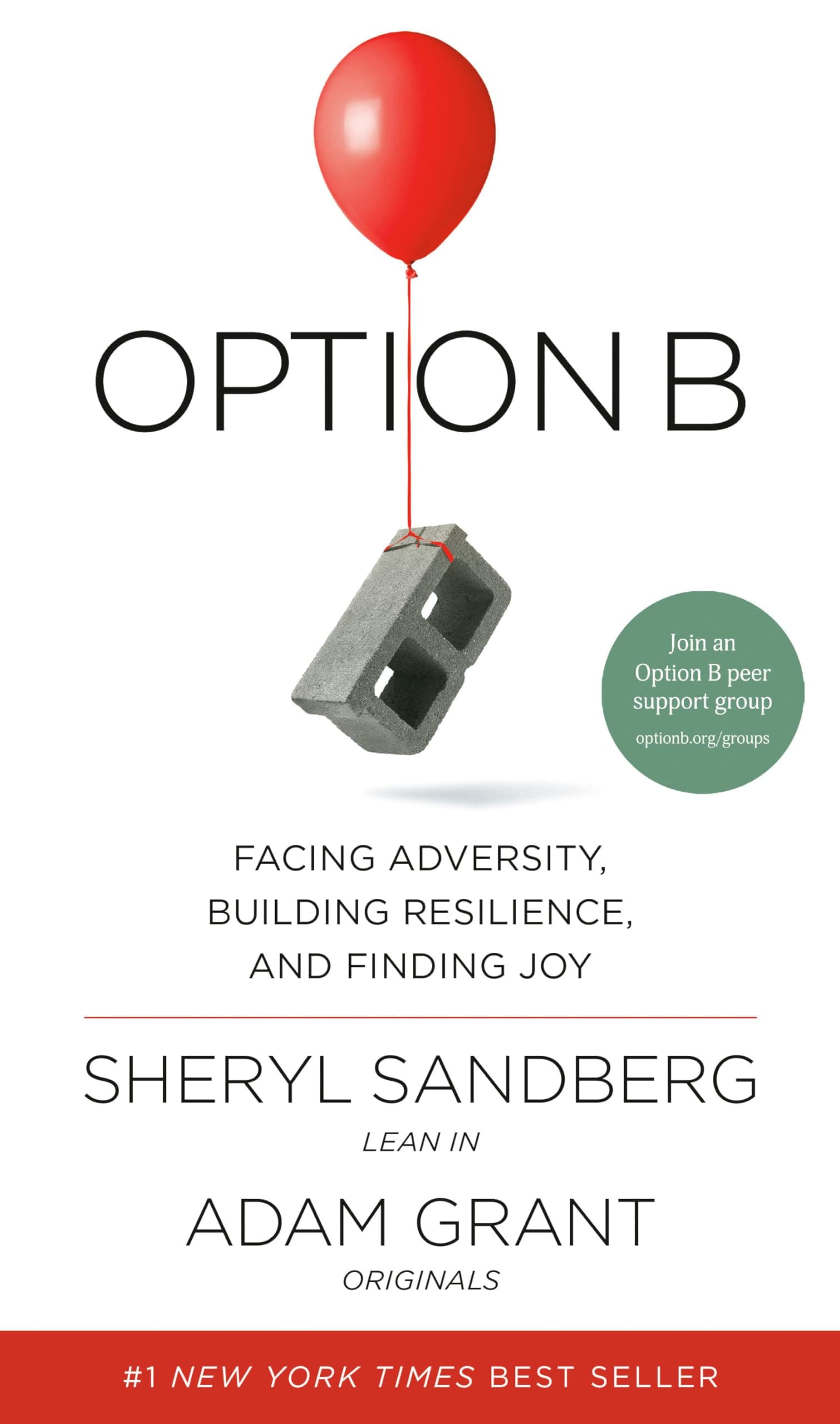
💪 Turn adversity into your greatest comeback story!
Option B is a bestselling, research-driven book by Sheryl Sandberg and Adam Grant that offers a compassionate, practical roadmap to overcoming grief and building resilience. With 175 endnotes supporting its insights, it combines personal narrative and scientific rigor to empower readers—especially professionals and parents—to transform hardship into growth and joy.


| Best Sellers Rank | #26,220 in Books ( See Top 100 in Books ) #52 in Love & Loss #166 in Business Motivation & Self-Improvement (Books) #173 in Motivational Management & Leadership |
| Customer Reviews | 4.4 out of 5 stars 7,995 Reviews |
L**E
Masterpiece - yes, masterpiece is, for me, the only word for this book
Option B is one of THE most absorbing books I’ve ever read. 1. Option B is so well written, absorbing and warm, it could make anyone grieving feel less lonely – I know it did me. I have one child who has very significant special needs, and both my parents died expectantly many years ago. I miss them every single day. I’ve never read anything like Option B that has helped me acknowledge these challenges. I’m amazed by how a book could validate my feelings of loss – for what might have been – while also encouraging me to consider what is possible. Option B is a beautiful, persuasive call to action, honoring our sadness without allowing those feelings to overwhelm us. In the immediate hours after finishing Option B, I began to think it was possible not just to resist feelings of despair but how to become stronger. You can’t manufacture hope. You can’t dictate emotion. You just have to feel it, and I urge anyone who is staggered by grieving to read Option B as soon as you can. 2. Option B teaches us about resilience. I thought I understood resilience, but I didn’t know nearly as much as I thought. Perseverance, I learned, is not simply a random trait, but it can be discovered and nurtured. That’s a powerful thought, and a reminder that this book has so much density of goodness. 3. The theory of Option B is fascinating – as I understand it, that is Grant’s domain, the research. In addition to teaching us about what resilience really is, Option B contends that everyone actually can become more resilient. Looking through all the endnotes (175 of them), I am grateful that Grant sorted through this research (much of it is his or his colleagues) and that he and Sandberg wove it into the narrative. I want to read many of the sources in the endnotes, learn more, and continue on this journey. Oh my God – who can make readers want to read endnotes! These brilliant thinkers and doers can. 4. Option B is also a stunning parenting book and a wonderful way to look in the mirror. While I thought this was going to be a book about grief, it was far more. I felt so much relief reading such practical advice about children and grief and children and loss and children and doing what will help children grow rather than just what will make me feel better as a parent. 5. Option B really teaches SO much important stuff in such a kind way. For example, I’m one of those many parents who thought they understood Carol Dweck’s “mindset” work. I now get that I’m just at the start of this. And Sandberg and Grant help us without making us feel stupid or inadequate as some other parenting books do (though not by design of course). So many people like me will be able to become better parents and workers and friends from Option B. It’s like the authors both have modeled all this amazing stuff for the world through this remarkable page-turner – by telling us Sheryl’s story. How incredible the degree to which Option B just helped me identify changeable stuff in the last two hours. I’m hopeful about changing my behavior now that I see what can come of it, especially for my children, and the rest of my family. Thank you to the authors for opening this remarkable window into resilience and for providing so much research about it. I was so moved that Sandberg could be so brave and share so much about her husband Dave’s death in the name of teaching others. Reading Option B (and I’ve been reading it nonstop since I got it) makes me understand how I can be a better person. Thank you to the authors for making this possible and for writing this absolutely arresting book. It's a tour de force - get it as soon as you can! And get it for someone who you think is grieving, either in the traditional sense, or maybe very non-traditional sense.
M**X
The way the book is written is easy to read and I think really makes the reader ...
I had to read this book for an HR class. After reading this book, I feel as if the stories brought out in this book can help others through hard times. The way the book is written is easy to read and I think really makes the reader think about life and how to handle tough situations. The Author's story is humbling as she was thrust into a tough position. She had many hard decisions that needed to be made. Instead of just letting life go by, she was strong and made something out of the tragedy. Great book and I would recommend others read it. Even an HR professional could recommend this book to employees as it really is very good at potential situations and dealing with these situations.
L**I
If life has devastated you and you’ve suffered like hell, this book is for you
Not every person has suffered trauma or devastation in their lives. For those who have not, it’s not over yet, and this is a not so gentle world we are living in. Not a wish for misfortune, just a heads up to not be surprised if it happens to you. You will see the world in a different way. I can tell you that. This book is about grief, pain, adversity, and suffering. It is told as a true story narrative of Sheryl Sandberg’s loss of her husband, the father of her children. The co-author, Adam Grant is one of many people who encourage her along the way as she processes the grief of her loss. His advice and counseling is throughout the book. In the first pages she writes of how she met her husband, and of the magic of their relationship and their family. Then she describes finding him collapsed at a gym while they were on vacation in Mexico. He dies shortly thereafter. That sets the stage for what will follow. You are taken through her journey through the pain of telling her children their father is dead, and of countless moments in her day to day life that presented a new challenge. Littered throughout the book are pieces of advice and insights from people in her life, and also brief descriptions of relevant scientific research about how people grieve and recover from trauma. The book has an overall uplifting tone, and a sense of possibility and optimism about the prospects life offers after a tragic loss. This book is not for everyone. Some people have had fortunate circumstances for their entire lives. If you think you’ve got it hard because you started out in life with only “a small loan of a million dollars”, not much here will resonate. But if you’re a survivor of child abuse, terrorist attacks, domestic violence, or if you lost someone you love, or if you’ve been devastated and destroyed in some other way, I recommend this. I felt a genuine connection to the author’s story and it was enlightening and therapeutic. The book’s name “Option B” is meant to mean the option we didn’t plan for. Option A was to not have your father die while you were young, or have your children’s father or mother die, or be abused by priests, or have drug addiction pour devastation all over your life, or get date raped by that person you so believed in. Since Option A isn’t possible for some of us, and we will never get to go back in time to change it, we have to make the most of Option B. In this author’s case, Option B was to go on living and make the most of life without her husband. For you Option B may be different, but there are common threads to how we react to grief or trauma. I got my $16 out of this book, and then some, and I hope you do to.
C**P
AND FINDING JOY, you could say that I felt connected to ...
Given that I highlighted a passage in almost every other chapter in Sheryl Sandberg’s OPTION B: FACING ADVERSITY, BUILDING RESILIENCE, AND FINDING JOY, you could say that I felt connected to her and pretty much everything that she had to say. While I haven’t lost a spouse and certainly my life was not upended like hers was, I unfortunately know grief, and it has impacted me in ways that I didn’t see coming and had a hard time coping with it. There are two major points in the book that Sandberg addressed that I felt especially comforted by. By comfort, I mean validated. But first, I want to say to those who might think that you have to be suffering from the grief of losing a spouse to want to read this book or to gain any insight from it, it’s not the case. Not only is this book not exclusive to this particular group or to those grieving or those having grieved in the past for anyone, whether a parent, sibling, or close friend, it is for anyone who has suffered a tragedy such as a trauma, disease, divorce, or other life change that has altered their existence. Together with a friend, who is a psychologist, Adam Grant, who helped Sandberg after her husband died, they co-wrote about feelings that you experience, how to ask for what you need from family and friends, how to resume life as you know it in a new world as life as it is now, along with sharing numerous cases of those who have suffered the loss of a loved one, as well as those who have endured terrible tragedies of other kinds. Sandberg, naturally writes about how challenging it was just to come to terms with the sudden loss of her husband and how she was going to explain the news to her young children. How they were going to get through the funeral, how would she, this strong woman who wrote about co-parenting and working in this modern world, do the same as a single parent, how she would face her colleagues at work, when was the right time to go back to work. So many unknowns. Her new world was so unfamiliar. The things that struck me were her feelings about how isolated she felt. She has a big extended family, including her husband’s. Many friends. Many work friends. Yet, she felt alone. People were scared to talk to her. Or if they asked how she was doing, they didn’t want to hear that she was not ok. It was ‘depressing.’ Asking how are you doing, is not really inquiring about the person on a personal level. You know they are not ok. Try to phrase it to the here and now. How did you get through today? Many people offer to do something but not many just do it. When you lose a loved one, she writes, and this is so true, don’t say “What can I do for you?” Just do something. Leave food for the person’s family so they don’t have to think about cooking, send some beautiful flowers, bring an uplifting book, take their kids out if they are up for it, so that your friend can rest, anything even taking on the most mundane task, just something that shows you care, that they didn’t have to ask for. Sandberg talks about a friend of a friend who lost a loved one and a friend showed up every day in the lobby of his building and asked what he didn’t want on his burger. He wasn’t imposing, wasn’t asking to see his friend, just let him know that he was bringing him lunch. In the past, before I experienced grief first-hand, I am sure that I was guilty of asking the too general “how are you?” and “what can I do for you?” without ill intentions, but because I didn’t know what to do. Sandberg is well aware that most people do not act to hurt you. As she says, “they’re not piling it on,” but that is how it feels. I do know that when I did offer simple acts of kindness, it went a long way, and vice versa. I can remember a time when a dear friend’s father passed away and friends and family gathered at their house. I asked what her father’s favorite dessert was. Blueberry pie. I promptly baked one and brought it over. Her mother told me numerous times over the years how comforting that was to her. The same has been done for me after losing my mother. A friend knew that there was a cookie recipe in my mom’s cookbook that was a cookie ‘made with love’ and she sent home a batch in my son’s backpack the week after her funeral. I was so touched and comforted at the same time. I will never forget that gesture of kindness. Another friend, would send me a note every week, just to tell me that she was thinking of me. Having endured much heartache, herself, she knew that once the period of Shiva is over, people don’t often check on you. She continued to check on me and this made me feel not only loved but as if she were hugging me. The day after my father died, I received a text from a good friend, who lives in the city where I do, and offered to come to Chicago, where my father lived. I will never forget how deeply this touched me. To know that a friend would do this for me, without my asking. Just as two of my closest, oldest friends did exactly that, flew across the country to be by my side when my mother passed away, will forever be fixed in my memory and in how I managed the initial shock. This is one way in which we are able to ‘build resilience’. Sandberg shares many of her own stories about how she ‘faced adversity,’ what people have done for her, such as her mother staying at her house for a month, and when she couldn’t be there, her sister-in-law took over. How her boss, yes, Jeff Zuckerberg, and his wife, invited her family to spend time with them on vacation so that they could just get away. When it was time to clean out her husband Dave’s closet, his own mother came to help her. If you or a friend is in need of a relatable book that can show you that you are not alone, that does not tell you what to do but shows you what others have experienced, and that while some pain never goes away, healing can come.
L**N
Important topic that most people don't know about.
I'm not finished but I wanted to chime in right away. I'm a Licensed Professional Counselor, part-time teacher at Colorado Christian University, and published author. I live in the Columbine neighborhood and worked with police and firefighters at Ground Zero so healing from trauma is of huge interest to me. I've spent the last four years researching and writing about the powerful topic of Posttraumatic Growth. (I wish I could tell you the title of my book but it remains in the hands of agents and publishers. I hope it gets to be born someday.) In the meantime I want to shout hurray and yeehaw on almost every single page of this book. The smashing point of this book: All people can heal, and some people are even launched to a more meaningful place after experiencing trauma; clinical research shows how. Growth is actually more common than the much better known and far better studied posttraumatic stress disorder (PTSD). The challenge is to see the opportunity presented by seismic events. After trauma, people need hope. In the aftermath of the tragedy, people need to know there is something better. Following a traumatic experience, most people experience a range of problems: Trouble sleeping, nightmares, agitation, flashbacks, emotional numbness, avoiding reminders of the traumatic event, anxiety, anger, guilt, hyper-vigilance, depression, isolation, suicidal tendencies, etc. Until recently the entire discussion of the human response to trauma ended with a summation of the hardships incurred by trauma. But as it turns out, a traumatic event is not simply a hardship to be overcome. Instead, it is transformative. Trauma survivors and their family and friends need to know there is another side to trauma. Strange as it may sound, half of all sufferers emerge from the trauma stronger, more focused, and with a new perspective on their future. In numerous studies, about half of all trauma survivors report positive changes as a result of their experience. Sometimes the changes are small (life has more meaning, or the survivor feels closer to loved ones) and other times they are massive, sending people on new career paths. The worst things that happen to us might put us on a path to the best things that will ever happen to us. A brush with trauma often pushes trauma survivors to face their own mortality and to find a more meaningful and fulfilling understanding of who they are and how they want to live. To be clear, growth does not undo loss, and it does not eliminate adversity. Posttraumatic growth is not the same as an increase in well-being or a decrease in distress. And even for those who do experience growth, suffering is not mitigated in the aftermath of tragedy. Growth may make the pain meaningful and bearable, but it does not deny the hurt. For decades, nearly all the psychological research into trauma and recovery has focused on the debilitating problems that people face, but Option B speaks of the paths people can take to heal from their experiences and discover new meaning in their lives. Just this morning a blog reader wrote to me and said she feels stuck because of her father's suicide many years ago. The first thing I did was tell her about your book. I have been, and will be, recommending this book to friends and clients. Thank you Sheryl and Adam.
P**M
An edifying personal narrative weighed down by too much activist boilerplate.
In some ways this is a welcome account of one person's process through grief after losing her husband. The fact that this person is Sheryl Sandberg needs no discussion; as a top global professional, she's articulate and has the financial and social wherewithal to be able to step back and write generously, since she faces comparatively little risk in doing so. For this reason, the list of topics and the stories about herself and her family resonate and are great to read. Many of the moments that she recounts are edifying and provide much material for thought, reflection, and perhaps even emulation amongst others who are grieving. At moments, it really is a lovely, helpful book to read. And then there are those other moments. I get it—in today's world, we're all supposed to be activists—but Sheryl takes the activist step in every chapter of stepping out of her own story and regaling us with facts, figures, and statistics about the downtrodden (especially women) around the world. These tend to go on for pages, and read like the byline-free newspaper column inches that give "background" on one story or another. Facts, figures, statistics, millions suffer around the world. Facts, figures, statistics, millions suffer around the world. Every time she did this, I was taken out of her story and ended up putting the book down. Then, after a few days, I'd recall something that she'd written about herself and be motivated to start again. We'd get a few pages farther, and then Sheryl isn't talking about Sheryl anymore, or even about grief, but about facts, figures, statistics, and how millions suffer around the world. This three-star review isn't indicative of three-star quality across the board, but of a five-star series of personal reflections, memories, and narratives, that are interspersed with a one-star series of what amount to posts from DailyKos or (to be a little kinder) The Atlantic. All I wanted to read about was Sheryl. The book would have been half its length and twice as engaging if she'd kept to that.
B**A
We must keep going under any circumstances. Because that's the life.
As far as I know Sheryl Sandberg through her ‘Lean In’, she seemed to be invincible. She’s come from a good family and been endowed a great talent in her field. To make it better, she has a pretty good sense of catching a perfect opportunity to achieve her goal. As for me, she seemed to be the exemplary of a successful woman in the western society. The thing is that I felt disconnected with her. But, but, but... I happen to come to pick up ‘Option B’ fortunately and her honest confession of her personal loss has made me humble and reach out to more efficient strategies to address my tough popping up issues. I don’t say that this book has magical power to take care of everything in demanding situation. But I assure that you’ll be able to build and strengthen your resilient muscle in dealing with a bunch of setbacks in your daily life. Plus we can overhear Sheryl’s stunning memories with her late husband. Life cannot be woven into the integral without indispensable mortality which based on the loss of our loved ones’. Then we have to get though that gracefully as possible as we can. In this sense, she offers amazing advice worth listening.
S**E
A great read and valuable insight on grief.
Thank you for your amazing openness and honesty in sharing this great loss with us Cheryl! I just lost my beloved best friend, partner and husband a year and a half ago. I related to every words you wrote and every feeling you felt. Having the support of loved ones is invaluable. I believe this book is for everyone because it give tremendous insight in to how to be with people who are grieving since everyone is different and needs and wants different things. One of the insights was rather than asking people what they need, which puts the burden on them to come up with something, make suggestions like, "should I pick up your dog and take him for a walk or would you like to join me and do it together?" or "I"m at the grocery can I drop off some food?" "Can I pick up the kids and give you some time or would you like some company, I'm in the neighborhood.?" I so appreciated your openness about regrets like "I should have been with him on that last hike in Mexico rather than walking with my girlfriend." I breathed a sigh and new that everyone had those same kind of regrets that I had when my husband died and that there is no such thing as the perfect wife. I appreciate your saying that because you find someone else does not in any way minimize what you had or negate the pain of the loss. I know that both Dave and Morty (my husband) would want us to be happy.
Trustpilot
Hace 4 días
Hace 3 semanas