We remain fully operational. Our teams are working around the clock to ensure your deliveries continue safely.

Descargar la aplicación


Servicios al cliente
Sobre nosotros
Copyright © 2025 Desertcart Holdings Limited
Descargar la aplicación
📈 Research smarter, design better — don’t get left behind!
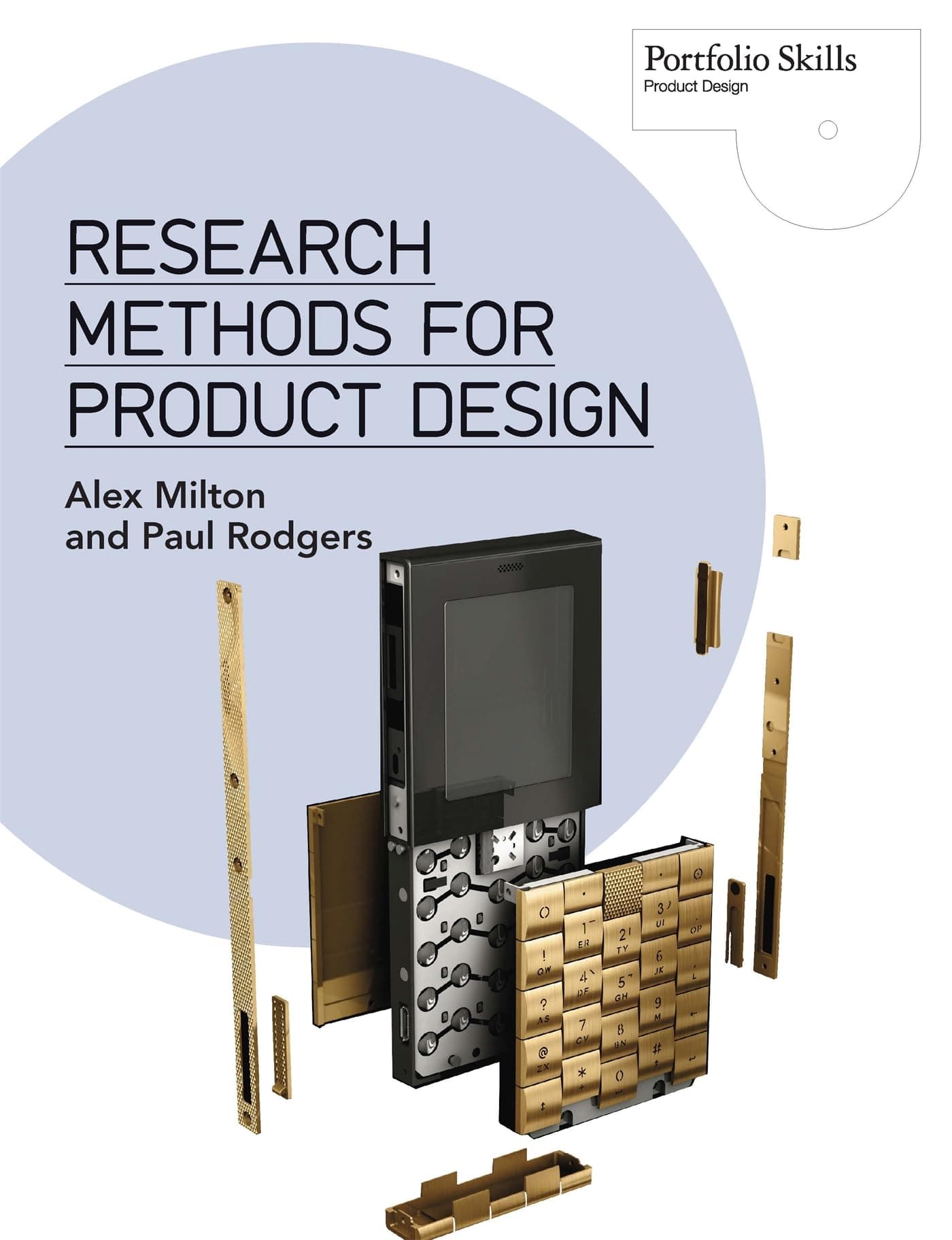
Research Methods for Product Design is a highly rated, curriculum-endorsed guidebook that equips aspiring and professional designers with essential research techniques to understand user needs deeply, enhancing product innovation and portfolio quality.
| Best Sellers Rank | 537,246 in Books ( See Top 100 in Books ) 402 in Under- & Postgraduate Student Guides 2,958 in Commercial Graphic Design |
| Customer reviews | 4.7 4.7 out of 5 stars (100) |
| Dimensions | 22.23 x 1.91 x 28.58 cm |
| Edition | Illustrated |
| ISBN-10 | 1780673027 |
| ISBN-13 | 978-1780673028 |
| Item weight | 745 g |
| Language | English |
| Print length | 192 pages |
| Publication date | 29 Oct. 2013 |
| Publisher | Laurence King Publishing |
K**N
budding designer? Buy it!
The book is part of the mandatory curriculum in my design degree and for good reason. If you want to know how to make better products by researching and understanding peoples needs vs. their wants this is the book to guide you.
D**Y
Five Stars
Bought for someone on a deign course - what they wanted / needed
B**G
Five Stars
Gift for someone doing design degree. It was well recieved.
J**E
Five Stars
present appreciated
O**R
Admittedly I've only skimmed through the book as it a ...
Admittedly I've only skimmed through the book as it a reference book but it does cover all that you'd need to product conception, design and development. It spends a lot of time going through the processes needed to determine if a product concept is viable. I bought it as peripheral reading to a design module I'll be doing with the OU.
A**N
Five Stars
excellent resource
G**Y
Five Stars
Excellent
W**A
Love it!
Amazing!
D**G
The book provide insight of how effective research benefits designer. Recommend to refers with relevant work field.
C**N
O livro e de ótima qualidade. O autor consegue tratar de forma bastante didática de uma metodologia muito interessante e atual.
A**R
No in depth information.Felt more like a magazine.
E**F
I'm surprised that no one has reviewed this book previously-- I bought a copy when it was published, nearly two years ago, and have referred to it frequently for ideas and reminders. The authors have compiled a thorough overview of more than 50 specific research methods that can be applied by students, teachers, and practitioners of product design, and many of the methods are relevant to systems design and service design contexts also. The methodologies are organized in practical categories (chapters) with titles like "Looking," "Asking," "Making," and "Testing." The opening chapter is a succinct explanation of and argument for the importance of conducting iterative (recurring) research as an element of product design, and the final chapter focuses on effectively communicating the results of one's research. Each chapter ends with two brief (2-page) case studies that explain how companies like Ideo, Adidas, and Dyson use research to assist "real world" product design. Also appended to each chapter are two tutorials (again, 2 pages each), covering a few more details of selected research techniques, such as "How to conduct an ethnographic study" and "How to write a great questionnaire." While the tutorials won't help a raw beginner to master a technique, they are excellent starting points. If used in conjunction with other, more detailed resources (or in a classroom with support from an instructor), these tutorials-- as well as the other descriptions of research methods-- should help designers avoid common errors and establish positive starting points for useful research. This book is not, in my view, a stand-alone replacement for a comprehensive research methods class... but as the authors point out, "research methods are a somewhat neglected subject" in some undergraduate design curricula. Therefore, I appreciate that Professors Milton and Rodgers have assembled this informative and readable explanation of numerous research techniques. They achieved their goal of providing "comprehensive, relevant, and visually rich insight into the world of research methods" and I hope their text will inspire many students of design (and working designers) to seek even deeper understanding of the benefits of product and audience research.
S**.
I received this book today. It offers a very structured overview of the design process, which might be helpful for industrial / product design students. However this book also was packed horribly. Instead of using a special cardboard for books, this item came in a plastic bag. Very frustrating because the cover has crinkles.
Trustpilot
Hace 2 semanas
Hace 2 meses