We remain fully operational. Our teams are working around the clock to ensure your deliveries continue safely.

Descargar la aplicación


Servicios al cliente
Sobre nosotros
Copyright © 2025 Desertcart Holdings Limited
Descargar la aplicación

📖 Refresh your brain, impress your circle!
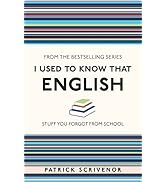
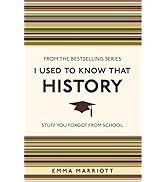
‘I Used to Know That’ is a bestselling, well-organized reference book that refreshes forgotten school knowledge with humor and clarity. Perfect for professionals seeking a quick, reliable memory boost, it’s highly rated and ships fast from the UK.











| Best Sellers Rank | 37,838 in Books ( See Top 100 in Books ) 115 in Trivia Collections 146 in Quiz Questions 196 in Encyclopaedias (Books) |
| Customer Reviews | 4.3 out of 5 stars 735 Reviews |
K**R
You Forget How Much You Have Forgotten
This book is so good at achieving what it says on the front cover that I consider it to be a reference work. It's a concise guide to all the stuff you learned at school and have since forgotten. I had maybe one or two niggling issues with the author's choice of what to include - I would perhaps have skipped one or two things in favour of adding in something else, but overall it is a really broad, well laid out, comprehensive guide to the basics of everything. It works very well as a layman's guide as well, if you are completely unfamiliar with a subject. It tells you the important and interesting bits, joins up the dots, and skips all the other boring crap. I have actually referred back to this more than once to check something! What a great little book. Would recommend downloading, reading and keeping this for when you forget it all again!
J**L
ENJOYABLE
I enjoyed this book very much as it took me back to my formative years and reminded me of school and all the people I knew then but haven't seen for years . I was surprised at the way I could recall some thingsvery easily whilst others were more difficult . I liked the little humourous comments along the way
D**R
Good Read
An interesting and informative little read, has all the bits that you should have remembered from school but probably don't. Easy reading style and good fun too!
B**S
Sometimes detailed; sometimes sloppy
I was looking forward to having my memories of school work refreshed with some maths and science formulae along with a host of other things that I'd forgotten over the years and there are certainly SOME parts of this book that live up to its promise. For instance, although I got Higher English and an `A' pass in my `O' Grade, I was never told about parts of speech like metonymy (which, on reflection, seems a bit strange). As for English literature, I remain unconvinced that there are any hard and fast rules about what makes a great novel or novelist; the reader either likes it or not, and it is in literature that the final "product" can be improved by the writer's imagination. However, imagination should have no place in the sciences but unfortunately, in spite of the author crediting "Bob" for "vetting the maths and science chapters", it isn't error-free. In fact, the maths and science chapters contain a LOT of mistakes. The author states that the terms "metric" and "S.I." are equivalent or interchangeable. Metric weights and measures are similar to S.I. (Systeme International d'Unites), but the latter is the world's most commonly used system of measurement both in commerce and science. S.I. is a system of seven base units that can be multiplied or divided (in increments of ten) to yield other units that may be more appropriate in certain circumstances. It is possibly this use of the factor of ten that tends to cause confusion among many. In her section discussing measurements, she says that "The pro-imperial way [of comparing the two systems] is that imperial units all used to mean something sensible, e.g. the foot was the length of a man's foot, the yard was the distance from his nose to the tip of his outstretched arm, etc." That would mean that, in days gone by, everyone (or every man) must have had feet exactly the same size - obviously preposterous. This could be countered by stating that the original idea for determining the length of a metre was that it should be one ten-millionth of the distance between the North Pole and the equator at sea level (at least, surely, as sensible an idea as its imperial equivalent being the distance from a man's nose to the tip of his outstretched arm), but it has been refined over the years as our knowledge of science improves. Since 1983, it is defined as the length of the path travelled by light in vacuum in 1/ 299,792,458 of a second. * The Systeme International is gradually being introduced to almost every country on Earth except the U.S.A., Liberia and Myanmar (!) * To say that "0.25 and .25 are the same thing" is sloppy in the extreme. It may be acceptable for this to be used in speech between two people, but the zero should not be omitted when writing the figure. The author writes: "milligrams - unless you're a pharmacist or something of that sort, you don't often need them. Something? Hmm. It's my personal opinion that it would do most people no harm to know the difference between large volumes of milligrams (running into several grams of certain drugs they may be taking each day) and very low doses of other drugs (sometimes measured in micrograms, or millionths of a gram). Ms. Taggart should remember that we ALL tend to be taking some drugs these days, even if only occasionally. Her definition of a mole (in chemistry) is vague ("A mole contains the same number of particles as there are in 12g of carbon-12 atoms - that is, 6.022 x 10^23 particles.") My chemistry teacher said that a mole of a particular substance was its atomic or molecular weight expressed in grams, but maybe that's the same thing. It's certainly more easily remembered. She really gets a bit confused the following when discussing synthesised elements: "Element 117, which will be called Ununseptium...", yet element 117 is shown on a table with the abbreviation "Uuo" and the name Ununoctium. The former explanation looks like the correct one. When discussing the states of water, she describes steam as a gas instead of a vapour. Since I haven't a clue about history, I can't say much about the history section in the book other than it concentrates a lot on English (as ever) monarchs and American presidents. That's probably doing it a disservice since it would be impossible to cram the work of a secondary school into one short book. Likewise with geography, although I did notice that she has described Australia (a country) as a "continent". I think you'll find that Australia is part of the continent called, alternatively, Australasia or Oceania. I haven't even got to the last 9% of the book - entitled "General Studies" (things like religions, wonders of the world and mythology, but I'd say that the more glaring errors should have been corrected even though she's had a fair stab at a very wide-ranging subject. * Wikipedia
A**R
Nice book and made to look old fashioned
With my mother-in-law rambling on and taking the long way around telling her stories this was ideal. When telling her stories she and veers off subject, many times forgetting what the point of the conversation in the first place. With the added bonus, sometimes of losing her thread, she sometimes forgets crucial details. For example a long winded joke and the punch line. Or a stunning place she wants to visit, but forgetting the location that was on a programme she was watching. She has been tested for memory loss, but despite not being a spring chicken passes all memory loss tests. It has therefore been established that this is just her and how she tells her stories/things she has seen on TV. This is perfect as recently she has decided to say that as a more experienced person she has better knowledge than me and my wife. Thanks to being an elder person in society she is a fountain of knowledge, just can never remember it! When she attempts to tell us, she forgets crucial details, mostly due to telling things the long way around. (Much like this review appears to have done!)
M**N
I did not learn all of it
I bought the Kindle version of this book and now realise I made a mistake. I have another of these books but as a 'book'. These are books that you can either read 'cover to cover' or as I prefer to pick up and delve when I have a couple of minutes or more to spare. But with a Kindle you have go keep going back to the index a choosing a subject if you want to do that. I have not read it all, but what I have read is very good. Some of the things I did not learn at school Like the sciences are interesting but only just.
M**D
I remember when we did that at school
Fascinating little book .I am frequently picking it up to have a browse, it also evokes memories of school, as I remember when I learned a particular topic and some of the teachers who taught me. It has also come in useful helping me to remember items when I am helping my grandchildren with schoolwork. All in all a cracking little book, so much so, that I have purchased two others in the series.
J**R
Another great volume from a great series!
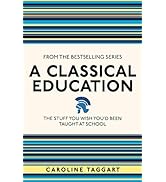
I love this series of books from Caroline Taggart (I also have 'A Classical Education' and 'My Grammar and I (or should that be me)'). Quite simply they do exactly as their titles suggest: serve as a very useful aide-memoire for a plethora of essential-but-oft-forgotten knowledge acquired at school but which has become shoved to the back of our consciousness in the intervening years! AND, they achieve this feat with HUMOUR! At times, they are as funny as the priceless '1066 and All That' with a vital difference: the information here is RELIABLE!!!! :-)
Trustpilot
Hace 1 mes
Hace 3 días