We remain fully operational. Our teams are working around the clock to ensure your deliveries continue safely.

Descargar la aplicación


Servicios al cliente
Sobre nosotros
Copyright © 2025 Desertcart Holdings Limited
Descargar la aplicación

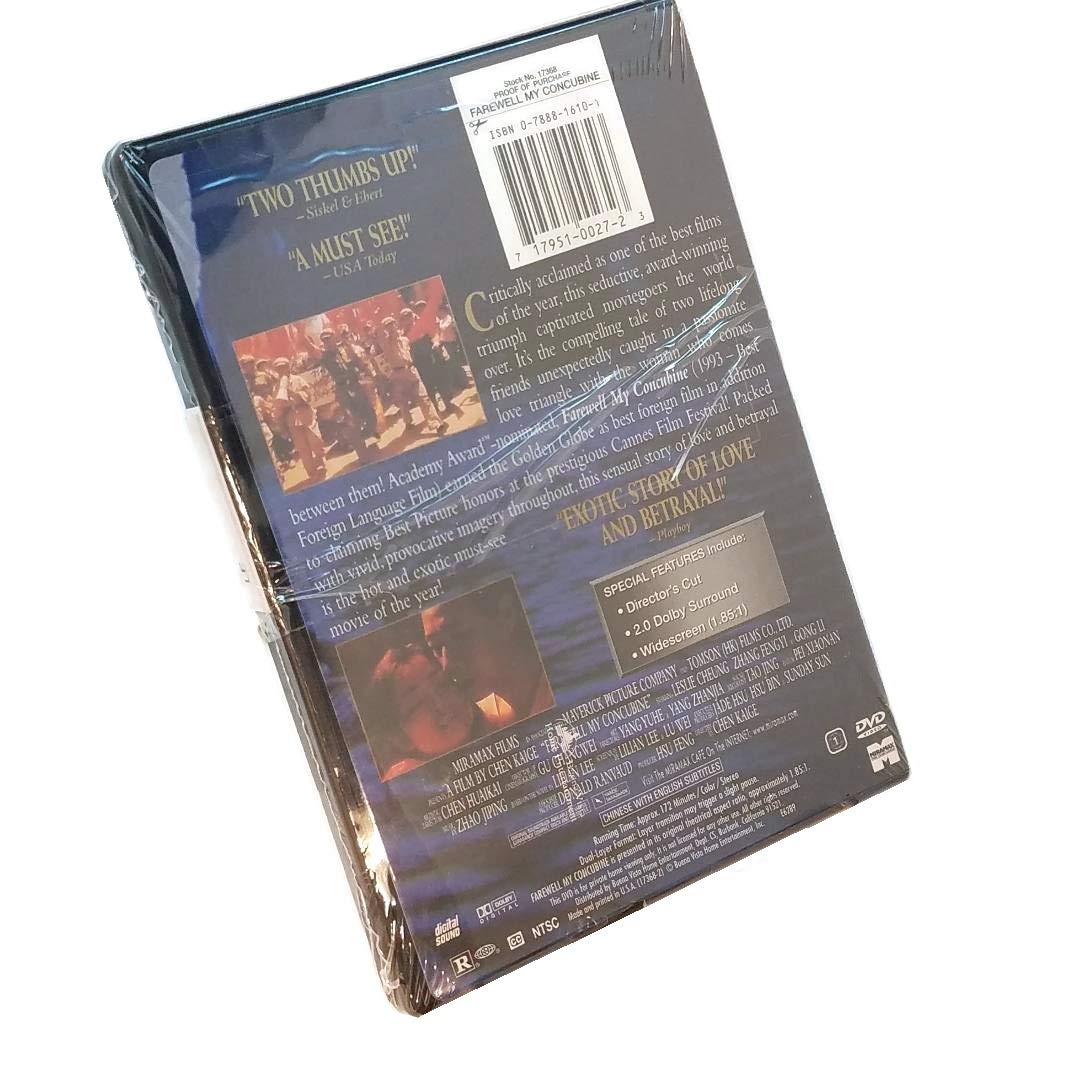
Critically acclaimed as one of the best films of the year, this seductive, award-winning triumph captivated moviegoers the world over. It's the compelling tale of two lifelong friends unexpectedly caught in a passionate love triangle with the woman who comes between them! Academy Award(R)-nominated, FAREWELL MY CONCUBINE (1993 -- Best Foreign Language Film) earned the Golden Globe as Best Foreign Film in addition to claiming Best Picture honors at the prestigious Cannes Film Festival! Packed with vivid, provocative imagery throughout, this sensual story of love and betrayal is the hot and exotic must-see movie of the year! Review: One of the great films of China - Not since Lawrence of Arabia has a film so successfully fused the personal with the epic, the grand drama of history with the melodrama of personal lives. And I use the word "melodrama" in the best sense - not as a pejorative for excessive affect, but in its older meaning, to connote an emotional story distilled to its most potent, primal form. Although it is easy (and not entirely incorrect) to assign significance to the subtext of sexual repression in China (sex and sexual abuse in many forms underlies nearly every important development in the film), it is only a small part of a much larger design. Modern China's identity crisis runs far deeper than the film's surface themes. It is a reflection of a larger human failing to find social and moral codes that work. From before the Second World War to the aftermath of the Cultural Revolution, China and her people were whipsawed between various brands of hedonism and oppression, individualism with its attendant chaos and tyrannical conformity with its rigidly enforced social order. In the Dickensian story of two orphaned boys forced into servitude with a Beijing Opera troupe, it finds an uncanny metaphor in their struggle for personal identity, and against the repression of their own natures imposed by both internal and external forces. Shitou is reared from childhood to play the king in the highly stylized traditional opera from which the film takes its title. He is by nature a sensualist, drinker, womanizer, and scoundrel. He has also been molded, initially quite against his will, in the role of a celebrity - a beloved star and public face of China's high culture. His girlfriend Juxian (Gong Li) is a prostitute, to whom he almost accidentally proposes, making her (and himself) "legitimate" to the masses when he marries her. Douzi is his acting partner, a homosexual who plays the role of the king's suicidal concubine in the same opera. As in Elizabethan England, only men were traditionally allowed on-stage, so, in a sense, Douzi's role was also forced upon him - although the film strongly suggests that his sexuality was more a matter of nature than nurture (he was born with an extra finger, to symbolize that he was always "different" from the others). Ironically, he must hide his true sexual orientation from an adoring public, even as the unrequited love for his co-star brilliantly informs his performance as the concubine. As we follow the men's struggles throughout China's tumultuous journey into the modern world, it becomes apparent that they have accepted and even embraced the roles that were initially foisted upon them by circumstance. We come to realize that they may very well have chosen them, had they been given the freedom to do so. At the center is the romantic triangle between Shitou, Douzi, and Juxian. All of which brilliantly sets the stage for one of the saddest third acts in cinema, in which the lines between free will and determinism, the necessity of circumstance and the will of the inner self, will blur, cross, and cross again. Each of the three main characters will betray and publicly denounce the others in order to survive, will claim allegiance to one revolution or another, and perhaps even mean it for a time, to stay the hands of the revolutionaries, whose shifting ideologies by turns celebrate and threaten each of them. In lesser hands such a story would be trite, morbid, and - well - melodramatic, in the bad sense of the word. But director Chen Kaige has a unique personal connection with the material, in that he denounced his own father during the Cultural Revolution - an act which he bitterly regretted later. It is therefore with sympathy and genuine compassion that he tells his tale, rather than cheap sentiment or maudlin histrionics. When made poorly a tale like this is insufferably turgid, awash with treacly tears. When made well - with care, precision, and truth - it is breathtaking. This is my favorite Chinese film. Review: Obsessions - It didn't take long to get drawn into "Farewell My Concubine". From the beginning, the acting, directing, sets, costumes, and overall majesty of the movie had me convinced that this was time well-spent. I was a little lost initially as I followed the story of two boys in China who suffer through their determined goal to become opera stars. However, as the years of beatings and suffering unfolded in their acting school, I realized just what an obsession that our two main characters had. As the movie progressed, it was interesting how each of the two dealt with their common obsession. To further illustrate this, a third person gets involved in their lives and we see how the three different persons handle their own obsessions; to what extent they will go to preserve or obtain what they want the most. Ultimately, this was the imagery I took away from "Farewell My Concubine". While I did not always accept the outcome of these and other individuals, the movie challenged me to dwell on what I had seen. For me, the additional impact of "Farewell My Concubine" was the portrayal of the history of China from the era of the warlords through the post "Gang of Four" era. With each change in between we are given a telling glimpse of its' impact on the people of China. Of special interest for me was the focus of the various phases of the communist rule such as the initial asumption of power to through the cultural revolution to the near present. I found myself reflecting on "The Last Emperor" and "One Man's Bible". The former, a movie, did a tremendous job of bringing this same history to life but weakened when dealing with Communist China. The latter, a book by Gao Xingjian, focussed primarily of the different phases of the communist rule. "Farewell My Concubine" falls somewhere in between those two for revealing what China went through in the 20th Century. As a history buff, I appreciated that. "Farewell My Concubine" is nearly a 3 hour movie in Chinese with subtitles. I did not think it overly long although I sometimes wondered where it was headed. Perhaps the early days may have stretched out a bit but then I might not have cracked up at the line "Who gave you permission to stand?". Sometimes it's hard to truly appreciate a movie that leaves you with a depressing feeling. One man weathered everything for something that meant so much to him. When he lost that focuss, he lost it all. His loss was our gain.
| ASIN | B00002RAPT |
| Actors | Da Ying, Fengyi Zhang, Leslie Cheung, Li Gong, Qi L |
| Aspect Ratio | 1.85:1 |
| Best Sellers Rank | #82,135 in Movies & TV ( See Top 100 in Movies & TV ) #677 in Foreign Films (Movies & TV) #13,095 in Drama DVDs |
| Customer Reviews | 4.5 4.5 out of 5 stars (417) |
| Director | Kaige Chen |
| Is Discontinued By Manufacturer | No |
| Language | Chinese (Dolby Digital 2.0 Surround) |
| MPAA rating | R (Restricted) |
| Media Format | Color, Letterboxed, NTSC |
| Number of discs | 1 |
| Product Dimensions | 7.5 x 5.38 x 0.6 inches; 4 ounces |
| Release date | December 14, 1999 |
| Run time | 2 hours and 51 minutes |
| Studio | Miramax |
| Subtitles: | English |
| Writers | Bik-Wa Lei, Lillian Lee, Wei Lu |
W**N
One of the great films of China
Not since Lawrence of Arabia has a film so successfully fused the personal with the epic, the grand drama of history with the melodrama of personal lives. And I use the word "melodrama" in the best sense - not as a pejorative for excessive affect, but in its older meaning, to connote an emotional story distilled to its most potent, primal form. Although it is easy (and not entirely incorrect) to assign significance to the subtext of sexual repression in China (sex and sexual abuse in many forms underlies nearly every important development in the film), it is only a small part of a much larger design. Modern China's identity crisis runs far deeper than the film's surface themes. It is a reflection of a larger human failing to find social and moral codes that work. From before the Second World War to the aftermath of the Cultural Revolution, China and her people were whipsawed between various brands of hedonism and oppression, individualism with its attendant chaos and tyrannical conformity with its rigidly enforced social order. In the Dickensian story of two orphaned boys forced into servitude with a Beijing Opera troupe, it finds an uncanny metaphor in their struggle for personal identity, and against the repression of their own natures imposed by both internal and external forces. Shitou is reared from childhood to play the king in the highly stylized traditional opera from which the film takes its title. He is by nature a sensualist, drinker, womanizer, and scoundrel. He has also been molded, initially quite against his will, in the role of a celebrity - a beloved star and public face of China's high culture. His girlfriend Juxian (Gong Li) is a prostitute, to whom he almost accidentally proposes, making her (and himself) "legitimate" to the masses when he marries her. Douzi is his acting partner, a homosexual who plays the role of the king's suicidal concubine in the same opera. As in Elizabethan England, only men were traditionally allowed on-stage, so, in a sense, Douzi's role was also forced upon him - although the film strongly suggests that his sexuality was more a matter of nature than nurture (he was born with an extra finger, to symbolize that he was always "different" from the others). Ironically, he must hide his true sexual orientation from an adoring public, even as the unrequited love for his co-star brilliantly informs his performance as the concubine. As we follow the men's struggles throughout China's tumultuous journey into the modern world, it becomes apparent that they have accepted and even embraced the roles that were initially foisted upon them by circumstance. We come to realize that they may very well have chosen them, had they been given the freedom to do so. At the center is the romantic triangle between Shitou, Douzi, and Juxian. All of which brilliantly sets the stage for one of the saddest third acts in cinema, in which the lines between free will and determinism, the necessity of circumstance and the will of the inner self, will blur, cross, and cross again. Each of the three main characters will betray and publicly denounce the others in order to survive, will claim allegiance to one revolution or another, and perhaps even mean it for a time, to stay the hands of the revolutionaries, whose shifting ideologies by turns celebrate and threaten each of them. In lesser hands such a story would be trite, morbid, and - well - melodramatic, in the bad sense of the word. But director Chen Kaige has a unique personal connection with the material, in that he denounced his own father during the Cultural Revolution - an act which he bitterly regretted later. It is therefore with sympathy and genuine compassion that he tells his tale, rather than cheap sentiment or maudlin histrionics. When made poorly a tale like this is insufferably turgid, awash with treacly tears. When made well - with care, precision, and truth - it is breathtaking. This is my favorite Chinese film.
R**N
Obsessions
It didn't take long to get drawn into "Farewell My Concubine". From the beginning, the acting, directing, sets, costumes, and overall majesty of the movie had me convinced that this was time well-spent. I was a little lost initially as I followed the story of two boys in China who suffer through their determined goal to become opera stars. However, as the years of beatings and suffering unfolded in their acting school, I realized just what an obsession that our two main characters had. As the movie progressed, it was interesting how each of the two dealt with their common obsession. To further illustrate this, a third person gets involved in their lives and we see how the three different persons handle their own obsessions; to what extent they will go to preserve or obtain what they want the most. Ultimately, this was the imagery I took away from "Farewell My Concubine". While I did not always accept the outcome of these and other individuals, the movie challenged me to dwell on what I had seen. For me, the additional impact of "Farewell My Concubine" was the portrayal of the history of China from the era of the warlords through the post "Gang of Four" era. With each change in between we are given a telling glimpse of its' impact on the people of China. Of special interest for me was the focus of the various phases of the communist rule such as the initial asumption of power to through the cultural revolution to the near present. I found myself reflecting on "The Last Emperor" and "One Man's Bible". The former, a movie, did a tremendous job of bringing this same history to life but weakened when dealing with Communist China. The latter, a book by Gao Xingjian, focussed primarily of the different phases of the communist rule. "Farewell My Concubine" falls somewhere in between those two for revealing what China went through in the 20th Century. As a history buff, I appreciated that. "Farewell My Concubine" is nearly a 3 hour movie in Chinese with subtitles. I did not think it overly long although I sometimes wondered where it was headed. Perhaps the early days may have stretched out a bit but then I might not have cracked up at the line "Who gave you permission to stand?". Sometimes it's hard to truly appreciate a movie that leaves you with a depressing feeling. One man weathered everything for something that meant so much to him. When he lost that focuss, he lost it all. His loss was our gain.
G**S
Bittersweet tale, beautifully told
I have loved this film for ages. The only thing I hate is having to buy it again on streaming!!! Part of me realllllly misses my old DVD collection.
A**G
👍🏽
S**K
Le montage est excellent. L'image a été rafraîchie et remasterisée en 4K. Elle n'est pas parfaite, les noirs manquent parfois de profondeur, mais dans l'ensemble, c'est très bon ! C'est un vieux film et il ne faut pas en attendre grand-chose. Le film présente de belles photos et vaut le détour en qualité 4K. Le film est émouvant, parfois intense, parfois magnifique.
W**E
Un drama China muy interesante!
E**H
Ich freue mich sehr ein Exemplar von diesem Film zu bekommen, wovon nur wenige Exemplaren noch gibt und beim keinen Streamen-Platform angeboten wird. Ich muss sehr hohes Preis (50 Euro) bezahlen und beschädigte Produkt akzeptieren aber ich freue mich so sehr es zu bekommen dass ich alles verzeihen kann. Das Film selbst ist ein Klassiker und zeigt China als er in der Nachtkriegszeit durch Bürgerkrieg und Kulturrevolution entwickelt hat. Ich finde die Szenen mit der Misshandlung von den jüngen Darsteller in Peking Opera brutal und schwierig anzuschauen.
J**A
One of the best Chinese movies I have seen. The story is very capturing and touching. the full beauty of opera masks and costumes against the brutality of actors upbringing was remarkable. And spectrum in humanity was shown in the light of recent history of China.
Trustpilot
Hace 1 mes
Hace 2 meses