We remain fully operational. Our teams are working around the clock to ensure your deliveries continue safely.

Descargar la aplicación


Servicios al cliente
Sobre nosotros
Copyright © 2025 Desertcart Holdings Limited
Descargar la aplicación
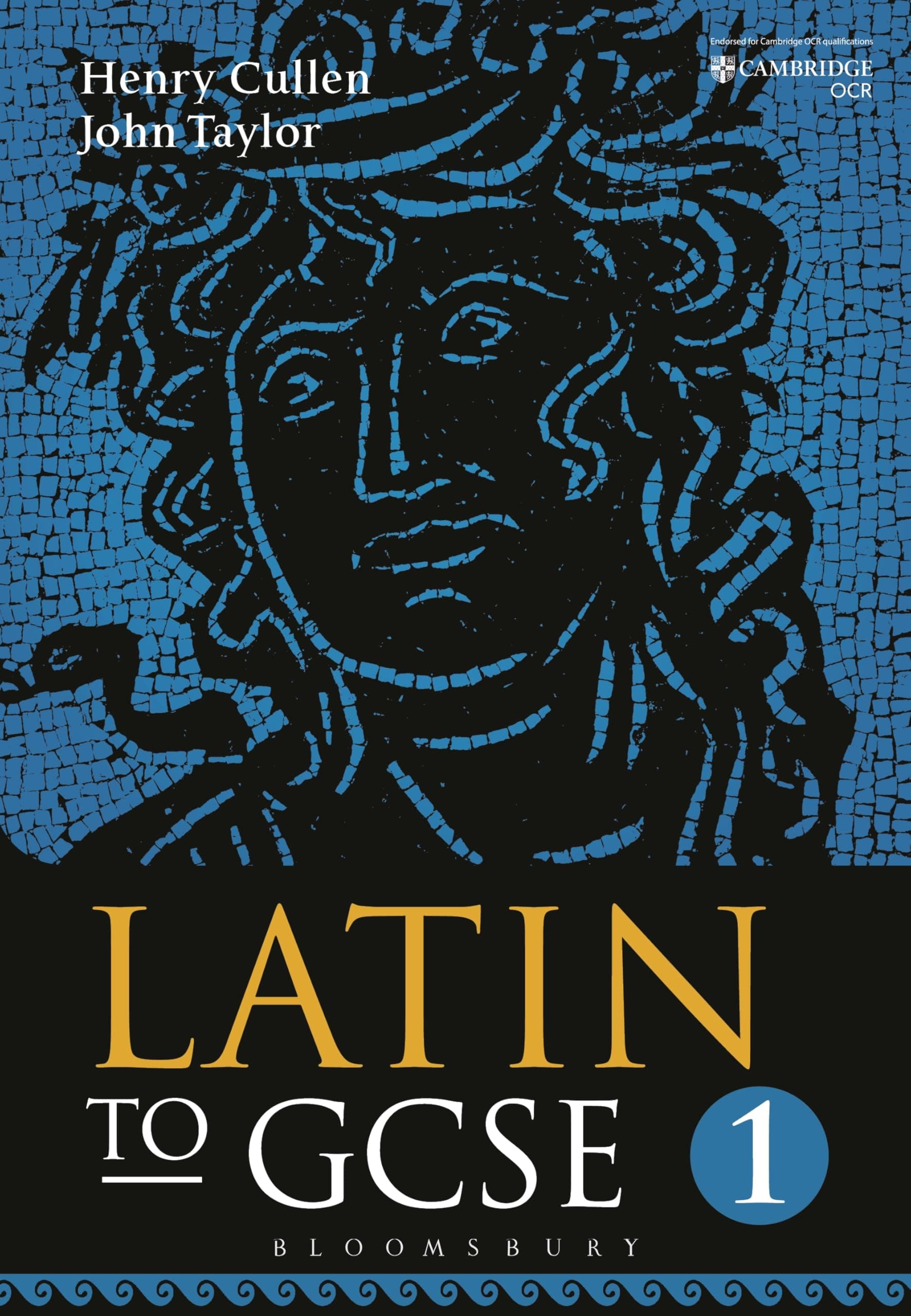
Latin to GCSE Part 1 : Henry Cullen and John Taylor: desertcart.co.uk: Books Review: Latin, for learning - A great book to support latin to GCSE Review: Just love it! - Well laid out. Explains the different noun declensions from nominative through to ablative in an easy to understand logical manner. The different verb conjugations and tense endings are presented in the same way. By the second chapter you get a buzz by translating the Trojan war from Latin to English and learning new words. It’s very addictive. I wish I had this book at school.
| Best Sellers Rank | 14,201 in Books ( See Top 100 in Books ) 1 in Latin Language Learning for Young Adults 56 in Language Training by Language 141 in Language Study for Young Adults |
| Book 1 of 2 | Latin to GCSE |
| Customer reviews | 4.6 4.6 out of 5 stars (284) |
| Dimensions | 17.02 x 1.65 x 24.26 cm |
| Edition | Illustrated |
| ISBN-10 | 1780934408 |
| ISBN-13 | 978-1780934402 |
| Item weight | 476 g |
| Language | English |
| Print length | 208 pages |
| Publication date | 7 April 2016 |
| Publisher | Bloomsbury Academic |
M**R
Latin, for learning
A great book to support latin to GCSE
A**R
Just love it!
Well laid out. Explains the different noun declensions from nominative through to ablative in an easy to understand logical manner. The different verb conjugations and tense endings are presented in the same way. By the second chapter you get a buzz by translating the Trojan war from Latin to English and learning new words. It’s very addictive. I wish I had this book at school.
J**N
New Pragmatic GCSE Latin Language Course
This two-part course, published in April 2016, is the companion — on the bookshelves if not in most classrooms — to John Taylor’s Greek To GCSE, and the prequel to his Latin Beyond GCSE. The course is co-authored, but the joins hardly show. Each author claims to be 'responsible' for the whole of one of the parts. The format of the two parts is almost identical, which helps to maintain consistency of style and approach across the course as a whole. It may also be an advantage that Cullen was both a pupil and colleague of Taylor, therefore well familiar presumably with his modus operandi. (Inevitably, there is some overlap between Part 2, for which Taylor is responsible, and his Essential GCSE Latin.) The main advantages this new course has over its competitors are (i) like Greek To GCSE, it can be completed more quickly than rival courses (the main saving of time is in there being less reading material and background content and related follow-up activities), and (ii) it is targeted almost exclusively — ruthlessly, one might say, certainly unremittingly — at the language requirements (language only) of the new OCR (which 'endorses' the publication) GCSE specification. In fact it could just as well be titled Latin For GCSE. If it does not omit anything from the specification then it certainly does not add anything either, apart from the 'Background' sections. (Background to the reading passages, that is, not background as in the Cambridge Latin Course (CLC) 'paralinguistic material'. The publisher’s puff about the background content (that it provides 'an excellent introduction to Roman culture alongside the language study') is just that. Users will certainly be missing out on the kind of coverage of Roman culture contained in most of its competitors. But this is not part of the language requirements of the GCSE specification, which, as I have said, are the course's almost exclusive concern.) Another advantage (as I see it) is that it is not centred around some awful pseudo-Roman John and Jane family (plus dog), with slaves and other illiterates (including the dog) speaking in elite Latin — very culturally authentic. Other advantages over its rivals are that much more care is taken to attempt to explain, rather than simply to state, Latin usage (though some may feel that this is sometimes overdone), and that Part 2 of the course can be used as a stand alone revision guide for GCSE, containing as it does, inter alia, a summary of the required grammar and syntax, all the prescribed vocabulary and specimen language exam papers (five of them). These may go a long way to commending it over its rivals. The reading passages (curiously called 'Exercises') are made-up Latin (with all the drawbacks that entails) retellings of well-known Roman myths, legends and allegedly historical events, stuff they might not (and should) encounter actually in other (recent) courses, as the authors suggest in the Preface. The penultimate chapter of the course consists of 20 pages of additional reading passages included for revision of the whole course. Some guidance as to how best to use these, and how to get the most benefit from them would be helpful; one feels that they might simply be omitted otherwise (especially as the previous chapter concludes with the words ‘Coverage of all GCSE grammar and vocabulary is now complete’). No help is given either with how to tackle the types of questions that will be set in the exam, i.e. do's and don'ts of unseens, comprehensions, grammar/syntax questions, translation into Latin. The closest the course gets to this is a section on how to tackle the typical complex sentence in Latin. More could have been said too about decoding the various kinds of word terminations and the absolute importance of being able to do this successfully — it is after all the most important skill to acquire for understanding an inflected language. And, unpalatable though it may be, the sheer necessity of old-fashioned learning of what needs to be learned, and of having a substantive as opposed to a procedural memory, needs to be stressed. As the authors say in the Preface, it cannot be acquired by osmosis. The rationale — to get to GCSE as quickly and effectively as possible while providing a sound platform for AS/A Latin — and the format of the books are very similar to those of Greek To GCSE. The main differences of presentation are that Latin To GCSE makes (?over)use of text boxes, some use of colour for the text (pale blue only), and there are some photos and other images (all of them very poorly reproduced in a uniform almost monochrome dingy grey-blue — though I concede, of course, that aesthetic appreciation is a subjective matter). The differences of content are that Latin To GCSE contains specimen GCSE language papers, English into Latin sentences of the kind to be found in the new OCR specification, much fuller syntax summary and revision guide, an appendix on words with more than one meaning and a skeleton guide to grammatical terminology. The approach to second language learning is traditional, i.e. theory averse, though not dogmatically so. But such is the emphasis on acquiring a sound grasp of grammar and syntax and an understanding of how the language works, there is little in the course to hold the interest of a person to whom this sort of stuff does not appeal. Also, given that the format and approach are basically the same as those for Greek To GCSE, what works for high ability, self-selected, well-motivated handfuls (one hand, usually) of Greek learners may not work for more mixed ability Latin groups, many of them perhaps conscripts (for one year at least, at any rate). Students beginning Greek have usually already covered the rudiments of Latin and therefore have an advantage over those beginning Latin. These factors help to make the aims of the Greek course more realistic. None of these factors applies to Latin: beginners are not likely to have any experience of a fully inflected literary language, and many/most of them may not be anywhere near as talented linguistically (or as motivated) as those who do Greek. .And, as I have said, there is no paralinguistic material, meretricious though some of it may be, to grab them if learning the language doesn't. The question that needs to be asked is whether this new course will meet the needs of the bulk of the people (including people outside a classroom) who use it, and whether it will do so better than its competitors. Put crudely, will they stand a better chance of getting a good grade in Latin at GCSE? The statistics show that most GCSE Latin candidates already get good grades using other courses. So that cannot be a USP for the new course. Is the new course more likely to recruit more people to begin Latin — and to continue with it successfully to GCSE? The last question is by far the most important in a time of falling numbers for the take up of Latin and Greek. The answer to it may make other questions about courses' relative merits irrelevant. Time, as they say, will tell. But one thing is for sure, something that no course can alter and that no one should try to conceal: for most people Latin is not an easy subject to do well in. It may be (deceptively) easy to begin with, but it is not long before the gradient of difficulty gets progressively steeper. There is reason to think that this course will make it relatively easier going for most learners. Each chapter of the course (except for the final two chapters) has the following contents, usually in this order: Presentation and explanation of new grammar/syntax Latin sentences for translation to test understanding of new grammar/syntax English sentences for translation into Latin to test understanding of new grammar/syntax Revision checkpoint Reading passages (from Chapter 2) Background Summary of chapter grammar/syntax New vocabulary (Latin-English) to be learned (Note the relative order of new grammar/syntax and reading passages.) And some visual material, of course. There is (at the moment) little bloatware in the form of the sort of supplementary materials that constitute the bulk of the CLC. Some additional materials would be welcomed (and indeed are forthcoming), especially by those using the course without the assistance of a regular teacher. This is the way things are heading in any case with the learning of Latin and Greek — though as far as numbers of learners are concerned things are generally going in reverse. (Even so, there were nearly 9,000 candidates for OCR GCSE Latin in 2015, with about 2,000 for the GCSE equivalent WJEC.) Macrons as guides to pronunciation are eschewed throughout, which some may regret. The section on pronunciation is inadequate. No guidance is given as to how to find out whether vowels are long or short, nor what difference this makes to their pronunciation. Nor is it explained when the stress falls on a penultimate or antepenultimate syllable of a polysyllabic word (though this would require an explanation of the principles of syllable division and the difference between heavy and light syllables). There is no mention of how to pronounce repeated consonants, e.g. as in annus or bellum, or aspirated consonants, nor how most single consonants are pronounced. One gets the impression that it is not expected that the Latin in the books will be read aloud much (unlike in the ancient world). Not a GCSE requirement, of course, or not a language requirement at any rate, though students will presumably be expected to show some awareness of the sound of the language when studying the set texts (especially verse) for the literature part of the specification. It is not generally known that Latin and Greek are the only subjects in which it is possible to study at GCSE level (sophisticated) literature written in languages other than English. (I can understand why the authors decided not to include this semi-technical information at the outset of the course; but it could have been given in an appendix to Part 1 or Part 2, or both.) It would be surprising if the course did not contain some errata and corrigenda, but I have not been through it with my fine-tooth comb so I cannot comment on this. To conclude: this is a thoroughly pragmatic, exam-oriented Latin language course; as such it can be recommended. It can also be recommended for beginners (including adults) who wish to reach the level of GCSE without necessarily aiming at an actual GCSE qualification. What is needed now (and is not likely to see the light of day) is a course that addresses the OCR specification as a whole (as with other GCSE subjects), or at least one which reaches the parts that this one does not reach.
E**M
Essential
This has been a lifesaver for me. I've been using the Cambridge course but the grammar is spread out and I found by the time I got to Book III, it was all starting to fall apart in my mind. I realise that this may say more about me than the course materials, but after working my way through this book and immediately ordering the second, I have a much firmer grip on the language. Even after the first few chapters, I was much more confident about case endings and could write simple sentences, something i'd certainly not felt able to do before. A brilliant resource, well explained, and intelligently organised.
M**E
Highly Recommended
Having done a little bit of Latin at school many decades ago I thought I would revisit it during lockdown to revise and improve. I worked my way through this and the subsequent Part 2 and thoroughly enjoyed the journey. It's well paced and very well presented, with even the daunting parts being thoroughly explained along the way. The only slight frustration is not having access to the correct answers to check my work along the way. I don't intend to take the GCSE exam, but I managed to take the practice papers at the end fairly confidently, so I'm a satisfied customer.
S**D
Fits the Bill
This book helps me return to my study of Latin. I took GCSE in 2003, aged 47, amongst youngsters at Norwich School. I achieved a grade A which I am proud of. This situation itself was a most weird experience. How this came about was my being part of the first cohort of Bob Lister’s innovative venture into independent learning of Latin with the Cambridge Classics Project. This particular textbook would have met my needs at my mature time of study. I was somewhat irritated with a need to cover some aspects of culture etc. with CLC, feeling it rather puerile for someone my age, and also a course that doesn’t really make you think. I just wanted to learn the language. I took language and prose for the exam, but now looking back, I feel let down by the lack of rigid study on these aspects, and have a feeling that I could have got a “star” if there was a more rigorous approach. What I am getting at, is that looking at the exam paper, I would have loved to tackle the English to Latin paper, but was not prepared for this. This course really gets to grips from starters, and I am rather thrilled that I can tackle much of the early stuff after such a long time away from the language. I have skimmed much of Part 1 for reassurance, but will now slow down to imbue it all, and then Part 2 etc. It would be great if such a course could be available on the internet. This book is just what I need.
C**S
No answers to exercises
A good book with exercises well tabulated but no way of finding out if my answers are correct.
J**N
At last!
At last, a Latin textbook which combines clear explanations and a rigorous approach to grammar with direct relevance to current exam specifications - and doesn't waste valuable time on long and involved stories which take way too much time to read and are often frankly overfacing. This book could easily be used by a student learning on their own, or even by a non-specialist teacher learning along with the class! Only two things would improve it: 1) answers to the exercises, perhaps provided in a separate book (this may be available, but there was no reference to it in the book itself) and 2) proper coloured pictures rather than strangely stained blue ones!
N**R
I got this as a refresher after learning with Wheelock's Latin ten years ago. The design of this course is excellent. The explanations are really genuinely insightful and easy to grasp. There have been multiple times where I'll go over a grammatical concept and wish I had had this book when I first learned. The amount of vocabulary to learn per chapter is manageable and Latin vocabulary is pretty easy to learn anyways. There aren't a ton of sentence translation exercises but you'll be reading extended passages by the second chapter. I can't recommend it highly enough.
S**M
Come da descrizione! Spedizione veloce! Venditore consigliatissimo!
D**S
An excellent book. Very clearly set out with just the right amount of practice materials. Very pleased to have this.
S**I
Prodotto arrivato come di consueto nei tempi previsti, valido per chi vuole dare un approccio non consueto al latino. Si traduce dal latino in inglese
A**S
Since the GCSE exam does not require macrons to indicate a vowel being long or short, you will find no macrons in this textbook. The advantage is that most Latin primary sources do not have these vowel markers. The disadvantage is you will not know the proper pronunciation for the core Latin vocabulary for beginners, unless you use a lexicon that shows as much. For this reason, 2-star deduction on an otherwise excellent volume.
Trustpilot
Hace 2 semanas
Hace 2 semanas