
Descargar la aplicación


Servicios al cliente
Sobre nosotros
Copyright © 2025 Desertcart Holdings Limited
Descargar la aplicación
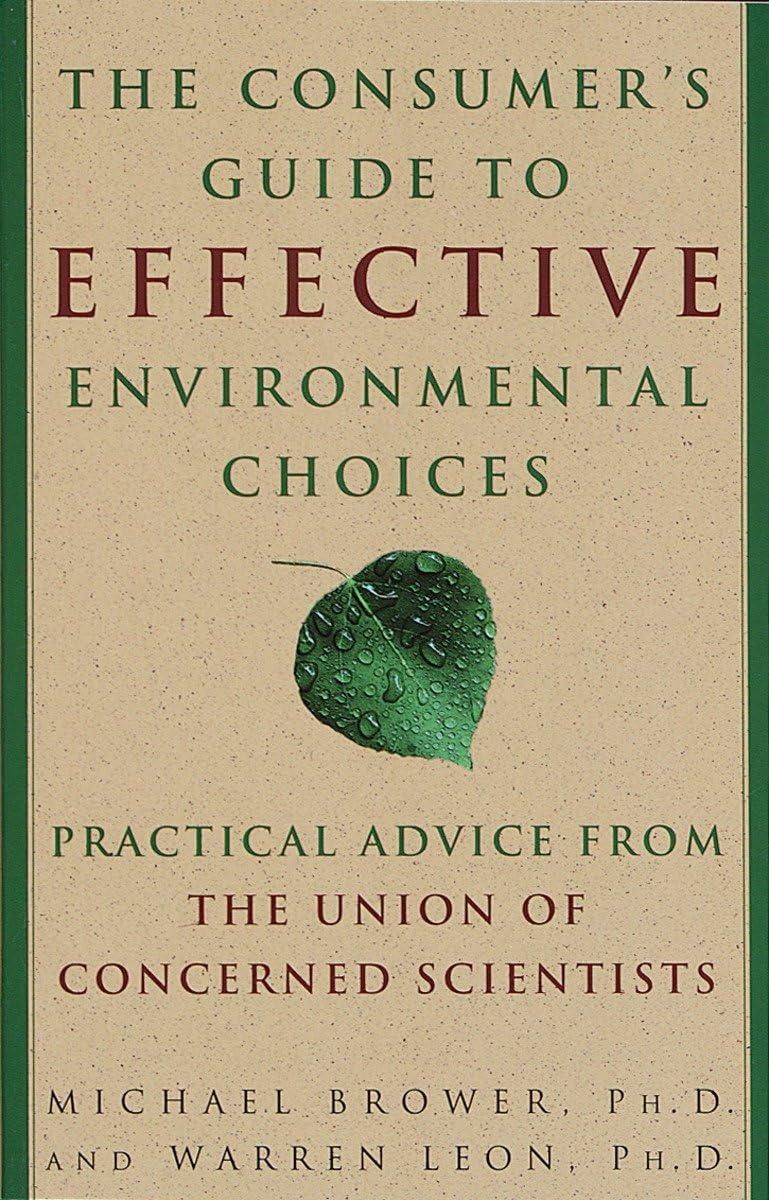
Buy The Consumer's Guide To Effective Environmental Choices by Brower, Michael, Leon, Warren online on desertcart.ae at best prices. ✓ Fast and free shipping ✓ free returns ✓ cash on delivery available on eligible purchase. Review: This book, written by two PhD scientists, documents and explains what actions consumers can take to help the environment. Unlike some other books on the subject, it is not just a laundry list of ideas...The authors have built a model which attempts to assess the environmental impact of various consumer products ranging from refrigerators to diapers. The basic conclusions are that some things are worth worrying about (e.g., what kind of car you drive and how much you drive, how energy-efficient your house and the major appliances you own are, what sort of food you eat). Others are not (e.g., "paper of plastic", cloth or disposible diapers, occasional use of disposible cups and silverware). Perhaps the best summary of the conclusions is provided by Denis Hayes (Chair of Earth Day 2000) as quoted on the back cover: "Too many people drive their Land Rovers to the grocery store and think 'paper or plastic' is a meaningful choice. [This book] will help you to distinguish the crucial from the trivial and make choices that are congruent with your values." I found this book to be an excellent attempt to assess the environmental consequences of one's lifestyle choices. It is not the last word on the subject, of course. No such study is perfect. However, the results are cogently and honestly presented (and with good humor too). I think it sets a new high standard for discussions about how to protect the environment through your purchases. Review: If you're like me, you feel overwhelmed at times with environmental problems: global warming, water depletion and pollution, ozone alerts, animal waste runoff, garbage, plastic, etc. etc. So much seems to be broken that it's difficult to figure out what to begin fixing--especially when you're just an average consumer. Where to begin? And even if you do begin, can you really make a difference? The virtue of this *Consumer's Guide* is that the authors help us separate the urgent from the not-so-urgent, the easily doable from the this'll-take-more-time-and-effort. They pinpoint three major areas in our consumption in which we can make immediate changes that really do impact for the better on the environment: vehicle usage, how we heat/cool our homes,and what we eat. Almost all of us use our cars more than we need to, and a growing number of us have vehicles much larger than we really need; all of us can do better about insulating our homes, cutting down on electricity, and using environmental-friendly appliances; and we don't really need to eat as much meat as we do--growing food animals is a colossal waste of grain protein as well as a major water and air polluter. Just as handy, the *Consumer Guide* gives tips for social and political as well as individual action. Changing one's own behavior is essential; but building coalitions with others and putting pressure on corporations and the government to be more eco-responsible is essential too. Finally, Susan Strasser's concluding essay, "From Walden to Wal-Mart," a reflective analysis of our consumerist culture, is by itself worth the price of the book. Very nice indeed! So get this book, read it, and take hope: you CAN make a difference!
| Customer reviews | 4.3 4.3 out of 5 stars (16) |
| Dimensions | 13.18 x 1.7 x 19.81 cm |
| Edition | 1st |
| ISBN-10 | 060980281X |
| ISBN-13 | 978-0609802816 |
| Item weight | 249 g |
| Language | English |
| Print length | 1 pages |
| Publication date | 30 March 1999 |
| Publisher | Three Rivers Press |
J**E
This book, written by two PhD scientists, documents and explains what actions consumers can take to help the environment. Unlike some other books on the subject, it is not just a laundry list of ideas...The authors have built a model which attempts to assess the environmental impact of various consumer products ranging from refrigerators to diapers. The basic conclusions are that some things are worth worrying about (e.g., what kind of car you drive and how much you drive, how energy-efficient your house and the major appliances you own are, what sort of food you eat). Others are not (e.g., "paper of plastic", cloth or disposible diapers, occasional use of disposible cups and silverware). Perhaps the best summary of the conclusions is provided by Denis Hayes (Chair of Earth Day 2000) as quoted on the back cover: "Too many people drive their Land Rovers to the grocery store and think 'paper or plastic' is a meaningful choice. [This book] will help you to distinguish the crucial from the trivial and make choices that are congruent with your values." I found this book to be an excellent attempt to assess the environmental consequences of one's lifestyle choices. It is not the last word on the subject, of course. No such study is perfect. However, the results are cogently and honestly presented (and with good humor too). I think it sets a new high standard for discussions about how to protect the environment through your purchases.
K**S
If you're like me, you feel overwhelmed at times with environmental problems: global warming, water depletion and pollution, ozone alerts, animal waste runoff, garbage, plastic, etc. etc. So much seems to be broken that it's difficult to figure out what to begin fixing--especially when you're just an average consumer. Where to begin? And even if you do begin, can you really make a difference? The virtue of this *Consumer's Guide* is that the authors help us separate the urgent from the not-so-urgent, the easily doable from the this'll-take-more-time-and-effort. They pinpoint three major areas in our consumption in which we can make immediate changes that really do impact for the better on the environment: vehicle usage, how we heat/cool our homes,and what we eat. Almost all of us use our cars more than we need to, and a growing number of us have vehicles much larger than we really need; all of us can do better about insulating our homes, cutting down on electricity, and using environmental-friendly appliances; and we don't really need to eat as much meat as we do--growing food animals is a colossal waste of grain protein as well as a major water and air polluter. Just as handy, the *Consumer Guide* gives tips for social and political as well as individual action. Changing one's own behavior is essential; but building coalitions with others and putting pressure on corporations and the government to be more eco-responsible is essential too. Finally, Susan Strasser's concluding essay, "From Walden to Wal-Mart," a reflective analysis of our consumerist culture, is by itself worth the price of the book. Very nice indeed! So get this book, read it, and take hope: you CAN make a difference!
M**L
Book arrived quickly and even though I purchased it as "Used, Like New", it was immaculate and looked like new. Exactly as described and packaged very nicely. Would recommend this seller. Will buy from this seller again. Great book, too, very informative. Am happy with my purchase.
R**N
Too much talk, not enough information.
R**O
This books is very good and gives clear updated information about what are the choices you can take in your life to avoid causing bad consequences to the environment. They can easily be applied in your life, often saving you money too. I feel that people need to be educated about the consequences and repercussions that their daily choices and lifestyles can cause. It is essential to realize that our children will not be able to live in the same beautiful environment we grew up into, if we don't revise our wasteful, egocentric and inconsiderate behavior. Also check their web site, [...] a lot of information there as well. Roberto
Trustpilot
Hace 2 semanas
Hace 1 día