We remain fully operational. Our teams are working around the clock to ensure your deliveries continue safely.

Descargar la aplicación


Servicios al cliente
Sobre nosotros
Copyright © 2025 Desertcart Holdings Limited
Descargar la aplicación
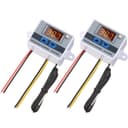
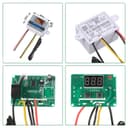

🌡️ Stay cool, stay precise — master your climate like a pro!
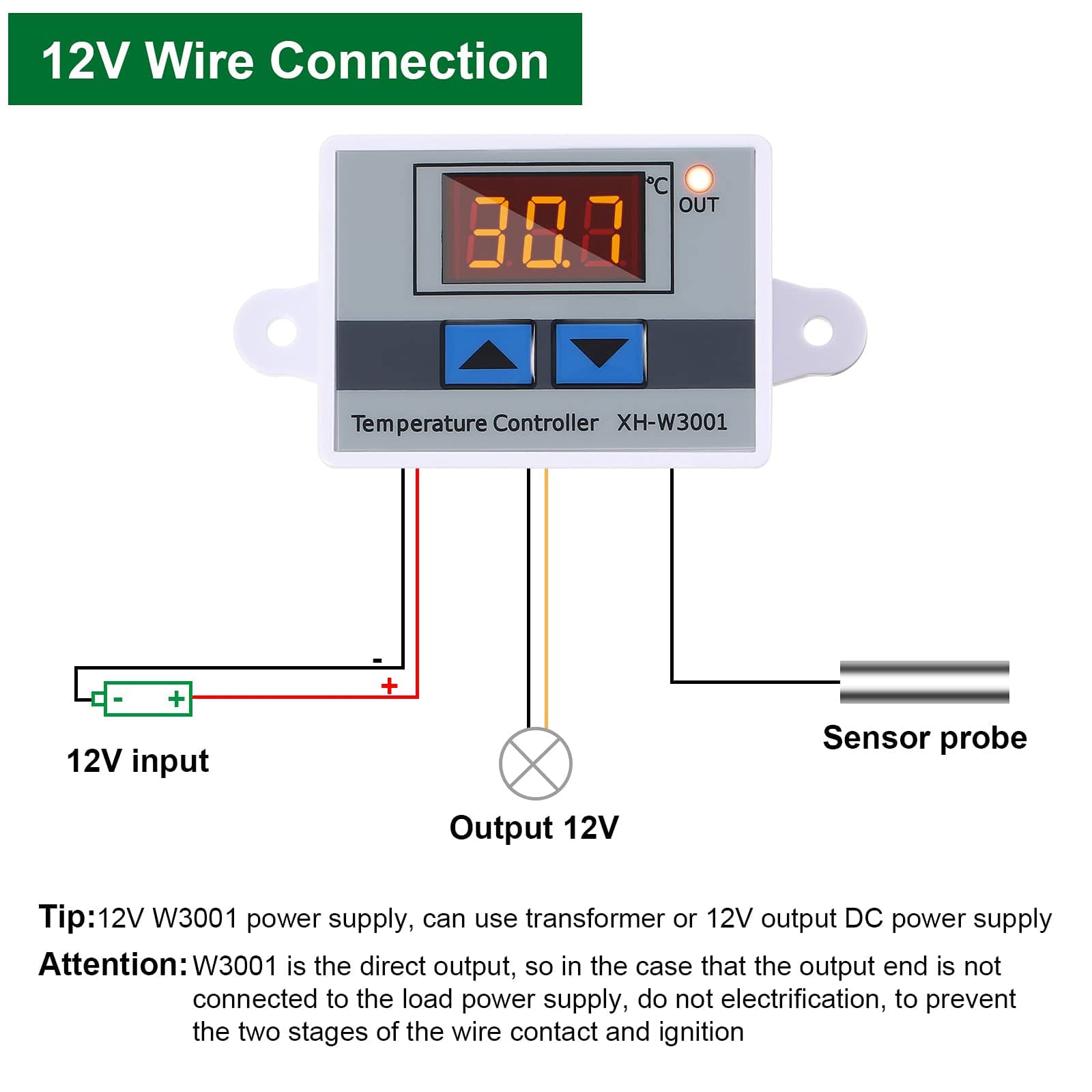
The XH-W3001 Digital LED Temperature Controller Module offers professional-grade temperature management with 0.1°C accuracy across a wide range (-50℃ to 110℃). Featuring a waterproof stainless steel probe and durable ABS housing, it supports both heating and cooling functions at 12V and 10A output. Perfect for tech-savvy users managing incubators, aquariums, or custom equipment, this dual-pack ensures reliable, programmable climate control with an easy-to-read LED interface.


| ASIN | B08QZ5VRYC |
| Batteries required | No |
| Customer Reviews | 4.0 4.0 out of 5 stars (313) |
| Date First Available | 27 November 2023 |
| Display type | LED |
| Item model number | XP-Weewooday-584522 |
| Manufacturer | Weewooday |
| Product Dimensions | 5.99 x 3 x 4.5 cm; 99.79 g |
M**T
These temperature controllers are perfect, work very well, I will buy more. I love it when something is so well designed, is affordable and approachable. I like (preferred) the layout and simplicity of the face and controls and the case is aesthetically clean and sensible. Dialing in the settings, has been easy, fairly intuitive. I wanted / needed a temperature control in the completion of several audio (power amplifier) projects. I am using the slowest speed fans, 1) foremost needed a silent fan system 2) positioned for linear dissipation across the 9x12" heat sink... turns out, the layout is still "too efficient" and cools below my target of a 3) consistent 95 to 100 degrees... **This may apply to no-one... My project a 500 watt class A/B MOS FET design, very liner with with extended bandwidth... [I believe] temperatures across the +/- transistor pairs is (or has become) so apparent through extended evaluation. Bottom line, the control from the XH-W3001 [temperature influence] made a discernible difference in the performance of my amps. A helpful tool in modeling amplifier output stage operational temperature ranges.
M**E
Works perfectly. I use it to control a muffin fan for my solar controllers. I was worried that it would loose it's memory when disconnected or power off. It does not loose it's memory. It is in C not F and as far as I know you can't change it. I printed a little chart and hung it by the solar controller. I did not use the second one but I now have a spare.
U**D
This review is for the 12 VDC version. Application: Cool a 30 and 40 amp solar charge controllers with a small 12 volt DC fan Pros: There are some very good videos on the inter-screens on how to set this up. After watching them, you will see it is quite simple. It retains the settings that you have set in NVRAM and will go back to them after a loss of power. The on/off/settings seem repeatable over time and do not seem to drift. The display is easy to read, Cons: The thin wire size requires one to be pretty good at soldering. If you can solder the whiskers back on to a cat (if for some strange reason they fell off), you can do this easily. If testing your abilities, please use a heat sink so that it doesn't upset the cat :). The other issue is that because these wires are so thin, there is no way it could support 10 amps of continuous current. Things will get stinky pretty quick. The other minor issue i that It only reads in Celsius, but that should really not be a problem with a simple formula to calculate it, if Fahrenheit is your thing. Conclusion: The two I have work great for my application with a small fan. If you want to run a bigger cooling or heating device with more than a 3 amp draw, I would suggest you use the output of this device to turn on a relay and hook your load to a more robust, higher current relay. I thought about taking this device apart and slobbering on some thicker wire, but for a low current 12 VDC computer fan, it wasn't required. It seems like it works really well and for the price, it's a steal really. Just don't expect it to run 10 amps through those wires :) This thing works great if you understand it's limitations (that are not really documented). Like a lot of things on the inter-screens these days, you never want to try to run the device at it's documented limits. You could let the smoke out.
D**W
I am an Electronic Engineer. I verified functions and connections to the best of my ability. I will stick to facts, and objective analysis, providing no opinions or commentary. Grading ... A: Excellent, B: Good, C: Average D: Poor, F: Fail I purchased these temperature control modules: a. UMLIFE XH-W1209 LCD Display Digital Thermostat Module b. Weewooday DC 12V Electronic Temperature Controller Module Both had similar issues -- 1. Instructions: D - were not well written. 2. Wire attachment mechanism : C - was cumbersome and of low quality. 3. Physical Quality: D -- it would take a relatively small amount of force (just using hands) to break 4. Functional Quality: F -- ALL units failed within 10 minutes I purchased Weewooday 's XH-W3001 module. Much better; integrated wires, programming instructions simple and clear, superior quality. Unit is still working after burn in test. it would take a much greater force level to break this unit. Instructions: B - Better written Wire Attachment: A - integrated wires Physical Quality: B+ - sturdy Functional Quality: A - Still going ...
M**C
For the price, I really didn't expect much here, but am very impressed. I got this as a freeze thermostat for a 12VDC bubbler in our pond and it works great. The temperature sensor is accurate to my surprise even though the controller is outdoors (in a watertight enclosure). For this application, set the 'Start Temp' to 0 deg C and the 'Stop Temp' to 1 deg C. This will turn on the bubbler at 0C (32F) and off at 1C (34F). Although it's rated at 10A at 12v, I wouldn't want to run 10A through the small gauge wires that come out of the box. Probably the internal relay is rated 10A. Since my bubbler is only about 1/2 A, it is fine and this would probably handle 1 or 2A ok. You need to search for an English manual after you receive it. Standby current is only about 40mA. When the relay is on, it's about 70mA. Quite low for a controller with an LED display. For about $5 each, how can you go wrong?
Trustpilot
Hace 2 semanas
Hace 3 días