We remain fully operational. Our teams are working around the clock to ensure your deliveries continue safely.

Descargar la aplicación


Servicios al cliente
Sobre nosotros
Copyright © 2025 Desertcart Holdings Limited
Descargar la aplicación
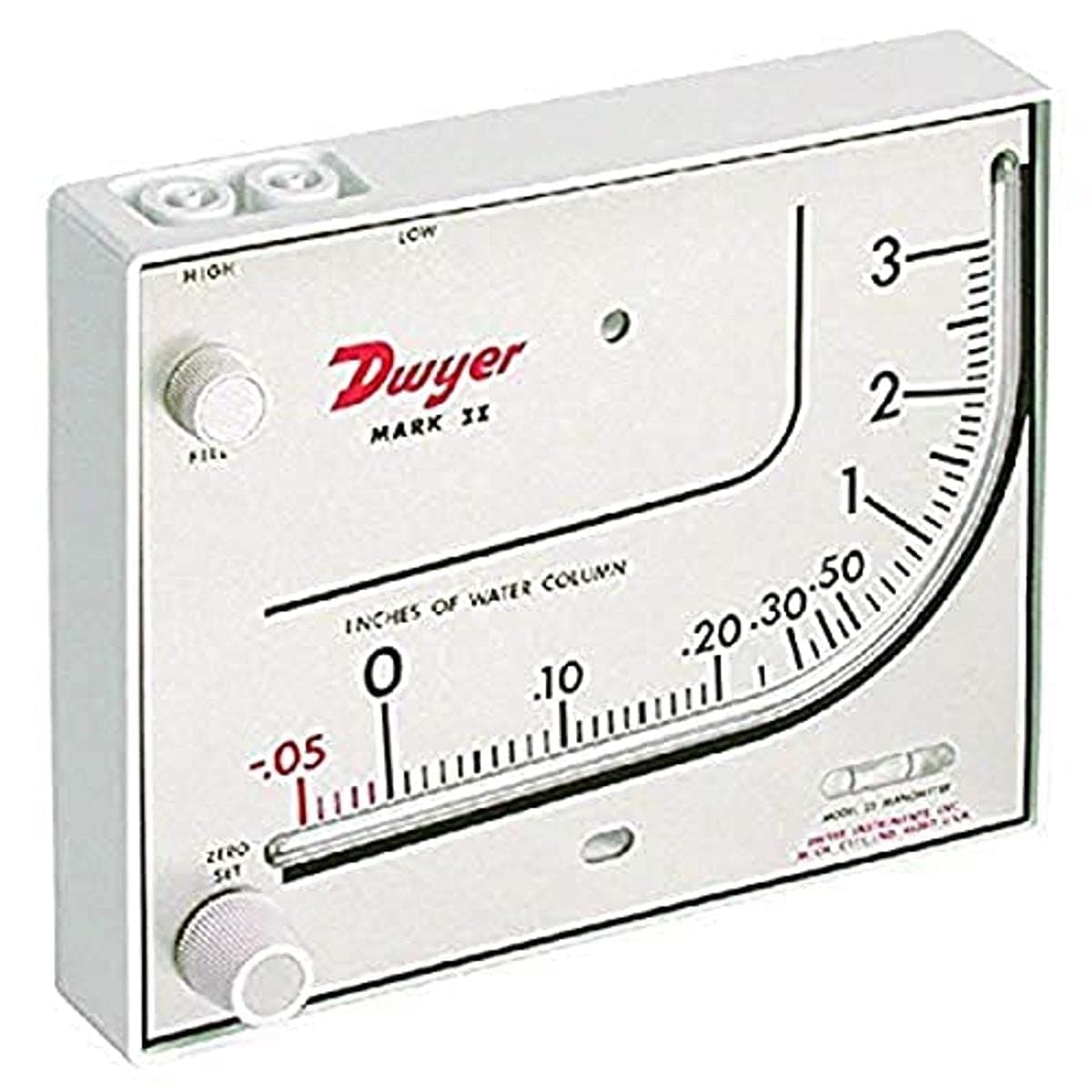
📊 Elevate your airflow insights with precision and durability — don’t get left behind!
The Dwyer® Mark II 25 Liquid Filled Wall Mount Manometer offers precise differential pressure measurement (0-3 inH2O) with ±3% accuracy. Featuring freeze-proof red gauge fluid and leakproof O-ring seals, it’s engineered for durability in cold and demanding environments. Its versatile vertical mounting with built-in spirit level simplifies installation, while expanded scale viewing and epoxy-coated aluminum scales ensure easy, long-lasting readability. Ideal for HVAC, lab, and industrial applications, this manometer delivers reliable, maintenance-free performance that professionals trust.
| ASIN | B009PAN3C8 |
| Best Sellers Rank | #153,131 in Industrial & Scientific ( See Top 100 in Industrial & Scientific ) #43 in Manometers |
| Date First Available | February 17, 2007 |
| Is Discontinued By Manufacturer | No |
| Item Weight | 1 pounds |
| Item model number | 25 |
| Manufacturer | Dwyer Instruments |
| National Stock Number | 6685-00-897-4402 |
| Product Dimensions | 7 x 7 x 2 inches |
9**N
3 years so far measuring the draft on my coal stove. A+++
I bought this to measure the draft of my coal furnace. it functions perfect. Easy to install with great instructions. came with extra liquid in case you need to transfer it or whatever. this is three years now and works as good as the day i installed it. came with everything you need. including the fittings.
D**M
$60 and 20 minutes saves a lot of expensive filters
With increasing combinations of heat and smoke in our area, we upgraded our air handler to accomodate a MERV16 4" filter. The filters are about $100 each and the default suggested lifespan is one year. It needed about 20 mintues to install this manometer and discover that at one year of age our filter was causing pressure drop far below the rating of our air handler. Given that interception by filters improves as they choke, the filter is doing fine. A six month extension of filter life in our case pays for half the cost of this device. Photo indicates simplicity of installation. Two holes in ductwork for tubing port attachment, double-sided tape to mount manometer. Note that the area marked "filter" on the air handler is superseded by the larger filter housing at right (it's important to make sure manometer tubing is correctly installed on upstream downstream sides of filter).
J**Y
Outstanding product and more like a piece of lab equipment.
I am using this Manometer to allow for a visual identification of when my whole house furnace filter needs to be changed. As the filters are between $30 and $40 I do not want to change too often as I will be wasting money and if I wait too long potentially damaging my HVAC system which is less than ideal..... My current scheme is to pull the filter out and look at the color of the filter which is inaccurate to say the least, so after a recent cold snap and my furnace not operating due to a filter that needed to be changed I opted to do something about it. Competitive products seemed a little cheap to me so I went this route. As a mechanical engineer by training I was very pleased with the lab instrument quality of this Manometer, when you open yours up you will be surprised by the size of the this unit, fully 6"x6" or more. Everything that I needed to accurately measure a pressure differential was included as well as a surprise built in level for that really assisted with the installation of the product. What is extremely important about this Manometer is that the first inch of the water column is essentially more "horizontal" allowing for more accuracy in the first inch of the water column. The reason for this is that your furnace is most likely designed for about 0.5" of static external pressure. This is typically found on the HVAC systems label. So in my case when I installed the Manometer and zeroed it out with no filter in place, then added a new clean filter it measured .1" rise in the water column. That is about 20% of the total rise allowed by my HVAC units spec. (By the way that was a dead on match to the Filtrete specs for this filter, which is always nice) So I will need to change that filter when the water column reads .5" of water. Having that first inch essentially expanded out is really nice so I can see what is going on visually. Long story short, if this keeps my wife happy because her house is warm as her furnace filter was changed when it should have been then all things considered this was a great purchase. :-) Have a great day and some fun as a home geek. Jeff
Z**A
Installed and working (measuring?)
Installed using the A-489 static pressure tips I found in the accessories list on the Dwyer Instruments web site. Adjusted the zero point by taking the filter out while the fan was running and closing the door. That should give me "0" differential between the probes. The system fan runs at low speed most of the time and then ramps up with heating/cooling demand. I put filter back in and the reading is what you see in the picture with very low fan speed. The filter has been in for a month so there is a little dust buildup on the pleats. Its a 4” filter that’s supposed to last 3 months (we’ll see) and the reading right now is .35 when the fan is at normal(demand) operating speed. I haven’t added the green or red arrows to the plate yet that will show filter “new” and change times(red). I’ll try to remember to update this eval when I get to the filter change. Installing the probes and manometer to the plenum were no issue. A 1/4 " drill for the probes to penetrate the plenum and some screws to hold the probes and manometer to the plenum. Like was mentioned in an earlier post, add the liquid slowly, I overshot the volume and spent 5 minutes with a pipe cleaner to blot up the excess liquid in the reservoir. I’m anticipate the differential meter will be helpful to more accurately determine when the filter really needs to be changed instead of guessing at 3,4,5 months. Update Feb 15 2019, The idle value went down to .3 (was .35) I'm not sure why that would happen, I sort of expected it to increase with the dust load indicating more differential pressure between the probe above and below the filter..
G**4
I have used Dwyer products for many years and have always been satisfied with their accuracy and quality. I'm using this manometer to monitor the air pressure drop over my premium in-line electronic air filter. The manufacturer of the air filter says it could go for up to nine months before servicing, but I never expected that kind of performance. The Dwyer manometer proves that my filter, in my application, must be serviced within 40 days or the system airflow becomes too restricted leading to excessive energy consumption. I'd rather clean the filter more often than pay extra for fuel and electricity. Looks great too! Comes with mounting screws, red indicating fluid, and tubing. You'll need to buy a pair of magnetic static tips to insert into your ductwork.
U**E
Arrived and works as described
K**.
I use this product to test Total External Static Pressure (TESP) on furnaces. It's also utilized to balance Heat Recovery Ventilation (HRV). The only suggestion would be adding magnets.
A**M
Buen aparato , lo hemos usado durante muchos años , aunque con la llegada de los menos complicados manómetros digitales , estoa aparatos no se usan mucho , excepto cuando se acompañan de un tubo pitot.
Trustpilot
Hace 1 mes
Hace 3 semanas