Desert Online General Trading LLC
Dubai, United Arab Emirates
Desert Online General Trading LLC
Dubai, United Arab Emirates

Full description not available


G**R
One of the best on trading psychology out there
Yes you read that right the author is a pro poker player. However in every single sentences the word power is mentioned you could easily replace it with trading. The similarities are striking. The mental model provided and insight is very useful for traders. You can have ‘one good trade’ with perfect execution and still get a bad outcome. It doesn’t mean that the trade was bad. 10/10
M**D
Useful book on how to think better
The author is quite a remarkable person - a Ph.D. psychology candidate who learnt to earn an income from poker through economic necessity and became a champion player. Her insights aren't new, but she has brought the seious scientist's mind to helping the reader think better, and make better decisions. Some very useful tools.
P**K
It is worthwhile - it gets better after 100 pages.
I was in doubt whether this is a 3 or 4 star book.Duke writes well and tells many anecdotes - making her points more memorable.Some of the points are somewhat trivial - and is covered in by greater works by Daniel Kahneman (Thinking fast and slow) and Nassim Taleb (Fooled by randomness). Duke prefers to use the term of "luck" over "randomness" - although it does feels like, quite a bit of inspiration comes from Taleb.I like the book, although, especially the first 100 pages are rather repetitive, re. the simple message of recognizing randomness (luck) from skill when evaluating the outcome of a decision.I recommend you to hang in there and finish the book - the last 50-80 pages are quite good.The list of recommended readings is quite useful.I settled on the 3 stars due to the points being made in a repetitive manner - but it is close to a 4.I might read more from Duke. There are some real world (mine is in investing) lessons that are useful to keep in mind.
@**S
Did you know that great decisions can create bad outcomes?
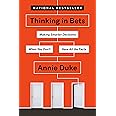
Annie Duke, the author of “thinking in bets” is a former World Series of Poker champion, turned business consultant. In the book, Annie discusses the importance of the different types of decisions. Good decisions can generate, bad outcomes and bad decisions can generate great outcomes. This is something she has learned from playing poker.She also discusses the difference between “skill” and “luck”, often in life if we had a good outcome we put that down to skill and a bad outcome, we put down to bad luck. Surely everything is about skill? Annie discusses that if you say to people “will you take a bet on that?” people will start unpacking their belief systems and the knowledge we have which we assume to be true. Once pushed, to put our money where our belief systems are will we really do it?Finally she discusses the need to have an open mind in life and a lifelong learner.I certainly enjoyed the book and it’s worth adding to the reading list.
F**I
Parables bear repeating
This is a decent book.It won’t have much new in if you are familiar with psychology or decision theory, but it revises these concepts well.The central metaphor that life is one long poker game has something to it.Poker-specific concepts like “resulting” and “tilt” are useful additions to my vocabulary.
G**E
How to make smart decisions
To guess is to gamble. Applying some methodology to decision-making reduces, if not eliminates, guesswork thus making any decision less of a gamble. Thinking in Bets describes that sort of methodology quite comprehensively.For example, considering negative predictions, besides positive ones, can insert some scepticism into a decision so rendering it more realistic. A smart decision involves knowing all the pros and cons of each option, which is where history comes in, then weighing up those pros and cons. A few hands, of poker, come to mind where if I had done exactly that I would have folded a cooler.Annie Duke describes how to manage the decision-learning process. Not all negative outcomes are down to flawed decisions. Random factors will also influence the outcome. Outcome quality is different from decision quality.Thinking in Bets is useful because it helps you to identify the flawed assumptions in your decision making.
A**R
Excellent book full of helpful tools
You don’t have to be a poker expert to appreciate Annie Duke’s approach to decision making. She gives us a series of excellent tools to ensure that we make good decisions and avoid echo chambers. Including letting Marty Mcfly meet Marty Mcfly
C**F
Sound techniques for making - on average - better decisions
A book both entertaining and practical, based as it is on lessons learned from thousands of hours of decision making under pressure, as Annie Duke played high-stakes poker. At heart, it's about how we distinguish skill from luck in decisions, how we can improve the skill part of the balance,while understanding that luck will always play a part.
Trustpilot
Hace 2 semanas
Hace 1 semana