We remain fully operational. Our teams are working around the clock to ensure your deliveries continue safely.

Descargar la aplicación


Servicios al cliente
Sobre nosotros
Copyright © 2025 Desertcart Holdings Limited
Descargar la aplicación
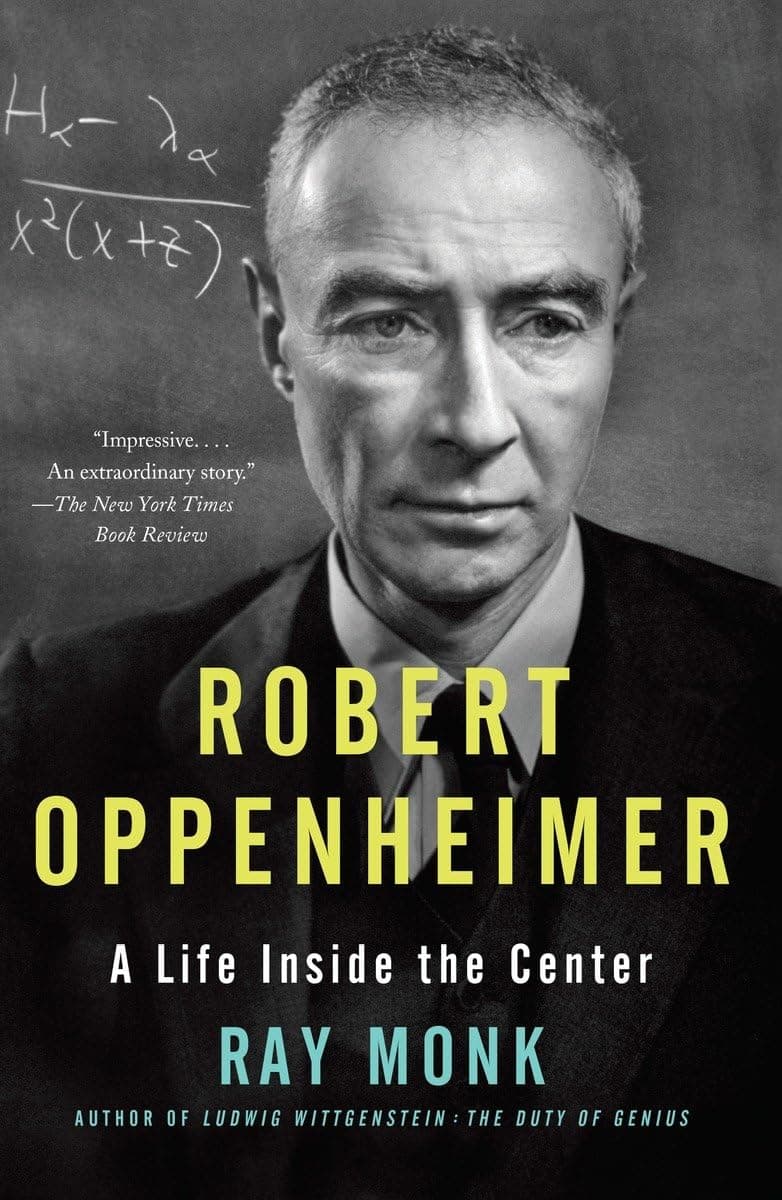
Robert Oppenheimer: A Life Inside the Center [Monk, Ray] on desertcart.com. *FREE* shipping on qualifying offers. Robert Oppenheimer: A Life Inside the Center Review: Covers the academic side very well - Monk's biography covers all that Bird and and Sherwin left out: the development and course of Oppenheimer's academic life. Monk followed Rabi's suggestion that Oppenheimer had a vacuum because he ignored his Jewishness, which is interesting as well but the coverage of academic development is first rate. The book is a history of the development of physics 1920-50 and of American nuclear science policy in the early 1950s. Monk covers very well the story of how Truman and Eisenhower rejected the proposal to try to reach a nuclear policy agreement with the USSR, and instead went ahead full steam with the USAF's drive to get the H-bomb. I.e., how we ended up in the situation where Dr. Strangelove's policy won. I have a small correction to add. On pg. 410 Monk follows the standard line that Heisenberg did not know how to calculate critical radii. This claim was laid to rest in my American Journal of Physics paper AJP 92, 765-74, 2024. Heisenberg foreshadowed Serber's Los Alamos Primer by formulating the critical radius problem and calculating radii for reactors in 1939. Under captivity at Farm Hall in 1945 he recalled his 1939 work from memory and independently reproduced Serber's 1943 calculation for a bomb. He only knew the fast fission cross sections between two limits. Serber's cross section was midway between the two. It is ludicrous to continue to repeat Goudsmit's misconception that Heisenberg did not understand the difference between a reactor and a bomb. Mathematically, there is no difference in the basic formula for the critical radius, the difference is in the cross sections and neutron production per fission that enter the formula. Otherwise Monk's book is extremely interesting and well worth reading. After reading Bird and Sherwin, in contrast, I had trouble recalling what I'd read chapter by chapter. Review: Great writing about an enigmatic man - Ray Monk’s superb biography of Oppenheimer leaves him a puzzling figure with a lot of contradictions. The same man who tried to poison his advisor and strangle his friend becomes one of the most effective administrators of people in the history of American science. The man who made acerbic and arrogant comments to colleagues and young physicists at conferences was at the same time one of the most respected student advisors who went out of his way to publish papers with his students to help their careers. The man who loved the history, freedom and open spaces of America and who headed the most secret major project in American history became partly through his own fault one of the most reviled Americans in the early 1950’s. Biographers of other great 20th century physicists have been able to pinpoint certain consistent themes in their subjects’ lives. Farmelo’s great biography of Dirac shows the effect of his autistic tendencies throughout his brilliant life; Cassidy’s terrific biography of Heisenberg traces his love of German culture through his childhood leadership of youth groups and all the way through his decision to stay in Germany under the Nazis. But it is extremely hard to find a consistent thread for Oppenheimer. Monk claims it is his love of America that runs through his choices. This seems accurate in many cases. But, despite the paranoia and hatred of his enemies in the early 50’s, some of the questions raised about him do make one wonder how deep that love of America went. It seems that love of his friends, few as they were, challenged or overcame at times his love of country. But friendship was hardly sacred to him either. With his “cock and bull story” that got him into so much trouble, he seemed willing to throw at least one of his friends under the bus. Some of this behavior can be simply explained by fear and self-defense. But there appears to be, for want of a better word, a “disconnect” in several of Oppenheimer’s words and actions. Monk spells these out in detail and, in the first part of the book, cites some childhood experiences (and real traumas) that might well have shaped Oppenheimer’s future life. I am not sure there actually is one consistent thread that can be traced through Oppenheimer’s life except perhaps his love of physics. This book will get the reader to think – about the justification of the Manhattan Project, about the issue of identity in America, and above all about the motives behind Oppenheimer’s actions. It is exceptionally well-written. Monk does as fine a job as can be done of explaining the issues in atomic physics that Oppenheimer dealt with his whole life. If the book has any weakness, it is the limited amount of information about Oppenheimer’s family relationships which, if Monk is right, were not good, and which led to some tragic consequences. But this is a small criticism for a masterpiece of biographical writing. The book is large (695 pages of text) but never boring. I highly recommend this Oppenheimer biography both for clearly laying out the mystery that was Robert Oppenheimer and, to younger readers, the mystery that was the United States in the 1940’s and 50’s.
| Best Sellers Rank | #966,351 in Books ( See Top 100 in Books ) #30 in Scientist Biographies #74 in United States Biographies #263 in Nuclear Weapons & Warfare History (Books) |
| Customer Reviews | 4.5 4.5 out of 5 stars (352) |
| Dimensions | 6.2 x 1.5 x 9.2 inches |
| ISBN-10 | 0385722044 |
| ISBN-13 | 978-0385722049 |
| Item Weight | 2.4 pounds |
| Language | English |
| Print length | 880 pages |
| Publication date | March 11, 2014 |
| Publisher | Anchor |
P**Y
Covers the academic side very well
Monk's biography covers all that Bird and and Sherwin left out: the development and course of Oppenheimer's academic life. Monk followed Rabi's suggestion that Oppenheimer had a vacuum because he ignored his Jewishness, which is interesting as well but the coverage of academic development is first rate. The book is a history of the development of physics 1920-50 and of American nuclear science policy in the early 1950s. Monk covers very well the story of how Truman and Eisenhower rejected the proposal to try to reach a nuclear policy agreement with the USSR, and instead went ahead full steam with the USAF's drive to get the H-bomb. I.e., how we ended up in the situation where Dr. Strangelove's policy won. I have a small correction to add. On pg. 410 Monk follows the standard line that Heisenberg did not know how to calculate critical radii. This claim was laid to rest in my American Journal of Physics paper AJP 92, 765-74, 2024. Heisenberg foreshadowed Serber's Los Alamos Primer by formulating the critical radius problem and calculating radii for reactors in 1939. Under captivity at Farm Hall in 1945 he recalled his 1939 work from memory and independently reproduced Serber's 1943 calculation for a bomb. He only knew the fast fission cross sections between two limits. Serber's cross section was midway between the two. It is ludicrous to continue to repeat Goudsmit's misconception that Heisenberg did not understand the difference between a reactor and a bomb. Mathematically, there is no difference in the basic formula for the critical radius, the difference is in the cross sections and neutron production per fission that enter the formula. Otherwise Monk's book is extremely interesting and well worth reading. After reading Bird and Sherwin, in contrast, I had trouble recalling what I'd read chapter by chapter.
D**N
Great writing about an enigmatic man
Ray Monk’s superb biography of Oppenheimer leaves him a puzzling figure with a lot of contradictions. The same man who tried to poison his advisor and strangle his friend becomes one of the most effective administrators of people in the history of American science. The man who made acerbic and arrogant comments to colleagues and young physicists at conferences was at the same time one of the most respected student advisors who went out of his way to publish papers with his students to help their careers. The man who loved the history, freedom and open spaces of America and who headed the most secret major project in American history became partly through his own fault one of the most reviled Americans in the early 1950’s. Biographers of other great 20th century physicists have been able to pinpoint certain consistent themes in their subjects’ lives. Farmelo’s great biography of Dirac shows the effect of his autistic tendencies throughout his brilliant life; Cassidy’s terrific biography of Heisenberg traces his love of German culture through his childhood leadership of youth groups and all the way through his decision to stay in Germany under the Nazis. But it is extremely hard to find a consistent thread for Oppenheimer. Monk claims it is his love of America that runs through his choices. This seems accurate in many cases. But, despite the paranoia and hatred of his enemies in the early 50’s, some of the questions raised about him do make one wonder how deep that love of America went. It seems that love of his friends, few as they were, challenged or overcame at times his love of country. But friendship was hardly sacred to him either. With his “cock and bull story” that got him into so much trouble, he seemed willing to throw at least one of his friends under the bus. Some of this behavior can be simply explained by fear and self-defense. But there appears to be, for want of a better word, a “disconnect” in several of Oppenheimer’s words and actions. Monk spells these out in detail and, in the first part of the book, cites some childhood experiences (and real traumas) that might well have shaped Oppenheimer’s future life. I am not sure there actually is one consistent thread that can be traced through Oppenheimer’s life except perhaps his love of physics. This book will get the reader to think – about the justification of the Manhattan Project, about the issue of identity in America, and above all about the motives behind Oppenheimer’s actions. It is exceptionally well-written. Monk does as fine a job as can be done of explaining the issues in atomic physics that Oppenheimer dealt with his whole life. If the book has any weakness, it is the limited amount of information about Oppenheimer’s family relationships which, if Monk is right, were not good, and which led to some tragic consequences. But this is a small criticism for a masterpiece of biographical writing. The book is large (695 pages of text) but never boring. I highly recommend this Oppenheimer biography both for clearly laying out the mystery that was Robert Oppenheimer and, to younger readers, the mystery that was the United States in the 1940’s and 50’s.
D**E
This book had a great combination of personal, political and scientific content. It really gives one a sense of the times and how events shape and are shaped by people like Oppenheimer. Gained an understandable explanation of the physics of nuclear energy and current day issues around centrifuges and such technology. The book, by extension, gives insight to the role of government sponsored fear -- back then the Soviets, workers' parties, red scare, the Cold War, SAC, duck-and-cover for us kids, and all the stories that go with it, including files on Oppenheimer and friends. Not that things have changed -- just the items used for the fear factor.
M**I
mancano delle pagine per un errore di stampa (la 31 è la 81 ripetuta)
S**S
THE BEST BIO of Oppenheimer. 10 Year work. Just an extraordinary book!
J**L
A must read for all those who are interested in the life of Oppenheimer. The author have narrated the biography in an unbiased way. Also the book narrates a good account of the conditions prevailing for the development of atom bomb. The scientific inventions associated with nuclear physics is well narrated. In brief a good buy..
T**E
As great a biography as I have ever read – in fact, one of the greatest works of literature I have ever read – this is certainly as good as the other ‘rave’ reviews state. Utterly well-researched; the science does not get in the way (it is applied lightly, with a deft touch, just at the right moment; and in clear, precise language – just as with all the other research); and the writing is fluent and insightful. I picked this up after being awestruck by the RSC’s breathtaking new play ‘Oppenheimer’: wanting to know more about the “father of the atom bomb” – and I was not disappointed. It does the great man justice, without attempting to hide the fact that, as well as being a great scientist, and a greater organizer and inspirer of men, he was a human being – with all the pride and flaws that comes with that. Hard to put down (apart from the fact it’s a hefty thing: even in paperback) – and almost certainly of fundamental importance in vividly documenting an immensely important period of historical, military and scientific development.
Trustpilot
Hace 2 días
Hace 2 meses