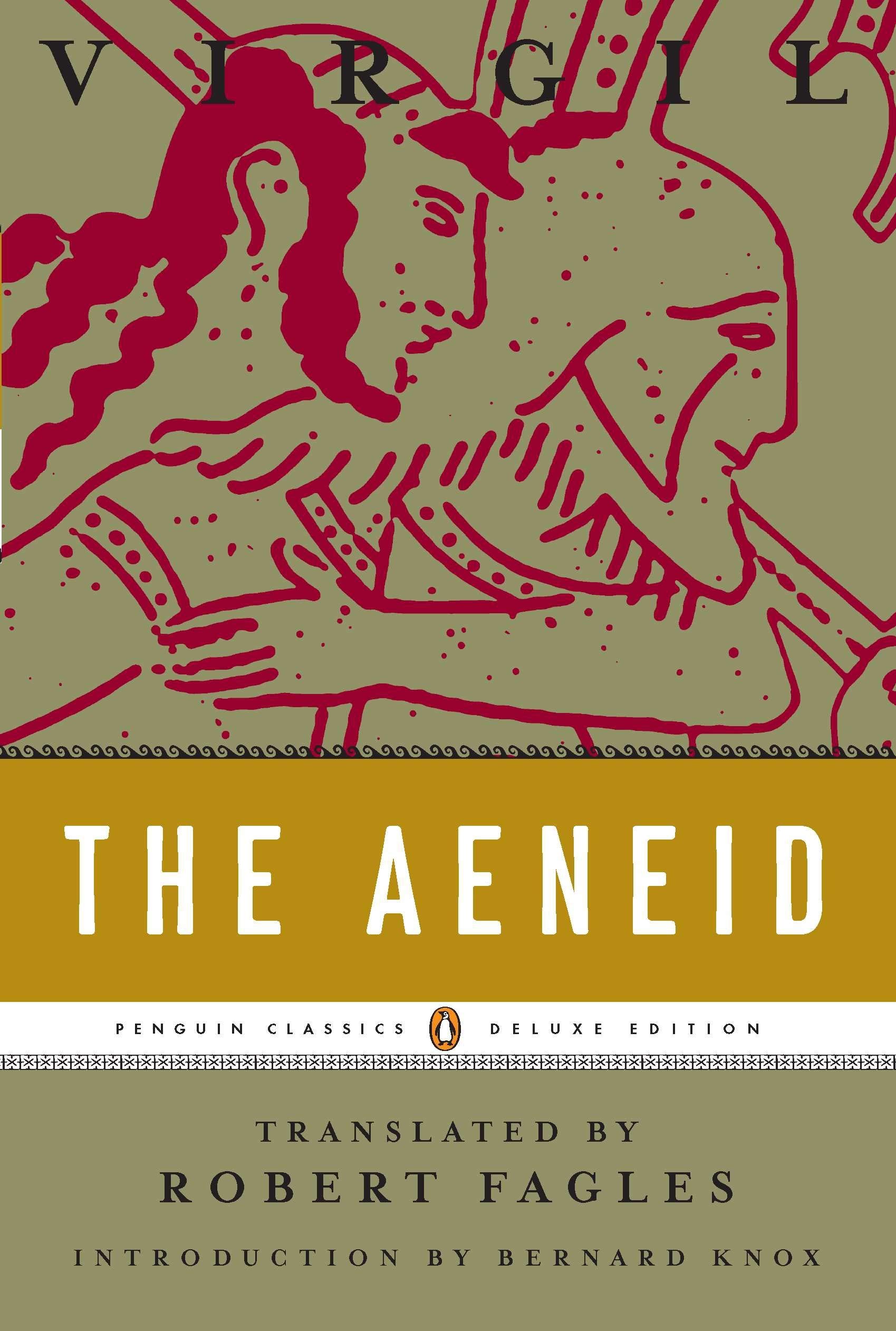
desertcart.com: The Aeneid (Penguin Classics Deluxe Edition): 9780143105138: Virgil, Fagles, Robert, Knox, Bernard: Books Review: epic undertaking - Allen Mandelbaum's translation of Virgil's Aeneid won the National Book Award in 1973. Of that translation Robert Fagles wrote: it "has a wonderful, detailed liveliness in every line." That's true. I love the Mandelbaum Aeneid and have taught undergrads from it for nearly a quarter-century. But into this year of stock depressions and women not being worthy of the Oval Office comes a ray of pure joy. (Yes, OK, Obama is a ray of hope, yes he is. But I don't teach him twice or three times a year.) The Robert Fagles translation is beyond lively: it's lyrical. It's compelling, like the poem itself. I think it may move even the least-motivated undergrad to feel . . . . something. Of the death of Dido: Mandelbaum: For as she died A death that was not merited or fated, but miserable and before her time and spurred by sudden frenzy, Proserpina had not yet cut a gold lock from her crown, not yet assigned her life to Stygian Orcus. Fagles: Since she was dying a death not merited or deserved, no, tormented, before her day, in a blaze of passion - While I miss the reiteration of "fate" (arguably Virgil's favorite noun) -- nam quia nec fato merita nec morte peribat,'sed misera ante diem subitoque accensa furore, -- I still find the Fagles lines more liquid and agonizing, more urgently pulling the reader along to an awful consequence. There's a similar comparison even in the best of Mandelbaum, the speech Aeneas makes to Dido, when the reader realizes how much he hates his life and how he longs to have been allowed to stay in Troy. And the text itself is a thousand time more helpful. Here is a longer glossary than in Mandelbaum's and maps and a genealogy and the best thing: digressive notes on the translation with sound-bites from other translations. Check out the info on the pictures on the temple doors in Book I. The best is the discussion - complete with quotes from Dryden writing about his own translation - on Mercury's line to Aeneas in 4.710-11. Anyone who doubts the inherent misogyny of Rome need read no further. Mandelbaum probably didn't get any control over the textual apparatus in the Bantam edition, but for a teacher - and I would think, a reader - that's really beside the point. What the Fagles' translation offers is much more helpful. Much. For this I may have to do that least-favorite thing: copy all my notes into a new edition. Sigh. Review: Trojan foundation of Rome - 'The Aeneid', of course, is one of history's great epics and rates a full five star rating. Fagle's translation is good, as are his introduction and comments. As an epic poem, it doesn't live up to Homer's grandeur. But, then again, whereas the Iliad and Odyssey were the product of many lyricists who 'sang' the tales centuries before Homer, 'The Aeneid' is the product of a single author, Virgil, and as a work by a single author the work has to be greatly respected. As an amateur historian I'm interested the history that may be behind the epics. In the case of the Odyssey and especially the Iliad, there is reason to believe that the account [excluding the Gods and Goddesses] is firmly based in the truth. 'omer 'smote 'is bloomin' lyre' approximately 600 years [Iron Age] following Bronze Age events but his poems still record the almost exclusive use of bronze implements and weaponry. Iron in Homer's songs is a rare and valuable metal. 'The Aeneid' clearly doesn't have this claim to authenticity. The tale, theoretically at least, still a Bronze Age world but Virgil, clearly not recognizing his error, puts iron weapons and implements in the hands of his protangonists many times, discrediting the overall veracity of the story. Then again, 'The Aeneid' has a different purpose than Homer's tales. Homer recited for entertainment but Virgil wrote to butter up Augustus and to provide the basis for a Roman foundation myth. Such myths were important. Alexander of Macedon, for example, claimed lineage from the remarkable Achilles. The question remains, however, did Virgil base his story on a previous tradition...a tradition which may have had some slight detail of fact? Fagles mentions that there were Roman myths regarding a Trojan beginning by 500 BC, which would be close to the time frame given Homer. Apparently, however, this wasn't just a Roman insider story because, as Fagles mentions, the destructive Pyrrhus came to Italy to conquer Rome. Pyrrhus claimed that he was a descendant of Achilles and that was his birthright as a Trojan-hater to finish the Trojan/Romans off. What do I think? I'd like to think that Trojan heroes made it to Italy where they helped to found the future Rome....but...I seriously doubt it. Ron Braithwaite, author of novels--'Skull Rack' and 'Hummingbird God'--on the Spanish Conquest of Mexico
| Best Sellers Rank | #5,809 in Books ( See Top 100 in Books ) #12 in Epic Poetry (Books) #301 in Classic Literature & Fiction #730 in Literary Fiction (Books) |
| Customer Reviews | 4.7 4.7 out of 5 stars (1,048) |
| Dimensions | 5.65 x 1.3 x 8.32 inches |
| Edition | Reprint,Deluxe |
| ISBN-10 | 0143105132 |
| ISBN-13 | 978-0143105138 |
| Item Weight | 1.23 pounds |
| Language | English |
| Print length | 484 pages |
| Publication date | January 29, 2008 |
| Publisher | Penguin Classics |
J**R
epic undertaking
Allen Mandelbaum's translation of Virgil's Aeneid won the National Book Award in 1973. Of that translation Robert Fagles wrote: it "has a wonderful, detailed liveliness in every line." That's true. I love the Mandelbaum Aeneid and have taught undergrads from it for nearly a quarter-century. But into this year of stock depressions and women not being worthy of the Oval Office comes a ray of pure joy. (Yes, OK, Obama is a ray of hope, yes he is. But I don't teach him twice or three times a year.) The Robert Fagles translation is beyond lively: it's lyrical. It's compelling, like the poem itself. I think it may move even the least-motivated undergrad to feel . . . . something. Of the death of Dido: Mandelbaum: For as she died A death that was not merited or fated, but miserable and before her time and spurred by sudden frenzy, Proserpina had not yet cut a gold lock from her crown, not yet assigned her life to Stygian Orcus. Fagles: Since she was dying a death not merited or deserved, no, tormented, before her day, in a blaze of passion - While I miss the reiteration of "fate" (arguably Virgil's favorite noun) -- nam quia nec fato merita nec morte peribat,'sed misera ante diem subitoque accensa furore, -- I still find the Fagles lines more liquid and agonizing, more urgently pulling the reader along to an awful consequence. There's a similar comparison even in the best of Mandelbaum, the speech Aeneas makes to Dido, when the reader realizes how much he hates his life and how he longs to have been allowed to stay in Troy. And the text itself is a thousand time more helpful. Here is a longer glossary than in Mandelbaum's and maps and a genealogy and the best thing: digressive notes on the translation with sound-bites from other translations. Check out the info on the pictures on the temple doors in Book I. The best is the discussion - complete with quotes from Dryden writing about his own translation - on Mercury's line to Aeneas in 4.710-11. Anyone who doubts the inherent misogyny of Rome need read no further. Mandelbaum probably didn't get any control over the textual apparatus in the Bantam edition, but for a teacher - and I would think, a reader - that's really beside the point. What the Fagles' translation offers is much more helpful. Much. For this I may have to do that least-favorite thing: copy all my notes into a new edition. Sigh.
M**O
Trojan foundation of Rome
'The Aeneid', of course, is one of history's great epics and rates a full five star rating. Fagle's translation is good, as are his introduction and comments. As an epic poem, it doesn't live up to Homer's grandeur. But, then again, whereas the Iliad and Odyssey were the product of many lyricists who 'sang' the tales centuries before Homer, 'The Aeneid' is the product of a single author, Virgil, and as a work by a single author the work has to be greatly respected. As an amateur historian I'm interested the history that may be behind the epics. In the case of the Odyssey and especially the Iliad, there is reason to believe that the account [excluding the Gods and Goddesses] is firmly based in the truth. 'omer 'smote 'is bloomin' lyre' approximately 600 years [Iron Age] following Bronze Age events but his poems still record the almost exclusive use of bronze implements and weaponry. Iron in Homer's songs is a rare and valuable metal. 'The Aeneid' clearly doesn't have this claim to authenticity. The tale, theoretically at least, still a Bronze Age world but Virgil, clearly not recognizing his error, puts iron weapons and implements in the hands of his protangonists many times, discrediting the overall veracity of the story. Then again, 'The Aeneid' has a different purpose than Homer's tales. Homer recited for entertainment but Virgil wrote to butter up Augustus and to provide the basis for a Roman foundation myth. Such myths were important. Alexander of Macedon, for example, claimed lineage from the remarkable Achilles. The question remains, however, did Virgil base his story on a previous tradition...a tradition which may have had some slight detail of fact? Fagles mentions that there were Roman myths regarding a Trojan beginning by 500 BC, which would be close to the time frame given Homer. Apparently, however, this wasn't just a Roman insider story because, as Fagles mentions, the destructive Pyrrhus came to Italy to conquer Rome. Pyrrhus claimed that he was a descendant of Achilles and that was his birthright as a Trojan-hater to finish the Trojan/Romans off. What do I think? I'd like to think that Trojan heroes made it to Italy where they helped to found the future Rome....but...I seriously doubt it. Ron Braithwaite, author of novels--'Skull Rack' and 'Hummingbird God'--on the Spanish Conquest of Mexico
G**E
Very nice edition with useful information
N**.
"Wars and a man I sing..."
This is the second translation to Virgil's "The Aeneid" I've read and so far it's the one to beat. I think Fangles does a great job making this poem accessible and easy to understand. My one knock against it, and this is just a nerdy critique, is that the poem is not arranged in hexameters like the original Latin, so references specific lines isn't the easiest. But overall, I would recommend this translation hands down
A**S
Just excellent
N**S
pleasing to read
H**M
PLEASE BE AWARE ~ This review is for the Penguin Classics Deluxe Edition only. Amazon have replicated my review on the Oxford Classics edition webpage which is inaccurate. If I'd gone on the strength of the pitiful reviews on here, I'd never have bought this version and would, instead, have opted for perhaps the Oxford Classics version. However, a personal twist of fate (American partner bought this, and I wanted to keep abreast) meant me purchasing this over another. I can't speak highly enough, especially given the trepidation I felt before receiving it. Fagles' translation is superb, and for anyone new to Aeneid, you're in for a serious treat. If the Aeneid was a film, it would be something high octane, probably directed by Ridley Scott or James Cameron (the good ones!). The language is powerful, luxurious, surging forward off the pages. Fagles' use of present tense does not damage the experience for me whatsoever. If anything, it brings the experience of this adventure to the fore. In short, a page-turner. It's exciting. Take, for example, this wonderful early description of King Aeolus' Winds that he keeps locked up: "With such anger seething inside her fiery heart the goddess reached Aeolia, breeding-ground of storms, their home swarming with raging gusts from the South. Here in a vast cave King Aeolus rules the winds, brawling to break free, howling in full gale force as he chains them down in their dungeon, shackled fast. They bluster in protest, roaring round their prison bars with a mountain above them all, booming with their rage. But high in his stronghold Aeolus wields his scepter, soothing their passions, tempering their fury. Should he fail, surely they'd blow the world away, hurling the land and sea and deep sky through space. Fearing this, the almighty Father banished the winds to that black cavern, piled above them a mountain mass and imposed on all a king empowered, by binding pact, to rein them back on command or let them gallop free." Stunning. I have to say, Penguin have done a lovely job with the deluxe classic editions they're printing. Mine has a different, golden cover, and the page edges are milled. I'm not sure what this edition is like, but it is also a deluxe edition so I imagine it's pretty sumptuous. (Edit ~ the stock photo now shows the same version I have). Incidentally, the reviews on amazon.com are far more balanced and informing and if you're deliberating over which edition might suit you best, you could do worse than taking stock of what folks the other side of the pond are saying about this.
H**S
Recommended
S**N
I already have a kindle version. But with some classics, need to be read many times and annotated over time to refine one's understanding of it. This is one such classic.
Trustpilot
Hace 3 semanas
Hace 2 meses