We remain fully operational. Our teams are working around the clock to ensure your deliveries continue safely.

Descargar la aplicación


Servicios al cliente
Sobre nosotros
Copyright © 2025 Desertcart Holdings Limited
Descargar la aplicación
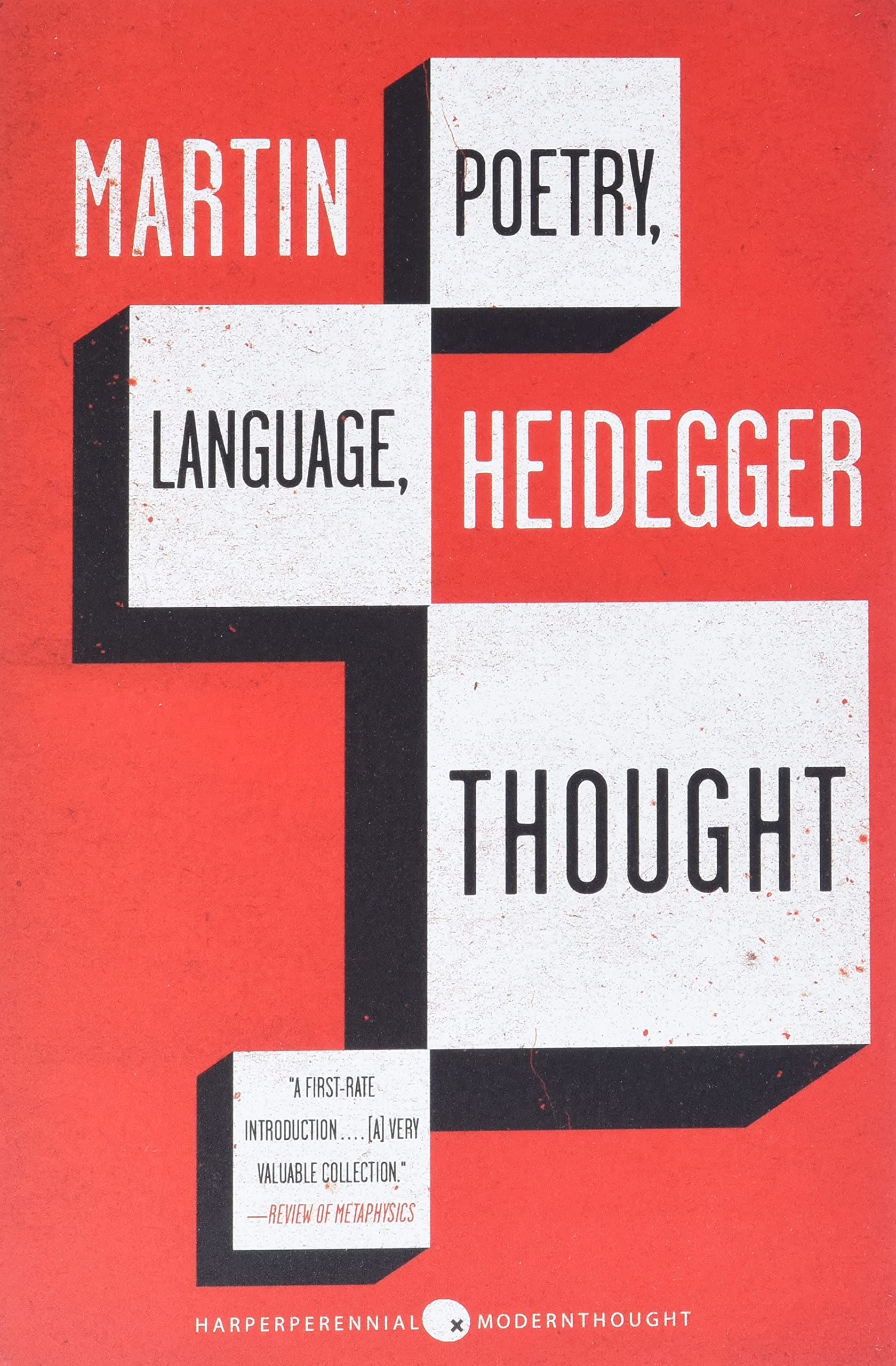
desertcart.com: Poetry, Language, Thought: Essential Philosophy―Heidegger's Brilliant Writings on Art, Truth, and Thinking (Harper Perennial Modern Thought): 9780060937287: Heidegger, Martin: Books Review: Deserves a Second Read - This was the first of Heidegger that I ever read, and it pushed me to pursue many philosophical questions about art and thought. P.L.T. deserves at least two read-throughs to understand all of what Heidegger is saying. Many of the thoughts he writes about in this book, he further develops in other writings. Heidegger tackles many deep subjects about the nature of art and how humans interact with it. His philosophy seems clearly influenced by the Ancient West—people like Plato and Aristotle—but he opposes Plato especially by arguing that poetry (and art) is the highest form of truth. Review: Prompt processing of order and personalized attention - Used book for pleasure reading - received in excellent condition
| ASIN | 0060937289 |
| Best Sellers Rank | #116,876 in Books ( See Top 100 in Books ) #24 in Phenomenological Philosophy #43 in Philosophy Aesthetics #164 in Philosophy Metaphysics |
| Customer Reviews | 4.6 4.6 out of 5 stars (120) |
| Dimensions | 5.31 x 0.58 x 8 inches |
| Edition | Later Printing Used |
| ISBN-10 | 9780060937287 |
| ISBN-13 | 978-0060937287 |
| Item Weight | 2.31 pounds |
| Language | English |
| Print length | 256 pages |
| Publication date | November 6, 2001 |
| Publisher | Harper Perennial Modern Classics |
R**Y
Deserves a Second Read
This was the first of Heidegger that I ever read, and it pushed me to pursue many philosophical questions about art and thought. P.L.T. deserves at least two read-throughs to understand all of what Heidegger is saying. Many of the thoughts he writes about in this book, he further develops in other writings. Heidegger tackles many deep subjects about the nature of art and how humans interact with it. His philosophy seems clearly influenced by the Ancient West—people like Plato and Aristotle—but he opposes Plato especially by arguing that poetry (and art) is the highest form of truth.
A**R
Prompt processing of order and personalized attention
Used book for pleasure reading - received in excellent condition
A**R
As expected
Clean and pristine.
K**S
This is what makes him both so hard to comprehend rationally and so beautiful to read
This collection of essays on the purpose of art and the relationship between art, language, and thought epitomized through poetry is a dense but fascinating read. Heidegger ultimately argues that the purpose of art is to mark the boundary between things and being. The contemplation of what it is to Be is the defining characteristic of humanity. All things Are but only humans think about what it is or means to Be. According to Heidegger, language is merely utilitarian unless it points to beingness. Without illuminating the gap between merely doing things and the awarenss of beingness, language is dead. Language speaks only when it demarks the boundary of the mystery of Being. Because much poetry explicitly uses language to explore existence beyond the literal, it is the epitome of art - dancing in the gap between language and inarticulable consciousness. The essays indicate a spiritual understanding of the profound humanness of consciousness of that which is beyond and engages with some poems in a way that tend to indicate a willingness to accept a literal embodiment of Heaven and Earth that strikes me as contrary to the understanding of the mystery of Being discussed outside the context of the specific poems. Although Heidegger presents himself as a philosopher and a rational thinker, he cannot remain so in the context of this conversation. He is explicitly trying to use language to point out how language is used to illuminate the gap between concrete, objective facts and subjective understandings of the world, amd to do that, he is required to use language in exactly the poetic way he is describing. This is what makes him both so hard to comprehend rationally and so beautiful to read. He is writing poetically on the nature of poetic use of language. As a reader of poetry and a writer and storyteller, there was nothing in these essays that I didn't already know from my experience working with language and art, but it was a pleasure to engage with a serious thinker thinking seriously about these ideas. In the final essay in the collection, he makes an argument that Kindness is foundational for human being and awareness of the world that allows for understanding. Although it is not addressed in this book, this final point about Kindness gets to the heart of the biggest intellectual problem with Heidegger for a modern audience - his anti-Semitic acts and his relationship with Nazism. In Heidegger's thinking, caring is fundamental for knowledge and because human beings are incapable of caring about everything, we cannot help living in a bubble of knowledge surrounded by ignorance. And, it is clear that in his life, his caring did not encompass politics enough for him to see what we now see about the world he lived in.
A**R
Five Stars
Wrong frontpage compared to the one received
O**L
"The sail of thinking keeps trimmed hard to the wind of matter"
So writes Martin Heidegger in Section I, The Thinker as Poet (Aus der Erfahrung des Denkens) of "Poetry, Language, and Thought" translated by Albert Hofstadter and originally published in 1971. The 233 pages include seven essays: I The Thinker as Poet II. The Origin of the Work of Art III. What Are Poets For? IV. Building Dwelling Thinking (Note: omission of commas is intentional) V. The Thing VI. Language VII. "....Poetically, Many Swells." Heidegger, who lived to 86 years of age, had time to write extensively about why philosophers since Plato were wrong. Not only did they often ask the wrong questions but also misunderstood the nature of Being and man's basic relationship to the nature of things. Before he was finished, Heidegger had shook up philosophy, psychology, aesthetics, some aspects of religion, and made forays into thought in politics and economics. Among the ways of thinking he is credited with influencing are existentionalism, phenomenology, and (possibly) the beliefs of the Nazis. That hard-trimmed sail of thinking had its meaning in the world of real, perceived, actual matter. The 22 paqe introduction by editor & translator Albert Hofstadter provides a useful summary of these broader aspects of Heidegger's thought, particularly his 1927 "Being and Time," and offers valuable analyses of each of the seven chapters. These analyses discuss both the salient ideas and the nuances of the translation. The meaning to Heidegger, for instance, of "ereignen" is ".....a coming into the open, the clearing, the light---or disclosure---with the conjunction and compliancy of mutual appropriation." (p. xxi) As the other reviewer has remarked, Heidegger's writing can have moments of incomprehensibility, but can reward patient reading. However, much may be both accessible and beautiful to readers familiar with poets such as Ranier Maria Rilke, because the essays tend to be reflections on poets, writers, and thinkers. This familiarity can give readers a leg up and also leave us with a more complex, complicated, and perhaps ultimately noble understanding of these poets. Here for example is Heidegger on Rilke's Angel, which shows Heidegger's word-play (haleness, holiness, wholesome) that is characteristic of this translation and according to Hofstadter, the German original: "In the invisible of the world's inner space, as whose worldly oneness the Angel appears,the haleness of worldly beings becomes visible. Holiness can appear only in the widest orbit of the wholesome.." Reader Alert: This book is English only and translation only except in a few phrases. It is not a bilingual edition. There is no index and only a few brief references to the original sources of the seven essays. That is, the book was brought together with Heidegger's approval from varied other work because the editor/translator felt the essays fit together on the topic of poetry, language, and thought. This is a good thing indeed for readers interested in this aspect of Heidegger's thought since the original souces are magazines and journals not easily accessible to many of us, such as Jahrbuch der Akademie, Bund l, 1951. OVERALL: Highly recommended. The version reviewed here is paperback, Harper Perennial Classics, 2001, with usual quality paper and binding. Quoting again, "We are too late for the gods and too early for Being. Being's poem, just begun, is man." As a reader, I may not be sure at first what Heidegger means exactly, but I do like thinking about it until a meaning(s) is clearer, and perhaps other readers will too.
D**S
Great book and was delivered in good condition.
D**L
This is a great collection of some of the central writings of Heidegger. Highly recommended.
N**H
Very dense- as is most of Mr Heidegger; but if taken slowly & patiently, is very instructive.
P**G
Great delivery time. Thank you.
Trustpilot
Hace 2 meses
Hace 2 días