Murder in Piccadilly (British Library Crime Classics)
Product ID: 15163790
Buy anything from 5,000+ international stores. One checkout price. No surprise fees. Join 2M+ shoppers on Desertcart.
Desertcart purchases this item on your behalf and handles shipping, customs, and support to Bolivia.
desertcart.com: Murder in Piccadilly (British Library Crime Classics): 9781464203732: Kingston, Charles, Edwards, Martin: Books Review: Mysteries have changed... - "Murder in Piccadilly: A British Library Crime Classic", by Charles Kingston, is a reprint of a mystery, originally published in 1936, by Poisoned Pen Press. The book is set in London, 1936, and the reader has to realise that styles of mystery writing have changed in the intervening 70 years. Not necessarily improved...but changed. This is not "your" mystery, but more likely your grandmother's. Poisoned Pen Press is republishing a series of these mysteries; "Piccadilly" is the second, so far. "Murder in Piccadilly" is a fun read that is as much a study of mid-1930's society as it is a "who done it". Only one murder occurs, and, though done by a stiletto, is surprisingly bloodless. Much bloodier, in a way, are the conversations among the characters. "Bobbie" Cheldon is a 24 year old man who is waiting for his wealthy uncle to die and leave him his fortune and his estate. Unfortunately, Uncle Massy isn't THAT old, and besides being snobbish, crotchety, and cheap, is likely to live for a while yet. Bobbie is getting tired of waiting for his fortune to be made for him and is unwilling to work for a living. Like many young men without a life's path, he is weak and easily led. And led he is by Nancy Curzon, a 19 year old dancer from Whitechapel. Nancy has appeared in Bobbie's life and is only willing to remain with him if he's rich. Bobbie, who must be the stupidest person in Christendom, is unable or unwilling to see Nancy's true nature. Everyone around him, though, can see it just fine. Okay, so Uncle Massy must die - and he does - for the book to continue. The Scotland Yard detective, Chief Inspector Wake, begins his investigation by asking that old Latin question - "cui bono" - and his investigation brings him directly to Bobbie, the heir. Wake's sized up Bobbie pretty well and knows that he is too weak minded to actually do the deed, so Wake concentrates on Nancy and other characters in her world. Because, even if Bobbie is the direct heir - 10,000BP a year! - others also stand to benefit. Wake and his men investigate and even find the killer, but then a twist at the ending leaves everything - and everyone - at a bit of a loss. It's a clever book, well told. The best thing about this book - and I presume the others in the series - is that it is written contemporaneously. Everything we're reading about actually existed at the time. This is what a a slice of London society looked like. As I like reading historical novels - mysteries, included - it was great fun to read "Murder in Piccadilly" and I'm giving it a 5 star review, within its own genre. IF you're not interested in historical fiction, then you might not like "Murder in Piccadilly" as much as I did. (I was given this book by Poisoned Pen Press, in exchange for an HONEST review, which I have given. I am honest about liking the genre, but telling others who may not, not to buy the book. How much more "honest" can I get?) Review: A mystery with a mysterious author - Perhaps the biggest mystery involved in Charles Kingston’s “Murder in Piccadilly” isn’t even in the book. Who exactly was Charles Kingston? Historians of the Golden Age of the crime and detective novel know that Kingston;’s real name was Charles Kingston O’Mahoney. He has written one historical work, “The Viceroys of Ireland,” before he turned to crime writing. He wrote some 23 mystery novels from 1925 to 1945, He was born in 1884. Dorothy Sayers appears to have been a fanh, or at least gave him a good review. And that’s about all anyone knows of Charles Kingston. “Murder in Piccadilly,” published in 1936, was the first of seven novels involving Chief Inspector Wake of Scotland Yard. There’s nothing flashy or eccentric about Chief Inspector Wake – he gets the hob done and the criminal brought to justice by simple and plodding hard work. He knews the terrain he’s investigating, and he knows the people who inhabit it. And he’s relentless. In this first Chief Inspector Wake novel, what I investigated is technically not a mystery. We know how Massy Cheldon came to be killed – with a knife to the heart in the Piccadilly underground station, We know why he was murdered – he had a lot of money, and the heir didn’t want to wait for the old man to die of natural causes. We know all the people involved in the crime. But Chief Inspector Wake doesn’t know what we know, and he is determined to find out what actually happened. So “Murder in Piccadilly” is less a mystery and more of a “will the detective catch the perpetrators” kind of story. Kingston is particularly strong in his characterizations. The crook con artist living offered a borrowed pound here and there; the night club dancer; the weak, spoiled heir who allows himself to be manipulated by all the wrong sorts; and even the capable, competent if rather dull police detective. The reader can easily see the characters because Kingston is so good in describing both their physical looks and their thoughts and actions. The novel is one of the mysteries from the Golden Age (and earlier) being republished by the British Library in its Crime Classics series. Kingston’s novels have been long out of print; this novel, in fact, is the only one available without having to visit used bookstores. “Murder in Piccadilly" is another good example of the kind of books popular in the decades of the 1920s through the 1940s when mysteries and crime novels were enjoyed by large numbers of people in Britain and North America.
| Best Sellers Rank | #2,149,006 in Books ( See Top 100 in Books ) #5,380 in Historical Mystery #8,520 in Traditional Detective Mysteries (Books) #11,770 in Classic Literature & Fiction |
| Customer Reviews | 3.8 out of 5 stars 280 Reviews |
G**L
Mysteries have changed...
"Murder in Piccadilly: A British Library Crime Classic", by Charles Kingston, is a reprint of a mystery, originally published in 1936, by Poisoned Pen Press. The book is set in London, 1936, and the reader has to realise that styles of mystery writing have changed in the intervening 70 years. Not necessarily improved...but changed. This is not "your" mystery, but more likely your grandmother's. Poisoned Pen Press is republishing a series of these mysteries; "Piccadilly" is the second, so far. "Murder in Piccadilly" is a fun read that is as much a study of mid-1930's society as it is a "who done it". Only one murder occurs, and, though done by a stiletto, is surprisingly bloodless. Much bloodier, in a way, are the conversations among the characters. "Bobbie" Cheldon is a 24 year old man who is waiting for his wealthy uncle to die and leave him his fortune and his estate. Unfortunately, Uncle Massy isn't THAT old, and besides being snobbish, crotchety, and cheap, is likely to live for a while yet. Bobbie is getting tired of waiting for his fortune to be made for him and is unwilling to work for a living. Like many young men without a life's path, he is weak and easily led. And led he is by Nancy Curzon, a 19 year old dancer from Whitechapel. Nancy has appeared in Bobbie's life and is only willing to remain with him if he's rich. Bobbie, who must be the stupidest person in Christendom, is unable or unwilling to see Nancy's true nature. Everyone around him, though, can see it just fine. Okay, so Uncle Massy must die - and he does - for the book to continue. The Scotland Yard detective, Chief Inspector Wake, begins his investigation by asking that old Latin question - "cui bono" - and his investigation brings him directly to Bobbie, the heir. Wake's sized up Bobbie pretty well and knows that he is too weak minded to actually do the deed, so Wake concentrates on Nancy and other characters in her world. Because, even if Bobbie is the direct heir - 10,000BP a year! - others also stand to benefit. Wake and his men investigate and even find the killer, but then a twist at the ending leaves everything - and everyone - at a bit of a loss. It's a clever book, well told. The best thing about this book - and I presume the others in the series - is that it is written contemporaneously. Everything we're reading about actually existed at the time. This is what a a slice of London society looked like. As I like reading historical novels - mysteries, included - it was great fun to read "Murder in Piccadilly" and I'm giving it a 5 star review, within its own genre. IF you're not interested in historical fiction, then you might not like "Murder in Piccadilly" as much as I did. (I was given this book by Poisoned Pen Press, in exchange for an HONEST review, which I have given. I am honest about liking the genre, but telling others who may not, not to buy the book. How much more "honest" can I get?)
G**G
A mystery with a mysterious author
Perhaps the biggest mystery involved in Charles Kingston’s “Murder in Piccadilly” isn’t even in the book. Who exactly was Charles Kingston? Historians of the Golden Age of the crime and detective novel know that Kingston;’s real name was Charles Kingston O’Mahoney. He has written one historical work, “The Viceroys of Ireland,” before he turned to crime writing. He wrote some 23 mystery novels from 1925 to 1945, He was born in 1884. Dorothy Sayers appears to have been a fanh, or at least gave him a good review. And that’s about all anyone knows of Charles Kingston. “Murder in Piccadilly,” published in 1936, was the first of seven novels involving Chief Inspector Wake of Scotland Yard. There’s nothing flashy or eccentric about Chief Inspector Wake – he gets the hob done and the criminal brought to justice by simple and plodding hard work. He knews the terrain he’s investigating, and he knows the people who inhabit it. And he’s relentless. In this first Chief Inspector Wake novel, what I investigated is technically not a mystery. We know how Massy Cheldon came to be killed – with a knife to the heart in the Piccadilly underground station, We know why he was murdered – he had a lot of money, and the heir didn’t want to wait for the old man to die of natural causes. We know all the people involved in the crime. But Chief Inspector Wake doesn’t know what we know, and he is determined to find out what actually happened. So “Murder in Piccadilly” is less a mystery and more of a “will the detective catch the perpetrators” kind of story. Kingston is particularly strong in his characterizations. The crook con artist living offered a borrowed pound here and there; the night club dancer; the weak, spoiled heir who allows himself to be manipulated by all the wrong sorts; and even the capable, competent if rather dull police detective. The reader can easily see the characters because Kingston is so good in describing both their physical looks and their thoughts and actions. The novel is one of the mysteries from the Golden Age (and earlier) being republished by the British Library in its Crime Classics series. Kingston’s novels have been long out of print; this novel, in fact, is the only one available without having to visit used bookstores. “Murder in Piccadilly" is another good example of the kind of books popular in the decades of the 1920s through the 1940s when mysteries and crime novels were enjoyed by large numbers of people in Britain and North America.
R**B
A murder mystery involving a substantial inheritance
A clever plot revolves around a greedy and spoiled young man who is manipulated by a cunning gangster to ‘speed up’ his hoped for inheritance.
A**K
Extremely well done. Highly recommended.
It's always a pleasure to find a mystery novel with a new and distinct structure, good characters, and unquestionable plausibility. Charles Kingston is not a well-known name—he is not in the 1971 extensive catalogue of Barzun and Taylor. Crime novels are often long on the whodunit puzzle and short on character, but Murder in Piccadilly is full of well-developed characters and their personalities are essential to the plot. It all flows smoothly and naturally—simply a delight to read. It is pleasantly free of the hallowed cliche's and customary formulas of the genre. If there are more by Charles Kingston, I certainly hope to find them soon.
H**N
Interesting Golden Age British mystery with a weak ending
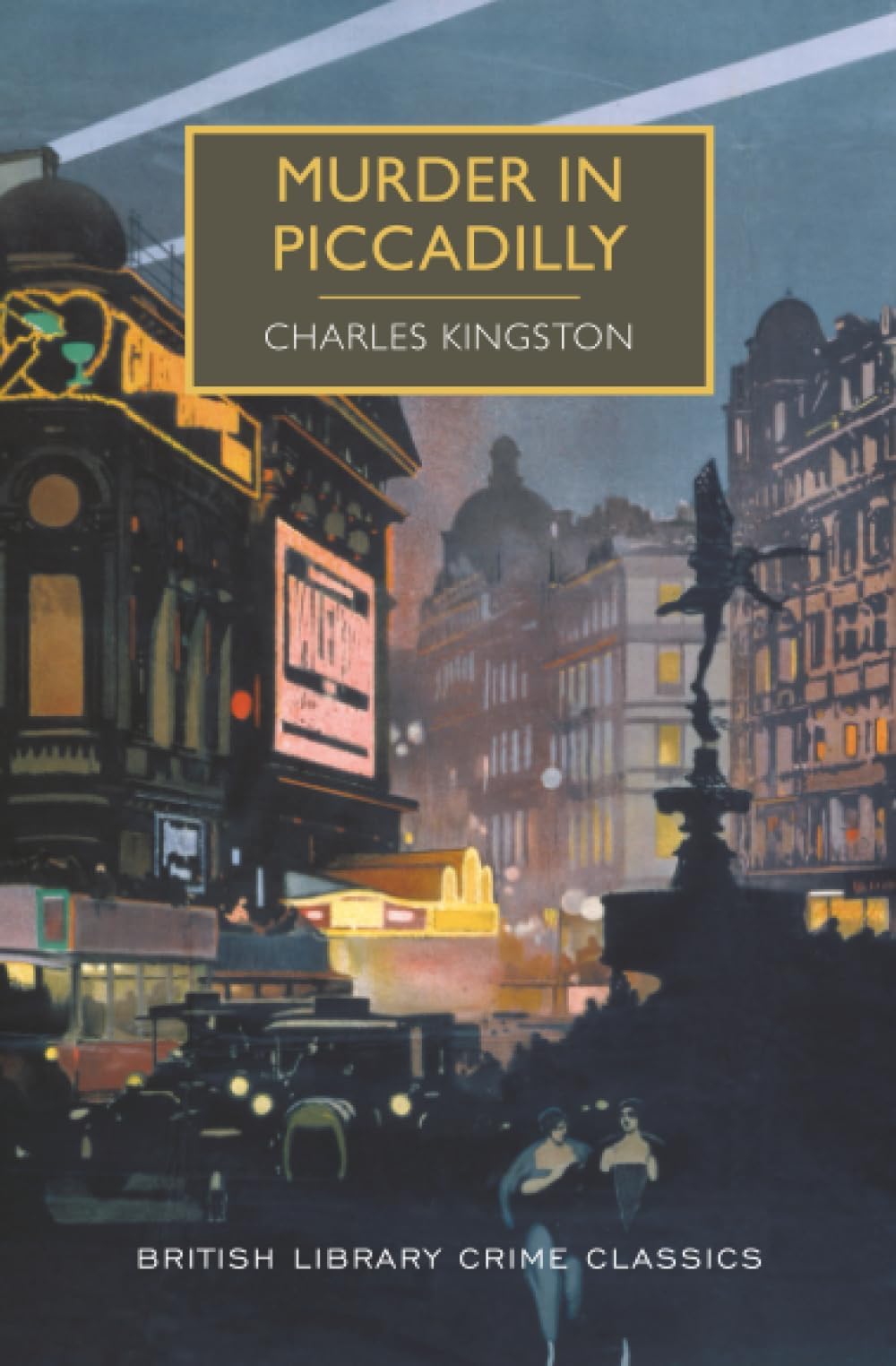
This is another entry in the British Library Crime Classics series that reprints (mostly) Golden Age mysteries, often by authors who are now forgotten. This book is an instance; I'd never previously heard of Charles Kingston (real name Charles Kingston O'Mahoney). The cast of characters in this book seems to have escaped from a P.G. Wodehouse novel: The rich but stingy uncle; the lazy nephew, anxious to collect his inheritance; the scheming lower-class dancer hoping to marry the nephew and his inheritance. I kept waiting for Bertie Wooster to appear and, with the help of Jeeves, set everything right. The book is well written and engaging. My only real objection is that it comes to rather an abrupt (and surprising) conclusion. The pace suddenly accelerates at the end in way that seems jarringly out of synch with the rest of the book. I almost wonder whether Kingston was racing to meet a deadline or whether the manuscript was initially too long (at 305 pages in this edition, it is lengthier than the typical mystery of the period) and he was obliged at the last minute to trim it down. I knocked one star off the rating to account for the rather unsatisfactory ending. I like the design of the books in this series. Many, like this one, use images from period travel posters on their covers. Martin Edwards contributes a useful introduction, recounting what little is now known of Kingston. One word of warning, however: Edwards divulges too much of the plot for my tastes. So I would read the introduction after finishing the book rather than before. I would avoid reading the copy on the back cover for the same reason.
A**W
NOT a Mystery!!
This review is for the paperback edition. The grammar is good, the sentence structure is good, and five of the main characters have been given very good character development (for these reasons I have rated the book as 2 star instead of 1 star). However, there is no mystery. A murder is planned, a murder is accomplished (not until long after page 100), and Scotland Yard becomes involved and solves the mystery (which is no mystery to the reader). The Chief Inspector Wake from Scotland Yard was the only truly delightful character in the book. There are also a few twists in the last few pages of the book which almost make it worthwhile reading (but only if the reader is not interested in reading a mystery). The clean-up at the end is haphazard and lacking, especially after all of the extraneous words/sentences used to write this novel.
A**E
Okay Story But The Actual Crime Is Almost Halfway Through The Book!
Before this, I read a book entitled The Piccadilly Murder by Anthony Berkeley so I decided that since I had another book with the same setting, I'd give it a go. It's a pretty reasonable setup: Bobbie Cheldon, a young man of name but not yet means, falls for a dancer in a club and wishes to marry. The dancer is a gold-digger and not satisfied to have a husband with a job so will only marry him if he inherits the title and manor. Uncle Massey Cheldon is the current holder of those things and likely to live a couple decades yet, much to Bobbie's chagrin. Enter a couple of others from the club who see an opportunity and before too long a plot is concocted and embarked upon to get Bobbie his inheritance. The murder of Uncle is investigated and proves wily for the detectives to solve but there was a ringer in the end that none saw coming that made fools all around. The actual murder here takes place almost halfway through the story and no, the preamble wasn't that scintillating to warrant so long a run-up. It's a peeve of mine in murder mysteries. Accordingly, the second half of the book was much faster. Chief Inspector Wake was okay but ultimately does not bring the architect of the conspiracy in and that was a bit unsatisfying. There are two racial slurs used in this story and given the characters, made sense. The extent of othering "foreigners" was threaded throughout and off-putting. To be sure, this story is peopled with plenty of dregs, properly English and spanning the class ladder. Trash from the top down. So, in the end, when so many anglers found their schemes or opportunism foiled, that was quite satisfying. Also, there's an aspect of the crime that is asked about at the end of the book and is never answered. I still have no idea who screamed and whether or not it was a connected diversion or part of the plan. That was annoying. The British Library Crime Classics are always worth reading even though each can't be a favourite. The forward by Martin Edwards of course didn't disappoint here and even referenced that other Piccadilly book I mentioned at the beginning of this review. A fair number of new-to-me words for crosswords and other puzzles were acquired: valetudinarian : person unduly concerned about their health; hypochondriac. purlieus : a person's usual haunts; surrounding area. termagant : harsh tempered, over-bearing woman. darbies : handcuffs. Memorable quotes & passages: On Bobbie Cheldon, lazy nephew: Bobbie’s hatred and contempt for his uncle were ingrained and nothing had ever happened to weaken them. The boy had grown up to idealise a father who had died in action on the very day that Massy Cheldon had received the O.B.E. for his eminent services as the Food Controller of a small provincial town. There had been nothing for the soldier except a shell which had torn him to pieces, but for the civilian there had been a reward for successful evasion of military service. On Massey Cheldon, mean uncle: Resentment deepened into something lower than mere jealousy when he reminded himself that all this youth and vivid enjoyment might one day—perhaps, soon—be allied with wealth. A street accident, poisoned food, any of the ordinary ills of life—the middle-aged man who was obsessed by meanness shuddered at the thought of being parted from his museum of coins, banknotes, share certificates and rents. and No one had ever thought of offering him anything outside the liability of his cheque-book and he resented any increase in the importance of his neighbours. An exchange on those who marry perpetually: “Most of my pals have had a shot at it and missed badly. Look at Tom Hedley who’s been married four times and——”“Four times!” Ruby exclaimed. “Why, it’s polygamy on the instalment plan.”
R**I
Murder in Piccadilly
An interesting portrait of London life and the chronic conflict between the hope for the reflected status of pseudo "royal " standing and the unwashed.....good story well written with the proper pacing and character development and a wonderful surprise ending.What more would a reader want for an evenings reading pleasure?
Trustpilot
3 days ago
2 weeks ago