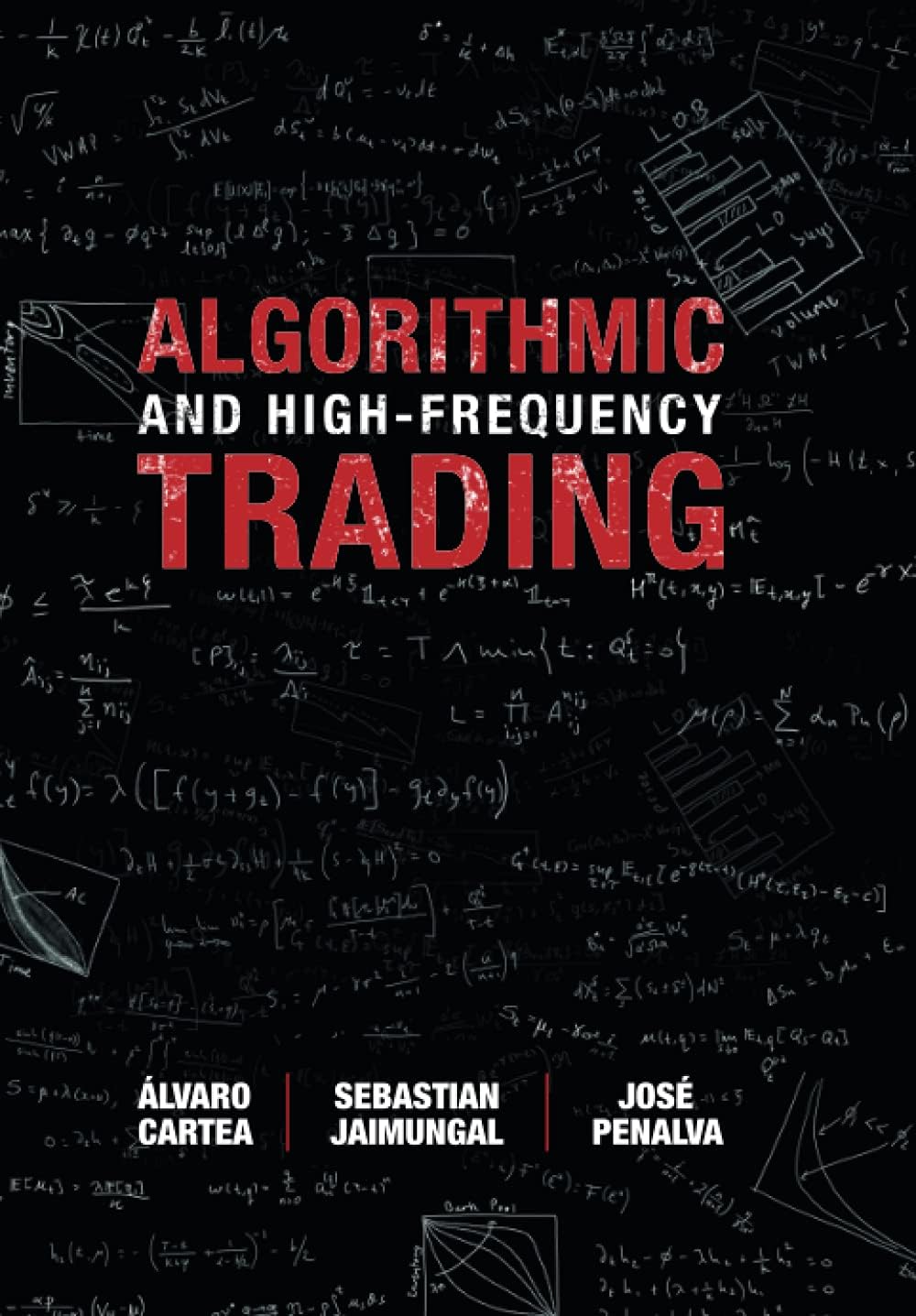
Algorithmic and High-Frequency Trading (Mathematics, Finance and Risk)
Product ID: 20567877
Desertcart purchases this item on your behalf and handles shipping, customs, and support to Bolivia.
The design of trading algorithms requires sophisticated mathematical models backed up by reliable data. In this textbook, the authors develop models for algorithmic trading in contexts such as executing large orders, market making, targeting VWAP and other schedules, trading pairs or collection of assets, and executing in dark pools. These models are grounded on how the exchanges work, whether the algorithm is trading with better informed traders (adverse selection), and the type of information available to market participants at both ultra-high and low frequency. Algorithmic and High-Frequency Trading is the first book that combines sophisticated mathematical modelling, empirical facts and financial economics, taking the reader from basic ideas to cutting-edge research and practice. If you need to understand how modern electronic markets operate, what information provides a trading edge, and how other market participants may affect the profitability of the algorithms, then this is the book for you. Review: Already a classic - Undoubtedly one of the best books out there on this topic. It is on the mathematical end but rooted on data and realistic applications. Those who want to learn about the maths behind trading algorithms must start here. Review: Good read - A very practically oriented and mathematically simple narrative. Plenty of examples of exactly solvable dynamic programming problems. Most chapters end with a discussion of practical implications of the calculations.
| Best Sellers Rank | #558,714 in Books ( See Top 100 in Books ) #54 in Financial Engineering (Books) #597 in Investment Analysis & Strategy #945 in Applied Mathematics (Books) |
| Customer Reviews | 4.2 out of 5 stars 73 Reviews |
A**C
Already a classic
Undoubtedly one of the best books out there on this topic. It is on the mathematical end but rooted on data and realistic applications. Those who want to learn about the maths behind trading algorithms must start here.
V**O
Good read
A very practically oriented and mathematically simple narrative. Plenty of examples of exactly solvable dynamic programming problems. Most chapters end with a discussion of practical implications of the calculations.
M**0
Five Stars
Very helpful and practical. Some mathematical maturity required.
R**4
Excellent book
Excellent book with detail explanation of derivations and applied to trading data.
R**N
it would also make an excellent resource for a student with advanced mathematical background that ...
This book gives a thorough coverage of modelling methods and algorithm design with the goal of optimal financial trading. The early parts of the book begin with description of market microstructure through a description of markets in practice, some of the classical theory of price discovery (such as the Kyle and Glosten-Milgrom models), and statistical analysis of high-frequency financial data. The later parts cover mathematical modelling of limit order book dynamics with methods of incorporating several features, and different techniques for formulating optimal trading problems. This material should be understandable by anyone with graduate level mathematics (specific topics in optimal control are introduced over the course of several chapters) and could definitely be used as a reference for a course in asset allocation or algorithmic trading. As such, it would also make an excellent resource for a student with advanced mathematical background that wants an introduction to market microstructure and trading through self-study, either with the intention of continuing with academic research or leading into an industry career where quantitative optimization of trading is an important factor. The two main strengths in my opinion are the extensive number of exercises (helpful in course design) and the clear explanation of the mathematical analysis in the latter half of the book. The most significant weakness is that I found two of the earlier chapters to be quite poorly written. Understanding some of the ideas and discussion of the topics took several rereads, and the interpretation and discussion of the statistical data analysis were quite dry. The clarity and importance of the later sections of the book make up for this though. Don't let the first few chapters turn you off before taking a stab at the second half of the book.
A**R
Definitely move along if you aren't an advanced calculus student that can write code using just proof
Can be useful but you have to be an advanced calculus student and have to understand proofs well without practical exercises. As of this writing very little is available on their website and I had bought the book more than 9 months ago the exercises and examples are "still coming". You need more data than what is provided for sure unless you want a biased result. On the good side they have a few good ideas. I had no idea what optimal stopping even was before i read this book.
G**L
The book is more of an academic art than a useful trading manual
Not very practical. The book is more of an academic art than a useful trading manual as the title indicated. It maybe useful for someone interested in academic research and paper publishing. As a previous reviewer said, the whole book is just putting everything together into a single HJB equation. It would have been better if the book could have more paragraphs devoted to numerical procedures.
D**O
Not for everyone/Unpractical
Despite its attractive title and presentation this book is not made for everybody. You will be interested in this book if you are a quant working in a Market Making firm, a hedge fund or an asset management firm (for these last two, only if you are an execution quant implementing algos to minimize market impact for large trades). All the book is based on a single mathematical framework which translates an objective function (representing an expected wealth constrained by variance, inventory, opportunity cost ...) to a sophisticated differential equations, dynamic programming equations (DPEs). This boils down to continuous reinforcement learning whose environment is defined by stochastic processes. Despite the effort made by the authors to make us believe that these techniques are used everywhere, they are in reality not. The DPE/Stochastic control framework is quiet new and as far as I know only very few market making firms are using it. This framework is only useful if your company is the main market maker on a market (and backtesting becomes less of an option). The concepts describe are not practical, the book provides the DPEs and analytical solutions for some specific cases but do not focus on the most important things, how do you solve DPEs and how do you implement them and scale them. In reality you never deal with three stocks etc... Do not get me wrong the framework is interested but the problem is how to truly implement it. There is no answer to that. I read some comments that seems very out of lines compare to what the book is really about, I will be cautious about them, they are probably fake. I put one star for the attempt the authors have to make us believe the book is about "Algorithmic and high frequency trading" in general, this is not the case. The book should be renamed "Stochastic control applied to finance".
A**R
Fantastic book for graduates and post-graduates
I'm a graduate student of Computational Finance and I found this book to be both challenging for my education level and extremely interesting. It provides an extensive introduction to concepts such as market microstructure, touching on the fundamental of stochastic calculus before introducing the stochastic optimisation chapter. The second part of the book is exclusively dedicated to algorithmic trading models. I found useful to support this book with Continuous-time Stochastic Control and Optimization with Financial Applications (Stochastic Modelling and Applied Probability) by Pham, which provides an in-depth mathematical structure where the reader may need it. Overall a great book, suggested to any student willing to get a self-contained guide for the field of algorithmic trading.
C**.
Wissenschaftliche Grundlagen
Die systematischen, finanztechnischen Überlegungen zur Darstellung der Algorithmen des High Frequency Tradings (HFT) sind hilfreich bei Beurteilung der Verfahrensweise von Dark Pools.
A**T
Amazing collection of trading problems and how to solve them
Amazing collection of trading problems and how to solve them. Not for the casually reader, but those willing to put in the effort will gain lots of insight. Some of the models need to be peppered with real world nuances to make them practical. My sense is that they wrote this book as a demonstration of how to apply control methods to algorithmic trading, rather than providing just a collection of rules of thumb. All in all, well worth the price.
D**S
Buon Libro
Ottimo Libro. Per gli amanti del trading. Richiede minime conoscenze di Matematica o Statistica. Se letto con grande cura, è ricco di spunti operativi.
A**A
Useless Dont waste
Useless Dont waste money
Trustpilot
2 months ago
3 weeks ago