

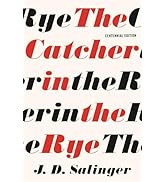
The Catcher in the Rye
Product ID: 211877
⭐4.4/5 from 47,638 readers
🏆Top 10 in Teen & Young Adult Classics
📚75 years of timeless literary impact
Desertcart purchases this item on your behalf and handles shipping, customs, and support to Bolivia.
📖 Own the classic that defined a generation’s voice—don’t miss out on the cultural phenomenon!
The Catcher in the Rye by J.D. Salinger is a seminal 1951 novel that captures the turbulent emotions of adolescence through the eyes of Holden Caulfield. Celebrated for 75 years, this top-ranked classic in Teen & Young Adult literature explores themes of alienation, rebellion, and the search for authenticity. With a 4.4-star rating from over 47,000 readers, this First Little, Brown and Company mass market paperback edition is a must-have for any discerning literary collection.



| Best Sellers Rank | #26,055 in Books ( See Top 100 in Books ) #5 in Censorship & Politics #9 in Teen & Young Adult Classic Literature #10 in Literature |
| Customer Reviews | 4.4 out of 5 stars 47,638 Reviews |
D**S
Famous book but the author style of writing is not for me
I had to read this book just because of all the incidents connected with it. I don’t particularly like the way the author writes even though he’s well known that doesn’t make him a good writer. Of course that is my opinion and everybody is different and some people may like his writing, but I don’t. In fact I could write better than him I know that, but everybody has different opinions and that is mine.. To tell you the truth, I didn’t finish the book just because I only wanted to find out what catcher in the Rye meant and I found out what it meant. That’s all I really wanted.
R**E
Dealing with Late Struggles of Youth
One scene that has always stuck in my mind in "It's A Wonderful Life" is when George Bailey and his future wife were talking and George was taking his time on making his move to kiss her for the first time, when in the background an old man said "Well are you going to kiss her or not, ahh youth is wasted on the young." To my way of thinking many classic novels which we as in our youth had to read and study and be tested on in high school and later in college, were actually never really fully understood or appreciated. To me, I was told to read these books and later the teacher or the professor would lecture and have active discussions in detail of the nuances and literal and figurative interpretations on the intentions of the author and the real plot of what the author was trying to convey to the reader. The better students would learn the triggers of success and mimic their instructor's persuasions and add "a little" of how the novel affected them in their young lives. But my take on many of these classics actually confused me and being the rebellious student that I was I usually didn't go with the program and in many instances took my rebellion in the force of protest and usually ended up with an old-fashioned hook a C. I did the same thing when I first read "Catcher in the Rye" in fact being very much like Holden Caulfield in my studies of this novel. The fact remains that as one grows older one gains from life experiences and is able to appreciate life on a wider and more knowledgeable scale. I have spent most of my academic life reading and writing of history and life memoirs of things that have actually happened. My studies were based on things that have happened. However I find myself being brought back to the classics and with that added maturity, I have found out that I do indeed understand them better. J. D. Salinger was really writing of his youth when he wrote this book. Holden Caulfield is a dysfunctional youth who in all reality hates the concept of growing up and following teacher or parental guidance or instruction. Being born to wealth and surrounded by siblings who all seemed to be normally adjusted youths, Holden held out to be the family "black sheep." The traumatic effect of his younger brother's death had deeply disturbed Holden. In fact this event may have started the trigger that he would rather remain a child and not grow up in the "phony" lifestyle of being an adult. The other key sibling that Holden held in very high regard was Phoebe who he regarded as not only as a sister but a person who personified the goodness in the essence of what youth is. Simple and loving! The book is written in the first person by Holden Caulfield and it tells of his relationships with his classmates, teachers and his parents. It is written in the mind of a seventeen year old which is contradictory, whimsical, funny, mad, nonsensical and at times very funny. In fact it does represent the brain of a person who has not fully developed. To tell you the truth this writing in the vernacular of a teenager, represents the brilliance of Salinger's writing. Some youth can adapt to the adult world and move on; others like Holden have a very hard time in doing so. My review intent is not to give away the meaning and plot of this classic book but to rather engage the reader to see that this book is indeed of deep meaning in which I never recognized 46 years ago. The meaning of the title makes sense as it never did before and as an added insertion to my discoveries I found this book to coincide greatly with the story of "Peter Pan." If you have never read the book do so. If you read it as a young student, I daresay read it again, it will surprise you!!!!
L**N
“I thought what I’d do is I’d pretend I was one of those Deaf Mutes.” (On Literary Censorship)
Holden Caulfield has been making the rounds again. Originally published in 1951, J.D. Salinger’s Catcher in the Rye maintains an unsavory status. While it is no longer banned with as much frequency as its early days — from 1961 to 1982 it was the most censored book in American schools and libraries — Holden Caulfield’s distinctly troubled and troubling voice solidifies its place as a novel rife with incredibly vocal and cyclical detractors. According to the ALA, it was the 10th most frequently banned or challenged book from 1990 to 1999. Around a month ago, following a rather strange list of books and authors a poster considered “problematic”, Catcher made its seemingly annual rounds on Twitter, where people extolled their dislike for the book and its protagonist. So what gives it such staying power, and what made it such an issue for so many in the first place? That it should be taught in schools seems natural given its teenage protagonist and his struggle to find his place amid the interim world of childhood and adult . Being depressed and/or disillusioned at 16 is a cliché for a reason, after all. No matter how much we want to brush it under the rug, kids struggling to find their way in a society that emphasizes so strongly knowing the path of your future at such a young age is so common it’s hardly interrogated — it’s almost expected. So why, then, is there such a strong movement to stifle works that might help students understand or at least work through their emotions at such a chaotic time of life, and why is such a familiar protagonist so widely misunderstood and/or hated? Teachers have been fired for teaching Catcher. It’s been challenged or outright removed from schools and libraries since 1960 for “vulgar language”, sexual references, violence, and any number of other easy to grab buzzwords. It’s even been accused of being “part of a larger communist plot” and having had something to do with multiple shootings, from Reagan’s assassination attempt to John Lennon’s murder. The truth of it is, though, it’s the story of a 16 year old boy sitting in a mental institution recounting the story of how he ended up there, starting it out with “if you really want to know” and regretting having said any of it by the end. That this book was written in 1951 and so accurately depicts the numbness and emotional roller coaster of depression is both impressive and upsetting. That Holden Caulfield is received with such a range of response speaks just as much to the way we treat mental illness as the way we treat books. The reality no one wants to acknowledge — especially those seeking to ban the book from their children — is that Holden’s excessive use of language, his approach to dealing with sex, everything for which he is most commonly criticized are all perfectly ordinary high school student experiences even today. Everything parents seek to shield their children from are things they’re doing outside of earshot. Perhaps the most painful thing about Holden Caulfield’s character and the bannings tied to him relate to the “sexual references”. Reading Catcher in the Rye is an experience in reading mental illness and trauma in a palpable way. From page one we feel the weight of his life and emotions, even as he brushes some of the most traumatic happenings off with a sentence. There is every evidence — even an outright declaration — that Holden has experienced childhood sexual assault, which naturally complicates his relationship to sex and seems to prevent him from “getting sexy” with any girl, even when he wants to. Consequently the scenes where he is reckoning with this tension get interpreted as vulgarity. One of Catcher’s most harrowing scenes comes when he runs away to his former teacher’s house and wakes up to find this previously trusted authority figure stroking his head, sending Holden into the spiral that eventually lands him in the hospital. The description of his meltdown is painfully familiar to anyone who’s been in a similar situation. While it is perhaps not surprising that a book about a male sexual assault victim struggling to feel solid in a world that seeks only to push him toward the next milestone for societal success rather than actually listening to his pain, asking no real questions until he lands in a mental institution, it is unusual that it should garner the kind of reputation it has. That it is tied to things like assassinations — both attempted and successful — is odd to say the least when you reckon with the story itself, but may make sense when you consider the way most people consume art. People see what they want to see when it comes to things like literature and film. If they want an angry outcast out for revenge against society to justify their actions then they’ll find one. If they want an immoral character promoting violence, that’s what they’ll see. Most of what gives Holden Caulfield his staying power in the cultural conversation is his complexity. What makes him complex is the refusal to interrogate the fact that the way he interacts with the world is common to victims of things like assault. We’d rather see him as problematic than lost, more troublesome than desperate for help. He regrets telling his story to so many people because he starts missing the people he had flashes of connection with, however volatile. Meanwhile his point is proven by the way we react to him: no one, it seems, really wanted to hear about it after all.
G**D
If a body catch a body coming through the rye
"Anyway, I keep picturing all these little kids playing some game in this big field of rye and all. Thousands of little kids, and nobody's around - nobody big, I mean - except me. And I'm standing on the edge of some crazy cliff. What I have to do, I have to catch everybody if they start to go over the cliff (...)" J. D. Salinger is an American novelist and best known for this very book, The Catcher in the Rye, which is considered a classic of USA's literature, being in Times list of 100 best books since 1923. This book tells a rather uninteresting story of this sixteen-year-old character Holden Caulfield and his wanders through New York for a couple days, after his expulsion from his boarding school, exposing the real face of teenager's life, in which the main character is also the narrator. What is perhaps more interesting is that he has such a depressed and lonely way of life that it is almost impossible not to have anything in common with this global character, who is supposed to represent the transition from childhood to adult life. When I started reading this book, I found out that I was addicted to it, even though it had no plot at all. It really doesn't, it's just a dude telling about his life. But it is Holden who you are actually reading. I have never read, in my whole life, such a descriptive and well-developed character. You actually feel that you are reading a teenager's book who has failed in about four schools, not an intellectual like J. D. Salinger. That's probably why the book is so addictive: it's a clean and straightforward writing, which makes it feel real, a very real account. I do have a lot against writers and philosophers who are claimed to be wonderful and swell, but they can't write clearly such as Salinger does. This book may be read by anyone - in fact, it is aimed to teenagers and I do recommend them to read - and anyone who reads this book will understand what it is talking about. Some of them may not like, but they will surely get the least of it. Holden Caulfield is this teenager that wanders around New York and lives a very teenager life - don't forget this book was written in the 50's - and finds himself in the transition from child to adulthood; facing problems like an adult - and that's probably why Salinger set him alone in NY - but still with a mind of a kid. While he tries to evolve, starts to find out that everybody looks fake and lousy, but he turns out to be a complete hypocrite, which is probably the main purpose of the book. The title deserves five stars just for itself. Although you read the book until about the middle without getting where the author is trying to get you to, when Holden hears a little boy singing this song about a catcher in the rye - which he actually misspelled -, everything starts making sense. Holden flies through the book trying to find a shoulder to lean on, someone that will hold him while he's passing through his puberty, sexual life and depressing times of adolescence; and that's what he searches, even unaware of what's actually happening. While he's not getting anything that's valuable from his current relationships - which are represented by his Pencey school and his friends in there -, he goes way back to the innocence of childhood and brings back his old memories and relationships in attempt to survive the hard times that is entering the adulthood. But when he actually gets to those memories, he is not a kid anymore and his mind has changed. In this quest of finding "a catcher in the rye", Holden even unburies his dead brother Allie and contacts people who are still in their innocent times - such as his sister - and people who are really in the adulthood, like his old teachers. This transition is easily seen in every sense. From trying to drink being a minor to a massive change of his views on the world, contrasted by what he remembered things to be and what they really are right now. I highly recommend this book to anyone. This is surely one of the best - if not the best - novels I have ever read in my entire life. Although aimed to teenagers, this story is surely universal. 100/100
J**E
Holden, Holden, Holden...
I'm not really quite sure what all the fuss is about this book... I certainly found the narrative engaging, and I really enjoyed the authenticity with which Holden seemed to speak and express himself, but, while I identified with much of the way he felt and (re)acted, and the internal monologues were simply dead-on perfect, I never really connected with anything until I was nearly 90% finished. Perhaps had I read this when I was younger it would have affected me more, but now, as I try to find or create a connection, I'm just left... Well. I'm just left. It was Mr. Antolini's note to Holden that finally grabbed my attention. "It is the mark of an immature man that he wants to die nobly for a cause, while it is the mark of a mature man that he wants to live humbly for one." I was told I was too immature recently, and it just killed me. "Boy, it really did." I tried to figure it out and tried to understand how I gave that off. Without truly knowing what I was doing, I think I realized that I had given up on the option of living humbly (or living at all) for any cause at all long ago. Whether it be something, someone, or just myself. At some point I was finally able to see something in front of me and felt like I understood what it was to live for something. Not just, as I've often thought in the past, to be the catcher in the rye for anyone who strayed too close to the edge but to be the catcher for a specific reason... and to equally allow the possibility that I also, at times, might need a catcher myself. I wish I had the gift of speech and introspection such that I could have so succinctly put my thoughts, feelings, and actions into words. This epiphany... or at least the motivation for it... evaporated quite quickly, and I, missing the point, fell back into searching for something for which I could nobly die. To see Holden cry for and over his little sister for whom he obviously held a great respect and had the utmost love, come to the conclusion that he should not tell anyone anything was quite rather depressing. I waver, but is it worse to live in fear of missing someone and, therefore, remain isolated or is it worse to allow yourself to catch and be caught and, inevitably, miss those who caught you and are now gone? Did he "really like" people who were dead precisely because the only thing left to do was miss them? Knowing there was no hope of actually being open with those that he'd lost and, therefore, no risk in missing them more seems like the perfect depressing escape. One with which, in the past, I likely would have agreed completely. I still struggle with that question today, and I honestly don't know the answer, but I am glad this book turned out the way it did giving me another pretty clear perspective into one potential answer to one of life's most important questions. For Holden to have kept Mr. Antolini's paper (especially in a way that seemed meaningful to him) and still arrive at his final conclusion was a bit jarring. Especially in light of the final scenes when he *should* have been able to see the cause right in front of his face, even if he couldn't realize that he himself was cause enough. Sooo... I had to try pretty hard to pull something out of this that seemed to really matter to me, but I think I got it. Or at least I got something. Overall, enjoyable, but nothing particularly amazing. At least I can now say that I've read it.
P**S
Prescient Classic
Holden's cussing and some of his escapades made me cringe, but I am SO glad I finally read The Catcher in the Rye. Salinger was prescient in the writing of this book. Through Holden's vision on life and his panic at being the Catcher at the edge of the cliff, we can see the future decline of society.
H**Y
Amazing!!
Amazon sold this book for so much cheaper than the cover price! The book came in amazing condition, felt nice while reading, and was very high quality. The novel was amazing too!
A**N
Great book
I love this book! Great book and amazing price. It’s small and compact so they’re the exact same ones we read at school. I’m glad to have it.
V**A
Buen producto
Buena historia, muy buen formato de libro; es chico y poco pesado con hojas resistentes y no se pasa la tinta, el único detalle sería que llegó con un pequeño doblez en la tapa de atrás, pero nada más
M**T
Ok
A must have classics
G**A
An amazing read 😍🙌❤️❣️🎈
Read a sensitive novel after so long. The book is amazing and connects to us emotionally. Holden is not feeling emotionally ready for anything. And we find that we have also felt the same at some point in our lives. The vividness with which he explains each and every person he has ever interacted with is very true, very deep and very close to reality. The foggy things that goes in our mind, Holden speaks them out and is no where far from from real and that is why we understand what he goes through in those 3 days. Throughout the book I find Holden to be clearly suffering from depression, which he himself mentions quite a few times. What he needs is someone to support him in every decision he makes and that is why I think Phoebe calms him down. He is 12 and it might also be signs of coming-of-age. But what he needs is quiet listener and a blind supporter who believes that he will get it through. I love this novel for so many reasons.
V**E
The Catcher in the Rye
It's as advertised. I have also attached pictures of how the book looks without the cover for those interested.
S**A
..
جودة الورق رديئة بس الطباعه كويسه
Trustpilot
2 months ago
1 month ago