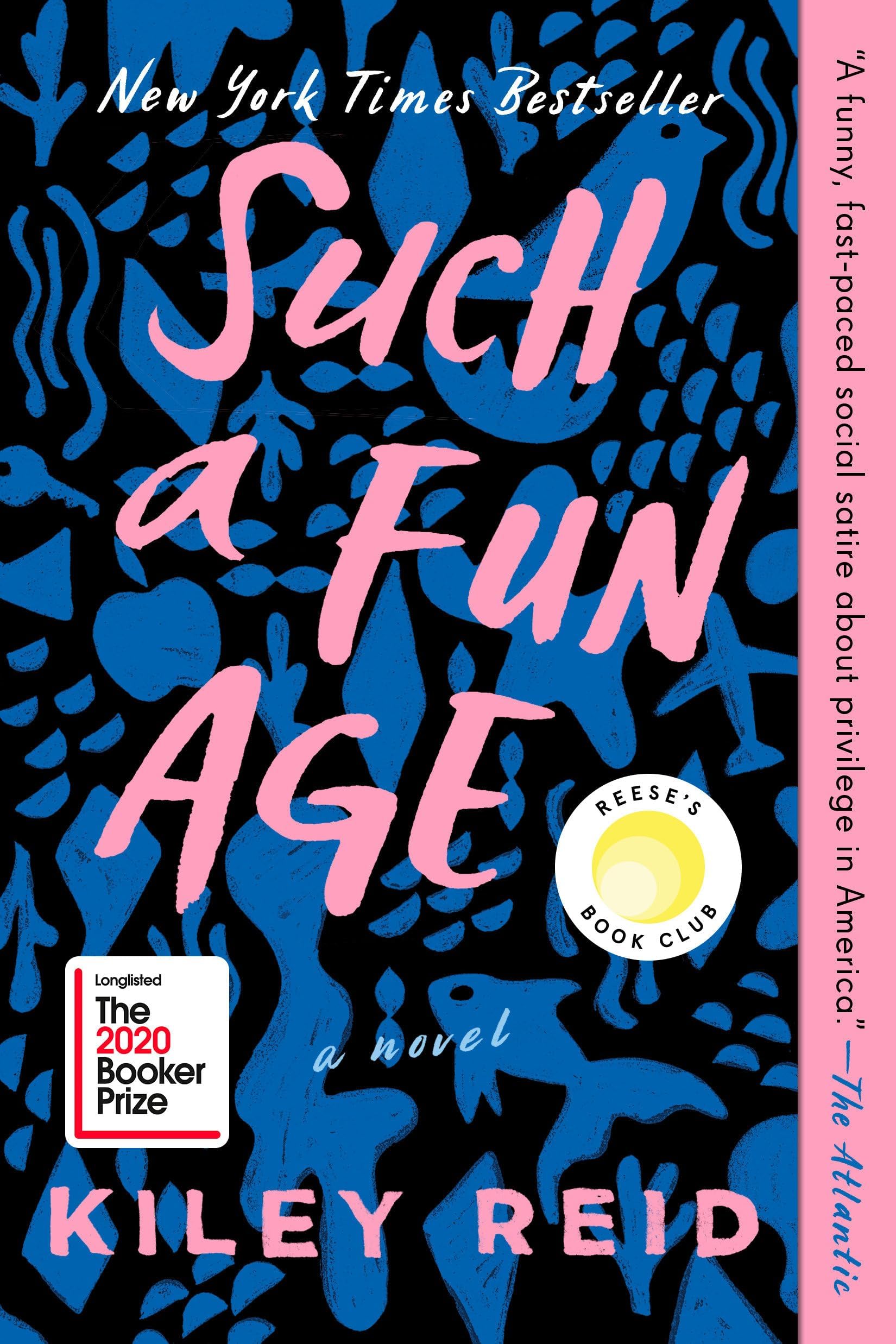
Such a Fun Age: Reese's Book Club
Product ID: 308483652
Desertcart purchases this item on your behalf and handles shipping, customs, and support to Bolivia.
A Best Book of the Year: The Washington Post • Chicago Tribune • NPR • Vogue • Elle • Real Simple • InStyle • Good Housekeeping • Parade • Slate • Vox • Kirkus Reviews • Library Journal • BookPage Longlisted for the 2020 Booker Prize An Instant New York Times Bestseller A Reese's Book Club Pick "The most provocative page-turner of the year." --Entertainment Weekly "I urge you to read Such a Fun Age ." -- NPR A striking and surprising debut novel from an exhilarating new voice, Such a Fun Age is a page-turning and big-hearted story about race and privilege, set around a young black babysitter, her well-intentioned employer, and a surprising connection that threatens to undo them both. Alix Chamberlain is a woman who gets what she wants and has made a living, with her confidence-driven brand, showing other women how to do the same. So she is shocked when her babysitter, Emira Tucker, is confronted while watching the Chamberlains' toddler one night, walking the aisles of their local high-end supermarket. The store's security guard, seeing a young black woman out late with a white child, accuses Emira of kidnapping two-year-old Briar. A small crowd gathers, a bystander films everything, and Emira is furious and humiliated. Alix resolves to make things right. But Emira herself is aimless, broke, and wary of Alix's desire to help. At twenty-five, she is about to lose her health insurance and has no idea what to do with her life. When the video of Emira unearths someone from Alix's past, both women find themselves on a crash course that will upend everything they think they know about themselves, and each other. With empathy and piercing social commentary, Such a Fun Age explores the stickiness of transactional relationships, what it means to make someone "family," and the complicated reality of being a grown up. It is a searing debut for our times. Review: Complex exploration of the space between intentions and consequences - I loved this book. I found the characters -- including their concerns, their varying tone and language registers, and their reactions to each other -- entirely relatable. (Context: I am a black woman in her mid-thirties who spent eight years in the northeastern US and has lots of cousins in their mid-twenties, with whom I chat via text every day.) If you prefer plot-driven books and/or don’t like ambiguity, this is probably not the book for you. If you have ever felt like a guest star in your own life, you may be able to relate more easily to the characters. As other reviewers have pointed out, a number of the book’s later events are signalled early. To me, the experience of watching this slow motion train wreck as it happens is central to the narrative’s point. As the book progresses, it explores two central stories and, in each, pushes the reader to question how much control any of us has over our life stories, and even our personalities. How possible is it to assert oneself and reinvent oneself, when others see you in a specific way? To what extent do the blind spots of our lives ultimately define us? Such a Fun Age’s true gift is in exploring what I’ll call “negative space”: the difference between what someone meant and how that action or characteristic is perceived. The novel balances the remarkable feat of using the exploration of this negative space to propel the action forward while also being smoothly readable. Ultimately, we spend more time in characters' heads than we do in exploring "objective" action, as the characters reflect on where they are in life, others’ potential perception of where they are in life, and where they would like to be. Through the eyes of a white woman in her early thirties and a black woman in her mid-twenties, Such a Fun Age explores race, class and power dynamics, but also aspirational motherhood, self-serving narratives, and the difference between who we think ourselves to be and who we might actually be. Other reviewers have suggested that Emira, the black protagonist, is not well fleshed out. It is true that Emira’s character has less nuance and less backstory than the two main white characters (Alix and Kelley), but I was still able to get a strong sense of Emira’s immediate desires, her likes and dislikes, and her concerns and fears -- and that was enough for me. Since Emira spends the book trying to figure out what she wants for herself, it seemed plausible that nothing too jarring might have happened in her life prior to that moment. It also seemed plausible to me that she uses her experiences to figure out what she wants, muddling through ‘no’s until she gets to her ‘yes’. Indeed, part of the book’s point is that it is OK to not buy into a hyper-aspirational narrative -- that it is OK to feel fulfilled with what others might consider to be “mediocre”. I’ve also been in a place where everyone seems to know more about what I should be doing and how I should get there than I do myself, so I found elements of both Emira’s and Alix’s internal spaces entirely relatable. Coming into Emira’s life at this moment of pause -- where she knows she must move forward in order to be considered successful but is paralyzed by her internal lack of clear direction -- also makes sense for some of the themes the book explores. During the course of the novel, we see at least three other characters (two white, one black) treat Emira as a blank space on whom to project their own feelings about what she should be doing at this point in her life. This paternalism ranges from the explicit to the unintentional and is always well meant, even as Emira chafes against it. And in rebuffing that paternalism, Emira reminds the reader that she is very much her own person, even if that person is not who the world -- or even some readers -- want her to be. To the person who said that it is possible for black people to be relaxed with their friends and speak properly, well, duh. Emira and her friends do sometimes speak to each other “properly” -- in person. Sometimes they use a far more casual register; thinking about how I speak with my friends in text and in person, that makes sense, too. I found it completely believable that Emira could receive texts that say, “Trap trap trap trap get that l.l.bean [d**k] gur” (without the brackets and asterisks), and also deploy words like “connoisseur,” as the occasion demanded. I wondered whether the reviewer that wrote this sentence doubting Emira’s language use only had type-A, hyper-aspirational friends. Lastly, I thought the book's ending provided a nice balance between answering the key plot questions while also leaving space for readers to make their own decisions about some aspects of the characters and their paths. Based on some of the other reviews, your mileage may vary! I would have actually been happy with even more ambiguity, but it seems that many people wanted less. Review: So good! - This is my second Kiley Reid book (first of hers I read was Come & Get It) and I am officially becoming a fan! Reid is definitely becoming the queen of character driven novels for me. Her writing style is so unique, and while it usually takes me a while to get into her books, I eventually end up devouring them. I've especially been enjoying them on audio. While on the very surface level I would consider this a good read, it still manages to go much deeper and really hits on some real world issues that we face in our society (systemic racism, discrimination, etc) which are all very relevant to today's culture. I even loved that it went into "woke" culture and all the issues that can come with that like the white savior complex and doing everything in ones power to save their own image to come across as an "ally" and do good deeds for it only to be a self-serving motivation. Alix was such a complex character, who I absolutely loathed (in the best of ways) and got me thinking of the people I know in real life that act like her. Reid did such a good job at making her so infuriating. I also loved the character of Emira. She brought forth other real struggles outside of race that I really clung to, such as needing to rely on a job in order to get health insurance, and just the struggles one faces at that age - learning where we fit into society and trying to find our way into something that will make us happy, and what comes next. It's such a confusing and stressful time, and I really identified with Emira's own struggles with that. That being said, I do feel like there was something missing from the characters that would have given this book that next level of *oomph* that it needed. I think they needed just a touch more of depth, something to really make me fall in love with them and experience the story on a different level. But overall, I REALLY enjoyed this one and absolutely can not wait to read more from Kiely Reid!
| Best Sellers Rank | #48,757 in Books ( See Top 100 in Books ) #551 in Coming of Age Fiction (Books) #1,359 in Black & African American Women's Fiction (Books) #1,902 in Literary Fiction (Books) |
| Customer Reviews | 4.1 out of 5 stars 49,503 Reviews |
K**N
Complex exploration of the space between intentions and consequences
I loved this book. I found the characters -- including their concerns, their varying tone and language registers, and their reactions to each other -- entirely relatable. (Context: I am a black woman in her mid-thirties who spent eight years in the northeastern US and has lots of cousins in their mid-twenties, with whom I chat via text every day.) If you prefer plot-driven books and/or don’t like ambiguity, this is probably not the book for you. If you have ever felt like a guest star in your own life, you may be able to relate more easily to the characters. As other reviewers have pointed out, a number of the book’s later events are signalled early. To me, the experience of watching this slow motion train wreck as it happens is central to the narrative’s point. As the book progresses, it explores two central stories and, in each, pushes the reader to question how much control any of us has over our life stories, and even our personalities. How possible is it to assert oneself and reinvent oneself, when others see you in a specific way? To what extent do the blind spots of our lives ultimately define us? Such a Fun Age’s true gift is in exploring what I’ll call “negative space”: the difference between what someone meant and how that action or characteristic is perceived. The novel balances the remarkable feat of using the exploration of this negative space to propel the action forward while also being smoothly readable. Ultimately, we spend more time in characters' heads than we do in exploring "objective" action, as the characters reflect on where they are in life, others’ potential perception of where they are in life, and where they would like to be. Through the eyes of a white woman in her early thirties and a black woman in her mid-twenties, Such a Fun Age explores race, class and power dynamics, but also aspirational motherhood, self-serving narratives, and the difference between who we think ourselves to be and who we might actually be. Other reviewers have suggested that Emira, the black protagonist, is not well fleshed out. It is true that Emira’s character has less nuance and less backstory than the two main white characters (Alix and Kelley), but I was still able to get a strong sense of Emira’s immediate desires, her likes and dislikes, and her concerns and fears -- and that was enough for me. Since Emira spends the book trying to figure out what she wants for herself, it seemed plausible that nothing too jarring might have happened in her life prior to that moment. It also seemed plausible to me that she uses her experiences to figure out what she wants, muddling through ‘no’s until she gets to her ‘yes’. Indeed, part of the book’s point is that it is OK to not buy into a hyper-aspirational narrative -- that it is OK to feel fulfilled with what others might consider to be “mediocre”. I’ve also been in a place where everyone seems to know more about what I should be doing and how I should get there than I do myself, so I found elements of both Emira’s and Alix’s internal spaces entirely relatable. Coming into Emira’s life at this moment of pause -- where she knows she must move forward in order to be considered successful but is paralyzed by her internal lack of clear direction -- also makes sense for some of the themes the book explores. During the course of the novel, we see at least three other characters (two white, one black) treat Emira as a blank space on whom to project their own feelings about what she should be doing at this point in her life. This paternalism ranges from the explicit to the unintentional and is always well meant, even as Emira chafes against it. And in rebuffing that paternalism, Emira reminds the reader that she is very much her own person, even if that person is not who the world -- or even some readers -- want her to be. To the person who said that it is possible for black people to be relaxed with their friends and speak properly, well, duh. Emira and her friends do sometimes speak to each other “properly” -- in person. Sometimes they use a far more casual register; thinking about how I speak with my friends in text and in person, that makes sense, too. I found it completely believable that Emira could receive texts that say, “Trap trap trap trap get that l.l.bean [d**k] gur” (without the brackets and asterisks), and also deploy words like “connoisseur,” as the occasion demanded. I wondered whether the reviewer that wrote this sentence doubting Emira’s language use only had type-A, hyper-aspirational friends. Lastly, I thought the book's ending provided a nice balance between answering the key plot questions while also leaving space for readers to make their own decisions about some aspects of the characters and their paths. Based on some of the other reviews, your mileage may vary! I would have actually been happy with even more ambiguity, but it seems that many people wanted less.
A**R
So good!
This is my second Kiley Reid book (first of hers I read was Come & Get It) and I am officially becoming a fan! Reid is definitely becoming the queen of character driven novels for me. Her writing style is so unique, and while it usually takes me a while to get into her books, I eventually end up devouring them. I've especially been enjoying them on audio. While on the very surface level I would consider this a good read, it still manages to go much deeper and really hits on some real world issues that we face in our society (systemic racism, discrimination, etc) which are all very relevant to today's culture. I even loved that it went into "woke" culture and all the issues that can come with that like the white savior complex and doing everything in ones power to save their own image to come across as an "ally" and do good deeds for it only to be a self-serving motivation. Alix was such a complex character, who I absolutely loathed (in the best of ways) and got me thinking of the people I know in real life that act like her. Reid did such a good job at making her so infuriating. I also loved the character of Emira. She brought forth other real struggles outside of race that I really clung to, such as needing to rely on a job in order to get health insurance, and just the struggles one faces at that age - learning where we fit into society and trying to find our way into something that will make us happy, and what comes next. It's such a confusing and stressful time, and I really identified with Emira's own struggles with that. That being said, I do feel like there was something missing from the characters that would have given this book that next level of *oomph* that it needed. I think they needed just a touch more of depth, something to really make me fall in love with them and experience the story on a different level. But overall, I REALLY enjoyed this one and absolutely can not wait to read more from Kiely Reid!
K**S
Fantastic writing; Interesting start; Lackluster end
SUCH A FUN AGE was our May book club pick and, at first, I was loving it. Kiley Reid broke the book up into four parts, which made it so easy for our club to read and discuss. Up until the last part, I thought Reese Witherspoon had picked another winner for us as she has yet to me down with her Reese’s Book Club picks. I kept wanting to read ahead; I was enthralled with the story; then bam! it changed directions and I just felt off. Was this Reid’s intention? Am I supposed to feel unsatisfied at the end? I’m not sure. But after such a powerful and intoxicating read, I would like to think not, which is why I felt disappointed. Reid is an exceptional writer. For a debut novel, I was thoroughly captivated by Emira, Alix, and Briar’s stories. Yes, I know Briar didn’t have a narrative, but through Emira and Alix, I felt she did. The complex story that she wove was beautiful piece of fiction yet the scary part is we are living it. It’s on our news. It’s part of our daily lives. It makes you think. And there are so many complexities within SUCH A FUN AGE in regards racial bias, privilege, and race that I can’t speak on due to me being a middle-class white woman, but the enlightening that Riley puts forth with a fictional story widens your vision. What ended up disappointing me is Emira loved her job as a nanny. It gave her life. She even spoke about it. She was constantly belittled for it. I agree, she had to get out of toxic situation, but to not take another nannying because it’s “babysitting” or “what kids do” irks me. I’m a nanny. I’m good at my job. It’s what I can do because of my health / my situation, but I also do it because I love it and it’s better than other opportunities that are available and I felt that way with Emira’s situation as well when she had to make some choices for a new job. It bothers when people belittle things others find joy in. And after that I lost the joy in this book. Will I read another book by Reid? Yes, I enjoyed her writing immensely. Will I recommend this one? No, but I won’t discourage you from reading because she’s an excellent writer. Plus, I would love to hear your thoughts on it because this book brought up wonderful debates in our book club - highly recommend it for a book club read! Content Warnings: racism, racial slurs, toxic relationships, police brutality, bullying, fatphobia, body shaming Follow me on instagram: @niftyreads
V**.
Illuminating - absolutely a must-read
Such a Fun Age, Kiley Reid’s debut novel, is a contemporary fiction novel that discusses issues surrounding differences in race, age, culture, and socioeconomic class. For me, reading this book at this time is no coincidence. In the midst of the global Black Lives Matter protests, Such a Fun Age is a stepping stone to understanding the implicit differences between black and white that, frankly, one just wouldn’t understand unless they have experienced it firsthand. I am a white, twenty-six-year-old woman, and I know that I don’t, and will never, understand these complexities and injustices firsthand. But reading this book got me a little bit closer. The view into Emira’s life was as illuminating as it was infuriating. There were several points where Emira identified subtleties that just wouldn’t happen to a white person in the same scenario. One, in particular, hit me hard: “...when white people compliment her (‘She’s so professional. She’s always on time’), it doesn’t always feel good, because sometimes people are gonna be surprised by the fact that she showed up, rather than the fact that she had something to say when she did.” Beyond the incredibly important discussions about race and social class, Kiley Reid’s writing style is phenomenal. When reading books written in the third person, I sometimes feel a distinct lack of connection to the characters. Reid bypassed this completely and made each personality shine through the pages. I’ve always felt that it’s easy to write about superheroes and villains. Good or bad, one or the other, these types of characters require minimal deviation from the template. But there were times in Such a Fun Age where I both loved and hated each character. Humans are inherently messy creatures, forced to face the ugliness within themselves as well as others, and Reid portrayed this beautifully. Another consistent theme throughout this book was one near and dear to my heart: the connection between babysitters and the children they watch over. Emira’s relationship with Briar is so pure, it was easily one of my favorite parts of the book. I always love when child characters are given unique personalities, and Briar was an amazing example of this. She’s inquisitive, loquacious, and weird in a way that only a toddler can be. Emira’s love for Briar is perhaps the one thing that remains constant throughout this book. It emphasizes that humans are born innocent. It is what they learn from their parents and others around them that shape the people they become. There are several topical themes throughout this book - racism, white privilege, and status - that are part of why I feel it is incredibly important to read. There was nothing in this book I didn’t like, and, although there were many times I found myself cringing in embarrassment along with one of the characters, I couldn’t put it down. It deserves every bit of the 5-star rating and I highly encourage everyone to pick up a copy.
J**W
A powerful debut that makes you stop and think
Such a Fun Age by Kiley Reid completely surprised me. I went into this book without knowing much about it, and it turned out to be such a powerful read. The very first chapter had me immediately invested and anxious for Emira. The situation she finds herself in is frustrating and uncomfortable to witness, and there were so many moments where I just wanted to pull her aside and remind her that she deserved better. This isn’t the kind of book you “enjoy” in the traditional sense because so much of what happens is difficult and thought-provoking. Instead, it’s the kind of story that makes you reflect on privilege, good intentions, and the complicated dynamics between people. There were also moments of humor sprinkled throughout that helped balance the heavier themes—Emira’s friend near the end especially had me laughing. For a debut novel, this was incredibly impressive. It kept me thinking long after I finished, and I’m definitely looking forward to reading more from Kiley Reid.
L**R
Witty, fun, brilliant social commentary on class and race
A friend and fellow bibliophile recommended this awkward, important, brilliant page-turner, and I’m so glad I read it. I’ve focused heavily on reading non-fiction by BIPOC, but this one is a reminder of how much we can learn through fiction. As a White person learning about racial justice, learning and unlearning is so important, but often it is, at least initially, “head knowledge.” The characters in this story help the head knowledge drop down into application, and I’m still thinking about the uncomfortable but true ways that I can identify with the problematic White characters. A headline by Stephanie Hayes from the Atlantic says it aptly: “Such a Fun Age Satirizes the White Pursuit of Wokeness,” and Reid, herself, describes it as “a comedy of good intentions.” In the story, Emira is a young Black woman who babysits for an upper middle class White family. At the very beginning, Emira is tasked with a late-night babysitting job and takes the child to a neighborhood grocery store while the parents are dealing with a family emergency. While there, she experiences a humiliating incidence of racism. From there, the book takes off in a fast-paced, entertaining, and deeply insightful look at well-intentioned people who make one cringe-worthy mistake after another, sometimes to the point that we begin to struggle to even call them “well-intentioned.” The recurring thought I had the whole time I was reading was that I had no idea where the plot was headed, but I really loved being along for the ride. This is a must-read and a brilliant social commentary on race and class. It forces White readers to consider what happens when our good intentions lead to obsessive behaviors that are more focused on appearances than anything else. It would be a great book club read!
R**R
An easy-to-read but thought-provoking book
I enjoyed this book very much, and I recommend it. It's a very thought-provoking book, although I'm having a hard time deciding what I think about everything. This book is about a young woman struggling to find a sustainable life that fits her. She's a college graduate, comes from a family full of successful, focused people, but she just isn't drawn towards any particular career. She's cobbling together part-time jobs to make ends meet, and she takes a babysitting job. She falls in love with her charge, and this is ramped up by the mother being disconnected and thoughtless. As might be expected, the mother has surrounded herself with like-minded people, so the babysitter gets drawn into an unhealthy world. The players are different races, and some of them have racial issues, so that adds a spin to their interactions. I would categorize this as a coming of age book. The book is about the babysitter finding her way through an unfortunate series of events that happens as she is establishing herself as an adult. I'm a Caucasian-Asian mixed race person, and I'm not sure what to make of the racial implications that I suppose could be pulled from this book. I identify the most with the babysitter, but because I was a late bloomer rather than any racial issues or thoughts she has or doesn't have. A lot of the racial thought doesn't make sense to me. Am I really supposed to see this Caucasian teen girl as evil when she is bullied and disrespected by a group of African-American teen boys four against one, and she reacts back? Especially since they don't even know each other, and she did nothing to instigate it? And I can't picture a group of teen boys finding a mushy love letter written from and to teens they don't know and deciding to take action. They go break into the girl's property, hassle and disrespect her, jump in her pool and refuse to leave. What's the motivation? Simply that she is white and her parents are rich? One of the kids had a full ride athletic scholarship, so why would he be feeling down and out? I'm supposed to see this boy as a victim because he gets caught and suffers the consequences? Like I said, lots of things to think about. This book kind of makes me feel like our entire nation, on all sides, has PTSD from all our collective negative racial experiences. From slavery to the trail of tears to the way many immigrants have been treated. The coming of age issues ring more true to me. A lot of readers were disappointed that the babysitter isn't more ambitious, but that's reality to me. Not everybody has the need to be the boss. I know because I am this way. I feel like she found where she wanted to be and is comfortable inside her own skin. She's happy and fulfilled.
S**U
Eye opening
I really enjoyed this book! It’s not something I would normally read because I’m more into the murder mysteries and thrillers but I found it to actually be a page turner! There were parts that boiled my blood and I had to keep reading to see what would happen next. I’m glad our book club read this pick because it is very relatable to what is going on in the past and still today. It’s set around 2016. The main character Emira reminds me a lot of us young adults trying to navigate our way through life and figure out what we want to do. Alix (the lady she babysat for) and Kelly (the man she started dating) both rubbed me the wrong way and although I don’t think they’re bad people they both did thing to benefit themselves and make themselves look like a hero. I think they both have a lot to learn about white privilege and need to acknowledge their unconscious bias. Without giving too much away I just want to say that I think we all need to read and watch things that make us uncomfortable about privilege and racism because if we don’t acknowledge it then it will never get fixed.
V**D
Tackles the issues as fiction does best
If I were to tell you that this is a novel that examines critical issues around race, class, gender, etc., you would probably not feel attracted to it. These issues matter, but so many attempts at tackling them in fiction have fallen short of good writing, are either heavy on sociological analysis, feel like proselytizing, trivialize the issues, or end up as a debate about the legitimacy of the author’s right to deal with them. Instead, I will assure you that this is a delightful debut novel by a writer whose prose flows easily, with a great command of dialogue, scene setting, character development, and storytelling. The novel tackles all the issues listed above as they are part of the story and cannot be dissociated from the characters and their actions, but tackles them as fiction does best, making you think and question yourself and your preconceptions. Read it.
S**S
I was there with the characters
Each woman in this book felt real and understandable. Their actions fitted with their characters and their flaws were described with compassion. I’m so glad to have read this.
T**1
The Phili Scene
Great look into the lives of a young generation of parents in Philadelphia, diverse, entertaining and written with empathy for our struggles. On the negative: somewhat chatty and not really exciting as a plot.
M**.
Me encanta
Es un libro que se lee fácil, me parece que es del 2015/2016 pero justamente los temas que toca son muy relevantes hoy en día, entretenido y educativo al mismo tiempo
M**I
Clever and insightful
While not necessarily agreeing with the answers given, I did find the questions raised by the book, in terms of culture clash and power dynamics, extremely well presented. An engaging and yet entertaining read, which I recommend.
Trustpilot
3 weeks ago
2 weeks ago