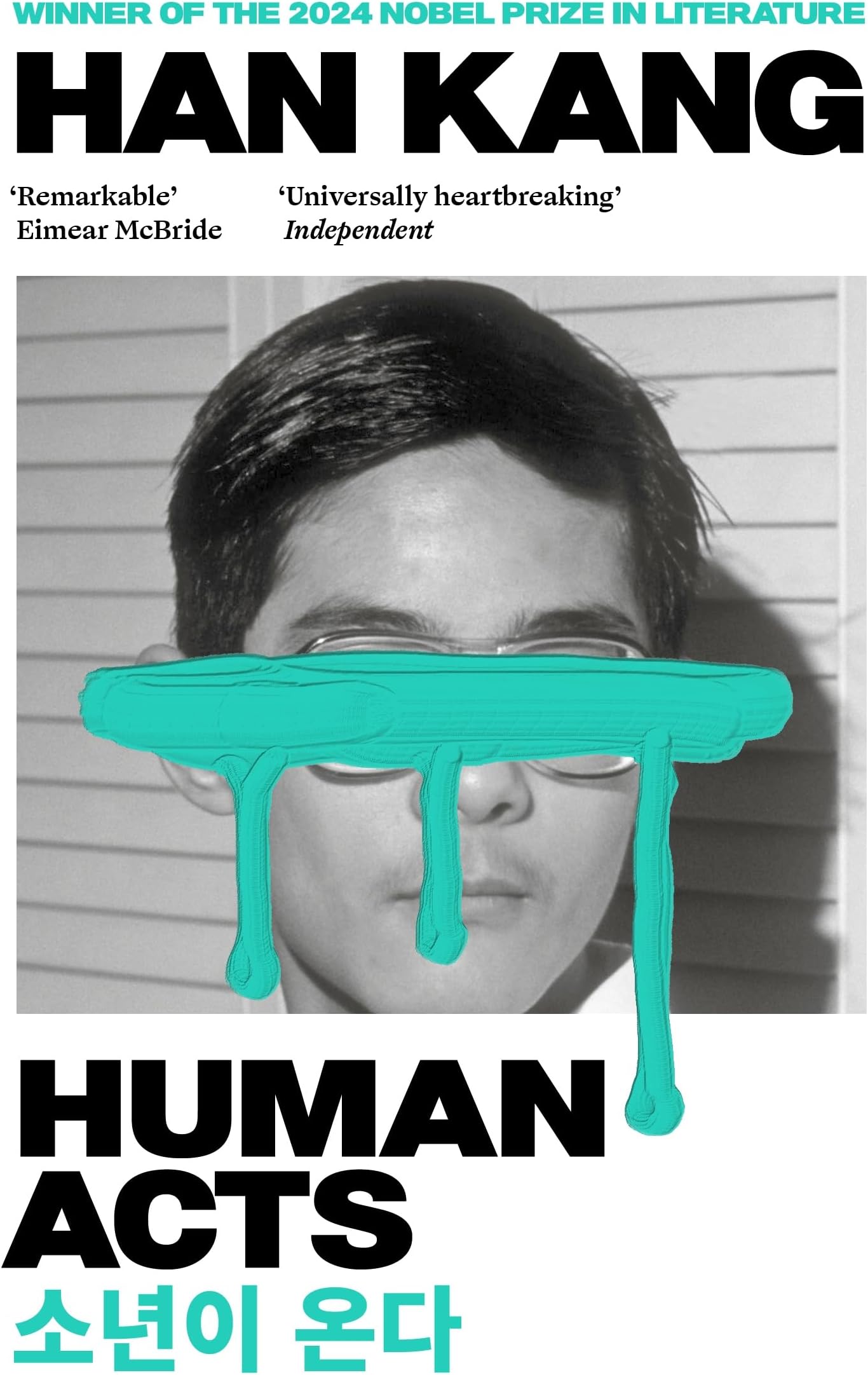
Human Acts
Product ID: 374584883
Desertcart purchases this item on your behalf and handles shipping, customs, and support to Bolivia.
Gwangju, South Korea, 1980. In the wake of a viciously suppressed student uprising, a boy searches for his friend’s corpse, a consciousness searches for its abandoned body, and a brutalized country searches for a voice. From the award-winning author of The Vegetarian comes a riveting and poetic examination of humanity at its most appalling, and its most hopeful. Review: Human Acts is a superb story that is well written book and enlightens readers - The Gwangju Uprising is another of many historical examples where a country’s leadership murdered many of its citizens. It lasted from May 18 to May 27, 1980. It was a movement against the military dictatorship of General Chun Doo-hwan. It began on May 18 after the assassination of longtime dictator Park Chung-hee in late 1979. General Chun Doo-hwan seized power in a coup. He expanded martial law nationwide. He closed universities and arrested political opposition leaders. Students responded with demonstrations. Chun deployed elite paratroopers who responded with brutal force, beating, stabbing, and shooting unarmed student protesters and bystanders. Outraged by the military's random killings, ordinary citizens joined the students. On the morning of May 27, Chun unleashed a massive force of tanks, armored vehicles, and helicopters, crushing the rebellion in just a few hours. The number of casualties remains a subject of ongoing historical investigation and division. The military regime claimed only 144 to 165 civilians died, alongside roughly 23 soldiers and 4 police officers. Local civic groups, bereaved families, and historians emphasize that thousands of people disappeared or were buried in mass graves outside the city. Modern scholarship and census analyses estimate that between 600 and more than 2,000 citizens were murdered or vanished during the 10-day massacre. Over 4,000 others suffered severe injuries. How can people describe the horrors of the thousands of citizens who were murdered, the suffering of those who died and their relatives and friends, and the government hiding bodies from relatives and friends? It needs the skill of a Nobel Prize Winner. Han Kang undertook the task in her 212-page book, in which we see a terrible, outrageous history of “Human Acts,” far from what “human” is supposed to mean. Han Kang was born on November 27, 1970, in Gwangju, the site of the uprising and murders. When she was nine years old, her family moved to Seoul. She grew up in a literary family; her father, Han Seung-won, is an acclaimed novelist. Han began her literary career in 1993 by publishing poetry in a Korean literary journal. In 1995, she made her fiction debut with the short-story collection called Love of Yeosu. What followed were many acclamations that she was one of South Korea's most distinguished novelists. Her international breakthrough came with The Vegetarian. In 2024, she became the first South Korean writer and the first Asian woman to receive the Nobel Prize in Literature. Her principal works include Love of Yeosu, Black Deer, Your Cold Hands, The Vegetarian, Breath Fighting, Greek Lessons, Human Acts, The White Book, Europa, and We Do Not Part. She has also published poetry, essays, and children's literature. The Swedish Academy awarded her the Nobel Prize in Literature "for her intense poetic prose that confronts historical traumas and exposes the fragility of human life." The Committee stated that her fiction explores the relationship between body and soul; examines the connection between the living and the dead; illuminates historical violence without sacrificing artistic beauty; and that her poetic, experimental style has made her an innovator in contemporary fiction. Han Kang also enjoys an exceptionally high reputation among literary critics who praise her for the beauty and precision of her prose; her emotional depth; her originality and experimentation with narrative form; her ability to transform historical tragedy into deeply personal stories; and her moral seriousness without sentimentality. General readers likewise admire her work, although many note that her novels can be emotionally demanding. Readers often describe her books as unforgettable, haunting, compassionate, and intellectually stimulating. Some readers find her style challenging because of its nonlinear narratives and unflinching depictions of suffering. Still, even many who find the material difficult acknowledge her extraordinary craftsmanship and the insights that her novels disclose. Human Acts is widely regarded as one of the finest novels of the twenty-first century and arguably Han Kang's masterpiece—the novel centers on the Gwangju Uprising. Rather than presenting a conventional historical narrative, Han tells the story through a series of interconnected voices: a young boy searching for a missing friend, grieving parents, former prisoners, editors, and survivors whose lives remain damaged decades later. The novel asks timeless questions: What happens to ordinary people when civilization collapses because of cruel leadership? How does memory preserve the dignity of the dead? Can beauty exist alongside unimaginable cruelty? What responsibilities do survivors bear toward history? These are questions that are also forefront for all-too-many similar “Human Acts,” such as the murders committed by Stalin and the Holocaust. While the novel's subject is harsh, Han's prose is remarkably restrained. She rarely resorts to melodrama. Her book’s emotional force grips readers through quiet descriptions, intimate reflections, and carefully chosen images that invite them to experience both horror and compassion. Her shifting perspectives reveal how violence continues to shape lives long after the events themselves have ended. The book's greatest strength is its humanity. None of the characters is an idealized hero. They are ordinary people confronted with extraordinary moral choices, making the novel universally relevant despite its specific historical setting. By the conclusion, the reader understands not merely what happened in Gwangju but also how historical violence echoes across generations. Critics have described Human Acts as "beautiful," "devastating," "urgent," and "one of the most powerful novels about political violence ever written." Readers learn much more than knowledge of Korean history. The novel teaches that human dignity can survive even in the darkest circumstances; historical atrocities leave psychological and hurting moral scars for generations; remembering victims is itself an act of justice; compassion is one of humanity's greatest strengths; and fiction can reveal truths that official histories sometimes suppress and/or are incapable of expressing. Human Acts is an unforgettable reading experience. It is emotionally painful, morally profound, and artistically magnificent. Few contemporary novels combine historical witness, philosophical reflection, and poetic language with such power. It fully justifies Han Kang's reputation as one of the world's leading contemporary writers and helps explain why the Nobel Committee honored her with literature's highest award. Review: powerful and introspective of societal practices - Riveting, disturbing, but necessary sometimes to reflect and question decisions society makes to control others. We read it in our book club and many of us thought it was ingenious and a couple thought it was overwhelming. I thought the author was very creative and was able to draw a great picture of the impact of human death on oneself and those who loved the deceased.
| Customer Reviews | 4.5 out of 5 stars 3,613 Reviews |
I**N
Human Acts is a superb story that is well written book and enlightens readers
The Gwangju Uprising is another of many historical examples where a country’s leadership murdered many of its citizens. It lasted from May 18 to May 27, 1980. It was a movement against the military dictatorship of General Chun Doo-hwan. It began on May 18 after the assassination of longtime dictator Park Chung-hee in late 1979. General Chun Doo-hwan seized power in a coup. He expanded martial law nationwide. He closed universities and arrested political opposition leaders. Students responded with demonstrations. Chun deployed elite paratroopers who responded with brutal force, beating, stabbing, and shooting unarmed student protesters and bystanders. Outraged by the military's random killings, ordinary citizens joined the students. On the morning of May 27, Chun unleashed a massive force of tanks, armored vehicles, and helicopters, crushing the rebellion in just a few hours. The number of casualties remains a subject of ongoing historical investigation and division. The military regime claimed only 144 to 165 civilians died, alongside roughly 23 soldiers and 4 police officers. Local civic groups, bereaved families, and historians emphasize that thousands of people disappeared or were buried in mass graves outside the city. Modern scholarship and census analyses estimate that between 600 and more than 2,000 citizens were murdered or vanished during the 10-day massacre. Over 4,000 others suffered severe injuries. How can people describe the horrors of the thousands of citizens who were murdered, the suffering of those who died and their relatives and friends, and the government hiding bodies from relatives and friends? It needs the skill of a Nobel Prize Winner. Han Kang undertook the task in her 212-page book, in which we see a terrible, outrageous history of “Human Acts,” far from what “human” is supposed to mean. Han Kang was born on November 27, 1970, in Gwangju, the site of the uprising and murders. When she was nine years old, her family moved to Seoul. She grew up in a literary family; her father, Han Seung-won, is an acclaimed novelist. Han began her literary career in 1993 by publishing poetry in a Korean literary journal. In 1995, she made her fiction debut with the short-story collection called Love of Yeosu. What followed were many acclamations that she was one of South Korea's most distinguished novelists. Her international breakthrough came with The Vegetarian. In 2024, she became the first South Korean writer and the first Asian woman to receive the Nobel Prize in Literature. Her principal works include Love of Yeosu, Black Deer, Your Cold Hands, The Vegetarian, Breath Fighting, Greek Lessons, Human Acts, The White Book, Europa, and We Do Not Part. She has also published poetry, essays, and children's literature. The Swedish Academy awarded her the Nobel Prize in Literature "for her intense poetic prose that confronts historical traumas and exposes the fragility of human life." The Committee stated that her fiction explores the relationship between body and soul; examines the connection between the living and the dead; illuminates historical violence without sacrificing artistic beauty; and that her poetic, experimental style has made her an innovator in contemporary fiction. Han Kang also enjoys an exceptionally high reputation among literary critics who praise her for the beauty and precision of her prose; her emotional depth; her originality and experimentation with narrative form; her ability to transform historical tragedy into deeply personal stories; and her moral seriousness without sentimentality. General readers likewise admire her work, although many note that her novels can be emotionally demanding. Readers often describe her books as unforgettable, haunting, compassionate, and intellectually stimulating. Some readers find her style challenging because of its nonlinear narratives and unflinching depictions of suffering. Still, even many who find the material difficult acknowledge her extraordinary craftsmanship and the insights that her novels disclose. Human Acts is widely regarded as one of the finest novels of the twenty-first century and arguably Han Kang's masterpiece—the novel centers on the Gwangju Uprising. Rather than presenting a conventional historical narrative, Han tells the story through a series of interconnected voices: a young boy searching for a missing friend, grieving parents, former prisoners, editors, and survivors whose lives remain damaged decades later. The novel asks timeless questions: What happens to ordinary people when civilization collapses because of cruel leadership? How does memory preserve the dignity of the dead? Can beauty exist alongside unimaginable cruelty? What responsibilities do survivors bear toward history? These are questions that are also forefront for all-too-many similar “Human Acts,” such as the murders committed by Stalin and the Holocaust. While the novel's subject is harsh, Han's prose is remarkably restrained. She rarely resorts to melodrama. Her book’s emotional force grips readers through quiet descriptions, intimate reflections, and carefully chosen images that invite them to experience both horror and compassion. Her shifting perspectives reveal how violence continues to shape lives long after the events themselves have ended. The book's greatest strength is its humanity. None of the characters is an idealized hero. They are ordinary people confronted with extraordinary moral choices, making the novel universally relevant despite its specific historical setting. By the conclusion, the reader understands not merely what happened in Gwangju but also how historical violence echoes across generations. Critics have described Human Acts as "beautiful," "devastating," "urgent," and "one of the most powerful novels about political violence ever written." Readers learn much more than knowledge of Korean history. The novel teaches that human dignity can survive even in the darkest circumstances; historical atrocities leave psychological and hurting moral scars for generations; remembering victims is itself an act of justice; compassion is one of humanity's greatest strengths; and fiction can reveal truths that official histories sometimes suppress and/or are incapable of expressing. Human Acts is an unforgettable reading experience. It is emotionally painful, morally profound, and artistically magnificent. Few contemporary novels combine historical witness, philosophical reflection, and poetic language with such power. It fully justifies Han Kang's reputation as one of the world's leading contemporary writers and helps explain why the Nobel Committee honored her with literature's highest award.
C**E
powerful and introspective of societal practices
Riveting, disturbing, but necessary sometimes to reflect and question decisions society makes to control others. We read it in our book club and many of us thought it was ingenious and a couple thought it was overwhelming. I thought the author was very creative and was able to draw a great picture of the impact of human death on oneself and those who loved the deceased.
J**N
Beautiful and brutal
Dong-ho is only 15 years old when he's violently killed during the 1980 Gwangju Uprising in South Korea. In a series of interconnected stories, Han Kang tells the story of Dong-ho and the people around him whose lives were taken or forever changed. If you've read Anthony Marra's The Tsar of Love and Techno, you'll recognize Kang's approach: while each story is distinct, together they unravel a loosely connected narrative. There's such immense, unflinching brutality in these page. This is a book about oppression, torture, violence, cruelty, trauma and death, and Kang isn't in the business of sugarcoating any of it. It's upsetting to confront the reality that this is all part of humanity—and has been all along. Kang reminds us that we're all bodies and those bodies can be destroyed in an instant, without a second thought. And yet there's also beauty in these pages. Because humanity is more than just its worst parts. And those bodies are more than just flesh and blood. Kang is an exceptional writer with prose that flow like poetry, and some of the stories in Human Acts are deeply affecting. That said, this book presumes a knowledge of recent South Korean history that I just don't have, so I think some it didn't resonate with me as much as it could have. This, of course, is not Kang's fault, however I rate books based in part on my subjective enjoyment of them so I feel compelled to reflect that in my rating. Some of the stories were 5-stars reads for me, others more like 3 stars, so I'm rating this in between.
J**H
The best novel
The best novel from South Korea. Well written. You can read it in 3 hours and I cried throughout the whole 3 hours..
K**T
reicievied
Poor victims of the Tsunami, a very good account of Korea and the authour deserves a credit with exceptional foresight and details of a tragedy. Shines in the presence of hardship
C**T
Excellent easy read and different style from what I'm used to.
This book is easy to read in that I finished it in about three days (busy schedule) and Deborah Smith did a fine job in translating - with a bit of a British angle to it. This lends the book its international flavor as it is not a typical book from an American novelist. I was surprised by its simple and straight forward prose, which reminded me to Hemingway's books. I read four to five of this great American author and in no way comparing Ms. Kang to him; but, she does appear to write in not an overly high Academic style, one I guess expects of a Nobel prize author. HOWEVER, I underwent several different emotions from sadness*, anger (at the Government soldiers), despondency and finally some hope. You have to read all the way through and Ms. Kang ties it all very well at the last chapter. Great job by this author. Footnote*: Sadness in that the Gwangju Massacre occurred in 1980, which is too recent and within my lifetime.
E**S
Why do I do this to myself?
Depressing but learning things about other cultures. Feel good book
R**N
Heart breaking
This book gave me so much information I never knew about.. the stories/povs were so raw and real, yet devastating. People fighting for better human conditions / life style(s) but were faced with death. Prayers. Go out to everyone. Keep fighting
B**G
A heartbreaking masterpiece.
"When a living person looks at a dead person, mightn’t the person’s soul also be there by its body’s side, looking down at its own face?" As someone who has been exploring Asian Literature for a few years, and has a massive TBR physical collection, I knew of Han Kang. The Vegetarian was infamous and she became a Nobel Prize Winner. I knew I wanted to pick up one of her books. But which one? The Vegetarian is a series of short stories which will never be the first thing I pick up. Not that I’ve never read a collection of short stories because I have, and some I’ve seriously enjoyed, but it will never be a priority read for me. The White Book is supposedly high concept and probably not the best book to buy. We Do Not Part was not yet released (I now have a sprayed edged edition of that book), so that left me with Greek Lessons and Human Acts. So I went book shopping. I am a browser, and enjoyed my time in Waterstones whilst deciding on which book to pick up first (along with perhaps a few more that I didn’t go for!). I approached it the same way as I approach any decision making when it comes to deciding what I want to read next, and that is read the first paragraph or page and see whether I unconsciously keep reading. "As though the raindrops suspended in the air, held breath before the plunge, are on the cusp of trembling down, flittering like jewels." Human Acts is a historical, political and literary piece of fiction. It uses multiple points of view throughout, following different but interlinked characters to tell a version of the historical event that took the lives of many young people during a student uprising in Gwangju, South Korea, in 1980. This is not in any way a nice book, yet it is a masterpiece. Unfortunately, I have found that the most tragic narratives which are often cemented in fact, are the most phenomenal of books, maintaining the intrigue whilst blanketed in the horror of humanity. The protagonist is Dong-ho. A young boy whose life becomes intertwined with others in order for Han to present an intimate picture of the impact the 1980’s uprising had on the youth, and families of Gwangju. Most of the characters we experience are well established by the time we reach their story, bar a couple who perhaps could have been fleshed out a little more to heighten empathy (don’t get me wrong, the empathy was there, just noticeably different to the characters we had met time and time again). Through all the horror, Han manages to include complex relationships and the realities of class and gender in South Korea. The atmosphere is tense, sickening, shocking, horrifying – it’s a page turner. I wanted it to stop, but I couldn’t put it down. I was hopeful, I was championing them, I was devastated and heartbroken. The emotions were raw. Han has done an incredible job of capturing something that only a Gwangju resident could tell, and for good reason. I cannot comment on Han’s written style from a Korean point of view, simply through translation. I feel, to the most, Deborah Smith, who translated Human Acts and most of Han’s other works, has translated very well. Han is known for her intellect and writing abilities, so with that in mind I feel this is an incredible piece. I have one complaint, and for me it’s a pretty big one. Smith had the audacity to ‘smuggle in the tiniest bit of Yorkshire…’. Though she argues that for her, ‘faithfulness’ to the translation process is vital and that in context of translating a language that does not use language in the same way, when she needed to be more creative in that translation she always attempted to maintain Han’s original sentiment. And yet, with full admittance, she did indeed squeeze in a bit of Yorkshire towards the end, and it stuck out so hard it made me furious. To me it screamed disrespect. Han couldn’t be further from the Yorkshire culture if she tried. As someone born literally around the corner from Yorkshire, I did not find it quaint. For this reason, when I saw Smith did not translate We Do Not Part, I can’t say I was disappointed – though I haven’t read it yet. Overall, this book is a must read. Don’t let the political aspect of it put you off as it’s not buried under political garb, more that it is connected to the political landscape and figures of the time. The narrative follows the lives of a group of students who got caught up in the events of 1980, rather than an in depth political discourse. It is a sad one. Trigger warnings listed below. I have included very little plot or storyline because to feel the impact you just need to read the book. I now own all previous titles mentioned. I have read the short story, The Vegetarian but I have yet to finish the book, so do pop back for a review of that one later on.
H**G
A Painful Storyline That Touched My Humanity
I found myself holding my breath several times while reading. Han's writing is stunning, capturing the pain and suffering of the characters with remarkable depth. I could easily relate to their emotions, frustrations, and struggles, which felt profoundly real and deeply human. After reading it, I recommended the book to my children.
S**H
Koreansk roman
Boken är i fint skick. Har inte läst den än.
Á**R
A short to read book full of meaning
I chose to read Human acts because I loved "The vegetarian" novel by Han Kang, however this one has nothing in common with the mentioned novel. It is very original in the way it is written and estructured. It doesn't focus on one character in particular as it imagine the consecuences of a massacre through time accross decades with different characters and thematic. It is a great novel in every aspect, it will leave a strange feeling with you after reading it.
N**H
Heart breaking greatness
Have you fallen out of touch with yourself? With society? Maybe you just want to feel something again? This novel will make you cry, refocus priorities and put you back in touch with your human spirit as it describes the various viewpoints of a tragic event, similar to Faulkner’s viewpoints in ‘As I Lay Dying’. And much like any Hemingway novel, you’ll want a stiff drink afterwards. I name drop these two greats because Han Kang is making their way there to the same realm. Pour a glass of whiskey and prepare your heart.
Trustpilot
1 week ago
2 weeks ago