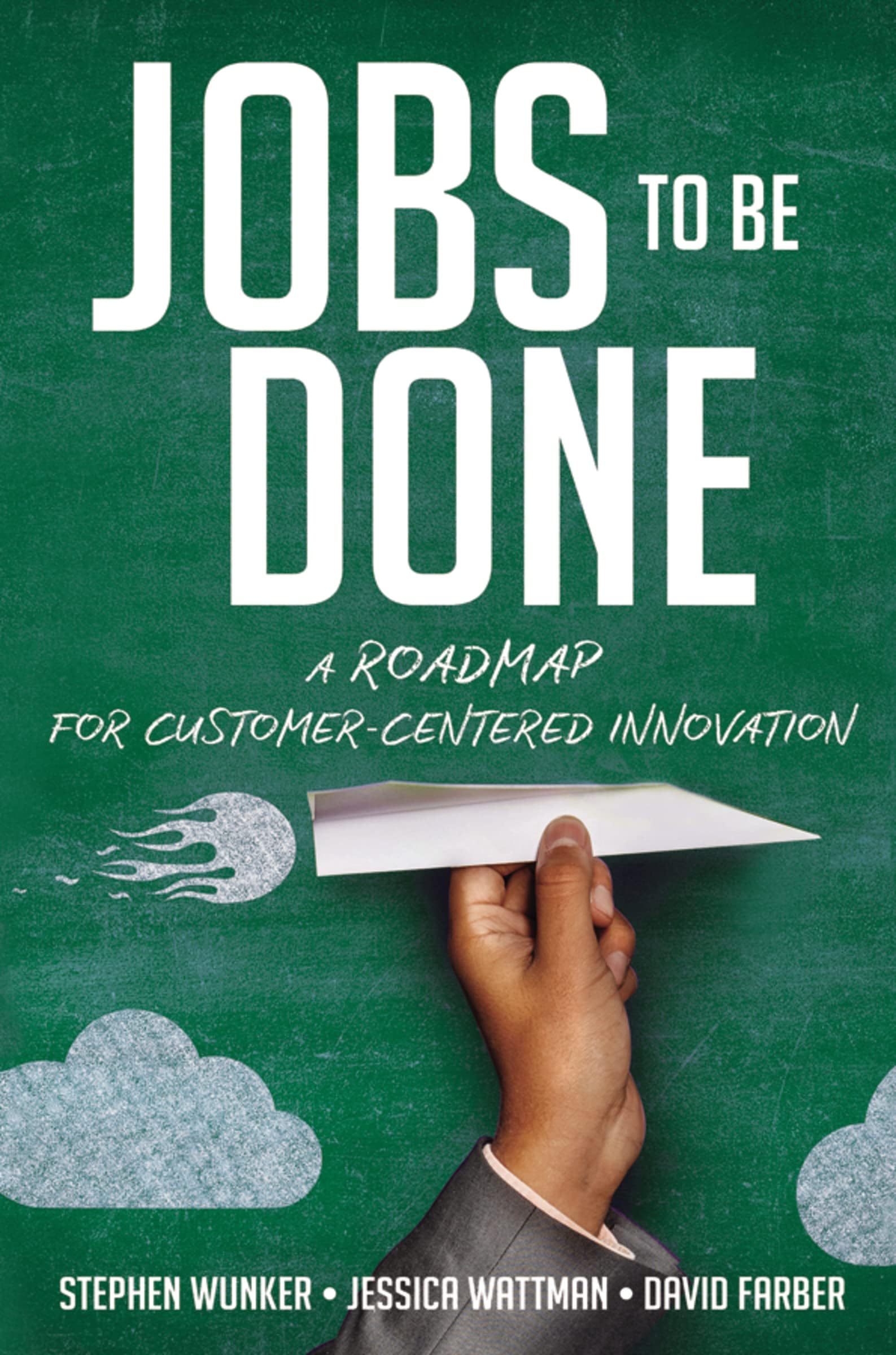
Jobs to Be Done
Product ID: 512145592
Desertcart purchases this item on your behalf and handles shipping, customs, and support to Bolivia.
In a challenging economy filled with multiple competitors, no one can afford to stagnate. Yet, innovation is notoriously difficult. How do you pinpoint the winning ideas that customers will love? Sifting through purchasing data for clues about what might sell or haphazardly brainstorming ideas are typical strategies. However, innovation expert Stephen Wunker offers the effective Jobs method: determining the drivers of customer behavior--those functional and emotional goals that people want to achieve. This simple shift in perspective opens up new insights about your customers and a wealth of hidden opportunities. For example, social media newcomer Snapchat used the Jobs process to capture the millennial demographic. By reducing functionality, the company satisfied its users' unmet need to document real life in the moment, without filters and "like" buttons. Packed with similar examples from every industry, this complete innovation guide explains both foundational concepts and a detailed action plan developed by Wunker and his team. In Jobs to Be Done , the groundbreaking Jobs Roadmap takes you step-by-step through the innovation process and reveals how to: Gather valuable customer insights Turn those insights into new product ideas Test and iterate until you find original profitable solutions And much more! Jobs to Be Done gives you a clear-cut framework for thinking about your business, outlines a roadmap for discovering new markets, new products and services, and helps you generate creative opportunities to innovate your way to success. Review: The Most Practical Framework for Innovation – A Step-by-Step Process To Achieve Customer Focus and Creative Breakthroughs - This book gives a comprehensive process for applying “jobs to be done” in your organization, whatever kind of organization you may be in (B2C, B2B, nonprofit, etc.). The whole book is constructed around a “Roadmap” analogy, and it provides a process in 12 parts. This is PRECISELY what I was looking for – something that I could put to use. And, as a bonus, it’s well-written and often a fun read too. There’s even an example worked in a ton of detail at the back of the book. Love it. Here are the steps it lays out in its “jobs roadmap.” Each of these have tools, do’s and don’ts, examples, etc.: - Establish objectives - Plan your approach - Discover the jobs - Understand the job drivers (what makes people/organizations prioritize jobs differently, links to segmentation approaches) - Map current approaches and pain points - Identify success criteria for new solutions - Investigate obstacles to adopting those solutions - Determine the value that can be created by accomplishing those jobs well - Assess what the “real” competition is for accomplishing those jobs - Generate ideas based on those insights - Reframe your perspective - Experiment and iterate Each of these elements is a chapter. There’s a final chapter on how a Fortune 500 company rolled this out as a standard methodology, and two appendices, one on the very detailed example and one on public sector applications of the concepts. Here’s the contrast to a couple other books on this that came out around the same time: - Competing Against Luck is excellent, but it’s higher level. There’s one figure in the whole book. It’s not a toolkit, and it doesn’t pretend to be. The two books are good complements - There’s what seems to be a self-published e-book called “Jobs to be Done: Theory to Practice”, but it reads like a commercial and doesn’t tell you almost anything that you can really put to use. Their “84 step process” includes such surprising steps as recruit participants, and develop a questionnaire, without saying a single thing about how to do that. It’s literally just those words as the steps – that’s it. Not useful. This book, in contrast, doesn’t require you to buy a workshop or consulting project to actually apply the thinking. I wish more business books were like this one! Review: Valuable amsterpiece - A masterpiece with extremely valuable insights that open the door to avoiding mistakes.


| Best Sellers Rank | #674,917 in Books ( See Top 100 in Books ) #59 in Business Research & Development #180 in Market Research Business (Books) #3,210 in Business Management (Books) |
| Customer Reviews | 4.2 out of 5 stars 178 Reviews |
M**S
The Most Practical Framework for Innovation – A Step-by-Step Process To Achieve Customer Focus and Creative Breakthroughs
This book gives a comprehensive process for applying “jobs to be done” in your organization, whatever kind of organization you may be in (B2C, B2B, nonprofit, etc.). The whole book is constructed around a “Roadmap” analogy, and it provides a process in 12 parts. This is PRECISELY what I was looking for – something that I could put to use. And, as a bonus, it’s well-written and often a fun read too. There’s even an example worked in a ton of detail at the back of the book. Love it. Here are the steps it lays out in its “jobs roadmap.” Each of these have tools, do’s and don’ts, examples, etc.: - Establish objectives - Plan your approach - Discover the jobs - Understand the job drivers (what makes people/organizations prioritize jobs differently, links to segmentation approaches) - Map current approaches and pain points - Identify success criteria for new solutions - Investigate obstacles to adopting those solutions - Determine the value that can be created by accomplishing those jobs well - Assess what the “real” competition is for accomplishing those jobs - Generate ideas based on those insights - Reframe your perspective - Experiment and iterate Each of these elements is a chapter. There’s a final chapter on how a Fortune 500 company rolled this out as a standard methodology, and two appendices, one on the very detailed example and one on public sector applications of the concepts. Here’s the contrast to a couple other books on this that came out around the same time: - Competing Against Luck is excellent, but it’s higher level. There’s one figure in the whole book. It’s not a toolkit, and it doesn’t pretend to be. The two books are good complements - There’s what seems to be a self-published e-book called “Jobs to be Done: Theory to Practice”, but it reads like a commercial and doesn’t tell you almost anything that you can really put to use. Their “84 step process” includes such surprising steps as recruit participants, and develop a questionnaire, without saying a single thing about how to do that. It’s literally just those words as the steps – that’s it. Not useful. This book, in contrast, doesn’t require you to buy a workshop or consulting project to actually apply the thinking. I wish more business books were like this one!
A**R
Valuable amsterpiece
A masterpiece with extremely valuable insights that open the door to avoiding mistakes.
B**S
meaning that it was a bit easy to skip over sections
Products and services fail regularly to meet customer expectations but what is going wrong? Companies are asking customers what they want and blindly seek to deliver it; yet not so many seem to analyse what they may need and work from that data point. This is the central argument expressed by the authors, who believe that people purchase products and services to solve a specific problem or need. If a company can focus on the “jobs to be done” by a product or service for a customer, their innovation, development and sales processes can be much more successful. It all makes for an interesting read. You can be wise and say that it is an obvious argument, but if that’s the case why are so many seemingly overlooking it? By reading this book maybe you can reboot your mindset and start to look at things in a different light. The style of the book was a little challenging and it felt disjointed, meaning that it was a bit easy to skip over sections, but the central theme and guidance is the main thing. Comprehensive advice is given throughout so the reader can easily use this book as a blueprint or roadmap for future change. It would be something that you would probably be consulting on many occasions, so the complaint about a disjointed feel may fade away with many visits. It probably affects the initial, sequential read and slightly risks reader interaction and engagement. It is definitely worthy of consideration in any case, assuming that your company does not already look at what customers need!
A**.
Great summary of Jobs to be done
A nice romantic way to learn about jobs to be done but it lacks a lot of the how to do it yourself. In order to understand and practice it you need to read other books and try all these theory in real life.
A**S
This book has some really interesting examples on how to not just create the best products, but also how to make those products
The subtitle of this book makes clear what it’s about: how to be customer-centric. From a marketing perspective, it was really interesting to read about how Jobs to be Done thinking touches every aspect of a company. This book has some really interesting examples on how to not just create the best products, but also how to make those products really resonate with customers. There are a lot of actionable takeaways in here, including some particularly helpful ones on how to make sure you’re marketing the right solutions to the right customers. The real-life story to start each chapter makes the book fun to read, while the quick recaps for each chapter make it easy to use. For me, it was great that there were so many tools that you could start using right away to think about how to design better products. Overall, I think it’s a great book almost regardless of what your role is in a company.
B**A
Good overview that puts "jobs to be done" idea in a 360 degree view of product and customer
This is a good book on the topic. It is quite broad so it some ways, it is a review of key ideas in marketing and product development. For decades we have heard, "The customer does not go to Home Depot because he needs a drill, but because he needs a hole." Good point. Later, Clayton Christenson expanded it for cases where the "job to be done" is far from obvious and requires some careful thought. Classically, commuters get a chocolate shake at McDonalds at 8 am because it (A) provides calories til lunch (B) gives them something to do while driving (C) only requires one hand and no accessories (paper, plates). The job to be done is calories + occupation. Wunker et al put this in a BROAD context, what is your product, what are customer needs, what are allied products or cross-sells to meet those needs, etc. So, while it is true to the topic of "jobs to be done" you get a 360 degree view of how this fits into product development and marketing.
L**N
A very practical roadmap to create positive change in any company from the first chapter
Jobs to be Done is an engaging and informative read, that taught me a lot about how companies can engage with customers. After learning the Jobs theory, their idea of a roadmap was extremely useful to display how these techniques are vital in a variety of industries. Each chapter includes interesting business anecdotes and my favorite, the hands on experience the authors have from past projects. This format helps me see the roadmap they have laid out and how to use these techniques in a real organization. The book delves into not only the importance of engaging employees in thoughtful ideation but the many needs of customers and their emotional repossess that lead them to commit to a company. Jobs to be Done has sparked many valuable conversations at work about how to be innovative and engage with our customer base.
O**Y
Creating Unrealized Value in the Marketplace by Understanding: Get the real stuff: The Innovator's Dilemma & Blue Ocean Strategy
I started out giving this book 4 stars, then 3, and now 2. Why? 4-stars: What's great about this book? Jobs-To-Be-Done is a CRUCIAL concept to get. The concept of Jobs-to-be-Done is an old one, famously coined by Clayton Christensen, the man behind the theory of disruptive innovation. Christensen has had a major impact on my thinking and choices in life. The insights he offers are not mere superficial 'nice-to-haves' but cuts to the root of understanding, dealing with and creating solutions that make the world a better place. Yes, very much so, as they hold the power to tackle those ingrained, big, hairy monstrous problems of systemic character. (Observe that the term 'disruption' is often sloppily used, with the lack of understanding of what the theory explicitly contains.) This book adds more flesh to the bones to the concept of Jobs-to-be-Done. It gives a practical guide towards using JOBS + JOB-DRIVERS to create customer segments based on deep understanding of what is truly important tasks for specific people under specific circumstances. As the authors state: "Making a "better" product is the easy part of innovation. The hard part is ensuring that your new product is better for the right people." and "Ultimately, it's a combination of jobs and job drivers that differentiates customers." Understanding and applying Jobs-To-Be-Done thinking will pay off: Don't waste your time solving superficial feature-problems. Get to the real issue at hand, and you'll have a winner. So then what's the problem? 1. The theory was developed by Clayton Christensen, and is much better explained elsewhere. There are books co-authored by him, articles and lectures. Get those first. 2. It is soooo poorly written! A disaster when it comes to organization and layout. And those visualizations? It feels like a first draft by amateur writers with a beginner-illustrator. The visualizations are dry and boring, and don't add much to the grasp of the content. And the problem with that is: IT IS VERY HARD TO TAKE THE CONTENT OF THIS BOOK AND APPLY IT, quickly and easily. I myself have created slide-decks, spread sheets and docs to help our team apply it. But that took almost two days. You'd think the authors and publishers could have bothered to do that job for us. A crucial "Job-To-Be-Done" is to easily take the content and apply it to practical business meetings and discussions. The authors failed on satisfying this Job to be Done + job drivers, and thus I predict this book will not be as great a success as it could have been. Inspiration would be to look at Design a Better Business Design a Better Business: New Tools, Skills, and Mindset for Strategy and Innovation Value Proposition design Value Proposition Design: How to Create Products and Services Customers Want (Strategyzer) and the like And last but, not least, probably MOST important: They are essentially giving a poorly written, poorly organized, superficial text (not a guide, not a 'drilling-deeper' text) of Both Christensen's Disruptive Innovation theory AND BLUE OCEAN STRATEGY. If you're into untapping unrealized value for customers and your company: GET BLUE OCEAN STRATEGY. The only section that is worth reading from this book, to complement Blue Ocean Strategy with is the Adoption section. GOOD LUCK.
D**T
A must for all product managers
This book helped me see how to guide organisations out of the orientation toward internal focus (internal processes, product features, etc) and make sense of where the real opportunities are for growth.
N**P
ジョブ理論の実践ステップを解説
クリステンセン氏のジョブ理論をより実践的に解説した洋書を探して出会った本。短い本だが、ジョブ理論をより実践するステップについてわかりやすく伝えている。
J**S
this book is absolutely brilliant: )
I must say .... this book is absolutely brilliant :)
R**S
A jornada para bem atender o cliente!
Desde meu primeiro contato com o JTBDencontrei o caminho para oferecer realmente o que o cliente precisa e deseja. Recomendo!
E**E
1) Ennuyant 2) Ennuyeux
Au bout de 50 pages, j'attendais encore que l'auteur commence à entrer dans le vif du sujet. Après 70 pages j'avais déjà hâte que le livre soit fini... Ce qui m'a le plus gêné dans le livre est que l'auteur mentionne la théorie du "Jobs To Be Done" dans le titre alors que le contenu me semble ne pas en reprendre les fondements même. Pour ceux qui s'intéresse à JTBD, je conseille fortement de commencer par "Competing Against Luck: The Story of Innovation" de Clayton Christensen.
Trustpilot
2 weeks ago
1 month ago