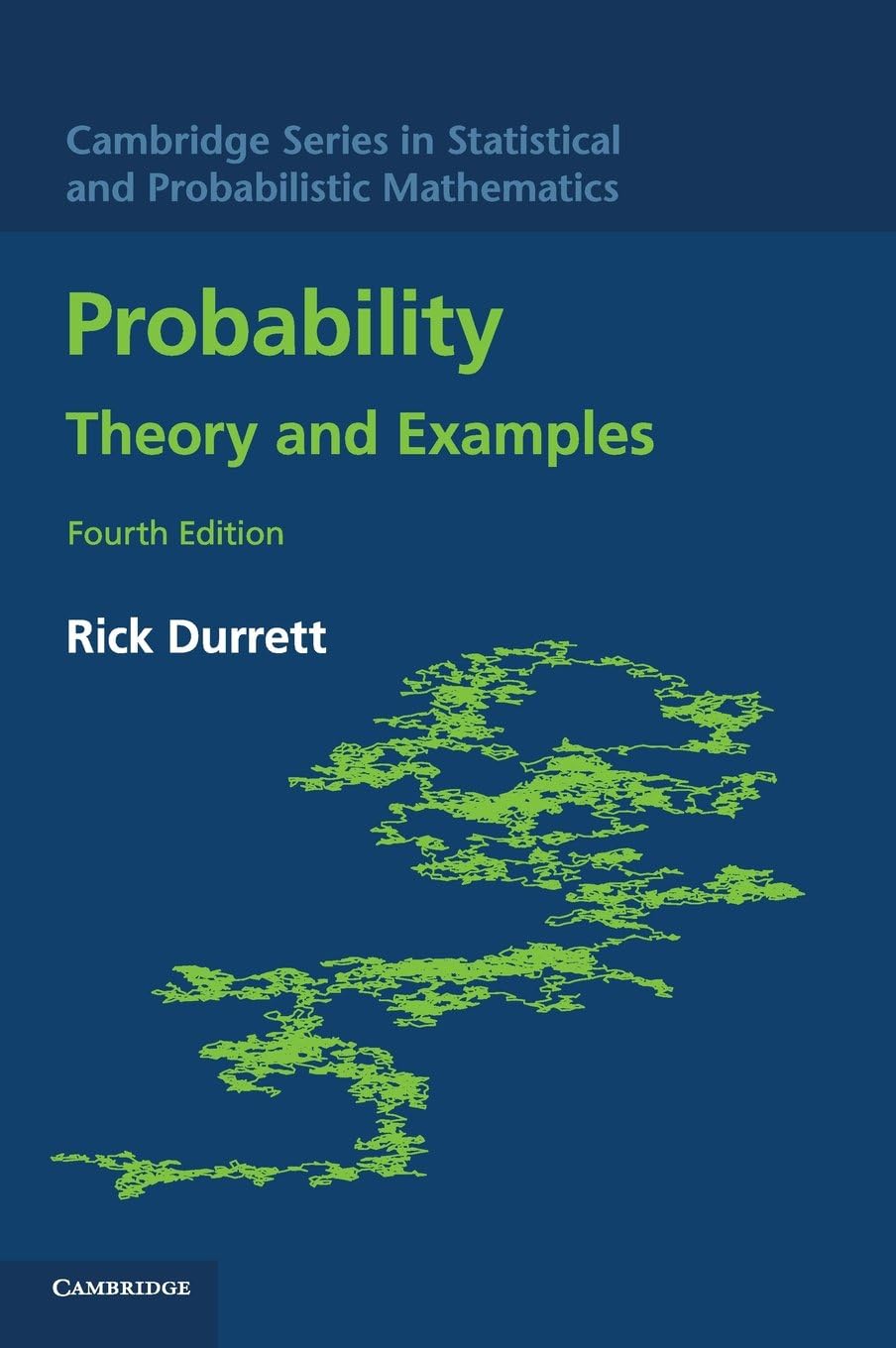
Probability: Theory and Examples (Cambridge Series in Statistical and Probabilistic Mathematics)
Product ID: 5780920
Desertcart purchases this item on your behalf and handles shipping, customs, and support to Bolivia.
This book is an introduction to probability theory covering laws of large numbers, central limit theorems, random walks, martingales, Markov chains, ergodic theorems, and Brownian motion. It is a comprehensive treatment concentrating on the results that are the most useful for applications. Its philosophy is that the best way to learn probability is to see it in action, so there are 200 examples and 450 problems. Review: Students learn from concrete examples - I am a Ph.D. student in statistics. I REALLY strongly dislike this book. Let me start with a contrast: I studied undergraduate real analysis from Strichartz, and I think that was an excellent book. The proofs were useful for the homework problems, and Strichartz's discussion, while lengthy, was helpful for providing the crucial insights to actually LEARN from the text. While I felt that the textbook was quite difficult for me -- I must have spent about 20 hours a week that semester studying Strichartz -- I felt like I came out of the class with (at least) twice as strong math skills as I did when I entered the course. It is from Strichartz that I learned how to do proofs with quantifiers. However, Durrett's textbook is the kind of textbook which teaches nothing. I do not feel like I could master the material by studying his proofs and "examples." The skills necessary to attack the (challenging) homework problems are not going to be reinforced by this textbook. I learned much more by looking at professor's online solutions to Durrett's problems. And that's what's really missing from this textbook. A good calculus textbook, like the one by James Stewart, is REPLETE with sample problems and fully-worked solutions. Most good calculus teachers know that students learn (inductively) from examples -- it is only LATER that they would care about something like a proof. So what is the point of this textbook? I'm not sure. As far as I'm concerned, it was completely and utterly useless. Review: good - The book is very suitable for graduate students major in statistics. The delivery is quick and the book is in good condition. I am satisfied
| Best Sellers Rank | #2,027,374 in Books ( See Top 100 in Books ) #2,196 in Statistics (Books) #2,603 in Probability & Statistics (Books) |
| Customer Reviews | 3.1 out of 5 stars 47 Reviews |
W**G
Students learn from concrete examples
I am a Ph.D. student in statistics. I REALLY strongly dislike this book. Let me start with a contrast: I studied undergraduate real analysis from Strichartz, and I think that was an excellent book. The proofs were useful for the homework problems, and Strichartz's discussion, while lengthy, was helpful for providing the crucial insights to actually LEARN from the text. While I felt that the textbook was quite difficult for me -- I must have spent about 20 hours a week that semester studying Strichartz -- I felt like I came out of the class with (at least) twice as strong math skills as I did when I entered the course. It is from Strichartz that I learned how to do proofs with quantifiers. However, Durrett's textbook is the kind of textbook which teaches nothing. I do not feel like I could master the material by studying his proofs and "examples." The skills necessary to attack the (challenging) homework problems are not going to be reinforced by this textbook. I learned much more by looking at professor's online solutions to Durrett's problems. And that's what's really missing from this textbook. A good calculus textbook, like the one by James Stewart, is REPLETE with sample problems and fully-worked solutions. Most good calculus teachers know that students learn (inductively) from examples -- it is only LATER that they would care about something like a proof. So what is the point of this textbook? I'm not sure. As far as I'm concerned, it was completely and utterly useless.
B**G
good
The book is very suitable for graduate students major in statistics. The delivery is quick and the book is in good condition. I am satisfied
A**X
Much better then Amazon reviews would lead you to believe.
I can't believe the amount of rage that the Amazon reviewers have towards this book. Surely there are more deserving books out there. My review will largely be a defense of this book, and I will try to convince potential buyers that this book IS worth their money. First of all, I admit that this isn't a book I would want to first learn from (I did learn from it, so I would know). When I was learning probability theory, I already knew measure theory, and so I wanted a book that would actually use measure theory freely. There are many important theorems, such as the central limit theorem, which demand that the reviewer use measure theory. It is the avoidance of measure theory which makes most elementary books on probability theory uninteresting. On the other hand, most measure-theoretic probability theory books assume that you've learned from an elementary book and so they don't waste time on developing intuition. I've found that most books, Billingsley's included, simply treat probability theory as an extension of measure theory. This is not what I wanted, and I was led to this book. Probability theory is a field with one foot in examples and applications and the other in theory. The thing that this book does better than others, except perhaps for the beautiful, but infinitely long Feller, is that it pays homage to the applications of probability theory. This should be expected, judging from the title. Every page of this book has an example. Every single theorem is used in an interesting example, and there are tons of exercises asking the reader to use the theorems and prove alternative theorems. A student would not leave with a healthy perspective of probability theory if all they learned from were, say, Varadhan's notes or Stroock's analytic book of death. They would know a whole lot of extra measure theory without having any idea of what problems this theory was designed to solve. A student working with Durrett's book will have seen plenty of examples and worked out a huge number of problems themselves. Hence, they will leave this book with a deeper understanding and a more balanced view of probability theory. It is these applications which attracts so many researchers to this book and make them impose it on their students. Now, this book is massive. It sits at a relatively slim 400 pages, but just about all of basic probability theory is in here: sums of independent random variables, basic limit theorems, martingales, markov chains, brownian motion, etc... There is nothing that a student could wish for (except coupling) which they won't find in here. As always, trying to learn from massive, sprawling books is a challenge. This expansive coverage makes the book great to have around as a reference and second textbook. There are also tons of tricks that he teaches which are really useful and aren't found easily in other books. Now, there are many complaints about the readability of this book. In the fourth edition, Durrett switched over to LaTeX (as opposed to just TeX I believe) and so the cross references and index have all be corrected. I found the typos in this book to still be too large in number, but they are almost universally trivial. None of the typos confused me. I will blame Durrett for being careless, but not an incompetent expositor. There is one wrong proof somewhere in here that my professor mentioned, so that's unfortunate. Also, when I was first learning probability theory, I found this book difficult to read. However, now that I know a good amount I find this book to be perfectly readable. I suppose it's just best as a second book. Overall, this book does have some flaws (hence, the subtraction of a star), but students will leave with a healthy perspective. This is why this is the best measure-theoretic probability book.
A**R
Worst Mathematics Book Ever
Not recommended neither as reference book nor text book. As reference book, it fails because it is probably the most sloppily written mathematics textbook I have ever encountered. Notation is sloppy, definitions are scattered randomly within the text, notation is not consistent and is not standard. As a textbook, it also fails because it never really explains the purpose of the theory he is discussing. This is probably the worst mathematics book I have ever read. (I am currently a 2nd year PhD student and my undergraduate degree is in Mathematics). The only upside of this book is that it contains some recently developed theory.
D**H
Five Stars
I love it
C**H
maybe a good reference but not a good text for study
Confusing and unclear notation usage. maybe a good reference but not a good text for study.
C**S
If you are a math PhD and am pretty sure that you are going to make probability as ...
If you are a math PhD and am pretty sure that you are going to make probability as your career, it's a nice book. More precisely, this book is comprehensive in terms of SKILLS that you will need to pass prelims/do research. Though, it is not very good to 'tell the story of probability'. For instance, section 5.4 is called 'Doob’s Inequality, Convergence in Lp'. If you are new to this area, you might wonder why we should study convergence in Lp of martingales. Severe lack of connections between theorems/sections. If you are an undergrad trying to find your interest / grad student in other discipline but want to use some grad probability, for instance, Maybe 'A Probability Path' by Resnick, or 'A First Look at Rigorous Probability' by Rosenthal are better for this purpose. It's a good book, but not for everyone.
A**R
Three Stars
The head cover with first few pages separate from the others so I returned it.
M**I
Not bad to get a view of the forest, awful to get a view of the trees.
28/08/2018 - This is a rewrite of my previous review on this book. Something that took me a while to understand, mainly because I had given up on reading this book, is that to read it, you should already have had a measure theory course. In fact it's mandatory. Simple theorems - I don't remember well, but I think an example of those was \int h(x) dF_X = \int h(x) f_X dx, when a the dist. has a density - are not in the 1st chapter, and are constantly used beyond it. Here lies the major problem with the book. The author was lazy, put forth the appendix as a chapter, and didn't informed the reader of the requirements to really understand the book. This shows, since much of the notation used in the 1st chapter is not defined in it, but only in chapter 2, or later. However, this is not the only example of lazzyness from the author. Another example is the example 3.6.8 for the definition of a poisson process on a measure space... You don't know to which sigma-algebra the sets belong to, everything is so condensed in to prose-like text that I prefered to just check the wikipedia page (Poisson Random Measure). The whole book is sprinkled with examples where the author could have done a better job at being more explicit, and using less irony. I would be ashamed if, in most examples, wikipedia did a better job. Some writing is so extempore/blunt, that it really makes one wonder how he's a professor. In exercise 4.4.3, there's this sentence about renewal process: «(Think of a public telephone or prostitute)». What's the relevance of the last example? It sounded to me like «Think of a gas chamber». Honestly... The big risk is that if you're using this book for self-study, there's confounding between lazy writing, irony (which is often used by the author), and typos... The non-native reader has increased difficulty in separating whether what's unclear, and what's simply a typo, and many times simply wasting his/her time when they could be reading something more fulfilling. Honestly I find the books by Resnick much more complete, and useful. The worst part are the proofs, since in those the author really summarises everything to a bare minimum. And again, I had to complement sometimes with wikipedia, which does a much better job. The best way to read this book is to just get a general idea of the 'forest' which is probability theory, and then pick up another book for the 'trees'... Don't worry too much with the proof, skim them, do the exercises with the errata next to you, and then just move on with your life. After all these years, I maintain my score to 1 stars. The amount of time lost on the book, was not fun...
K**U
It's my favorite probability textbook so far
I used Durrett for my undergraduate Probability & Stochastic Processes course at UBC. The writing style is clear and the proofs are neat. It's my favorite probability textbook so far. I would highly recommend it to any undergraduate specializing in Computer Science, Mathematics or Statistics.
Y**G
good
good
Trustpilot
5 days ago
2 weeks ago