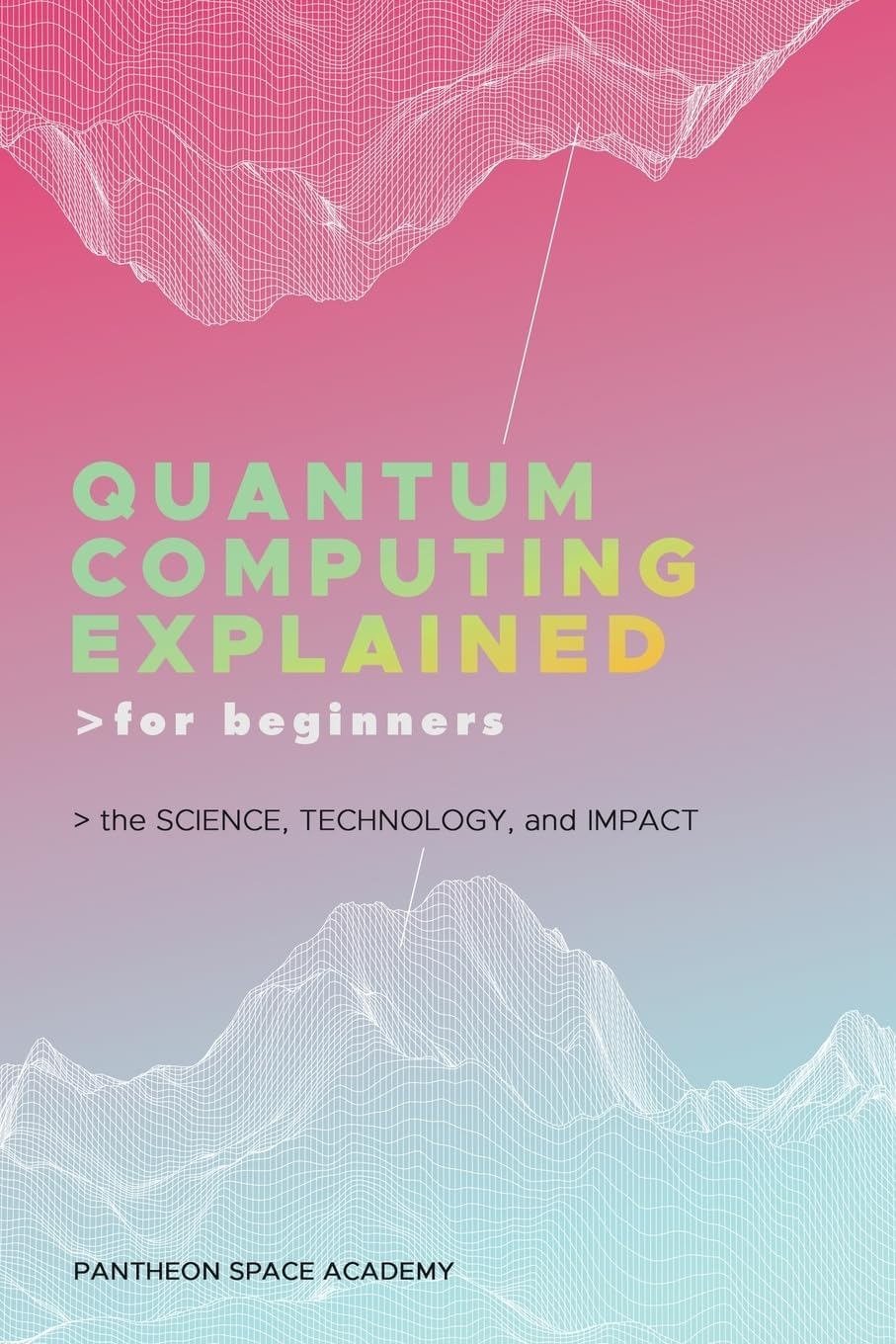
Quantum Computing Explained for Beginners: The Science, Technology, and Impact
Product ID: 590205384
Buy anything from 5,000+ international stores. One checkout price. No surprise fees. Join 2M+ shoppers on Desertcart.
Desertcart purchases this item on your behalf and handles shipping, customs, and support to Bolivia.
The Future of Computing — Made Simple for Beginners Quantum computing is widely considered the next revolution —but most explanations make it sound impossible to understand. This book changes that. If you're curious about the future of computing but intimidated by dense academic jargon, you're in the right place. Quantum Computing Explained for Beginners breaks down qubits, superposition, quantum gates, and the technology transforming industries—using clear language anyone can follow. Whether you're a tech enthusiast, software developer, student, or simply a curious mind, this book was written for readers exactly like you. You don't need a physics degree to understand quantum computing—you just need the right teacher. Inside the book : Foundation : Traverse the peaks and valleys of quantum mechanics, from entanglement to superposition. Building Blocks : Get hands-on with quantum computer hardware and software. Qubits? Gates? Quantum circuits? Algorithms? My book has it all mapped out. Into the Future : Explore the groundbreaking applications, from quantum cryptography to AI-infused innovations, and how they'll reshape our reality. But that's not all! I've included the exclusive Quantum Toolkit —from quantum simulators to resources and apps. Apply what you learn and start your quantum computing journey right away. This isn't just a quantum sneak peek—it's an in-depth tour covering everything from the foundation of quantum mechanics to the gadgets of tomorrow. You'll get hands-on with quantum computer hardware and software, and discover how cryptography and quantum healthcare will redefine our world. Why this book? Expert Insights : Written by the leading minds in quantum. Simple Language : No diving into the mathematical abyss. Future-Proof Skills : Elevate your tech-savviness and develop valuable skills for the future. No Prior Knowledge Required : Just bring your curiosity, and we'll handle the rest! By the end, you'll be equipped with skills that position you years ahead in tech knowledge. You won't just be informed—you'll be the go-to quantum whiz in your circle. Don't be left behind and outdated. Embrace the future NOW. Get your copy of "Quantum Computing Explained for Beginners" and leap into tomorrow, today! Review: Beautifully written beginner's guide! - Qubits and quantum circuits... oh, my! A super intimidating subject in an amazingly written book! I didn't expect the writing to resonate with me as much as I did. The author uses great analogies to explain some pretty complicated terms - something super useful for a visual-learning brain like mine. As someone who's always been intrigued by technology, but gets lost by technical jargon, this book was a great guide. The author's ability to present a tough complex topic and put it in layman's terms is nothing short of remarkable. What I particularly loved was the section on cryptography. My son has been interested in this topic for a while now, and I was actually able to have a conversation with him on the subject and not get lost! This book is a superb educational resource. From the foundational aspects of quantum mechanics to the thrilling potential applications in fields like cryptography and AI, I found myself eagerly absorbing every word. The chapters on quantum computer hardware and software were especially fascinating, giving me insights into a world I once thought was reserved for those with advanced degrees in physics. For anyone curious about the future of computing or looking to expand their knowledge in a fun, accessible way, I can't recommend this book enough. It's transformed how I view technology and inspired me to be more proactive in understanding the gadgets and innovations shaping our world. Review: Informative - I wanted to delve into the nuances of quantum computing, and this book caught my attention. Given the rapidly evolving nature of the field, there's always more to absorb, and I'm uncertain about how much information I've retained. The book not only defines key terms and benefits but also elucidates the distinctions between quantum and classical computing, making it a valuable resource for beginners. The book starts by establishing a strong grounding in quantum mechanics, skillfully navigating through complex concepts like entanglement and quantum gates. What distinguishes this book is its ability to simplify intricate theories, making them easily understandable for tech enthusiasts, software developers, students, and innovators. The author's commitment to simplicity ensures that readers can grasp the fundamentals of quantum mechanics without feeling overwhelmed. Beyond theoretical aspects, the book delves into the practical side of quantum computing, providing hands-on exploration of both hardware and software. It covers everything from understanding qubits to unraveling the complexities of quantum circuits and algorithms, offering a comprehensive guide for a diverse audience. Real-world applications, such as quantum cryptography and AI-infused innovations, are included, adding a practical dimension to the earlier theoretical foundation.


| Best Sellers Rank | #954,522 in Books ( See Top 100 in Books ) #32 in Teen & Young Adult How Things Work #768 in Quantum Theory (Books) #1,956 in Artificial Intelligence & Semantics |
| Customer Reviews | 4.0 out of 5 stars 498 Reviews |
T**M
Beautifully written beginner's guide!
Qubits and quantum circuits... oh, my! A super intimidating subject in an amazingly written book! I didn't expect the writing to resonate with me as much as I did. The author uses great analogies to explain some pretty complicated terms - something super useful for a visual-learning brain like mine. As someone who's always been intrigued by technology, but gets lost by technical jargon, this book was a great guide. The author's ability to present a tough complex topic and put it in layman's terms is nothing short of remarkable. What I particularly loved was the section on cryptography. My son has been interested in this topic for a while now, and I was actually able to have a conversation with him on the subject and not get lost! This book is a superb educational resource. From the foundational aspects of quantum mechanics to the thrilling potential applications in fields like cryptography and AI, I found myself eagerly absorbing every word. The chapters on quantum computer hardware and software were especially fascinating, giving me insights into a world I once thought was reserved for those with advanced degrees in physics. For anyone curious about the future of computing or looking to expand their knowledge in a fun, accessible way, I can't recommend this book enough. It's transformed how I view technology and inspired me to be more proactive in understanding the gadgets and innovations shaping our world.
B**E
Informative
I wanted to delve into the nuances of quantum computing, and this book caught my attention. Given the rapidly evolving nature of the field, there's always more to absorb, and I'm uncertain about how much information I've retained. The book not only defines key terms and benefits but also elucidates the distinctions between quantum and classical computing, making it a valuable resource for beginners. The book starts by establishing a strong grounding in quantum mechanics, skillfully navigating through complex concepts like entanglement and quantum gates. What distinguishes this book is its ability to simplify intricate theories, making them easily understandable for tech enthusiasts, software developers, students, and innovators. The author's commitment to simplicity ensures that readers can grasp the fundamentals of quantum mechanics without feeling overwhelmed. Beyond theoretical aspects, the book delves into the practical side of quantum computing, providing hands-on exploration of both hardware and software. It covers everything from understanding qubits to unraveling the complexities of quantum circuits and algorithms, offering a comprehensive guide for a diverse audience. Real-world applications, such as quantum cryptography and AI-infused innovations, are included, adding a practical dimension to the earlier theoretical foundation.
O**E
A useful book for beginners
Quantum Computing is a book I bought in order to write my own book on quantum computing. I was commissioned to write it by the university where I work as a guest writer, a task that ultimately took me more than a year to complete. It wasn't easy because the subject itself isn't. It's easy to think you're right when you're actually wrong, and vice versa. Now, while QC isn't a profound book that gets to the root of the problem, it is a helpful book for anyone interested in learning about the topic. I say helpful because there are key concepts, such as superposition and entanglement, that are difficult to understand, and QC explains them with some clarity. However, it's not a book that possesses the depth of any other on the subject, as that's not its purpose. Its purpose is to introduce the interested reader to aspects of quantum computing as a first approach. Therefore, I recommend it for those who know practically nothing about the topic. I should add that to finish my own work I read about fifty books (in addition to newspaper articles, podcasts, and videos), and QC turned out to be by far the easiest of them all. The main flaw of this little book is that it's very repetitive on certain topics. That's why I'd say it's quite long, but this flaw is forgivable because of how much its, shall we say, friendly tone helps us delve into this world where nothing, absolutely nothing, is as we think.
J**.
Computers of the Future
Whew! This book is a challenge to get through. The first part, which deals with some of the basics of quantum mechanics (the science of atomic and sub-atomics particles) is definitely not for beginners and I struggled. After that though, the basic idea is that computers based on the science of quantum mechanics could be and are being developed that have enormously more capability (for certain applications) than the computers we currently use. And this new power could be used for the benefit of mankind in fields such as healthcare, finance, energy, encryption and decryption, materials science, etc. And of course, given the nature of mankind, to its significant detriment as well. Image no bank account, health record, email communication, etc. being resistant to the decryption capability of these new computers. So all in all it was a fascinating, if lengthy read and made me realize that I have to learn more. And fortunately the resources provided by the book, including the references provided the avenues to do just that.
R**N
AI :(
ChatGPT slop. The format is the exact same ChatGPT uses (Lists on every other page). It uses the same words and pretty much re-states an idea for the next fifteen pages over and over again, not even using different explanations. Example: Page 8 - "Qubits. aren't confined to strict binary states like classical bits; thanks to the principles of duality, they can be both 0 and 1 until measured." Page 11 - "The duality allows qubits to be in a superposition, where they simultaneously exist in multiple states, unlike classical bits, which are firmly a 0 or 1." Page 15 - "Quantum computers operate using qubits, which can be in a superposition of states, unlike classical bits that are always either a 0 or 1. Essentially, a qubit represents both 0 and 1 simultaneously until it's measured." Page 18 - "In classical computing, we're used to bits being either in a 0 or 1 state. In quantum computing, qubits can be in a superposition of 0 and 1, but when we measure them, they collapse to one of the states." Page 20 - "In classical computers, a bit is either a 0 or a 1. But a qubit, governed by quantum rules, can exist in both states." Additionally, there is no author listed. Nobody gets any credit, probably because it was all ChatGPT.
J**K
Very little actual information, poorly edited, long winded
It felt like this book was created using a series of AI generated paragraphs. There was very little actual content and it was very repetitive, with some phrases repeated exactly in multiple places in the book but as if they were being said the first time. Descriptions sometimes referenced an advanced subject as if the reader already knew what it was and then later explained that concept (sometimes never did). For a complex subject there are exactly zero visuals - no diagrams, no pictures, nothing. I think there were two small tables that were unnecessary and repeated the adjacent text. Most of the book is written using metaphors as a way to avoid getting into technical content. But the metaphors were excessive and overused and not particularly useful for explaining the concept. The book was mostly focused on the implications of quantum computing but lack a lot of his explanation as to why. I give it two stars because it was not completely devoid of information, but for the uninitiated, a feature magazine/web article on the subject could have covered what it takes the "author" (who is not a person but some entity) over 200 pages to accomplish. Look somewhere else if you want an intro to this subject.
P**N
Covers terminology and buzz words but does not give a good feel for the basic theory
Good for terminology with general uses in different areas without really going into enough detail to explain how it works. I come away with the need to research or read more about the mathematical theory and a basic understanding of how the hardware is built. Severely lacking in diagrams and pictures.
B**N
An Amazing Read!
You may think the 300+ pages will take a while to get through, but the reality, you'll fly through the book. I do not work in tech, the closest I've gotten is working as a technical writer for a while. However, I love learning about new technology, or simply reading about things I know nothing about. With that said, if you are someone who is interested in the subject, but do not have any prior knowledge, this book is a great start. Everything is broken down very well without drawing out the details. Furthermore, the author's own excitement over the material is easily seen through the writing and helps to give the book an extra, almost inspirational, quality while reading. I read the Kindle version of the book, but I'm thinking of purchasing the hard copy to keep in my personal library. I would highly recommend this book to anyone interested in the subject, no matter their current knowledge.
M**E
Fascinating.
Fascinating! I learned a lot. It's well written and makes quantum computing more understandable.
A**H
Waste of money
This book is a waste of money. It does not really explain how quantum computers are constructed or work. Most of the book is devoted to repeating itself on the potential applications of quantum computing and a 1/3 of the book is about useful web sites. Very disappointing read I found more interesting information on google
I**I
Useless
Beside some typical known facts about quantum mechanics there is nothing explanatory about quantum computing. This book could be one page long !!
O**S
Not so good
I'm giving it 3 stars just out of the fact of the contents of chapter 6 and the clarification of some acronyms. For the rest it's a repetitive and non clarifying text that remains time and again in the most basic surface about quantum computing, explaining nothing about gates, algorithms and such. Useful as an absolute starting point and informative about where you can find some actual training. Nothing more.
J**O
Tries hard to be simple, but it’s still quantum
The book does a decent job of trying to break down impossible-sounding ideas like superposition, entanglement, and quantum gates without just throwing a bunch of equations at you. It gives you a full tour, the basics of quantum mechanics, the hardware, the software, and all the future stuff it will be used for, like AI and cryptography. The "Quantum Toolkit" it includes, which points to simulators and other resources, is also a really solid, practical touch. The book tries so hard to be simple that it ends up feeling vague. By avoiding all the math, the explanations for how things actually work are just a string of big words. It's like it explains what a qubit is, but not why it behaves the way it does. It's definitely not as "simple" as it claims, and I can see why some readers get frustrated. It's also written by an "Academy", and at times it feels a little dry, not like you're being guided by a single, passionate teacher. For a future edition, I have a weird suggestion: they should add some of the math back in. They shouldn't put it in the main chapters, but maybe create an appendix for "The Math, If You're Curious". It feels like they overcorrected so much that they left out the core logic. Sometimes, a simple equation is actually easier to understand than a 10-page metaphor. Overall, it's a good overview if you know absolutely nothing. But it's not the "aha!" moment I was hoping for, and it probably won't make you the "go-to quantum whiz" it promises.
Trustpilot
1 month ago
1 month ago