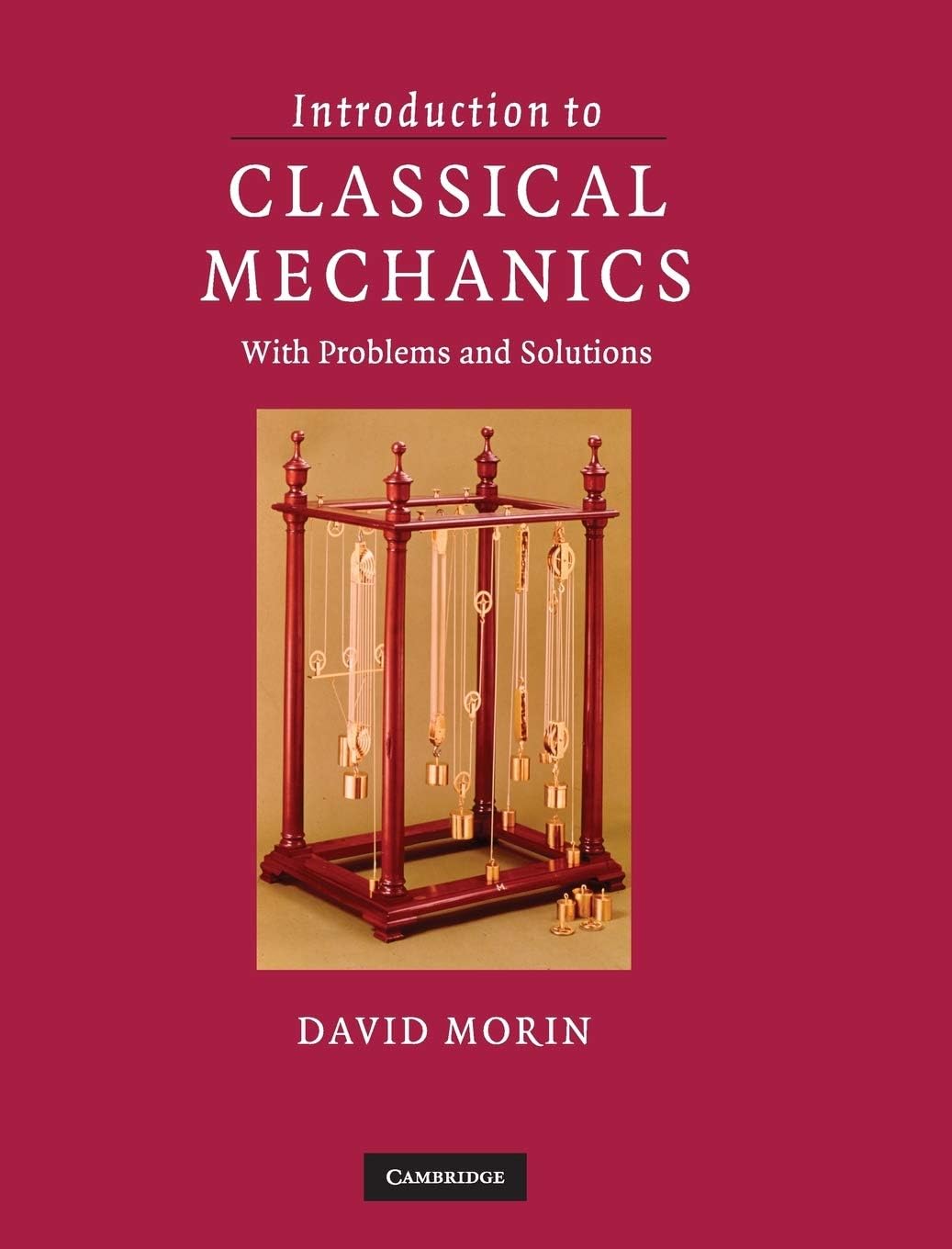
Introduction to Classical Mechanics: With Problems and Solutions
Product ID: 7202162
Buy anything from 5,000+ international stores. One checkout price. No surprise fees. Join 2M+ shoppers on Desertcart.
Desertcart purchases this item on your behalf and handles shipping, customs, and support to Bolivia.
Buy Introduction to Classical Mechanics: With Problems and Solutions on desertcart.com ✓ FREE SHIPPING on qualified orders Review: The most helpful Physics book ever - My background? Ph. D. Organic Chemistry. I did not do well at math, but I'm out of school now, and done taking classes. I bought this book to self-teach myself some remedial Physics in order to facilitate a non-trivial study of quantum mechanics. What a gem of a book. The introduction is very reassuring. The material won't be learned without working problems. Working problems takes time. Part of the learning process is doing problems wrong. They never told me this in college. Not getting it right the first time convinced me I had low aptitude for this stuff. It turns out, my sufferings were a natural part of the learning process. The tone of the book is very helpful. The author wants the student to succeed. Too often, I have taken a class or tried to use a book in which the professor's attitude was "many of you will die." Not only does Morin seem to want the reader to succeed, he even gives extensive instructions on how to succeed. He starts with a whole chapter on how to solve problems, even when the reader doesn't have quite the background to solve the problem. I was able to read well into the introductory material using the free chapters Morin puts online, so I was able to determine this was the right book for what I was trying to do before I bought it. I would recommend anyone to try the free stuff. I'm having about as good a time as I could ever expect with this material. Remember, pain and suffering are normal. The limericks? Perhaps they go over my head. Review: Very good problem collection - A strength of this book is the very good collection of problems at the end of each chapter. There is a nice progression of complexity in the available problems. There is a diagram to accompany each problem which really helps to clarify the problem. Solutions are included for a significant number of the problems.
| Best Sellers Rank | #154,799 in Books ( See Top 100 in Books ) #5 in Mechanics #23 in Physics (Books) #28 in Physics of Mechanics |
| Customer Reviews | 4.6 4.6 out of 5 stars (479) |
| Dimensions | 7.5 x 1.5 x 9.75 inches |
| Edition | 1st |
| ISBN-10 | 0521876222 |
| ISBN-13 | 978-0521876223 |
| Item Weight | 3.85 pounds |
| Language | English |
| Print length | 734 pages |
| Publication date | February 4, 2008 |
| Publisher | Cambridge University Press |
R**K
The most helpful Physics book ever
My background? Ph. D. Organic Chemistry. I did not do well at math, but I'm out of school now, and done taking classes. I bought this book to self-teach myself some remedial Physics in order to facilitate a non-trivial study of quantum mechanics. What a gem of a book. The introduction is very reassuring. The material won't be learned without working problems. Working problems takes time. Part of the learning process is doing problems wrong. They never told me this in college. Not getting it right the first time convinced me I had low aptitude for this stuff. It turns out, my sufferings were a natural part of the learning process. The tone of the book is very helpful. The author wants the student to succeed. Too often, I have taken a class or tried to use a book in which the professor's attitude was "many of you will die." Not only does Morin seem to want the reader to succeed, he even gives extensive instructions on how to succeed. He starts with a whole chapter on how to solve problems, even when the reader doesn't have quite the background to solve the problem. I was able to read well into the introductory material using the free chapters Morin puts online, so I was able to determine this was the right book for what I was trying to do before I bought it. I would recommend anyone to try the free stuff. I'm having about as good a time as I could ever expect with this material. Remember, pain and suffering are normal. The limericks? Perhaps they go over my head.
D**E
Very good problem collection
A strength of this book is the very good collection of problems at the end of each chapter. There is a nice progression of complexity in the available problems. There is a diagram to accompany each problem which really helps to clarify the problem. Solutions are included for a significant number of the problems.
B**M
Good third year undergrad mechanics
This is a very well written book. Good problem sets that build student knowledge along with thorough solutions provided after the problem sets. This would not be a good book for either first year physics students or first year honors physics students. They may be using this for first year honors at Harvard, but it is doubtful that the students are absorbing more that 50% of the information. There may be the exceptional student who is already grounded in Calculus and intro diff eqns along with a well developed AP physics, but most first year honors will be in over their heads. With that said, this would be a very good third year mechanics course text. The only real shortcoming is it is missing information on Hamiltonian, non-linear, chaos and such, but that could easily be supplemented during second semester. This treatise is much much better that Taylor's Classical Mechanics which is overly verbose, introduces other nomenclature at the same time it is introducing mechanics (no need to add to student's burdens by using different nomenclature than they are used to). Taylor's examples, problem and answer sets are very weak and add little value to that text. This particular text should be strongly considered for third year physics mechanics along.
A**J
Comparison of the canonical intermediate mechanics texts: Kleppner, Taylor, and Morin.
Taylor’s Mechancis is exceptionally well written as compared to the other popular mechanics books at about this same level (Kleppner, Morin). However, the book is unrigorous in both its use of mathematics (after all, it's a physics book!) and its treatment of physics, especially angular rotation and the variational dynamics. That makes it a good follow up to something like Halliday for students who are content to use math and do physics heuristically; that is to say, for most engineering and science students, this book makes for a good, gentle introduction to advanced topics in dynamics. However, Taylor is not suitable as a either and introductory or intermediate text in mechanics for students interested in graduate studies which will depend on this material. Kleppner rigorously derives the classical physics theorems in limited cases, using rigorous but elementary calculus, making it a more suitable introduction to the subject. Morin unrigorously derives the classical physics theorems in generality using huristic vector calculus, making it a much more suitable follow up to Kleppner and prerequisite to Goldstein (which is the standard doctoral text). Notice, though, that Taylor covers significantly more topics than Kleppner and Morin combined. This is in the nature of things: heuristic examples are easier to explain than theorems and proofs, which affords Taylor the time to introduce some amazing applications of the theory, for example nonlinear dynamics and fluid dynamics. If you are looking for a cohesive introduction to these tangential topics, and are content to do things heuristically, there might not be a better book than Taylor. I scored Morin 4/5 because it is the only book at this level which provides a rigorous accounting of physics of angular dynamics in the general case. However, the chatty style--not just the random poems, but also in the excessive number of casual “remarks” throughout--detracts from the physics. In particular, the chapter on Lagrangian Mechanics is terribly written. There again, the treatment is more correct but less clear than in Taylor, but in this instance the line of argumentation is nearly unintelligible on a first reading. However, it should be noted that almost no books prove, in the special cases where such a proof is possible, that Newtonian and Lagrangian physics are equivalent. They all, for whatever reason, simply argue the “if” or the “only if” part of the correspondence. In reality, Morin should probably deal with Lagrangian physics as he does angular physics: break it into two chapters, the first dealing with the most important special case (Cartesian degrees of freedom), the second dealing with the general case (generalized degrees of freedom). As it stands, none of the introductory Lagrangian Mechancis books, including Goldstein, do this--however, Goldstein is at least explicit enough with the definitions so that the untreated correspondence can easily be worked out by a student on a first reading. Furthermore, it should be noted that the treatment of Special Relativity follows the “curious paradox” line of reasoning, rather than the “homomorphic equations” line of reasoning. This is the standard, but by definition it is unintuitive. Since physical--in particular, mechanical and electrical--intuition is of paramount importance in the study and application of physics, I also think this standard treatment is rather useless. Physics Professors seem to insist on treating Special Relativity after Classical Mechanics but before Classical Electromagnetism, which precludes the line of argumentation which seemed to inspire Einstein in the first place: that Maxwell's Equations, including the constant factors, ought to have the same form under suitable changes of coordinates. For this reason, I think the best treatments of special relativity can be found in books like Griffiths and Jackson, rather than books like Morin and Taylor. (Indeed, Taylor explicitly refers the reader to Griffiths, which is ridiculous since both books deploy the same mathematical machinery).
Y**L
A escrita do Morin é incrível. Ele consegue explicar melhor do que qualquer outro livro que eu tive contato, nota 10. Além de ter a solução de todos os exercícios, o que ajuda bastante nos estudos.
A**A
Das Buch ist sehr gut geschrieben und deshalb einfach zu lesen. Die wichtigste Punkte sind betont, sowie die nützliche Strategien, um ein bestimmtes Problem zu lösen. Natürlich ist es bemerkenswert, dass es zahlreiche Übungen und gelöste Probleme gibt. Die Limericks gefallen mir nicht, aber das ist eine sehr kleine Schwäche des Buches!
J**Z
Venia con un detalle golpecitos, pero de ahí en fuera todo bien. Buen libro para iniciarse en mecánica clásica
V**A
Although printing is excellent (it depends on the piece), I can't comment on the content. Obviously, I haven't studied it yet, so how can I comment? But yes, based on perplexity, ChatGPT, Gemini, and Grok, this book is best for Olympiad preparation, specifically INPhO and IPhO. When I say Olympiad, I am not referring to JEE Advanced. If you are not from India(maybe), then think of this book as a question bank, with theory. I hope you understand. Thank you.
A**O
Il libro espone in maniera estremamente chiara ed esauriente la meccanica abitualmente presente in un corso di Fisica I, ma include anche un'introduzione al formalismo lagrangiano e basi di relatività ristretta. Gli esercizi sono molto vari e mai scontati, e fanno parte integrante dell'esposizione dei concetti. Ne sono presenti anche di notevolmente difficili (con soluzioni). In assoluto il miglior libro sull'argomento che si possa consigliare ad uno studente del primo/secondo anno di Fisica.
Trustpilot
1 month ago
1 week ago