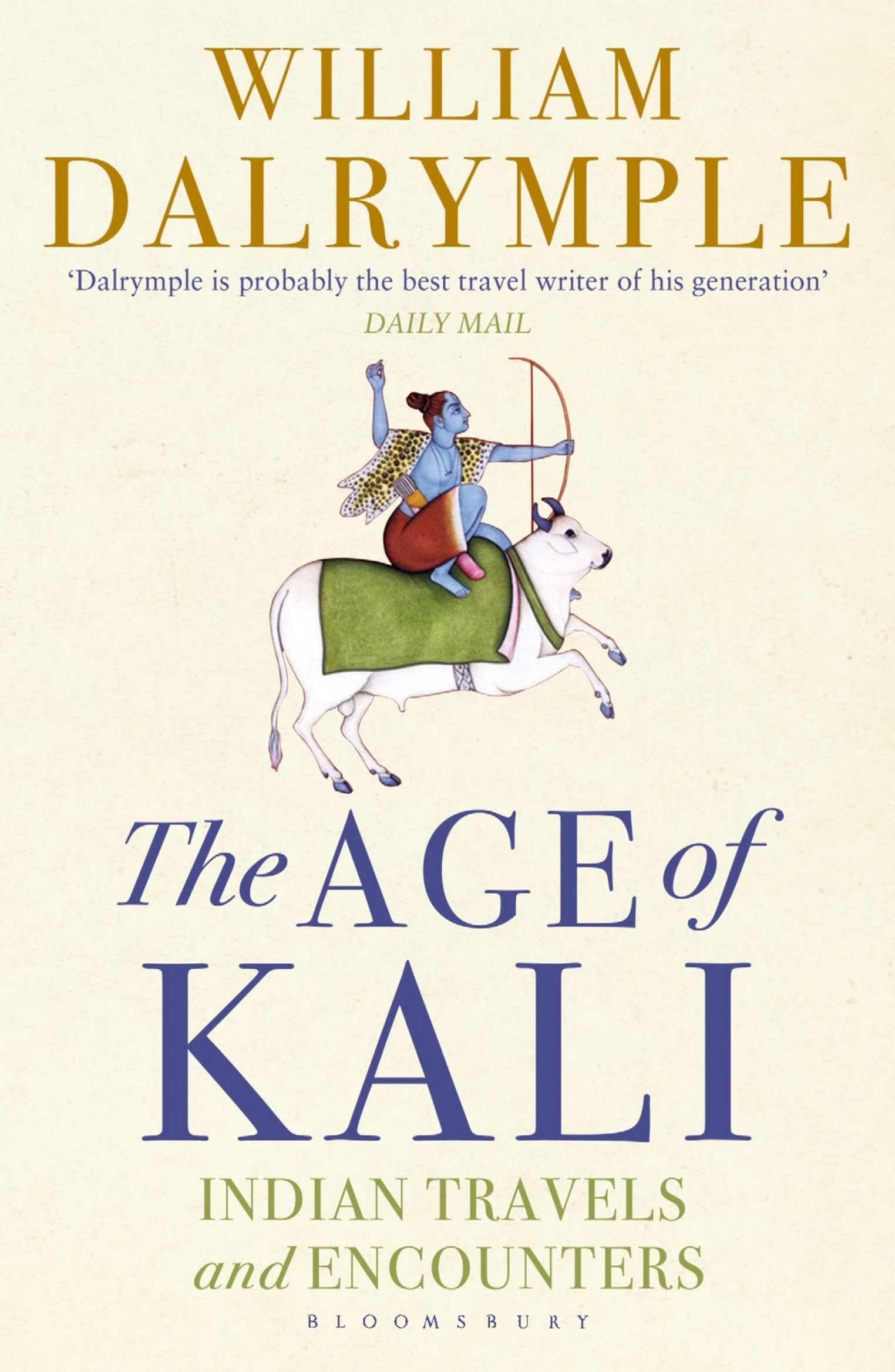
The Age of Kali
Product ID: 79904781
Desertcart purchases this item on your behalf and handles shipping, customs, and support to Bolivia.
The result of a decade of travels through the Indian subcontinent, the Age of Kali is a collection of essays ranging in scope from the widows of Vrindavan to rap stars in Bombay, the temples as old as the Parthenon in Madurai, the socialite author Shobhaa De, the remnants of the kingdom of Avadh, and meetings with then Prime Minister Benazir Bhutto and Imran Khan. Stylish, witty and bristling with insight, these jewel-like essays string together to create a captivating and enduringly relevant portrait of the subcontinent. Review: Breathtaking !!! - The Age of Kali: Indian Travels and Encounters by William Dalrymple is a compelling collection of essays that offer a vivid portrayal of contemporary India during the tumultuous period of the 1990s. Exploration of Contemporary Issues Dalrymple explores a wide range of social, political, and cultural issues affecting India at the time. From religious fundamentalism and communal tensions to economic disparities and environmental challenges, the essays provide a nuanced understanding of the complexities of modern Indian society. Dalrymple's observations are sharp and insightful, offering readers valuable insights into the forces shaping India's development and identity. Personal Engagement Central to the essays is Dalrymple's personal engagement with the people and places he encounters. Whether interacting with politicians, activists, artists, or ordinary citizens, Dalrymple brings their stories to life with empathy and sensitivity. His ability to capture the human dimension of larger societal issues adds depth and authenticity to the narrative, making the essays both informative and emotionally resonant. Cultural and Historical Context Dalrymple contextualizes contemporary events within India's rich cultural and historical tapestry. He draws parallels between past and present, reflecting on how ancient traditions and colonial legacies continue to influence modern Indian society. His exploration of cultural practices, religious rituals, and artistic expressions offers readers a broader perspective on India's cultural diversity and resilience in the face of change. Literary Style Dalrymple's writing is eloquent and evocative, blending journalistic rigor with literary flair. His prose is engaging and accessible, making complex issues accessible to a wide audience. Whether describing urban landscapes, rural communities, or political gatherings, Dalrymple's descriptive language vividly captures the sights, sounds, and textures of contemporary India. The Age of Kali: Indian Travels and Encounters by William Dalrymple is a thought-provoking exploration of contemporary India that combines insightful analysis with engaging storytelling. Through a series of essays, Dalrymple sheds light on the social, political, and cultural dynamics shaping India during the 1990s. The book is essential reading for anyone interested in India's modern history, cultural diversity, and the challenges of globalization. It offers a compelling portrait of a nation at a crucial juncture in its development, reflecting on both the promises and perils of progress in the "Age of Kali." Review: Must read. - This book is a must read.
| Best Sellers Rank | #24,787 in Books ( See Top 100 in Books ) #66 in Travel Writing (Books) #565 in Indian Writing (Books) |
| Customer Reviews | 4.5 out of 5 stars 584 Reviews |
J**P
Breathtaking !!!
The Age of Kali: Indian Travels and Encounters by William Dalrymple is a compelling collection of essays that offer a vivid portrayal of contemporary India during the tumultuous period of the 1990s. Exploration of Contemporary Issues Dalrymple explores a wide range of social, political, and cultural issues affecting India at the time. From religious fundamentalism and communal tensions to economic disparities and environmental challenges, the essays provide a nuanced understanding of the complexities of modern Indian society. Dalrymple's observations are sharp and insightful, offering readers valuable insights into the forces shaping India's development and identity. Personal Engagement Central to the essays is Dalrymple's personal engagement with the people and places he encounters. Whether interacting with politicians, activists, artists, or ordinary citizens, Dalrymple brings their stories to life with empathy and sensitivity. His ability to capture the human dimension of larger societal issues adds depth and authenticity to the narrative, making the essays both informative and emotionally resonant. Cultural and Historical Context Dalrymple contextualizes contemporary events within India's rich cultural and historical tapestry. He draws parallels between past and present, reflecting on how ancient traditions and colonial legacies continue to influence modern Indian society. His exploration of cultural practices, religious rituals, and artistic expressions offers readers a broader perspective on India's cultural diversity and resilience in the face of change. Literary Style Dalrymple's writing is eloquent and evocative, blending journalistic rigor with literary flair. His prose is engaging and accessible, making complex issues accessible to a wide audience. Whether describing urban landscapes, rural communities, or political gatherings, Dalrymple's descriptive language vividly captures the sights, sounds, and textures of contemporary India. The Age of Kali: Indian Travels and Encounters by William Dalrymple is a thought-provoking exploration of contemporary India that combines insightful analysis with engaging storytelling. Through a series of essays, Dalrymple sheds light on the social, political, and cultural dynamics shaping India during the 1990s. The book is essential reading for anyone interested in India's modern history, cultural diversity, and the challenges of globalization. It offers a compelling portrait of a nation at a crucial juncture in its development, reflecting on both the promises and perils of progress in the "Age of Kali."
J**M
Must read.
This book is a must read.
K**N
India in the 90s
I am a fan of his works. I know sooner or later I'll finish all of his published books. This book of his is about his travels through India and the chapter that stood out was Peshawar, the description of the place and the scenic beauty makes me want to see it and also the island of Reunion. I really wanted to read about Lakhswadeep, Andaman & Nicobar and also the North East, if only he could visit the states there and talk about how the war that came closest to India and its effects, its history and everything. The book though is from a perspective of a journalist, a neural party, witnesskng our age old traditions and customs, inspite of the writing being pretty balanced you can still sense an underlying scepticism and a slight hint of condescension about certain practices here - which is then picked up by the Western Media. These Orientals, they say! This book will take you back in time and show you a glimpse of how it was back in the 90s. India was opening up, Sri Lanka was struggling with a Civil war, Pakistan with it's political issues. I enjoyed reading it, though some chapters felt point less (Shoba De and Baba Saighal) but they bring out the essence and might be required.
S**D
Informative, gripping and exciting!
Dalrymple describes India like no one else. His treatment of India is just like a surgeon when he has to operate his own son or daughter!
A**A
Exceptional
Exceptional accounts on exceptional stories. The book is a journal of Indian changing society spanned over 10 years. A must read.
F**A
A must read !!
I am a certified dalrymple fanboy, and I have no qualms in admitting it. this book is a collection of different articles about India which he had written during the nineties, chronicling the events of the decade which shaped India to what it is today.
A**S
A wonderful travelogue
I prefer when travelogues have an underlining narrative, and The Age of Kali does this wonderfully. This travelogue is positioned from the perspective of the Kali Yuga, as a result of which it unabashedly reveals the darkest, most destructive sides of India. It leaves the reader both ashamed and depressed – and yet you can’t put the book down. Thankfully, the book gradually transitions to more positive stories that give us a glimmer of hope in an otherwise (seemingly) hopeless, corrupt, and violent world. Dalrymple uses his phenomenal storytelling capabilities to weave an enthralling, deeper narrative out of his travels all over both India and Pakistan.
L**H
Simple yet powerful language
Interesting way of storytelling. Crisp and To the point. Yet at times it is quite one sided. The power of journalism.
M**T
ANother wonderful book
The delivery and condition of the book (second-hand) are perfect, as usual. As for the content, I haven't read it yet but it is the only book by W. Dalrymple that I haven't read, so I know it will be excellent.
A**R
Exzellente Einblicke
Dieses Buch ist allen empfohlen, die sich mit Indien und Pakistan beschäftigen oder die eine Reise dorthin planen. Dalrymple beschreibt Indien als Kenner, nicht als naiver Reisender oder Beobachter. Er führt den Leser gezielt zu den interessanten Schauplätzen, nach Nordindien, in die Provinzen mit den höchsten Mord- und Gewaltraten, nach Pakistan in die Stammesgebiete der Pathanen und in die alten Zentren der indischen Fürsten. Es ist ein sehr gutes Buch mit sehr vielen interessanten Aspekten und Details, teilweise trifft Dalrymple berühmte Leute wie Imran Khan oder Benazir Bhutto, teilweise trifft er auf einfache Inder, die ihm recht offen Geschichten und Sachverhalte schildern, die er meist bestätigt findet. Ein großes Stück Reiseliteratur und ein sehr gutes Buch über Indien.
T**N
Five Stars
already posted.
P**D
Another piece in the Indian puzzle
Dalrymple is not a prolific writer. The reason is sheer depth of research and analysis. I love India but one can never visit and know all, one would need to spend a lifetim in each state and be proficient in each dialect. Dalrymple is the nearest we've got to that analogy and his books are occasional feasts rather than constantly produced junk food. 'The age of the Kali' is a collections of stories which, though unrelated, echo the theme of the age of chaos to which the title alludes. This is a good, solid lump of well researched pieces which can be read in any order.Dalrymple is not prolific,and this is a good thing. Each book takes time to read and time to digest. A good book, well written and one which will remain in my Indian section.
T**N
Fantastic account of the problems and promise of the subcontinent
_The Age of Kali_ by William Dalrymple is a fantastic and informative book on the Indian subcontinent, primarily abut India but with a section on Pakistan and essays as well on Sri Lank and the partially Indian island of Reunion. It is a result of ten years of travel by the author throughout the region, Dalrymple noting at the beginning of each essay in the book when he wrote it and in several cases following it up with a postscript (the earliest essay dates from the late 1980s and the book was published in 1998). In his introduction, Darlymple stated that the great question facing India now was whether the prosperity of the south and west of the country can overcome the "disorder and decay" of the east and the north. The author adopted a more or less regional organization of his essays accordingly. The first section was on the north and consisted of five essays. The first essay focused on the state of Bihar in the northeast of the country and on what the author termed the "Bihar effect;" Bihar has been gripped by corruption, caste conflict, government breakdown, and general lawlessness, something he feared might spread to other areas of India. Bihar has been subjected to nearly open warfare and outright massacres between armed Untouchables and high-caste Indians, criminal politicians (in 1997 thirty-three of its state assembly lawmakers had criminal records; one individual, Dular Chand Yadav, had fifty counts of murder pending against him), armed gangs robbing cars in broad daylight, kidnappings, and upwards of ten private armies roaming the countryside. Some of the problems of Bihar may be the result of a revolution in much of India, one in which lower caste politicians are supplanting upper-caste elites, a revolution which has had positive effects (among other things blunting the Hindu revivalist movement and anti-Muslim actions) and negative effects (the "emergence of a cadre of semi-literate village thugs" in some areas). Other essays in this section focused on the once beautiful city of Lucknow (capital of the former Kingdom of Avadh, "indisputably" the largest, wealthiest, and most beautiful pre-Raj city in India), its palaces, pleasure gardens, and gilded dome mosques decaying due to poverty, neglect, corruption, and being replaced by shanty-huts and ugly concrete tower-blocks; the city of Vrindavan in Uttar Pradesh, a "temple town" where many devout Hindus believe Krishna still lives, destination for hundreds of thousands of Hindu pilgrims, and also heartbreakingly many thousands of widows, who live lives of terrible poverty and suffering, the result of traditional Hindu society views on widows, which with the death of their husband lose all status and are often exiled from their homes and even villages; an interview with Rajmata Vijayaraje Scindia, seen as both a "madwoman and a saint," a leader of the militant Hindu revivalists and once heir to Gwalior, a Portugal-sized kingdom dissolved at Independence in 1947; and a visit to English schools, legacy of the Raj, fragile "archipelagoes of Englishness" in a "choppy Indian sea" facing very uncertain futures. The second section had three essays on Rajasthan (in the north and west of the country). The first essay was titled "The sad tale of Bahveri Devi" and was indeed a sad tale of brave sathins (informal social workers among village women) and their struggle to stop infanticide and child marriages and promote education for all children, the essay focusing on a lower-caste sathin who was raped and faced both caste and gender-based bias as result of her efforts and of the rape. The second essay focused on caste conflicts and what Indian opponents called "caste-apartheid." The third essay was on sati (the act of a widow throwing herself on her husband's funeral pyre); regrettably despite efforts to eradicate it sati is still deeply engrained in many parts of rural India and Rajasthan is a center for the cult of the goddess Sati Mata. The third section was one the author titled "the new India," with one essay somewhat light-hearted, profiling a Hindi rap star and a Bombay-based romance novelist, and another more serious essay on protests against Western businesses in India, the author focusing in particular on rapidly developing and prosperous Bangalore, which has quadrupled in size in 25 years thanks to among other things its computer industry but like much of India faces huge problems thanks to hyper-development and the massive strains its puts on infrastructure and on the growing disparity in wealth between rich and poor. The fourth section was on the south of India, the author taking the reader to the Tamil temple town of Madurai and the ancient worship of the goddess Meenakshi; to witness the decay of the culture and architecture of Hyderabad, a once Italy-sized state within India on the Deccan plateau, that thanks to its Golconda diamond mines once rivaled Belgium in wealth but was forcibly annexed by India in 1948 during Operation Polo; and to see an exorcism at a temple of the goddess Parashakti in Cochin. Section five was titled "On the Indian Ocean" and was fascinating; "At Donna Georgina's" detailed the city of Goa, still heavy with Portuguese influence (the Portuguese having set up shop in 1510 and not having left until the locally unpopular "liberation" of Goa by India in 1961), a place like Lucknow and Hyderabad that was having its culture and architecture forcibly and deliberately eroded; another essay provided an excellent summation of the Tamil Tigers and the war in Sri Lanka; and the third essay was a wonderful account of Reunion. The final section was on Pakistan, with essays on Imran Khan, ultra-famous sports star turned politician (and what his fame and life said about Pakistan as a whole); a very interesting tour of the tribal states of Pakistan and the ruins of the fascinating Gandhara civilization (a composite civilization influenced by the Alexander the Great, its greatest icon a meditating Buddha in a Greek toga), and an interview with and account of Benazir Bhutto and her family.
Trustpilot
2 weeks ago
1 day ago