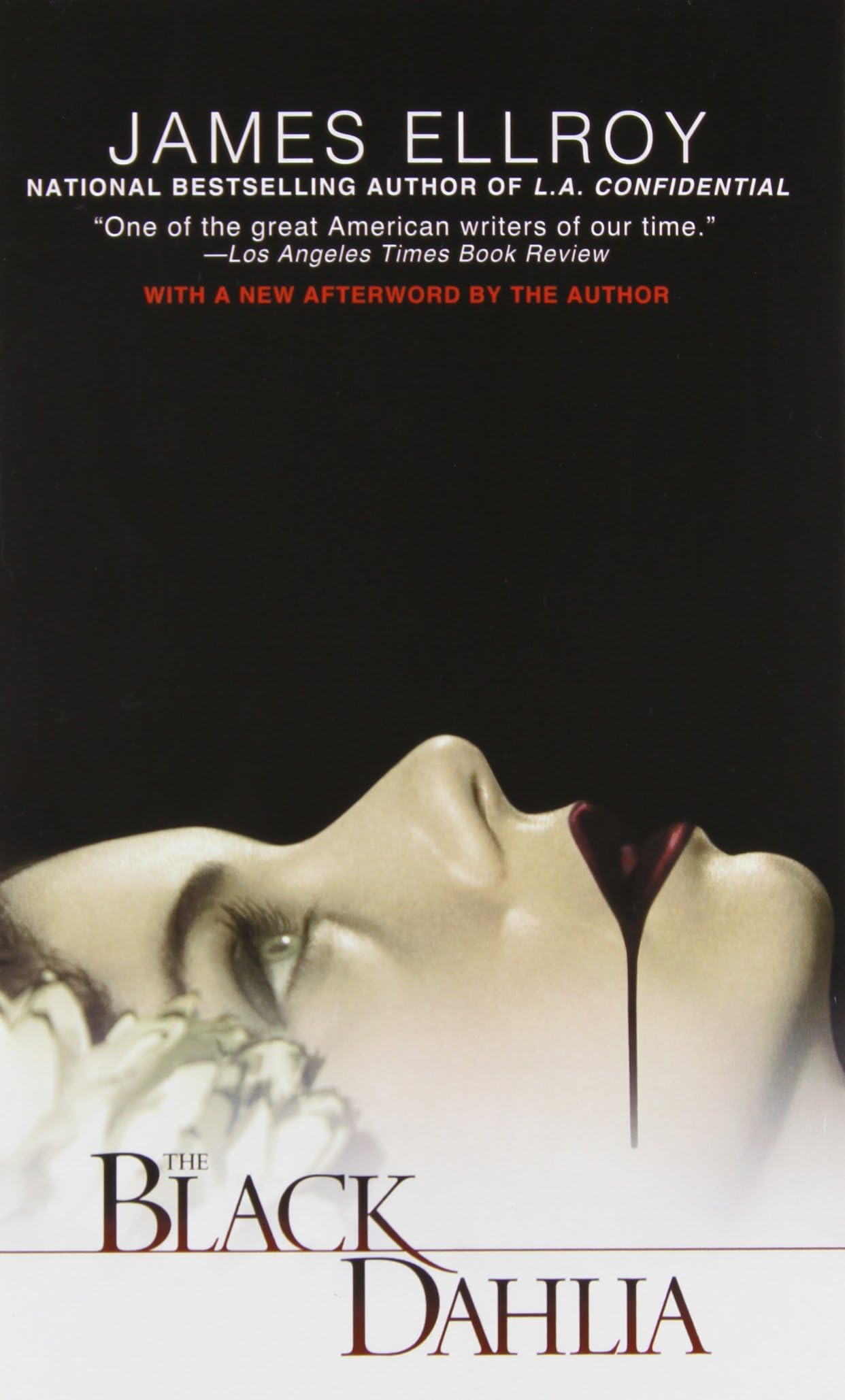


The Black Dahlia
Product ID: 8429443
Desertcart purchases this item on your behalf and handles shipping, customs, and support to Bolivia.
desertcart.com: The Black Dahlia: 9780446618120: Ellroy, James: Books Review: Difficult Masterpiece - This book is truly a masterpiece not only of the genre, but of literature. It is, like many masterpieces, a difficult read. As others have said, this is a complete novel. It's complex. The plot weaves around and resolves well, if not in the best taste. The writing is crisp but not staccato. You can get details from other four or five star reviews. So where is the difficult? It was, for this reviewer, in several areas. The first is the book is written in genuine 1940's American-ese which apparently used an utterly different idiom than modern American-ease. For example, what does it mean when a bunch of street bums 'wave their short dogs' at police? What is the 'high sign'? (No, it's not the middle finger salute - that made no sense in context). All too often the author goes on for a few pages and then concludes with one of these obsolete sayings or doings meaning the naive reader would lose the entire meaning of those pages. I'd have liked to have seen a glossary. The next issue is the motivation of the characters. None of them made any sense to me. I couldn't see real people behaving this way in reaction to events. Here's one small thing. The police mount a huge strike force to solve a murder but the investigation reveals the victim to be a nasty exploitative prostitute (for some reason, the author turned the real victim into this). I have a tough time believing that the 40's L.A. police would go all out for months to solve the murder of a prostitute. Worse, the characters' reactions to this victim made little sense but no less sense than how they react to each other. That was all true until the afterward of this edition when the author revealed, in such frank detail, why he wrote as he wrote, that for a bit, I thought I was reading a suicide note. I had a tough time believing anybody could be so honest about his inner thoughts and then just go in with life, but the author did. The afterward pulled the whole book together for me and suddenly, upon reading these last 15 or so pages, the previous 300 or so pages came into sharp focus. Part procedural, part psycho drama literature and all superb. Highly recommended. Review: Brutal, Savage - Donald Maass used The Black Dahlia in The Fire in Fiction to illustrate how to make a character "special." Since no one personality would appeal to all readers, the best way to make a character special is to show how that character impacts others. Elizabeth Short, "The Black Dahlia," had a life-altering impact on Bucky Bleichart, even though they didn't meet until after her murder. For the purpose of Maass's illustration, this book is perfect. The Dahlia affected every single character in the novel, major and minor, but she pervaded Bucky's life until he was obsessed with her. This is a brutal book, depicting a world devoid of beauty and populated by complex, ugly characters, as is expected in a noir. This isn't intended for tender-hearted readers, for those of us who have been blessedly sheltered from the savageries of life. It's a hard read, and I'm embarrassed to admit I read it. Being commanded to "keep your eyes from evil," I almost feel like I've sinned. For writers, there is so much to learn from Ellroy's style. He seems to have totally immersed himself into the underworld of 1940, and immersed himself into his character so well it must have messed with his psyche. His setting depictions were vivid--at times too vivid. All of his characters were complicated, many with intricately woven subtleties that added depth to their personalities. One, Russ, aka "padre," seemed to be the only character that didn't belong in the storyworld. He had a wife, a family; he seemed able to leave the ugliness behind him at the end of the day and not get caught up in the seduction of the hunt beyond professionalism. Although Ellroy never said so, he appeared to be a Christian. Ellroy would almost have to have a believer to round out his cast of characters. I can't decide how many stars to give this book. It deserves five, because the writing and the presentation of the story were amazing. But it's a hard read. The deeper you get in the story the more barbaric the events. I didn't like reading it, but was drawn to it every time I talked myself into putting it down. I'm definitely not a better person for having read it, but after studying some of his techniques during the read, I may become a better writer because of it.
| Best Sellers Rank | #174,400 in Books ( See Top 100 in Books ) #69 in Hard-Boiled Mystery #604 in Police Procedurals (Books) #1,050 in Murder Thrillers |
| Customer Reviews | 4.2 4.2 out of 5 stars (4,329) |
| Dimensions | 4.15 x 1.2 x 6.75 inches |
| ISBN-10 | 0446618128 |
| ISBN-13 | 978-0446618120 |
| Item Weight | 2.31 pounds |
| Language | English |
| Part of series | L. A. Quartet |
| Print length | 384 pages |
| Publication date | September 1, 2006 |
| Publisher | Grand Central Publishing |
P**L
Difficult Masterpiece
This book is truly a masterpiece not only of the genre, but of literature. It is, like many masterpieces, a difficult read. As others have said, this is a complete novel. It's complex. The plot weaves around and resolves well, if not in the best taste. The writing is crisp but not staccato. You can get details from other four or five star reviews. So where is the difficult? It was, for this reviewer, in several areas. The first is the book is written in genuine 1940's American-ese which apparently used an utterly different idiom than modern American-ease. For example, what does it mean when a bunch of street bums 'wave their short dogs' at police? What is the 'high sign'? (No, it's not the middle finger salute - that made no sense in context). All too often the author goes on for a few pages and then concludes with one of these obsolete sayings or doings meaning the naive reader would lose the entire meaning of those pages. I'd have liked to have seen a glossary. The next issue is the motivation of the characters. None of them made any sense to me. I couldn't see real people behaving this way in reaction to events. Here's one small thing. The police mount a huge strike force to solve a murder but the investigation reveals the victim to be a nasty exploitative prostitute (for some reason, the author turned the real victim into this). I have a tough time believing that the 40's L.A. police would go all out for months to solve the murder of a prostitute. Worse, the characters' reactions to this victim made little sense but no less sense than how they react to each other. That was all true until the afterward of this edition when the author revealed, in such frank detail, why he wrote as he wrote, that for a bit, I thought I was reading a suicide note. I had a tough time believing anybody could be so honest about his inner thoughts and then just go in with life, but the author did. The afterward pulled the whole book together for me and suddenly, upon reading these last 15 or so pages, the previous 300 or so pages came into sharp focus. Part procedural, part psycho drama literature and all superb. Highly recommended.
L**K
Brutal, Savage
Donald Maass used The Black Dahlia in The Fire in Fiction to illustrate how to make a character "special." Since no one personality would appeal to all readers, the best way to make a character special is to show how that character impacts others. Elizabeth Short, "The Black Dahlia," had a life-altering impact on Bucky Bleichart, even though they didn't meet until after her murder. For the purpose of Maass's illustration, this book is perfect. The Dahlia affected every single character in the novel, major and minor, but she pervaded Bucky's life until he was obsessed with her. This is a brutal book, depicting a world devoid of beauty and populated by complex, ugly characters, as is expected in a noir. This isn't intended for tender-hearted readers, for those of us who have been blessedly sheltered from the savageries of life. It's a hard read, and I'm embarrassed to admit I read it. Being commanded to "keep your eyes from evil," I almost feel like I've sinned. For writers, there is so much to learn from Ellroy's style. He seems to have totally immersed himself into the underworld of 1940, and immersed himself into his character so well it must have messed with his psyche. His setting depictions were vivid--at times too vivid. All of his characters were complicated, many with intricately woven subtleties that added depth to their personalities. One, Russ, aka "padre," seemed to be the only character that didn't belong in the storyworld. He had a wife, a family; he seemed able to leave the ugliness behind him at the end of the day and not get caught up in the seduction of the hunt beyond professionalism. Although Ellroy never said so, he appeared to be a Christian. Ellroy would almost have to have a believer to round out his cast of characters. I can't decide how many stars to give this book. It deserves five, because the writing and the presentation of the story were amazing. But it's a hard read. The deeper you get in the story the more barbaric the events. I didn't like reading it, but was drawn to it every time I talked myself into putting it down. I'm definitely not a better person for having read it, but after studying some of his techniques during the read, I may become a better writer because of it.
T**Y
Great writing
I bought the Kindle version, but added the audio to it and ended up listening because of the excellent narration. I am still reeling from the author's powerful prose. Excellent "film noir" atmosphere - the narrator's performance was absolutely superb! His voice was so versatile and compelling, it really made me stick with this book. I know I would have put it down if I was just reading by myself. His voice and the narrative take you right back to the 1940's, right after WWII. The writing is excellent - the subject matter is almost beyond a nightmare, not for faint hearted. The narrative is gritty, somewhat pornographic and definitely not of our politically correct times. I have to admit I found parts of it offensive. It was not easy to listen to, but the dialogue sounded authentic to how policemen must have spoke at the time. The storyline had so many highs and lows - twists and turns, especially near the end! This book is a work of fiction, based on two murders, one famous murder of a young woman in California and another murder of the author' s own mother. It's not just a crime drama, it's a study of obsession, guilt and redemption.
A**R
Enjoyed the book even though I found it disturbing. Not so much the graphic details of the murder of poor Elizabeth Short (the Black Dahlia), more so the psychological characteristics of the characters including the main character Bucky Bleichert, the LAPD cop. It wasn’t until I finished the book, I realized this novel uses a lot of true facts from the real Black Dahlia killing in 1947 Los Angeles. Then on learning something about the author, things started to drop in place as to why I found this book disturbing. Short was a young woman murdered in 1947, her body cut in half and discarded in Los Angeles, in a notorious and unsolved crime. According to one source, throughout the author’s youth, Ellroy used Short as a surrogate for his conflicting emotions and desires based on his own mother’s rape and murder when Ellroy was 10 years old. His confusion and trauma led to a period of intense clinical depression, from which he recovered only gradually. These personal issues are clear to see in this novel. Bleichert (surely the author?), his cop partner and buddy Lee Blanchard, and Kay Lake are the main characters at the centre of the novel. Initially, there is a kind of chaste and weird ménage a trois going on between them. Like most of the other characters they are dark and complex individuals weaving between righteousness, killing, corruption, and promiscuity - one moment trying to do good, the next … and that’s just the “good guys.” This book is full of dense plotting and a relentlessly pessimistic—albeit moral—worldview. I found it fascinating and hard to put down. You can expect dialogue and narration replete with jazz slang, cop patois, creative profanity and drug vernacular with a particular use of period-appropriate slang. This is a tale set in 1947 and the immediate years after so don’t be surprised to read words and attitudes expressed that are wholly unacceptable in 2020. It’s one of the few books I have read where I am forced to look up words and their meaning (American English). I now know the meaning of amscray, ixnay, and copacetic. The first two are derived from ‘Pig Latin’ – what I knew in Britain as back slang, whereby a made-up word is formed by transferring the initial consonant or consonant cluster of each word to the end of the word and adding a vocalic syllable and can be used in a conversation to convey secrecy. You can also expect stripped-down staccato sentence structures like some of the great noir and pulp fiction writers. Recommended.
B**R
Eines der wichtigsten Bücher die Rassimus, die ganze Finanzierung, Druckmittel und Mafia-Verbindungen von Hollywood schildern. Da ist Mr.Epstein ein braves Männchen dagegen.
W**L
This is the first time I read James Ellroy. I have become a fan, great writer. He has a great knack for bringing impossible characters to life.
R**.
mitica como la pelicula un viaje
A**R
Great book
Trustpilot
1 week ago
1 month ago