🔋 Power up your battery IQ — never get caught powerless again!
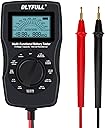
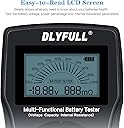
The X-cosrack Universal Battery Checker Tester is a compact, handheld device designed to test a wide range of batteries from 1.2V to 12V, including AAA, AA, C, D, 9V, Li-ion, and button cells. Featuring a clear LCD display, it provides precise readings of battery capacity percentage, voltage, and internal resistance, helping users accurately assess battery health. Its multi-functionality and broad compatibility make it an essential tool for professionals and tech-savvy millennials who demand reliable power diagnostics at their fingertips.


| ASIN | B07WS7HR31 |
| Best Sellers Rank | #455,073 in Tools & Home Improvement ( See Top 100 in Tools & Home Improvement ) #48,224 in Electrical Equipment |
| Brand | X-cosrack |
| Brand Name | X-cosrack |
| Color | Black |
| Customer Reviews | 4.4 out of 5 stars 1,004 Reviews |
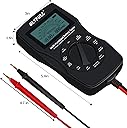
| Item Dimensions | 2.98 x 5.4 x 1.1 inches |
| Item dimensions L x W x H | 2.98 x 5.4 x 1.1 inches |
| Manufacturer | X-cosrack |
| Measurement Type | Multimeter |
| Model | M-BTB3-US |
| Power Source | Battery Powered |
| Style | B3 |
| Style Name | B3 |
| UPC | 194358026420 |
D**R
Good tester.
This battery tester works quite well. It accurately tells the battery's power level, not just good, bad, or needs replaced like some testers do. The price isn't bad for the item. It is pretty well built also. It has an electronic display and takes batteries. It tells the % of battery power left from 0 to 100%. It can test about any type of battery.
S**N
Quality device. Would definitely recommend!
This will definitely be my "Go To" Battery Tester, for all of my household type batteries from now on! It's the one and only one that I've found that actually displays useful information about the state of the battery under test. This tester requires 2 AAA Type batteries ( not included ). I opted to insert Energizer Ultimate Lithium's. With these batteries, the display is crisp, and very easy to read. No back-light in the LCD type display, but who's going to be testing batteries in the dark? Please be advised that the user needs to know that this tester is designed to be "voltage & battery type" specific. The 11 position rotary switch MUST be set to the correct voltage & battery type before performing the battery test. When switched to the appropriate battery V&T, the display capacity indicator sweeps from 100%, to 0% after a slight delay. I'm assuming that this is a sort of boot-up / self test. VERY COOL! At this point, use the spring loaded probes to press against the + (red) and - (black) battery terminals. After a couple of seconds, the display will indicate the battery Voltage, Resistance, and Capacity. If no test is performed within about 1 minute after power-up, the tester will turn itself off. Another outstanding feature of this tester is that it displays the status of the internal battery voltage in the upper right corner of the display (after being turned on). This tester has come in handy for me, because I was able to recover about 5% of a large number of batteries that I had tossed into a box for a future trip to the waste collection folks. Turns out that these 5% were still usable ... indicating 80% or greater capacity, and a good amount of voltage left. The only negative that I can mention about this tester is that the Battery Door was VERY DIFFICULT to open. I had to get a small screw driver, and gently pry on it while sliding it out of position. The "hook" in the center of the battery door is just a bit too high, and doesn't want to release when the door is snapped into place. I corrected this problem on mine by gently sanding the plastic tab down a bit. It releases much easier now. My personal conclusion is that this is an EXCELLENT and QUALITY MADE Battery Tester! Maybe a bit on the expensive side, but would definitely recommend!
D**S
Most Informative meter
First, this meter is designed to test mostly individual cells. It is accurate. It gives a better indicatio of the battery's health than most other testers. The attached test probes are much above average. The spring loaded gold-plated probe tips are pogo-pins with multiple pyramidal tips for excellent contact and consistent readings. The test lead wires are less flexible than I would like. The individual test probes are handy if you store your batteries in organizers that allow access to the battery contacts, but they are otherwise awkward. Good luck testing button cells. Some kind of holder built into the case would be welcome.The manual is difficult to undrestand. This instrument present several indications of a battery's health. It seems to report the open circuit (unloaded) voltage which is what a multimeter would measure. The open circuit voltage alone is not a very good indicator of the battery's state. While alkaline batteries have a gradual decline in voltage with use, other chemistries do not. For example, lithium cells have a very slight decline followed by a precipitous drop. All batteries Have a lower voltage output under load (when they are supplying current). So, the open-cicrcuit voltage may look good, but they won't run your device.. Many testers measure the battery's voltage under somel sort of load to get a better estimate of capacity.. This meter displays the battery resistance, which is the reduction in voltage divided by the change in load current. The resistance becomes higher with use. The meter uses the unloaded voltage, the measured resistance, and assumptions of other factors related to battery type and typical load requirements to estimate the remaining battery capacity. Obviously this can only be a guess of how the battery will perform for you, but it's better than other testers. You need to account for the load's characteristics. For example, does it draw high current? You must use the information from this meter --more than you get from most battery testers--together with your knowledge and experience to decide if you need to discard or charge--if appropiiate-- the battery. On another note, cells that have been in use will often have widely differing meter readings among rhe set. This is not a fault of the instrument. Cells are not made equal; they have slightly different discharge characteristics. Cells in battery packs influence each other as they discharg, resulting in differing discharge rates between individual cells. . Cells that are connected in series can even try to charge the cell that runs out of capacity first, backward! For best results, batteries should always be replaced as a set.
J**N
Tests most common batteries
This is a good battery tester that will test a wide range of batteries. Unlike some common battery testers, you have to use two leads to test the battery, making it awkward especially on smaller batteries.
S**K
Surprising versatility and functionality
Bought this to test CR2032 CMOS batteries and it found the weak ones! It does measure the batteries under load (a Pro) but it does not leave the load on (also a Pro). It seems to pulse the load on and off twice before giving the ESR measurement but the voltage displayed is a snapshot of when it was under load (a Pro). This is backed up by the fact that primary lithium batteries (non rechargeable) always give you ~3v when not under load so a multimeter will never be accurate. That is why a tester that puts load on the cell is a must when checking them. I was seeing voltages from 3 to 2.5 to 1.8 to 0.1 and I got rid of any that were under 2.5 around 2.2 to 2.3 or less so I am sure the batteries are going to last a long time in the computer I put them in. Pro's -Auto off feature that almost instantly wakes up, no different than a modern soldering iron (I have a TS-100) -Springy tips for stable contact, one note on those is that the wires are attached directly to the tips so the wires move when the tips move so you dont have to worry about that being an extra variable. -Almost true 4-wire, the cables are thicker than what might be needed is because there are 2 wires inside each. The reason it is almost true 4-wire because the wires connect in the tips not on the contact of the battery (see Con's). -Has a boost converter for low battery stability and accuracy. The internal voltage is higher (5v) than the battery voltage (<3v) so if the battery voltage gets low the output will still be the same until it cuts out completely. Con's -Uses AAA batteries, it could have been greatly improved if it had a rechargeable li-ion battery. It is so close because internally it uses a 5v boost converter to power the internals, so a li-ion battery, protection, charger and usb port would not be hard to implement, I would spend 5$ more if it had that. -Not true 4-wire, as stated in Pro's the 4-wire ends at the tips not continuing onto the battery to be tested, so always test 2 or 3 times to make sure you are making good contact on the terminal and the true reading is the one you get the most. -Rotary power switch, I like toggle buttons so I am not spinning the rotary dial all the way around to turn it off then spinning it all the way back to turn it to the same mode. I am overall pleased with the meter it is great for the price and I think some simple improvements would be great additions in a V2.
F**K
Very questionable accuracy...
Update 091020: After months of using, we're growingly uncertain that this tester is reliably accurate. All partial batteries, that test as high as 85% strong, fail soon after. We thought that maybe it was just the nature of the battery (low drain vs high drain). However, there have been other oddities as well, like how the testers internal battery gauge showed the batteries, that are powering the unit itself, to be completely depleted. After replacing them with new batteries, the old ones when tested externally with the same tester showed one battery to still be better than 50% strong and the other over 70%. I can understand the tester leads being more accurate than the units internal battery monitoring. But 0 to 50/70 is quite the disparity. Original review: This has been great for determining what partial batteries are still good enough to use after only using them briefly in Halloween or Christmas decor, as well as for testing batteries, when trying to figure out why a piece of electronics suddenly stops working properly, when you don't have a spare battery on hand to swap out. As batteries seem to be so wildly priced these days, with some brands costing as much for one as other brands charge for four, we also hoped it might tell us which budget brands are worth the money and which to avoid, as well as which vendors might be selling from an expired lot. There are many cheap testers that just tell you if the battery is good or bad without any relevant details as to how good or bad. This meter offered the promise of MUCH more refined results and works with a larger variety of battery types. It's pretty simple to use, without having to keep a manual handy, which this comes with a very small, brief paper manual for those who still value such, like we do. So far, we're happy with its seeming accuracy, but not exactly confident in it yet, as we've had several batteries, that tested near full, fail surprisingly fast for a near full battery. They were all cheaper generic batteries though. Maybe something about their design makes them drain faster than average in the devices we used them with. Or maybe once a battery starts to drop, it drops at an accelerated rate. The fact that we were using them in a bluetooth remote known to have poor power management, also leaves us skeptical of whether it had anything to do with the accuracy of this tester, which seems pretty precise otherwise. Regardless, it still feels a bit cheaply made - very light-grade plastic. The spring leads (see pictures) are a nice touch, though I've yet to figure out any practical advantage to them for this device, and it makes me wonder if they could compromise accurate conductivity. For the money, I think Dlyfull could/should have included a back-lit readout, as the screen is just too low contrast to easily read in low light. This is the kind of readout you'd expect from something made 10-15 years ago. Ultimately, we're glad we made the investment, as the product as already proved very useful, but in all honesty, ten to fifteen bucks seems a more appropriate price. Had we not had an immediate need, and had I seen it firsthand before buying, we would have held out for a better price.
N**E
This thing works!
Very handy. I checked a whole pile of aa aaa and 18650s, tossed out all the high internal resistance ones. Nice build quality. if you have rechargeables, I highly recommend it.
T**S
Great battery check
Great price for peace of mind battery check and well built unit.
Trustpilot
2 weeks ago
2 weeks ago