

Desert Online General Trading LLC
Dubai, United Arab Emirates
Desert Online General Trading LLC
Dubai, United Arab Emirates
Full description not available
H**F
Overcome your fears and expand your understanding of human intellegence
When I finally read this book I was very surprised at what I found. I'm not sure what I was really expecting, but given the level of hostility to the book I was thinking there must be some significant fault with it. I say "finally read" because I followed the controversy around this book when it was first published 15 years ago. Only recently did my courage and curiosity level become high enough to make me decide to give it a fair hearing. So if you are considering reading this book but not sure if you really should, I'd like to help put your mind at ease. When you do read the book what you will find is a surprisingly well written, scholarly and balanced view of intellegence.I'll begin with the question which is most likely on the forefront of your mind; Is this book racist? Most of us have noted from our own experience that Jews and Asians for example are more numerous in high IQ professions than would be proportional to their overall numbers. Likewise many have noted that other ethnic minorities aren't found as often in such professions as would be expected. This book's greatest sin is to note in chapter 13 that the same pattern of differences has been found repeatedly by psychologists studying IQ. Many would call the authors racists simply for noting these observations. But if noting observed patterns makes one a racist, doesn't this make anyone who notes the different frequencies in high IQ professions racist as well? Others assert that the differences observed in IQ testing prove a priori that IQ tests are racially biased. The authors address this contention head on, and I found the methods psychometricians use to eliminate cultural bias so fascinating that this alone was worth the cost of the book. If after learning more you still feel IQ tests are biased, you still have to explain why the same differences are observed by every intellectually rigorous test ever created. This begs the question of how the SAT, the ACT, the LSAT, MCATs, all state Bar Exams, your 10th grade math final, etc all wind up with the same group differences observed in IQ testing. Some might argue that there is a conspiracy by Jews and Asians to make the rest of us look less intelligent, but I can't buy that.However logic isn't all that applies when considering ourselves as members of a larger group. If you want to test this theory out, ask any married or dating couple if men or women are on average better drivers, more honest, more funny, more intelligent, etc. No matter how carefully you frame the question to pertain to the whole population of men and women (of which each individual counts for less than 1 in a Billion), without fail the discussion that follows will really be about which of the two of them is the better driver, etc. This holds true even if by their words they seem to be talking about men and women in general. So if you encounter someone who is unnaturally upset by this book, keep in mind that this is a perfectly natural response even though it isn't necessarily based in reason. No matter how logical we like to see ourselves, we are all subject to the whims of human psychology. So I plead with everyone to respond to such persons with the utmost restraint and compassion.Because of the way these kinds of things are so naturally personalized, I think many intelligent people hesitate to read this book for fear of what is upon examination obviously impossible. But sometimes the obvious isn't so obvious when something hits us at an emotional level, so I'll state this just to be clear: Reading this book and understanding IQ won't make you or anyone else any more or less intelligent than you (or they) already are. So don't worry. Your extremely intelligent African American boss: she'll still be extremely intelligent! Same goes for your wonderful Asian friend of more average intelligence; he won't be any different. And of course, the same goes for you.But why read this book if it has a potential to make some people uncomfortable? The selfish reason is to gain a clearer understanding of the world around you. However, there is an even more important reason. Millions of people today suffer for the fact that we generally haven't found adequate solutions to a whole host of social problems. Good intentions should be commended, but often private programs and government policy either have little benefit or end up actually harming the very people we are trying to help. One obvious example is education. Can we do a better job educating someone (of any race) who has an IQ in the 80s? Yes! Can this be achieved if we assume everyone has an IQ of 115 (as is implicit in most education policies today)? No. After you read the book you will notice countless other examples of how we are groping in the dark to solve problems that an understanding of the distribution of IQ would help illuminate. Certainly it isn't a magic bullet to solve all of our current social problems. But refusing to understand as much as we can about the dynamics of these problems won't help anyone, especially those who today suffer the most.
R**D
"Well-documented Revisit of Racial Groups and IQ/g"
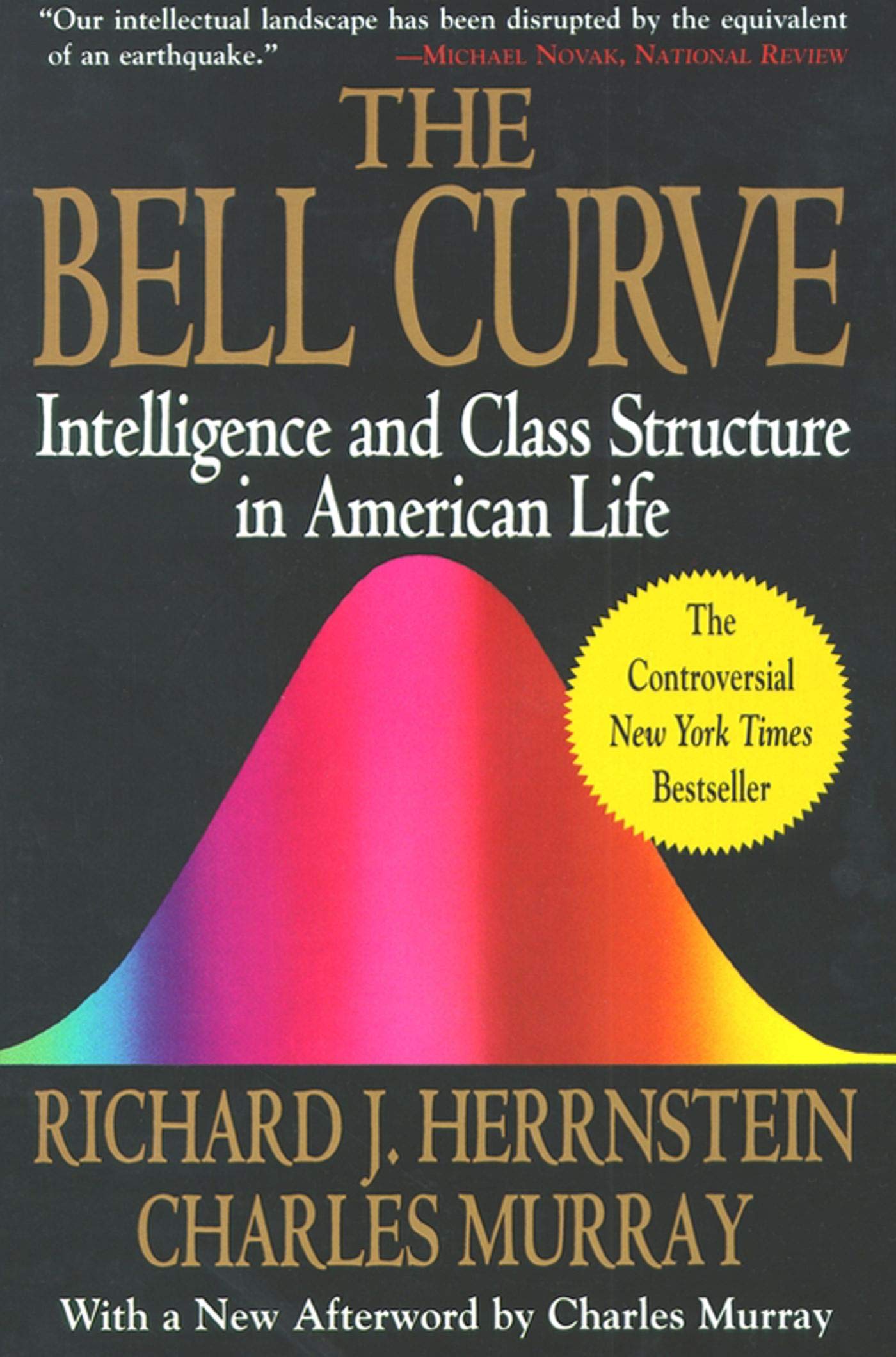
"The Bell Curve: Intelligence and Class Structure in American Life", by Richard Herrnstein and Charles Murray. Free Press Paperbacks Book (Simon & Schuster), NY 1994. ISBN-13:978-0-684-82429-1. PC 872/552. 9 1/4" x 6". Table of Contents: Part I - Emergence of Cognitive Elite, Part II - Cognitiv Classes & Social Behavior, Part III - The National Context, Part IV - Living Together. Appendixes (676 Pg.) Statistics, NLSY, AFQT, Regression analyses, Supplemental Material, & Evolution of Affirmative Action in the Workplace. Notes 110 Pg., Biblio.57 Pg. & Index 13 Pg. List of Illust. 5 Pg., & List of Tables 2 Pg. Additionally there is a clarifying Preface & 24 page Introduction.This treatise deals directly with the societal & politically sensitive subject of intelligence and class structure (hence the title). In my opinion this study is so exceedingly well-researched and exhaustively-documented as to likely persuade many skeptics and the uninformed of its truthful observations and conclsions. Nevertheless, similar earlier studies along these same lines, as those by William Shockley, etc., the subject matter is vehemently attacked as nonsense, racist, measured lies, mismeasure of man, prejudicial, and nonsense. In many ways these same arguments parallel those used in denouncing Darwinism and evolution. With few exceptions their arguments are non-sequetur, often irrelevant and depart from scientific methodologies. The bottom line appears to be an endless iteration of "figures lie and liars figure" used by many who decry "Bell Curve".For those unfamiliar with graphs and basic statistical concepts the book is not easy reading - but the authors provide excellent descriptions of specific groups being compared - economic status as poverty or wealth, family composition (single vs. two parent homes), educational credentials (graduate of HS, college degree, dropouts), job placements, truancy, crime, & divorce. Importantly, social issues as welfare, unemployment, illegitimacy and affirmative Action are examined with the evolution of Title VII (1964) and EEOC guidelines and the EEOA (1972).For social scientists, the implications of Bell Curve projected trends or changes in class structure and intelligence, over time, portend major shifts in demographics which is now being reflected in a number of European nations and segments of the United States as well, It is an interesting, informative and provocative read. Truthfully, unless you have read this book, one is not informed adequately to debate its contents as fiction or fact. The authors take great pains to point out that IQ testing scores reflect group scores and not to be applied or imply that all within a group have the same score. Again the IQ tests truthfully measure IQ (or 'g'), not intelligence itself, but certainly something with a causal link. The question of whether Races exist (as Asian, European White, Latino, & Black) or is merely a social construct is being studied by computers crunching large numbers of genes from each group; certainly there is no evidence that a single gene represents a specific racial group. For some, there is the fear of negative (eliminate) or positive (breeding) Eugenics. Depending on who, when and how applied, birth control is a eugenic measure - and its controversial for divers reasons. FINIS
Trustpilot
2 days ago
3 days ago