We remain fully operational. Our teams are working around the clock to ensure your deliveries continue safely.

DOWNLOAD THE APP


Customer Services
Copyright © 2025 Desertcart Holdings Limited
DOWNLOAD THE APP

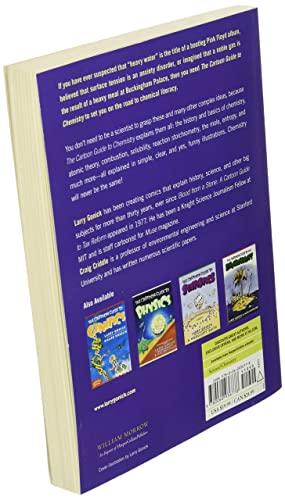

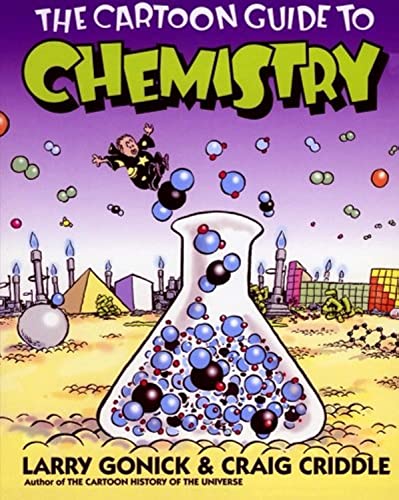


Buy The Cartoon Guide to Chemistry by Gonick, Larry, Criddle, Craig online on desertcart.ae at best prices. ✓ Fast and free shipping ✓ free returns ✓ cash on delivery available on eligible purchase. Review: CITATION: Gonick, L. & Criddle, C. (2005). The cartoon guide to chemistry. New York: HarperCollins. Reviewer: Dr W. P. Palmer Can students learn chemistry through cartoons? The answer may well be ‘only with extreme difficulty’. Nonetheless, this cartoon guide could be extremely helpful promoting student learning in some areas of chemistry. The way in which students learn chemistry is very much dependent on the student’s learning style and some students will reject the concept of a cartoon guide to chemistry out of hand. However, this book could prove to be a valuable resource for most Year 11/12 students studying chemistry, though there are difficulties. Interestingly it starts with some of chemistry’s history where there are some minor errors by the authors. It was Cavendish, rather than Priestley (p. 9), who first prepared and named hydrogen and also Cavendish who discovered that hydrogen burnt to form water. Robert Boyle had prepared hydrogen much earlier, but had not identified its properties. Reflecting on the early part of the text, it is easy to see how the cartoonist’s desire to use humour to help students remember and understand chemistry could equally be responsible for student chemical misconceptions. ‘Chemical bonding’ is likened to human love and affection, for example, ‘No wonder the subject is so sexy! (p. 46). This anthropomorphism can prove to be a source of further student misconceptions. There are a variety of less well known chemical reactions chosen by the authors as examples such as living on a desert island using its natural resources in a self-sufficient manner; this was extremely innovative and showed possible practical applications of chemistry. In the areas of physical and general chemistry, the authors do a good job of providing examples of typical calculations with which students need to be familiar. Areas of descriptive chemistry in inorganic and organic chemistry are difficult as students may often be required recall the practical details of experiments that they have carried out, whereas cartoon guides need to cut descriptions to a minimum number of words. Similarly industrial chemistry may prove difficult if details of industrial processes are required. Overall, The cartoon guide to chemistry covers more than most Year 12 curricula and could find a place in some university courses. There will be teachers who dislike the approaches to some topics or find definitions incomplete, but the appeal that a cartoon approach makes to some students should override these concerns. This book really covers much general and physical chemistry well, so can be recommended as an alternative approach. BILL PALMER Review: Esta serie me encanta, además de que se aprende se hace de forma divertida, en mi opiniòn es recomendable tanto si se sabe sobre el tema como si no se sabe.


| Best Sellers Rank | #49,978 in Books ( See Top 100 in Books ) #97 in Chemistry #924 in Humor #1,524 in Comics & Graphic Novels for Young Adults |
| Customer reviews | 4.6 4.6 out of 5 stars (685) |
| Dimensions | 18.75 x 1.47 x 23.5 cm |
| Edition | Illustrated |
| ISBN-10 | 0060936770 |
| ISBN-13 | 978-0060936778 |
| Item weight | 294 g |
| Language | English |
| Print length | 256 pages |
| Publication date | 7 July 2005 |
| Publisher | William Morrow Paperbacks |
| Reading age | 13 - 17 years |
W**R
CITATION: Gonick, L. & Criddle, C. (2005). The cartoon guide to chemistry. New York: HarperCollins. Reviewer: Dr W. P. Palmer Can students learn chemistry through cartoons? The answer may well be ‘only with extreme difficulty’. Nonetheless, this cartoon guide could be extremely helpful promoting student learning in some areas of chemistry. The way in which students learn chemistry is very much dependent on the student’s learning style and some students will reject the concept of a cartoon guide to chemistry out of hand. However, this book could prove to be a valuable resource for most Year 11/12 students studying chemistry, though there are difficulties. Interestingly it starts with some of chemistry’s history where there are some minor errors by the authors. It was Cavendish, rather than Priestley (p. 9), who first prepared and named hydrogen and also Cavendish who discovered that hydrogen burnt to form water. Robert Boyle had prepared hydrogen much earlier, but had not identified its properties. Reflecting on the early part of the text, it is easy to see how the cartoonist’s desire to use humour to help students remember and understand chemistry could equally be responsible for student chemical misconceptions. ‘Chemical bonding’ is likened to human love and affection, for example, ‘No wonder the subject is so sexy! (p. 46). This anthropomorphism can prove to be a source of further student misconceptions. There are a variety of less well known chemical reactions chosen by the authors as examples such as living on a desert island using its natural resources in a self-sufficient manner; this was extremely innovative and showed possible practical applications of chemistry. In the areas of physical and general chemistry, the authors do a good job of providing examples of typical calculations with which students need to be familiar. Areas of descriptive chemistry in inorganic and organic chemistry are difficult as students may often be required recall the practical details of experiments that they have carried out, whereas cartoon guides need to cut descriptions to a minimum number of words. Similarly industrial chemistry may prove difficult if details of industrial processes are required. Overall, The cartoon guide to chemistry covers more than most Year 12 curricula and could find a place in some university courses. There will be teachers who dislike the approaches to some topics or find definitions incomplete, but the appeal that a cartoon approach makes to some students should override these concerns. This book really covers much general and physical chemistry well, so can be recommended as an alternative approach. BILL PALMER
L**S
Esta serie me encanta, además de que se aprende se hace de forma divertida, en mi opiniòn es recomendable tanto si se sabe sobre el tema como si no se sabe.
5**T
Bought my kids this for heading into high school - they actually read it & was a perfect primer for them to get the foundational understanding needed before taking chemistry classes... Fast forward a few years, & I re-bought it (gifted on the original book) as a refresher heading into university as they've got chem coming up & haven't taken it in a few years - both boys were excited to see it again :)
V**I
Divertente, carino, leggero, istruttivo. L'idea del fumetto è molto simpatica, scorrevole, forse a colori sarebbe più carino. Nel complesso mi piace molto!
T**.
Fun, but at times slightly confusing somehow Perhaps am I still lacking certain basic knowledge about chemistry, nevertheless interesting read
Trustpilot
2 weeks ago
3 weeks ago