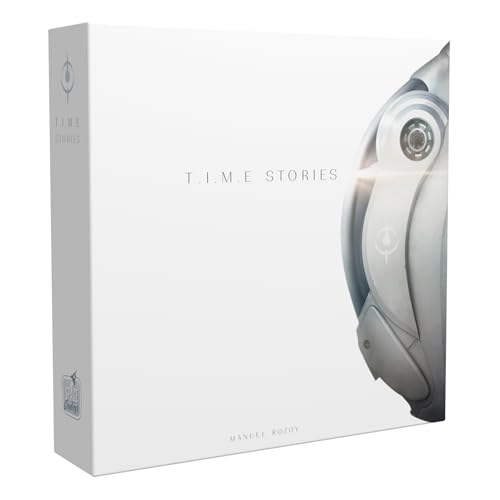


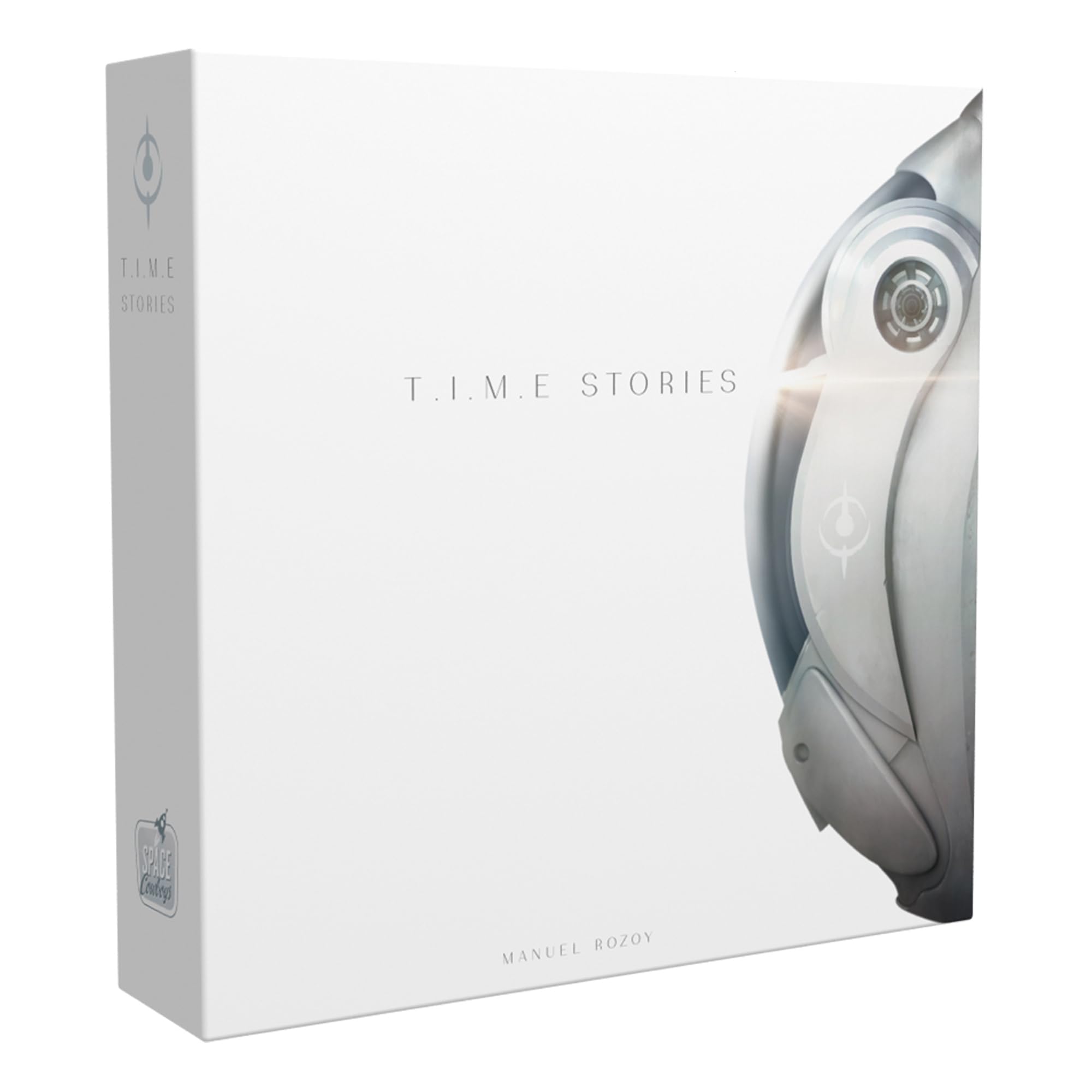

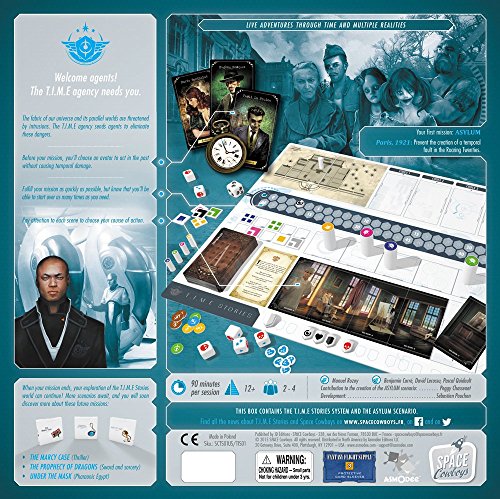
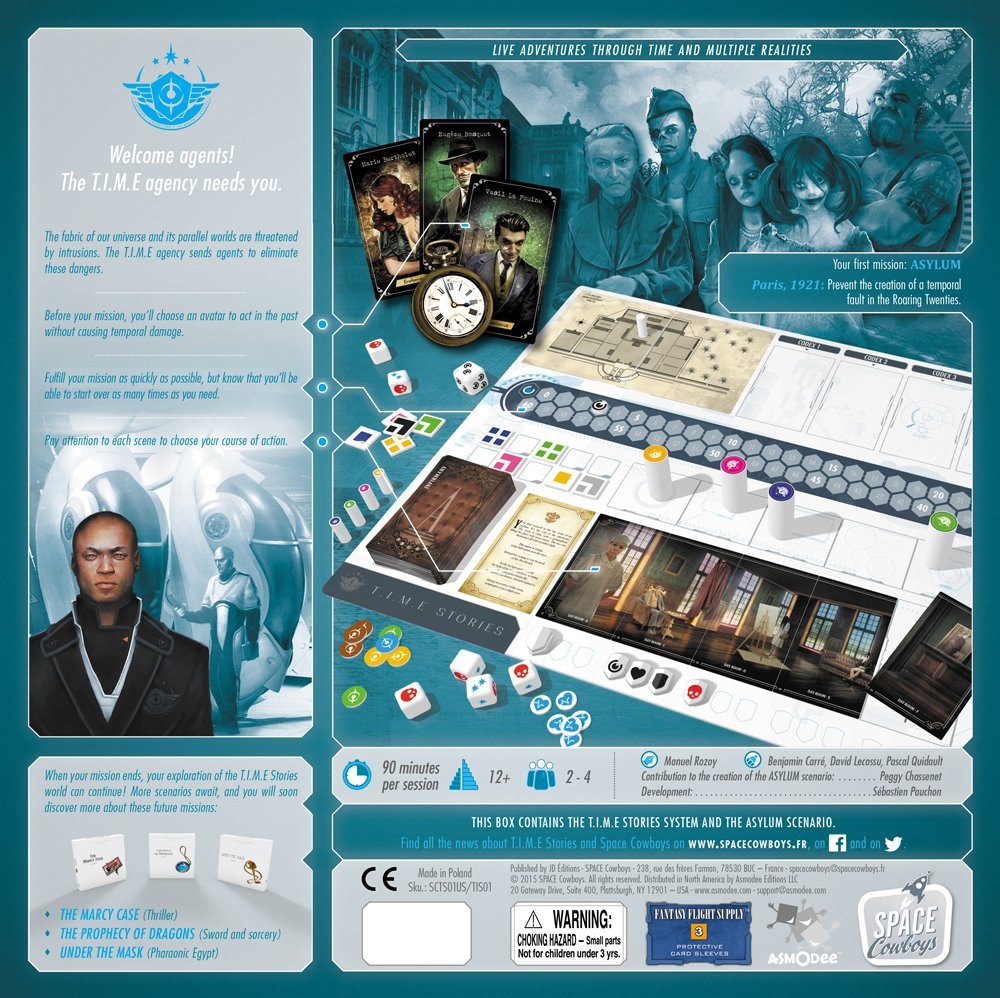

It has been a grueling training regiment at the Academy, but you're finally ready for your first mission as a full-fledged T.I.M.E. agent. You and your team will travel back (or forward) in time to prevent some cataclysmic event. But don't waste a moment. Every second counts! In T.I.M.E. Stories, you will work cooperatively with a team to solve a mystery taking place in a different era. Each team member will enter a shell of someone alive at the time and gain their physical strengths and weaknesses. If you can't complete the adventure in time you'll be sent back to the start of the mission for another attempt. Each T.I.M.E. Stories deck is a new scenario waiting to be discovered! When are we this time. Review: It took us a bit to get into the swing of the game, yet by the end we figured out how important it was to keep notes and get as much done each run as you can. The game is really well thought out, each character feels unique, the mystery has a satisfying resolution, and leaves you excited to try some of the other expansions that game has to offer. Review: Note that this review now incorporates the original TIME Stories game along with the Marcy expansion pack, which seems fitting given that desertcart seem to combine reviews for the two products. The Marcy review is in an update at the end of the main review. This game follows a recent trade of innovation in board games, but at the time of writing there isn't really a detailed review that explains how the game works, so I thought it was worthwhile explaining the game mechanism. The game is co-operative, and all players operate as members of the T.I.M.E agency, an organisation that has to fix faults with the timeline. What that means in reality is that players must solve mysteries set in a different time period. They do this by being sent into bodies of different people in that time period (much like the tv series Quantum Leap) in order to piece together clues and complete their mission. In terms of game mechanics, there is only one mission in this box. Each time you play the game, you are undertaking a 'run'. During this 'run' you perform actions using your characters, and each action uses up 'temporal units'. You only have a finite number of temporal units, and when you run out of temporal units the 'run' (and game) ends and resets, and you must effectively start the mission from the beginning next time you play. The difference being that for the next 'run' you will already know how to solve the puzzles that you solved in previous 'runs', and don't therefore need to spend temporal units in solving those. You can also play as a different character in each run, and can therefore choose a character in a subsequent run that might be better suited to individual tasks. The idea is that each time you play you get further along and closer to completing the mission. Eventually you will either complete or lose the game entirely. It's worth pointing out from the start that the 'temporal unit' and 'run' mechanic, which resets your game several times but allows you to get further towards completion each time you play, really is excellent. As you would expect from a newly released board game, the production values are high and the artwork is excellent, but it is this mechanic that really immerses you into the game and brings everything together. I've never played anything quite like this, and I found that I was really getting involved in the overall story as I worked through each 'run'. The bottom line is that the gameplay here really does work, and if you are at all interested in the premise you are probably going to really enjoy T.I.M.E Stories. It is also worth noting that, unlike some other co-operative boardgames, there really is no danger of 'quarterbacking' here, which is where one player essentially dominates the others by taking control of the game and telling people what to do, which is for three reasons. First, characters will go to different parts of each area and 'explore' different cards, and whilst they are allowed to tell everyone what is on the card, they cannot show the card to them. That means that everyone playing has to be involved in exchanging information. The second reason is that there is usually not a 'clear' way to go in terms of choices, and when there is a disagreement a vote is taken, with the person that has the tie breaking vote changing each time you change location, so the chances of someone actually dominating in that regard is slim. Thirdly, and most importantly, this game is difficult, at least in terms of the mysteries not at all being straightforward. It is therefore very unlikely that one person will actually know the answers to the problems posed. All in all, it is a game that actively encourages players to all get involved and work together, and it does so extremely well. There are a couple of further points to deal with, both of which are questions that I had before I started playing. The first is that this is a game for 2 to 4 players, and I wondered whether you could play from one game to the next with players that didn't play the previous runs. The short answer is 'yes', because as long as you have players involved that were in the previous runs, they can inform new players of the information that they know, and in practice new players can then very quickly engage with the mission and become involved in solving the next stages of the game. I predominantly played this with my wife, but for one game we had another player as well, and the integration was pretty seamless. In an ideal world you would go through the entire mission with the same group of players, but actually it is perfectly easy to bring other players in if you want to. The other question is perhaps obvious at this stage, and relates to replay value. Basically, once you've finished the mission that comes in this base game, you can't really get the same experience playing it again. The game therefore has very finite replay value, and indeed we finished the first mission in only a handful of 'runs'. On the face of it that raises a question as to value for money, but to my mind that is a necessary trade off considering the nature of the game. The experience that you get with T.I.M.E Stories is narrative driven and is very different to other board games where you start fresh each time. The fact that it is a finite experience is a large part of what makes it so good, and to my mind it does offer good value for money. You just need to appreciate what you're getting in to before you buy it. That said, there's no need to sell the base game as soon as you finish it, because the developers have produced a number of expansions, with more promised. Each of these have an RRP of £20 (the base game has an RRP of £35), and each one has a completely separate mission. More expansions are promised, and as such you can continue to get value out of the base game by buying these expansions. This does sound like something that can result in you spending a lot of money, and it is, but only if you enjoy the base game. If you do, in my view these expansions offer a great way of keep the experience of the game going. Finally, a note about suitability for children. There is nothing in the game that makes it unsuitable for children per se, but the game is designed to challenge your deductive abilities, and it will likely be too challenging for smaller children. I have only played it with adults, but I would have thought it would be too challenging for children below the age of about 13. Overall, I can only recommend T.I.M.E Stories. Like Pandemic Legacy, it is the latest in a range of board games that offer finite experiences, but it is all the more immersive and memorable for it. If you like your co-operative board games and want to take your experience to the next level, this really is an essential purchase. UPDATE 14/02/16 - Updated to add a couple of pictures of the box contents before the first game, which I forgot to add to the review initially, and to add in a couple more details. This is still a clear five star game, and an essential purchase if you have even the slightest interest in the premise. UPDATE 06/03/16 - I have just finished the Marcy Case Expansion, and the has game solidified its five star rating for one main reason, and that is that it is different to the Asylum case in the core box set. By which I don't just mean that it has a different mission with different characters and a different story in a different time period. That would be a given. I mean that the Marcy case has a completely different focus and feel to the Asylum case (right down to having a different art style on the cards), incorporates new rules, including using a section of the board that I hadn't actually realised was even there in the first mission, and forces you to play a different way. I don't want to give away anything by way of spoilers, but I'll simply say that the Marcy case has more of a focus on combat and survival rather pure exploration, and consequently it actually feels like a different game at times rather than just an expansion. That is really encouraging, because is seems that Asmodee are willing and able to mould the core game to create genuinely different scenarios with each expansion, which practically guarantees than I'll be buying each expansion from here on out. But for the purposes of reviewing the Marcy case all you really need to know is that it is a five star expansion in terms of quality, and if you are yet to buy the core set, the fact that it seems that the game will be well supported with quality expansion packs should be a further reason to take the leap and buy a copy.





| ASIN | B013TRQLJO |
| Best Sellers Rank | #225,624 in Toys ( See Top 100 in Toys ) #8,558 in Board Games |
| Customer reviews | 4.4 4.4 out of 5 stars (506) |
| Is Discontinued By Manufacturer | No |
| Item model number | TS01 |
| Product Dimensions | 7.62 x 29.85 x 29.85 cm; 1.77 kg |
| Release date | 1 March 2018 |
| Studio | Publisher Services Inc (PSI) |
M**T
It took us a bit to get into the swing of the game, yet by the end we figured out how important it was to keep notes and get as much done each run as you can. The game is really well thought out, each character feels unique, the mystery has a satisfying resolution, and leaves you excited to try some of the other expansions that game has to offer.
C**E
Note that this review now incorporates the original TIME Stories game along with the Marcy expansion pack, which seems fitting given that Amazon seem to combine reviews for the two products. The Marcy review is in an update at the end of the main review. This game follows a recent trade of innovation in board games, but at the time of writing there isn't really a detailed review that explains how the game works, so I thought it was worthwhile explaining the game mechanism. The game is co-operative, and all players operate as members of the T.I.M.E agency, an organisation that has to fix faults with the timeline. What that means in reality is that players must solve mysteries set in a different time period. They do this by being sent into bodies of different people in that time period (much like the tv series Quantum Leap) in order to piece together clues and complete their mission. In terms of game mechanics, there is only one mission in this box. Each time you play the game, you are undertaking a 'run'. During this 'run' you perform actions using your characters, and each action uses up 'temporal units'. You only have a finite number of temporal units, and when you run out of temporal units the 'run' (and game) ends and resets, and you must effectively start the mission from the beginning next time you play. The difference being that for the next 'run' you will already know how to solve the puzzles that you solved in previous 'runs', and don't therefore need to spend temporal units in solving those. You can also play as a different character in each run, and can therefore choose a character in a subsequent run that might be better suited to individual tasks. The idea is that each time you play you get further along and closer to completing the mission. Eventually you will either complete or lose the game entirely. It's worth pointing out from the start that the 'temporal unit' and 'run' mechanic, which resets your game several times but allows you to get further towards completion each time you play, really is excellent. As you would expect from a newly released board game, the production values are high and the artwork is excellent, but it is this mechanic that really immerses you into the game and brings everything together. I've never played anything quite like this, and I found that I was really getting involved in the overall story as I worked through each 'run'. The bottom line is that the gameplay here really does work, and if you are at all interested in the premise you are probably going to really enjoy T.I.M.E Stories. It is also worth noting that, unlike some other co-operative boardgames, there really is no danger of 'quarterbacking' here, which is where one player essentially dominates the others by taking control of the game and telling people what to do, which is for three reasons. First, characters will go to different parts of each area and 'explore' different cards, and whilst they are allowed to tell everyone what is on the card, they cannot show the card to them. That means that everyone playing has to be involved in exchanging information. The second reason is that there is usually not a 'clear' way to go in terms of choices, and when there is a disagreement a vote is taken, with the person that has the tie breaking vote changing each time you change location, so the chances of someone actually dominating in that regard is slim. Thirdly, and most importantly, this game is difficult, at least in terms of the mysteries not at all being straightforward. It is therefore very unlikely that one person will actually know the answers to the problems posed. All in all, it is a game that actively encourages players to all get involved and work together, and it does so extremely well. There are a couple of further points to deal with, both of which are questions that I had before I started playing. The first is that this is a game for 2 to 4 players, and I wondered whether you could play from one game to the next with players that didn't play the previous runs. The short answer is 'yes', because as long as you have players involved that were in the previous runs, they can inform new players of the information that they know, and in practice new players can then very quickly engage with the mission and become involved in solving the next stages of the game. I predominantly played this with my wife, but for one game we had another player as well, and the integration was pretty seamless. In an ideal world you would go through the entire mission with the same group of players, but actually it is perfectly easy to bring other players in if you want to. The other question is perhaps obvious at this stage, and relates to replay value. Basically, once you've finished the mission that comes in this base game, you can't really get the same experience playing it again. The game therefore has very finite replay value, and indeed we finished the first mission in only a handful of 'runs'. On the face of it that raises a question as to value for money, but to my mind that is a necessary trade off considering the nature of the game. The experience that you get with T.I.M.E Stories is narrative driven and is very different to other board games where you start fresh each time. The fact that it is a finite experience is a large part of what makes it so good, and to my mind it does offer good value for money. You just need to appreciate what you're getting in to before you buy it. That said, there's no need to sell the base game as soon as you finish it, because the developers have produced a number of expansions, with more promised. Each of these have an RRP of £20 (the base game has an RRP of £35), and each one has a completely separate mission. More expansions are promised, and as such you can continue to get value out of the base game by buying these expansions. This does sound like something that can result in you spending a lot of money, and it is, but only if you enjoy the base game. If you do, in my view these expansions offer a great way of keep the experience of the game going. Finally, a note about suitability for children. There is nothing in the game that makes it unsuitable for children per se, but the game is designed to challenge your deductive abilities, and it will likely be too challenging for smaller children. I have only played it with adults, but I would have thought it would be too challenging for children below the age of about 13. Overall, I can only recommend T.I.M.E Stories. Like Pandemic Legacy, it is the latest in a range of board games that offer finite experiences, but it is all the more immersive and memorable for it. If you like your co-operative board games and want to take your experience to the next level, this really is an essential purchase. UPDATE 14/02/16 - Updated to add a couple of pictures of the box contents before the first game, which I forgot to add to the review initially, and to add in a couple more details. This is still a clear five star game, and an essential purchase if you have even the slightest interest in the premise. UPDATE 06/03/16 - I have just finished the Marcy Case Expansion, and the has game solidified its five star rating for one main reason, and that is that it is different to the Asylum case in the core box set. By which I don't just mean that it has a different mission with different characters and a different story in a different time period. That would be a given. I mean that the Marcy case has a completely different focus and feel to the Asylum case (right down to having a different art style on the cards), incorporates new rules, including using a section of the board that I hadn't actually realised was even there in the first mission, and forces you to play a different way. I don't want to give away anything by way of spoilers, but I'll simply say that the Marcy case has more of a focus on combat and survival rather pure exploration, and consequently it actually feels like a different game at times rather than just an expansion. That is really encouraging, because is seems that Asmodee are willing and able to mould the core game to create genuinely different scenarios with each expansion, which practically guarantees than I'll be buying each expansion from here on out. But for the purposes of reviewing the Marcy case all you really need to know is that it is a five star expansion in terms of quality, and if you are yet to buy the core set, the fact that it seems that the game will be well supported with quality expansion packs should be a further reason to take the leap and buy a copy.
E**D
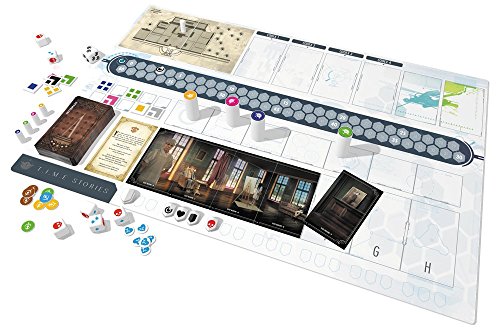
Originally posted at [...], a new idea everyday! Product-T.I.M.E. Stories Producer- Asmodee Price- $ 45 here http://www.amazon.com/Asmodee-SCTS01US-ASM-Time-Stories-Board/dp/B013TRQLJO/ref=sr_1_1?ie=UTF8&qid=1459128440&sr=8-1&keywords=T.I.M.E.+Stories Set-up/Play/Clean-up- 3 hours (1-4 players) Type-American Depth-Light TL; DR-The best DnD without a DM sandbox I could ask for.% Basics-Welcome to the T.I.M.E. corps! In this game you play agents of a future agency who teleport into the bodies of people living in various situations across space time-think Sliders and Quantum Leap. Will you prevent the rupturing of space time? The mechanics are as easy as they come. At the start of each adventure, you are told to find some problem, fix it, and then return. From the space station, you teleport into the bodies of different individuals at the scene. These bodies have their own problems. The first adventure is a bit of a Lovecraftian inspired tale, so you start in an insane asylum and your host bodies all have some strange ticks that prevent things from working completely well. From there, you have a map of four Tarot-sized cards that you use to indicate where your group is currently exploring and a spread of cards that indicate the room or location you’re currently looking in. Each card is either the introductory text of the room or a space that you can interact with. You can look at the back of each card, but some cards have conflicts you have to resolve in order to progress. Each body you enter has two to three different stats. These stats indicate how well you handle different tests. These tests can range from social, to investigative, to straight up combat. All tests are handled the same way. You decide if you want to handle the test, choose the appropriate stat to use, and roll the number of dice for the stat on some wooden dice. These dice have either blue explosions or red skulls. Each test has a number of shields, and blue explosions remove shields. Red skulls cause the test to attack you back. You add the number of red skulls and the number of shields that have red skulls on them, and if the number is higher than your defense stat, you lose one life. There are also some tests that have different shields like time or life and those will either take more life or subtract time from your total. Time is the main currency of the game. When you move between locations, roll the dice for a test, or move between panels at a location, you spend time. Moving between panels is just one click of time and can be done at the same time as another character at your location is rolling dice. Moving between locations results in your rolling a different die that takes between one and three time clicks to move around the map. When your time is up, you teleport back to the space stations. Here is the most interesting part. As you adventure around, you receive items and tokens. The tokens are all color and symbol combinations that you place on the board. As you move around, these tokens unlock new locations. Some locations have one or more pictures of colored tokens on them, and you can't access those locations until you get the tokens from other places on the map. The other thing a character can get is items. Items come from their own numbered deck, and these items range from maps to chainsaws. Some give you tokens or weapons to fight with. The most important thing some have is a mark indicating that you get to keep them if you run out of time. When you run out of time, you reset the board, replace all items in the deck except for any items marked with the TIME symbol. Then you most likely get yelled at by your TIME boss, and sent back in. But, now you can skip certain locations because you remember that information from your previous times through. In game terms you got a new map indicating the secret tunnel (for example), and you can just head there, bypassing the whole mess and a few other locations. Your goal is to find the problem, solve it, and head home. Using the above mechanics, your wits, and what you discover as you move around the map, can you save time itself? Mechanics- A summary from above-You have three stats, to do a test, roll the number of dice for the stat. You spend time when you roll or move. Moving to a new place takes time. Spend all your time, and you go back to the spaceship. Done! That is the rules for the game. With that you can get most of the game, and that level of simplicity is phenomenal! I love the way the mechanics don’t interrupt the game’s flow or over complicate things. This feels like a super simple RPG, and honestly, that’s not far from the truth in terms of how the game plays. 5/5 Theme- This game is the best American-style game I’ve played in a long time, including some of the RPGs I play all the time. Everything in this one feels right. The art is amazing, the cards all feel great, and the writing for the story is awesome. It’s got red herrings throughout that you want to check out, and little details that are awesome to understand. The only sad part is I can only play this once… 5/5 Instructions-Writing the instructions for this game are difficult. If you write too much, then you have to explain what some things that will happen are. If you write too little, you leave the players scrambling to understand what you meant. This game went a bit too little for my taste. The rules are by no means bad, but they are a bit too open as I played I and my group had to make a few calls about what things were and to just roll with the punches. That would be absolutely unforgivable in a game where every rule call could mean winning or losing, but since this game is a complete co-op game, it’s much more tolerable. If you don’t mind just saying “Ya, that seems right” a few times, then you won’t have a problem. If not, you will spend a bit of time on BoardGameGeek searching forums on how to execute the rules. 4.25/5 Execution-Execution is interesting. The game board and tokens feel sterile, and they should since your body is aboard the space station and you’re just being beamed into a person at the scene of the problem. The art of the cards is amazing, and it does help draw you into the scene. What I don’t like is some of the components, more specifically, the insert to keep things organized. It’s cheap loose plastic that was broken on my unboxing copy. This is a $60 game that after one playthrough I can't play again (without buying an expansion), so for my money I expect a bit more. Also, you can’t really fit all the components well into the holes provided, so most days after opening up the box, you have a mess! That might be a pain, but overall the game’s parts are all done well. For the price, it’s not bad, but it could use a bit more. If you want to see all the pieces in action, here is my unboxing video [...] Summary-This is a phenomenal game that basically self destructs. It has zero replay, and that is the main drawback. You can’t unlearn the mystery in the mystery novel, and once you know what the right choices are, then this game is basically over. That’s not bad, as point and click adventure games are amazing, but you have to know that going in. For what it is, it is amazing. Its an RPG game where you don’t have a DM/GM. I get to play with my friends with no prep and everyone is on the same side of the game. It’s completely cooperative. It is expensive at $60, but not overly so. Furthermore, since the base game is designed to serve at the springboard for future games, it's almost like buying the console to play video games. The story of the first adventure is fun, and any game that has sneaky Lovecraft has good Lovecraft (ie this game didn’t need to scream CTHULHU! to get sales). If want a fun co-op game where you get to play through a random adventure each time, provided you bought the expansion, then this is an amazing game that will draw you in and keep you hooked. 95%
A**R
The game has great mechanics, plot/story, artwork and the rules aren't that hard to follow. As you progress through the game you explore the current mission, expanding the understanding of what's happening in the story. One of the downsides is that there is only one story in the base game, but do to the nature of the game you have to do multiple runs to beat it. Also write notes of the game as you play just to keep extra pieces of info and some plot information down on.
J**O
Tal vez lo más difícil sea comprender la forma de rejugabilidad, es un poco extraña... pero la temática y el storytelling son una belleza y definitivamente te atrapan.
Trustpilot
1 month ago
5 days ago