

Desert Online General Trading LLC
Dubai, United Arab Emirates
Desert Online General Trading LLC
Dubai, United Arab Emirates



⚡ Power your adventure, anytime, anywhere!
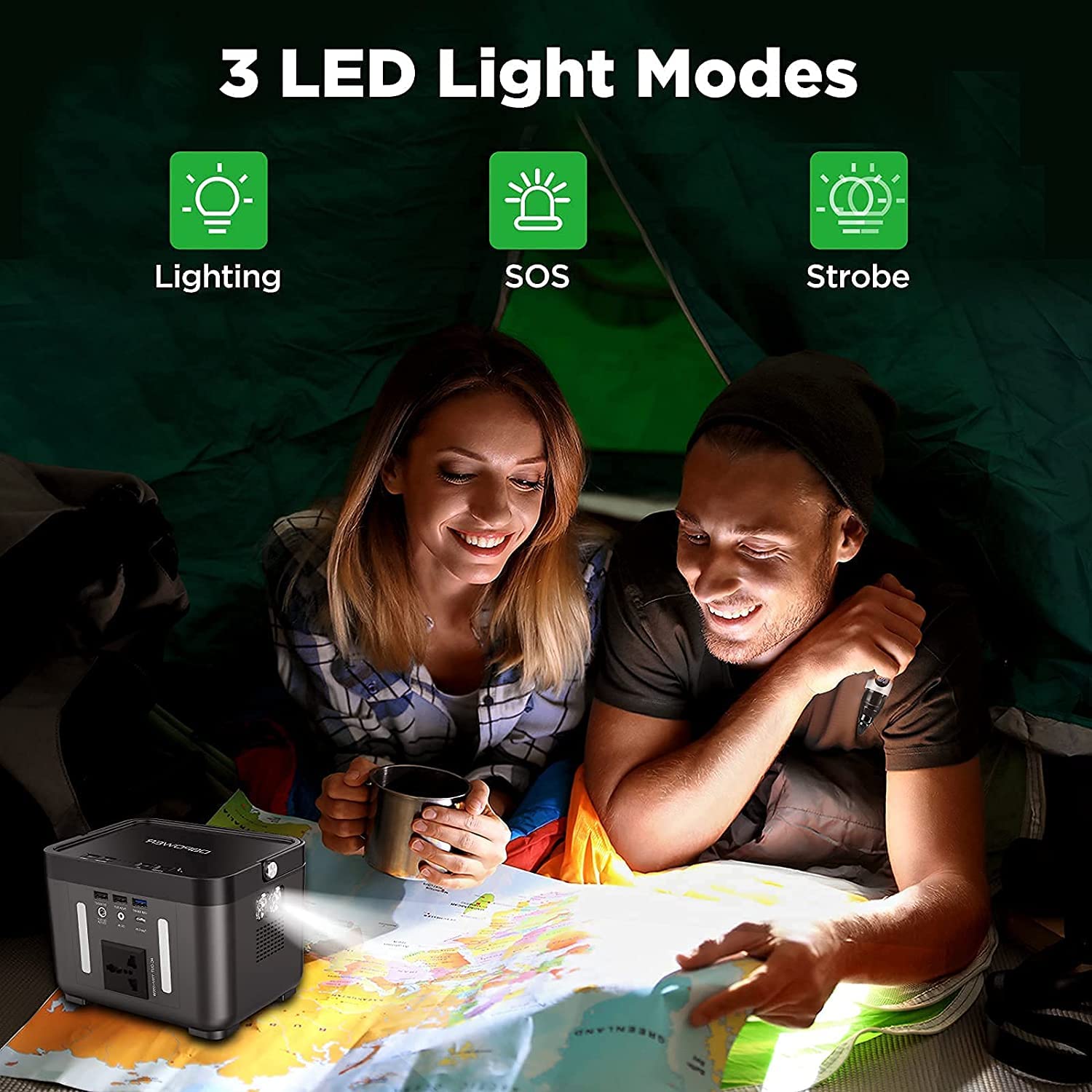
The DBPOWER Portable Power Station is a compact, 4.4-pound lithium-ion battery generator delivering 250Wh capacity and 350W peak pure sine wave AC output. It supports charging up to 5 devices simultaneously through AC, DC, and USB ports, with versatile charging options including wall, car, and solar inputs. Designed for emergency, outdoor, and professional use, it features built-in safety protections and multi-mode LED lighting, making it an essential power backup for millennial managers who demand reliability and mobility.


| Manufacturer | Shenzhen BenRong Technology Co., Ltd |
| Part Number | DBPOWER |
| Item Weight | 4.4 pounds |
| Product Dimensions | 7.16 x 5.39 x 5.04 inches |
| Item model number | PW0002 |
| Power Source | Corded Electric, Solar Powered |
| Voltage | 110 Volts |
| Wattage | 350 watts |
| Item Package Quantity | 1 |
| Special Features | Portable |
| Batteries Included? | No |
| Batteries Required? | No |
| Battery Cell Type | Lithium Ion |
B**
I’m so happy to have found this!
Well packaged and arrived early! It came charged to 50% (two lights) I fully charged it and have used it constantly since it arrived. It does everything advertised and more. I found out it will pass through charge, and will auto shut off if you forget (I fell asleep) and was very relieved it had turned itself off. Even off the fan was working. It pulls air through the unit and never even felt warm to the touch. I won’t make a habit of doing that, but I was relieved it had turned itself off.It holds its charge very well. I charged my phone, Goal Zero lantern, and small rechargeable fan with it. I’ve only had to recharge it two times. Once I let it get to 50%, then 25%. It still charged and held its charge for days. I got this for a trip coming up so I can keep my stuff charged without having to turn on the car. Mission accomplished! The LED lights are nice, on the side-a flashlight...the two on front perfect for lighting the tent or a room. I like the shape, the flat top with a lip around the edge let’s me set my lantern on top to charge, then put my glasses and jewelry on top for sleep. My iPhone battery was going bad. I had a bad habit of just keeping it plugged into the charger and it got to where it only lasted a couple of hours use off the charger. This is so easy to have nearby I charge and unplug and my phone battery is actually lasting longer the more I cycle it! Maybe that’s just common sense, I just got lazy. DBPOWER let’s me unhook and makes it easy to have what I need when and where I need it! The price is the best I’ve found for 250 WH. I see no reason to pay more! The ONLY drawback is it only comes with an AC adapter/charger, but customer service is easy to call and responsive. Quickly activated the warranty, and sent me a link to adapters. DBPOWER doesn't make them, and that’s a bit of a problem, but for my use, it’s perfect!
A**S
Works for my CPAP
Used this with DC power cable (not included) to power my Phillips ResMed AirSense10 CPAP. With the CPAP in airplane mode and tube temp/humidity turned off I got two nights of camping in and the power level was still showing 50%. However, if I turn on the heat, humidity, etc it drains much faster--this is a function of the CPAP not the power supply. This little pack did alright! It is light enough to pack a few miles in a pinch, and i love the extra ports. Have not tried AC power yet, but expect it will also drain power faster than DC. Dc Adapter cord is a must for CPAP! I have reccomended this product to several friends. I would buy again!
E**C
Do You Like Receiving 66% of What You Paid For?? Overinflated Specs + More Makes The Price Terrible
EDIT: I'm sorry but for devices such as this there should be two tiers of reviews. The reviews that are initially visible are the ones that provide pics or videos of a capacity test with something similar to a $40 DL24 Load Tester or even a $17 PZEM-015 Battery Monitor with a load hooked up. Anything! (so long as it's something generally accepted in the battery community to be somewhat accurate.) Then you should have to click "read all reviews" to see the OPINIONS of people that have no clue how hard they are being screwed. Down at the bottom I'm going to include some math for anyone that wants proof.I build lithium ion batteries. I have several different units for testing lithium batteries and large power banks. I can’t tell you how badly I want to tear this thing apart to expose DBPower for1. Lying about the specs. 164.5 watt hours.2. Using garbage cells that probably have a cycle life of 100, high internal resistance, and have no business being in a consumer product.I bought this for the capacity. The rest of the specs suck. No USB C output so definitely no Power Delivery protocol. At least give us 12V5A or 20V3A. No practical Solar input. If you think I’m going to plug a solar panel in with that tiny DC jack you are crazy. Maximum is supposedly 15V2A which is 30 watts so that’s freaking useless.Just get the EcoFlow River or River Pro. EcoFlow has some issues with their products (mostly seems to be the Deltas) but at least they don't lie about capacity and actually offer devices that have output ports that make sense. No, I'm not sponsored by EcoFlow. I don't even own one of their products, I've just spent some time trying out my friend's EcoFlow River. You prefer the Bluetti? Great, they've had some minor issues but overall have put out several models that are HIGH QUALITY.This DBPower unit is definition of Chinese junk and the savings between this "250Wh" unit and the EcoFlow River at 279 ACTUAL watt hours isn't enough to settle for DBPower. Even if DBPower gave you the advertised capacity, the inability to charge with solar in any practical manner and the weak weak weak output options are enough to spend way more than the $50 difference I was facing at the time when I purchased this hunk o garbage on Amazon Day.Even before you get this thing in your hands if you do some math you'll find something doesn't smell right. According to the manufacturer this is a lithium ion battery. What we commonly call Lithium Polymer is actually just a pouch version of Lithium Ion but nearly all manufacturers will say Lithium Polymer if their device uses the 3.7V nominal pouches. When they say Lithium Ion they are typically referring to the cylindrical cells (18650, 21700, 26650, 32650, etc).I’m going to do some math based on common cylindrical cells, their max capacity, and the weight per cell.18650=max 3600mAh (not common), 3500mAh (common but still an expensive cell at $4 each), weight 45grams or more21700=max 5400mAh (not common), 4800-5000mAh (common but still expensive at $5 each), weight 65 grams or moreSMALLER MODELSo we know this power station is likely based on 18650 or 21700 cells. It's possible they used another cylindrical sized cell but in my experience breaking down consumer products all you really see are 18650, 21700, and occasionally 26650 or 32650/32700. We know this battery is based on a 3 in series configuration of 3.7V nominal, 4.2V fully charged, ~3.0V fully discharged cells. Series is what changes voltage.3x4.2V is 12.6V, the maximum voltage of this battery. 3x3V is where the Battery Management System cuts out to prevent the cells from overdischarging (they can go a bit lower). My device started discharging from the DC port at 12.6V and cut out at 9V so all of this lines up. Now if they are claiming 48000mah we can easily do some math to figure out how many cells they have in parallel to achieve that rating and then multiply it by the 3 in series. With 3500mah 18650 cells it would be 13.71 cells. With 5000mah 21700 cells it would be 9.6. If I had to take a guess I'd lean towards 4800mah 21700 cells since there are many models with that capacity such as the Samsung 48G (don't kid yourself, they didn't put high end GENUINE batteries. in this) and I believe two respected Chinese manufacturers BAK and Lishen make cell that match. Ten 4800mah cells in parallel for this 11.1V nominal pack made out of 3.7V cells would mean we need 3 groups of 10 connected in series to get up to that voltage. So we have 30 cells and 21700 cells typically weigh 67-71 grams when they are in the 4500-5000mah range. Lets be generous and say 65 grams each for a total of 1,920 grams or 1.92 kilos.So....a device that weighs in total 4.4 pounds or 1996 grams has 1920 grams worth of batteries and the rest of the components and the case account for only 76 grams???!!The BMS board alone weighs at least 50 grams if not 100. The components for all the inputs/outputs are probably 100 grams. The case can't be less than 50 grams.Now here's the fun part. The LARGER model at 250Wh or 67200 mah weighs EXACTLY THE SAME according to DBPOWER. 67,200mah divided by 4,800mah is exactly 14 which is what made me settle on using a 4800mah cell. Who knows since they are lying about the capacity, something easily proven just based on the testing done by device that is specifically made to test battery capacity and is used by nearly EVERYONE in the DIY Lithium Iron Phosphate side of Lithium batteries. 18650 cells are not as energy dense so that would pan out even worse for DBPOWER.What will the excuse be? They got the weight of the device wrong (aka were lying to push it as super light). Either way if someone cracks one of these units open and provides pictures of the cells and their markings I will be able to conclusively identify them and determine the physical capacity. So far we have two forms of measurement (energy draining and known weights) that prove they are liars.I pulled 164.5 watt hours from my "250 watt hour" device. Now maybe you're thinking the way I conducted my capacity test was flawed. Nope. I didn't use milliamp hours or amp hours which is a number that can be very misleading. I used watt hours and I did it by pulling a load that was FAR LESS than the industry standard 0.2C load done to determine capacity.0.2C means 0.2 or 20% of the capacity of the battery in amp hours. 0.2*67.2 is 13.44 amps...in my test....I pulled one amp. 1. Amp. at the batteries voltage of 12.6 to its cutoff at 9V.Ok the BMS cuts off at 3V per cell but the battery could potentially go down to 2.5V per cell so maybe we’re missing out on a ton of capacity? Nope. I actually restarted the tester several times which is something you are not supposed to do. I initially hit the cutoff at 160 watt hours and turned off the load for several minutes to allow the cell voltages to rebound a bit. Then turned the load back on. I did this 3 times. The absolute most I would expect to gain if I could run the cells down to 2.5V is an extra 15%. Capacity is not proportional to voltage. Below 3.0V the cells start dropping pretty fast and you'll find yourself at the discharge cutoff voltage for the cell (2.50V or 2.75V, check the data sheet for your specific cell) in a fraction of the time you went from 3.50V to 3.0V or 4.0V to 3.50V.So there's the long winded explanation with all the math and the process for doing a discharge capacity test on lithium ion. I hope you learned something even though most of this is very confusing and at the very least I hope you can see how DBPower is lying to you and taking your money while only providing you with 66% of what you paid for.
C**7
Tiny but powerul
It’s very tiny and compact. I like the design a lot. Also it a small and powerful device! I tested everything on it and everything works. I order a solar panel for it and that works also. I’m really looking forward to using this backup power station!
K**.
Stopped holding a charge
Stopped charging after 2 yrs. But left it in my rv and only used it 1 a month not sure how many cycles it can go: be Leary of that I wish they would send me a new unit like it a lot .
T**.
Perfect
This is my favorite piece of camping gear! I absolutely love this. We went to a 4 day music festival and took this for our phones for easy recharge and whatever else we may have needed power for. This thing exceeded my expectations. Not only did it charge our phones for the whole time there but it charged fans, smart watches, and a rechargeable air pump for our mattresses and it powered a full sized ac sound bar for hours and we still had charge on it by the time we left. One thing you have to keep in mind is for something to provide that amount of power it is going to take a long time to charge. You can't expect to charge it in 30 minutes and expect it to last for days. This is also nice to have charged on standby for an emergency source of power if ever needed. I can't say enough about this item, I really am pleased with this.
Trustpilot
1 month ago
5 days ago
1 month ago
3 weeks ago