
DOWNLOAD THE APP


Customer Services
Copyright © 2025 Desertcart Holdings Limited
DOWNLOAD THE APP


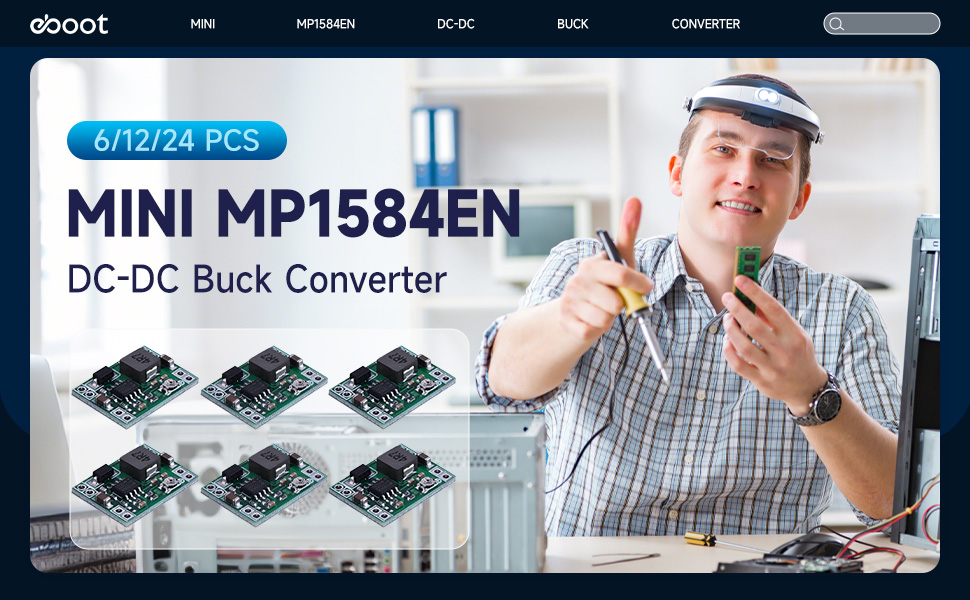
🔋 Power your innovation with precision and confidence!
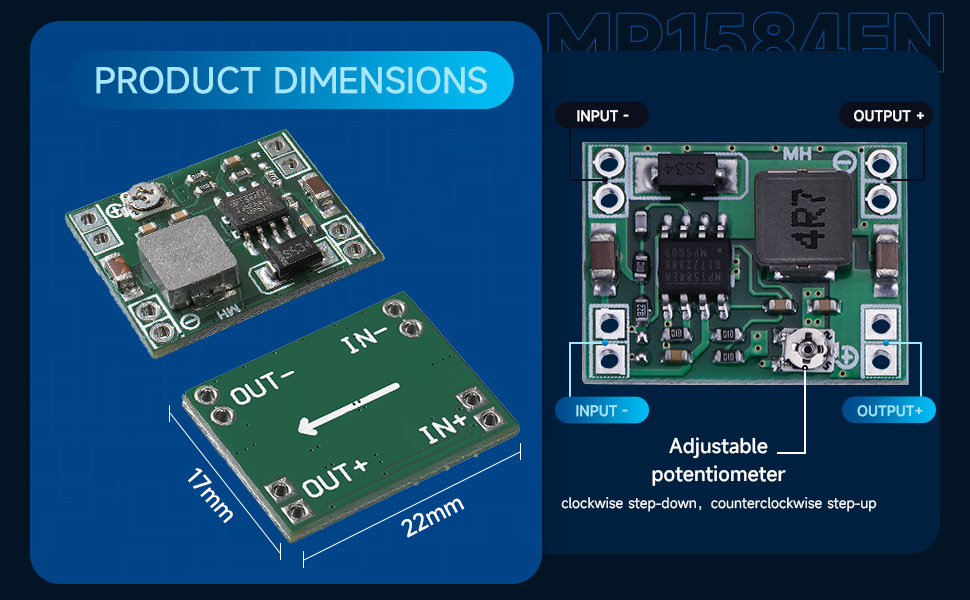
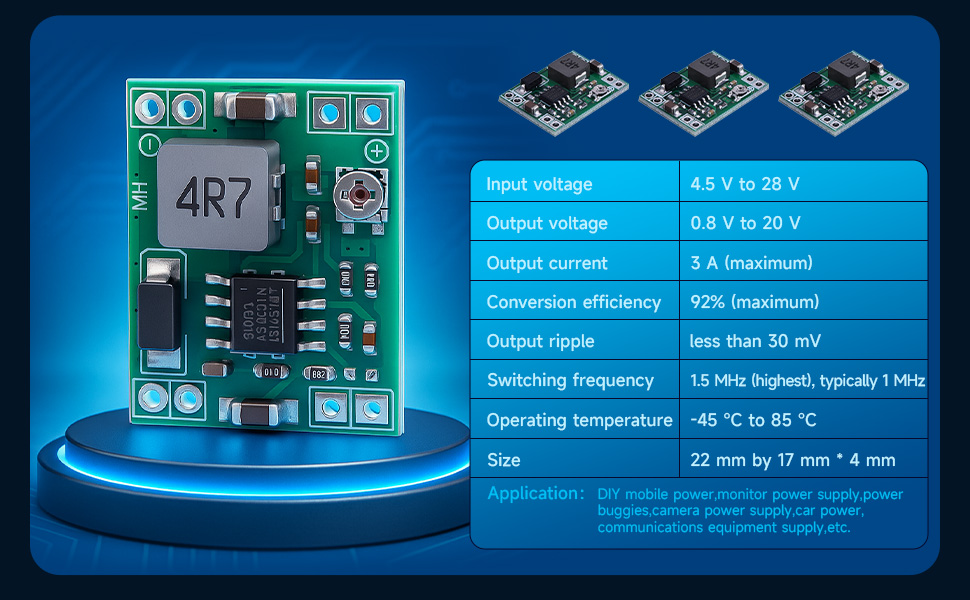
The EBOOT Mini MP1584EN is a high-efficiency, adjustable DC-DC buck converter module delivering up to 3A output current with a wide input voltage range (4.5V-28V). Its compact size (22x17x4 mm) and robust thermal tolerance (-45°C to 85°C) make it ideal for professional-grade electronics projects. With 92% max conversion efficiency and built-in fail-safe protection, it ensures stable, reliable voltage regulation to safeguard your high-value devices.

| ASIN | B01MQGMOKI |
| Best Sellers Rank | #37,728 in Tools & Home Improvement ( See Top 100 in Tools & Home Improvement ) #130 in Power Converters |
| Customer Reviews | 4.3 4.3 out of 5 stars (1,322) |
| Date First Available | November 10, 2016 |
| Is Discontinued By Manufacturer | No |
| Item Weight | 0.64 ounces |
| Item model number | Mini MP1584EN |
| Manufacturer | eBoot |
| Product Dimensions | 0.16 x 0.87 x 0.16 inches |
S**E
Dont even skimp on voltage regulators or you will pay for it.. these are great!!!
Excellent adjustable buck style voltage regulators.. don't get hot, provide a soild voltage feed with raises and falls that stay within 1 to 2 hundredths a volt.. give a fairly clean output voltage (still need a LC filter if you want very clean wave forms) provides 0.6 to 23 volts from my testing.. able to pull a constant 3.5 amps off it at 16.8v without it getting hot 2.5amps at 20volts gets warm but ok... 3amps at 20v will cook the coil in about 20 minutes.. at 12v I was able to pull a solid 4.2a off it for 2 hours and the temp never got above 97F, 4.5a at 12v smoked it in 7 minutes... If you cook the coil on it it does NOT allow full voltage to pass through (I have had some buck regs fail and allow full voltage to pass through for a few seconds.. I killed two of these intentionally to make sure that when it failed no voltage pass through and on neither one did that happen and that makes me VERY HAPPY. A failure acts like a breaker, it fails it fails and circuit is instantly broken.. I tested this with a O-scope and it had 0ms of full voltage seep when it failed..) These are incredibly cheap and excellent quality.. over preform and stay dang steady.. These are without a doubt the best cost to preformance ratio bucks you can buy... Bucks are not a place to skimp and buy as cheap as possible BECAUSE a failure on a buck that is supplying constant regulated voltage to high dollar electronics and fail and allow unregulated voltage to seep by for even a 1ms can damage sensitive to voltage electronics and ruin your day and make you wish you wouldn't have saved that 30 cents per piece.
N**U
Worked great in the beginning
It worked great when I tested one of them. So I permanently glued it to my setup. And now the potentiometer is not changing the voltage on 3 of them. I am pretty sure I didn’t turn it too far but who knows maybe I applied too much force. So just be gentle I guess. Giving it 1 star because the product was great when it worked. But didn’t even last a few seconds of adjustments. EDIT: I changed my mind. They are working really good now. Yeah the potentiometer can be finicky but it works. By trial and error you can get the right voltage. Just be careful to go really slow and gentle while changing voltage. Don’t push down too hard and turn slowly.
S**N
Nice little board but just a little too finicky at the low end
These may work really well for larger drops (12V to 3V?) but for my use of 5V to 3V the potentiometer is just way, way too finicky and nearly impossible to adjust with accuracy. The tiniest bump or turn and the output V can swing from 1V to 4V. I really wanted to like these little guys because the larger adjustables are just a bit too big for my use and these are a dream in terms of form factor and performance, but my use case is not sitting still in a box untouched or unbumped, and the little potentiometer screw here is just not solid and discrete enough for the low drop use case I needed them for. I'll be looking at other projects with a bigger drop to give them a better try in future.
K**.
Great product
Great product, work as described.
J**.
Adjustable voltage
I’m an Escape Room owner and have used these many times to reduce 12vdc voltage to 9v, 6v, 4.5v to power different escape room technical props/puzzles. I’ve also used to replace battery operated Halloween props like blow mold pumpkins using a 12v power supply and knocking down the voltage to replace the need for batteries. Cat5 wire or speaker wire works well, in a pinch, to accomplish this. As others have mentioned, adjusting voltage is a bit tedious and requires a small (tiny) screwdriver and it is somewhat hard to dial in, but it works with a little patience. Make sure your input power and polarity is correct or you will fire the circuit board. I tend to use a large heat shrink tube to enclose/protect the circuit board after hooking things up.
R**N
Great little boards
Work like a charm. I used them to rewire Christmas village lights. Damn department 47.
P**N
Way too hot with 1.9 amp load in less than a minute. Returning them
These are supposed to be good up to 3 amps. With 12v in and 3.75v out into a 2 ohm resistor, (meaning less than a 2 amp draw), in less than a minute it became "dangerously hot". To me that means when I touched it, I burned my finger slightly. That means it is too hot to use in a normal application. The voltage output was stable for the short time I was able to test it, but with that much heat, I had to quickly disconnect it so I have no long term data. I got the 12 pack and only opened the one I tested. They are all going back because I don't want to risk it. I was disappointed.
C**S
I got these to power a raspberry pi on my 3d printer. it was really simple to set it to 5.3v out on 24v in and it gets warm but not to a concerning level. voltage seems steady. Seems to be working great! cant wait to use the other 5 somewhere
A**E
As described. Works perfectly.
A**R
It had the right pin pitch for a breadboard and the pot could be adjusted to get the right output voltage.
A**R
This device is small and adjustable to any voltage within the range specified, not just the discrete voltages listed. ie you don't select a voltage from a finite set of choices, you adjust it to anything you want in the range. Once set, it doesn't matter what the input voltage is, so long as it's within the specified range. At 3A rated output, it's perfect for mobile application payloads (eg. on drones), instrumentation platforms, and so on to name a few. At the low cost these devices sell for, I'm going to buy another batch just to have them around for those last minute projects that need a great stable power supply.
O**R
Out of 5, 3 of them weren’t working, the rotating screw hole to make the voltage lower do not work. For the 2 remaining, it works well and is stable, great alternative to the bigger buck converter if space is a concern.
Trustpilot
2 weeks ago
1 month ago