We remain fully operational. Our teams are working around the clock to ensure your deliveries continue safely.

DOWNLOAD THE APP


Customer Services
Copyright © 2025 Desertcart Holdings Limited
DOWNLOAD THE APP

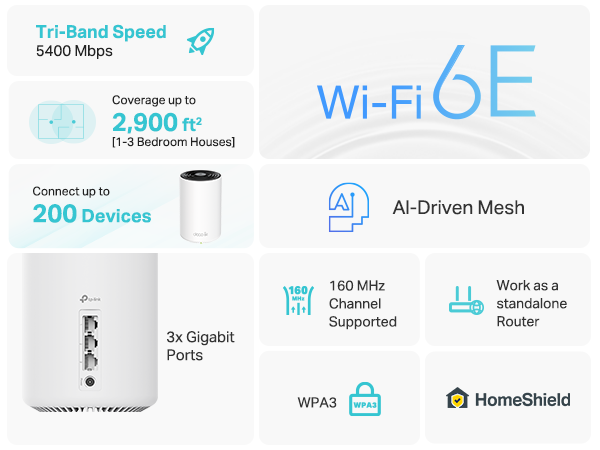
🚀 Elevate your home network with future-ready WiFi 6E power!
The TP-Link Deco XE75 is a cutting-edge WiFi 6E tri-band mesh system designed to blanket up to 2900 sq.ft with ultra-fast, stable internet. Featuring a brand-new 6 GHz band, AI-driven mesh technology, and speeds up to 5400 Mbps, it replaces traditional routers and extenders for seamless connectivity. Managed via an intuitive app and fortified with advanced security, it’s the perfect upgrade for tech-savvy professionals seeking reliable, future-proof home networking.




| ASIN | B0B3YZ5DQB |
| Antenna Location | Home |
| Antenna Type | Internal |
| Best Sellers Rank | #179 in Electronics ( See Top 100 in Electronics ) #2 in Whole Home & Mesh Wi-Fi Systems |
| Brand | TP-Link |
| Built-In Media | 1 x Deco XE75, 1 x Power adapter, 1 x Quick Installation Guide, 1 x RJ45 Ethernet cable |
| Color | Black, White |
| Compatible Devices | router |
| Connectivity Protocol | Wi-Fi |
| Connectivity Range | 2900 Square Feet |
| Connectivity Technology | Ethernet, Wi-Fi |
| Control Method | App |
| Controller Type | App Control |
| Coverage | broad |
| Customer Reviews | 4.3 out of 5 stars 8,634 Reviews |
| Data Transfer Rate | 5400 Megabits Per Second |
| Frequency | 6 GHz |
| Frequency Band Class | Tri-Band |
| Global Trade Identification Number | 00840030707124 |
| Is Modem Compatible | Yes |
| Item Dimensions L x W x H | 4.1"L x 4.1"W x 6.7"H |
| Item Type Name | Mesh WiFi |
| Item Weight | 0.53 Kilograms |
| LAN Port Bandwidth | 10/100/1000 Mbps |
| Manufacturer | TP-Link |
| Maximum Upstream Data Transfer Rate | 2402 Megabits Per Second |
| Mfr Part Number | Deco XE75(1-pack) |
| Model Name | Deco XE75(1-pack) |
| Model Number | Deco XE75(1-pack) |
| Number of Antennas | 4 |
| Number of Ports | 3 |
| Operating System | TP-Link Router OS |
| Other Special Features of the Product | WPS |
| Security Protocol | WPA, WPA2, WPA3 |
| Smart Home Compatibility | Smart Home Compatible |
| Special Feature | WPS |
| UPC | 840030707124 |
| Unit Count | 1.0 Count |
| Warranty Description | 2 year manufacturer |
| Wi-Fi Generation | Wi-Fi 6 |
| Wireless Communication Standard | 802.11ac, 802.11ax, 802.11b, 802.11g, 802.11n |
| Wireless Compability | 802.11ac, 802.11ax, 802.11b, 802.11g, 802.11n |
C**B
Excellent Mesh Network that meets my requirments
UPDATE 8-Dec-2024: In my review I mentioned the TP-Link Dual-Band BE5000 WiFi 7 Mesh Wi-Fi System (Deco BE25) was a lot more expense, and I suggested waiting until you needed WiFi 7. Well, the price is so close to the WiFi 6 I'd go with it now to help future proof! I didn't check other vendors, and I don't have the WiFi 7. If I had to buy today, I'd do the WiFi 7 for sure. 2-Pack WiFi 6 = $220 ($110 each) 2-Pack Wifi 7 = $230 ($115 each!!!!!) 3-pack, WiF 6 = $330 ($110 each) 3-pack WiFi 7 = $300. ($100 each!!!!!!!) UPDATE 29-Sep-2024: I'm totally satisfied. ZERO issues, works beautifully. I had this at 4-Stars to start as installation and set-up went smoothly however I wanted time for it to "bake-in" with use., now I'm at 5-Stars. There is a TP WiFi 7 model available that does cost less than other vendors, still expensive though. The WiFi 6E was $188 for the pair, WiFi 7 is $449 for a pair. That's a big jump, and yes, from what I've read you'll get higher performance. The question that needs to be asked: Do you need it for the extra price? If you can easily afford it, no reason not to. I've worked for 30 years as a network design/architect/consultant in the carrier industry. As described below, for my requirements the TP WiFi 6E is perfect. In 5 years, I may need to look into upgrading to a higher grade mesh. By then, prices will come down for a WiFi 7 and maybe when WiFi 8 is out that'll be a consideration. For now, WiFi 6E works. I give routers a 5-year life span as tech improves rapidly, but do you need annual upgrades? Not in my world, yet. I'm still waiting for 5G cellular service in my rural setting yet I do get 80Mbps down/19Mbs up (Verizon), and in some places in Colorado Springs I've clocked 1.3Gbps on my iPhone which is insanely fast. My iPhone does provide good hotspot backup if needed. If you have a "Brady Bunch" size family, maybe the WiFi 7 would better, and you may need more than 2 routers in the mesh depending on your house, basement, patio, number of devices and floors. The nice thing about the TP mesh is adding more as needed is easy, as it should be today. GENERAL: 16-Sep-2024 I needed a new WiFi mesh solution. I'll explain why in a bit. For 99% of the users at home, basic settings should be fine. For those with bespoke setting requirements, they know what needs to be done. This isn’t a commercial grade device like from Cisco or Meraki although for small offices, I think the XE75 would be excellent. DETAILS TO CONSIDER: I’m using the TP Deca XE75 – be SURE to know this, not Deco AXE5400 as this is not a choice when registering via the app. I use just a pair in a 3,800’ slab-on-grade ranch. Each XE75 works at 2.4/5/6Ghz. There are 3 “Networks”: Router, Guest and IOT to isolate connections. Pricing was excellent at $219 for the pair + a $30 discount coupon! This is not a Base plus Extender, these are both full-function WiFi routers with the first one setup being the Main. They each have 3 UTP Gbit ports. I only needed UTP on the Main. Password, frequencies, ect settings are all transparent across the mesh network. You can click on each Wifi router in the mesh to see what is connected to each. Each SSID will have its own password. Be sure to use Upper/lower/a few numbers/a few special characters, and MAKE SURE TO JOT THEM DOWN! SSID Router and Router_6Ghz + Password you create - iPhone, laptop, printer, SAN/NAS SSID Guest + Password you create: if I have visitors SSID IOT + Password you create: all other connections like Hunter-Douglas PowerView (motorized Roman shades), TVs, 22KW Generac generator, DTV, DVD, etc that have vendor access for updates and such. SETUP: SUGGESTION: Unplug your ISP equipment before you start setting up the app. My iPhone just downloaded via my Verizon cell connection nicely. This gives your ISP equipment the 5 or more minutes to quiesce (shutdown, clear). When I connected to my ISP equipment and powered-up, I called my ISP, they saw the new device, authorized and in a few seconds I was back on-line. Download the TP App, and follow the instructions step-by-step. When setting up, each XE75 has a barcode on the bottom that needs to be scanned as you set them up – easier than typing in the code. It’s a tad fuzzy to scan, just don’t give up. I used an iPhone 13 Pro to scan and was surprised how difficult it was. Just follow the instructions at setting up the router EXACTLY (keyword=EXACTLY) as they say. The app will ask you to name it, I used Office from the choices, and I think you could do a custom name. With my ISP, I have to call and tell them a new router is being connected so they can authorize it for security. My ISP is a local company in Colorado, Kellin, that services remote areas hence microwave (plans in the next 12-18 months include going up-to 500Mbps - way more than I need), and support is seriously fantastic after more than 10 years. The UTP ports (3 on each route) support 1Gbps. The TP should work for all ISP, probably even StarLink although check first to be sure. The App set-up worked great as I followed the instructions EXACTLY as they specified. Next, I created PASSWORDS for Office, Guest and IOT networks. Next, I added the other XE75 to the mesh using the barcode reader, and boom, up it came, connected to the mesh and I named it Bedroom. On the App you’ll see: ISP icon---Office/MAIN icon----Bedroom icon (these are my locations) plus you’ll see how many devices are connected to each with a footnote number for each. Nice. Next, I started discovery for Router – my laptop runs at 6Ghz. BTW, UTP connections go to Router only that I can tell, not Guest or IoT Next, I started discovery for IOT No Guests yet, however, they should connect as easily Under “More Settings” at the lower right corner of the app, click and you’ll see Wi-Fi Setting (Main Network), then Guest Network and IoT Network. Pretty straight forward; naming Wi-Fi Setting the same as the Main Network would make better sense at least to me. In Wi-Fi and Guest Networks you have 2.4/5Ghz and 6Ghz network options. In IoT you only have 2.4/5Ghz. I turned off 6Ghz for Guest as 2.4/5Ghz will be fine plus you’ll get better distance and plenty of bandwidth performance. If I need to connect my laptop to Guest or IoT, my laptop selects the highest frequency. My iPhone 13 doesn’t do 6Ghz. When I upgrade my iPhone in a year or 2, it’ll probably have 6Ghz. PERFORMANCE: My microwave ISP is 120Mbps Up/Down, plenty for me. I don’t game or have kids. I work from home as a consultant, do WebEx/Zoom/MS Teams video calls that are excellent quality, I’ll watch an Amazon Prime movie now and then, I use DirecTV not a streaming or cable service. So far, performance has been flawless. Generac has “issues” with mesh networks – this is on them to fix as it is 2024 and it is not a $50 device, but that is for another review. (Generac works great, it’s the 2.4Ghz WiFi set-up that is archaic.) If you do have a Generac, the best way is if the remote mesh router is near the Generac, turn it off and force the Generac to connect to the Base. Then, bring the remote router(s) back on-line. This seems to fix the stupid problem. And yes, it is stupid for a $17,000 device as it should have a great WiFi solution, it doesn’t. This is a problem for Generac with all mesh networks, not just TP. I did a lot of research and found a good work-around solution Reddit. For the price and performance, I think you’ll like this device. I only have the main and 1 remote. More remotes, no idea. My video calls, streaming with Amazon Prime (Netflix should be OK, I don’t have it) and gaming should be fine (I don’t game). Another thing that will affect performance over the Internet will be your ISP’s quality. They say like 1-Gig service however, that is the max you’ll probably get. During busy times performance may degrade based on how many people they support – it gets complicated with over-subscription to bandwidth during peak hours. Clearly, more users will be on between like 6PM and Midnight than at 1PM or 3AM in a residential area: streaming movies and gaming uses a LOT of bandwidth. That 1 Gig you subscribe to is not 100% all the time. This has nothing to do with TP or a home set-up. AND NOW FOR SOMETHING COMPLETELY DIFFERENT – Why TP? 2.4/5/6Ghz: What’s the difference? The higher the frequency, the more data that can be transmitted. Problem is, as the frequency goes up the ability to penetrate walls drops. 2.4Ghz carries less data however it penetrates walls better than 5Ghz and 6Ghz. I won’t get all wonky. Extenders are the reason they are needed in large houses/multiple floors to penetrate hence we have mesh networks today as single WiFi devices have distance problems at higher frequencies as more data is needed like for gaming, video, streaming, phone calls, ect all at the same time. I had to replace my Netgear Orbi 850 w/1 satellite. The Base unit UTP ports stopped working which means I lost ISP access and UTP devices. My hardware warranty ended 7 weeks prior. I paid over $600 in July 2023. I contacted sales to see if I could buy a refurb'ed 850 base at a decent discount. Nope. They just said your hardware warranty has ended - I was up-front and told them that. I connected my laptop to my ISP and it came right up. They wanted to troubleshoot. Waste of time. Duh. I’ve used Netgear for over 20 years, routers, WiFi and LAN switches. I upgrade when needed. This Orbi 850 issue and how they handled it was poor. This wasn’t a $50 device. And, now I have an Orbi 850 satellite I need to sell on eBay, the base will get recycled. Will I ever buy Netgear again? Extremely unlikely. I like the LAN switches, solid, reliable, lifetime warranty on the ProSafe products however I have all the Gigabit LAN switches I need as WiFi speeds get better. I tried the eero Pro 6E mesh Wi-Fi router, $184.00 + 20% rebate + $100 credit sending my Orbi back. Great deal. My ISP recommended eero. The set-up was a tad awkward (I wrote a review) and I got through it. Connected my devices and all. I noticed my laptop had really poor performance and disconnects. I decided to buy the eero Extender & wall mount total $95, neat set-up. Got it, however, my laptop kept going to the base router, never the Extender. The problem was the Extender only handles 2.4/5Ghz, not 6Ghz. I have no way to disable 6Ghz on my laptop, this is a deficiency and Lenovo support was no help. I called for eero support to see if a 2.4/5/6Ghz extender was available or if I could disable 6Ghz on the Base Router. No to each question. At least TP allows you to disable 6Ghz. The recommendation: buy a 2nd eero Pro 6E mesh Wi-Fi router, and now the price ~7 days later was $249. Not having an Extender at 2.4/5/6Ghz when the base equipment does is silly given we are now seeing WiFi 7 being released (EXPENSIVE though). I sent the eero stuff back for a refund. Had the eero Extender provided 6Ghz, I would have kept it as it did work really well, 2.4/5Ghz is fine for my house, and a new laptop would have cost a LOT more. If your device doesn’t do 6Ghz, eero would be fine. However, as with all technology we’ll see upgrades with new devices in the coming years. If you have a device that can’t disable 6Ghz, you'll have a problem. If you are still awake, I hope this helped.
D**D
Great Router & Mesh System So Far
Replaced an older ASUS mesh system that was a daily headache to deal with for a 4,500 sq ft house on 3 levels. Decided to give this TP-Link Tri-Band WiFi 7 BE10000 Whole Home Mesh System (Deco BE63) a go. Based on my constant problems with my ASUS mesh system, I was expecting this to be a pain from the start. I was dead wrong. This took about 30 minutes (if that) to set up and get going, start to finish, and it works flawlessly in this 3 level house. Whole house is covered, about 70 devices, and it hums right along with no issues. I'm very impressed (and relieved from not having to deal with that ASUS fiasco every day). I've only had this now for a couple of days, but everything is going well so far. PROS: 1. Setup was simple and straightforward via the Deco app 2. It worked perfectly out of the box - no hassles or hiccups 3. Enough flexibility to set your router's address and the DHCP range - if you have a lot of static IP addresses this makes transitioning to the TPLink much easier 4. Speed is great - I haven't benchmarked it, but it no one has noticed any lagging on any devices, multiple 4k TVs, etc. CONS: There are a couple of things - 1. What idiot designed these power adapters? First, they're HUGE. The way it has to be plugged in it takes up 3 outlets on a power strip. There's no reason a power supply has to be that large. Second, the flimsy power cord is way, way too short. Someone really dropped the ball in design of the power supply and cord, particularly for a $450 router. 2. The router has a USB port on it. (in fact each of the 3 units has the same 3 RJ45 and USB ports, but the USB for the main unit (the first one you set up and go through the installation) is the only one that you can hang an external drive off of and access it.)) I plugged an external hard drive into the USB port and was able to share it via the Deco app - the one catch is that you can't just create a share name, such as "backup". The router adds a "G" so that in order to use the share, it must be used as \\your.router.ip.address\G\backup ...not really a big deal, but I have many computers that run backups and I had to go reconfigure them to add the "G" to the network path. Other thoughts - You're forced to use the Deco app on a phone or tablet to manage the network. There is a webpage interface, but it's basic stuff only. That said, I'm pretty impressed with the Deco app itself - seems to have all of the needed features without a lot of stuff I don't really use or need that I had in the ASUS and have seen in other router setups. There is a basic level of security included for free, but TP-Link offers additional tiers of security. I ended up adding the Security+ ... but they also have a tier that includes advanced Parental Controls, VPN, Password Management, and several other things, for more money of course. So far so good on all of my IoT devices too. If you're looking for a router system with great coverage and speed that you don't have to muck around with daily, this appears to be a solid choice. I'll update this review if anything changes.
L**R
Solid, easy to use and reliable.
I have been looking for a great quality router for about a year now. I have watched YouTube videos and visited different forums to find the perfect one for our 1350 ft.² single family home. I have read differnt reviews and this is one did not come up a lot. It was not till I was chatting with a friend that I heard about this item. After he explained how the 6e worked I was excited to get it in and try out. The router I had was from 2019 and in my eyes I thought it was working fine but once I connected the TP-Link to my modem and started doing some testing around my property I didn’t realize what I was missing and how my old router was not even giving me the speed I was being providing. Set up was so easy. Once you download the app all you have to do is follow the app instructions. It literally is that easy. And the second until was plug and play. I now am able to utilize the speed my service is providing me which is Spectrum throughout my house and beyond. Signal strength is amazing. For what you get price was very reasonable. The app and user interface is not complicated at all. Another nice feature is there is only one light and it is not that bright which is nice because you don’t want a super bright light while all other lights are off. I would highly recommend this router system and as of now will give it a 5 start. I will give an update down the road on how it is holding up. Device seems to be durable and solid.
C**N
Setup - in my case anyway - wasn't a breeze
I purchased the 3-pack of BE63 devices to replace an Asus Mesh network. The Asus had supported us well until an early March release of firmware caused the router and mesh nodes to go offline often. A FW update released in late March was supposed to address the issue, but the issue remained and my router dropped offline often. I sought assistance from Asus and was given the old "let's reset everything and start from scratch" approach - something I didn't want to do as I knew the issues would remain. I took a deep dive with these TP-Link Deco units. They're not cheap but offer WiFi 7, which will "future proof" my setup for the foreseeable future. Most of what I've read and reviewed indicate these are a breeze to setup. That wasn't the case for me. I setup one of the devices as the main router. After repeated retries to find the Deco with my Android device it was finally detected. It took another few attempts for the Deco to "see" the internet. It eventually connected and I saved the WiFi information to my phone as part of the setup. Setting up the additional two nodes was a piece of cake - they simply needed to be plugged in and allowed to boot and were eventually detected by the app on the phone. But that's when the fun began. NO OTHER wireless clients would connect. They'd either indicate the network password was incorrect (I repeatedly checked the setting to ensure we were using the correct one) or that it simply couldn't connect to the network. I chatted with a Deco technician who eventually recommended resetting the Deco router and nodes, choosing one of the satellite nodes to be the main router, uninstalling and then reinstalling the Deco app. These steps worked. Clients were able to connect to all three points of access. An FW update was detected by the app and applied to all 3 devices in about 5 - 8 minutes time. A couple of notes. I used the same SSID with this new network as I had with the Asus network, the thinking being that wireless clients would automatically connect once the network was back up (and eventually accessible). During setup, however, I learned that setup mandated an 8-character minimum password. My previous password, while strong, was only 7-positions in length. This necessitated visiting every wireless client to update the network password for each. These include several Ring cameras, a Ring Chime Pro, several smart bulbs and 5 Bose Soundtouch devices (the Bose units were really "fun" to reconnect). During my chat with tech support I asked if there was any way to suppress the 8-character minimum but, alas, there isn't one. Network speed is impressive. I've got Verizon FiOS with 1Gb up & down. Wireless clients (none of which support WiFi 7 (yet)) exceeded 900Mb up & down. Speed can only improve as WiFi 7 devices are added to the network and Verizon eventually offers speeds exceeding 1Gbps. Signal strength from all clients is strong, indicating my coverage is good. I'm looking for a heat map application that I can use to determine actual coverage. All in all, I'm pleased with network performance, but setup (in my case, anyway) was not as advertised. Recommended!
J**Y
Easy setup
The set up was amazingly easy. The Deco App is user friendly. The satellites connected smoothly. There was a surprisingly vast increase in signal strength, range & speed compared to my old mesh system. If you’re upgrading, I highly recommend using the exact same name & password as your old network. That way your connected devices should automatically connect to the new system. The only device that won’t connect is my 12 year old printer. I’m hoping a firmware update will fix that.
B**S
Pathetic roaming and frequency management
I am an network engineer with 30+ years of experience - way longer than WiFi has been around. I have designed and implemented many business WiFi systems that support seamless roaming over larger areas so when I say that this system is a pathetic implementation of meshed WiFi and roaming I do have experience to back it up. I bought this system because I wanted to upgrade my home's WiFi system with a 6GHz WiFi 6e capability and I was sorely disappointed in this system's meshing and roaming capability. I performed extensive testing with demanding applications on modern Android phones, Apple iPads, Samsung tablets and laptops. The bottom line - this system is an abysmal failure for supporting roaming in a meshed WiFi network. This system's ability to allow devices to roam between access points is pathetic to non-existent. You might as well have 3 independent WiFi access points in your home. In spite of everything you read about this system it is technically inferior because it relies on using the exact same WiFi frequencies on all units when they are meshed! This pretty much kills the ability for devices to smoothly roam between the APs without dropping, re-scanning and re-connecting. The reviews for WiFi access points generally only emphasize performance - how fast you can download and upload and how much the signal degrades based on distance to the AP. That is fine for a single AP however, any system like this one that is supposedly offering a fully meshed solution it is an inadequate measure of performance and completely leaves out test results for the main reason to consider a meshed system in the first place. In fact, I have yet to read a single review that addresses a consumer grade system's meshing/roaming capabilities and performance. This system like almost all of the 'consumer' grade systems do not set the WiFi frequencies independently for each AP. This system chooses the exact same WiFi channels for 2.4GHz, 5GHz and 6GHz for each node. This makes it all but impossible for devices to smoothly roam between AP's. Why you may ask? Because the device has a difficult time distinguishing between a signal that is fading from a more distant AP and the stronger signal of the next AP (that it has yet to connect to) effectively causing the device to stay connected to the distant AP until it is overwhelmed by the interference of the stronger signal from the the same WiFi frequency on the closer AP next to the device. Eventually the device just drops the connection to the distant AP and goes through a 'scan and connect' to the closer AP with the stronger signal. This will always interrupt VoIP (WiFi) calls and other latency sensitive applications such as gaming and trading apps. This system purports to offer 'Fast Roaming' (802.11r) but it is totally ineffective. Next there is the issue of frequency management. A good system will only use 2.4GHz bands with client devices as a last resort. Either because the client device can only connect on 2.4GHz channels (many IoT devices only work on 2.4GHz channels) or because a device has gone beyond the useful range of a 5GHz channel. 5GHz channels are a much lower power level and don't penetrate walls very well. 2.4GHz channels offer better penetration through walls and floors. A well designed and implemented WiFi AP will 'encourage' devices to connect on 5GHz channels because 5GHz offers much better performance than 2.4GHz. This system does not do this AT ALL!! In fact it will mostly connect at 2.4GHz - especially once a device moves far enough away to make 5GHz to weak. From that point on - even when switching (I can't call it roaming because it is a drop, scan and re-connect) to the next AP it will tend to remain on 2.4GHz channels. Only devices that stay relatively still, close to an AP and rarely move to another AP will utilize 5GHz channels and even then for no reason the device may switch from 5GHz to 2.4GHz even if it doesn't change position and has a strong 5GHz signal. This could be caused by nearby interference (your neighbor's WiFi). Please don't confuse this with the selectable option that causes the AP to only use 5GHz channels - an option that is disruptive to most devices and can actually make roaming and the overall WiFi experience worse by depriving devices the ability to use 2.4GHz channels when 5GHz channels would be ineffective. The absolute worst aspect of this system (and most other 'consumer' meshed WiFi systems) is that it used the exact same 2.4GHz, 5GHz and 6GHz channels for each node making it impossible to mitigate any external WiFi interference near each node (mostly your neighbor's and outside WiFi systems) since each node is bound to be exposed to different WiFi frequency interference. There are so few WiFi channels available that this means at some locations you will have good WiFi performance with the nearest AP and at other locations performance will be poor due to local interference newar that AP. The bottom line don't buy this if you are looking for smooth and seamless roaming between APs. The high cost of this system just means you are throwing more money away - not getting a good solution. In case you are wondering - I returned mine.
R**H
Best 2-pack wifi7 with 2.5gbps wirelessly
I used with Google Fiber 8gb edge, overkill is my style, imagine my shock when I see the equipment sucks from google, WiFi 6, random disconnects, and max WiFi speeds of 500mbps on wifi6 devices and 5hz devices even worse at maybe 100mbps, then you have to connect to each band manually, there is no network handling for automatic band handover! This system has wifi7, 2.5gb Ethernet ports, and on 6hz band is getting almost 2gbps, on 5hz 250+mbps, and I have yet to see it have to use 2.4hz because the 5/6hz bands have such good coverage in my 3000sq ft 2 story house. I have had zero disconnects, and no issues. I am very happy with this 2 pack Deco system and glad to know it can cover 5000 sq ft so when we move into our dream home we have this covered. I have had google home WiFi, nighthawk, syth lord, and others; this system takes it and gives me WiFi as fast as Ethernet. Latency is 5ms, ping is 2ms near perfect.
R**T
Very happy! Made a big difference in wi-fi performance
We have an AT&T gateway and have been using three older TP-Link routers as access points connected by ethernet using our home's structured wiring and a TP-Link repeater to boost the signal to our two Ring doorbells. I'm embarrassed to say but we only have 50mb/sec internet because nothing faster is available where we live, even though communities right next to us have had fiber for years. That said, the speed we have actually works just fine for everything we do, which is quite a lot. We do streaming for all our TV watching, work from home, have many Ring cameras and doorbells, and lots of other devices. The problem was that our wi-fi seemed to get bogged down and wasn't able to even deliver the 50mb/sec speed we have. This was especially problematic for our two Ring Doorbell Pros, where the video quality really suffered. Everything was blocky and blurry, I'm assuming because the cameras weren't getting enough speed and/or strong enough connection. The construction of our house likely doesn't help since the front is brick and stone. With this new Deco system, everything works and works well. We have a 3-story house, and I placed one unit on each floor. The first and third floor units are wired and the second floor unit is wireless, connected to the third floor unit above it. This configuration allowed me to place the second floor unit closer to the front of the house where the two Ring doorbells are, without the need for an extender. The system was very easy to set up and the app is great. It is easy to navigate, and settings are straightforward and easy to change. It provides lots of information on status, connected clients, signal strength, speed, etc. It's not as 'advanced' as the typical web-based router configuration interfaces but seems to have everything I needed. I have these in access point mode also, since my gateway acts as a router. I may see if I can change that at some point, but everything works flawlessly, so I may not mess with it. The great part is that I now have full wi-fi speed everywhere in the house and everything loads much faster. Live feeds on the Ring doorbells take less than a second to start and video is crisp and clear. I'm also getting excellent signal strength readings from all our outdoor cameras and doorbells, with readings in the -40s. Streaming starts faster on every TV, and we haven't had a single issue since we started using this system. Also, you can customize settings for every connected device, like which Deco you prefer it connect to and if you want to restrict it to a certain band (both default to 'Auto'). This is useful in certain cases, like for our two Ring doorbells, I set them both to preferred connection to the second floor Deco because it's the closest one. That way if it gets unplugged or there's a power outage, this will ensure it always connects to the closest one. I left most everything else on Auto and that seems to work fine, and it seems to select the best (closest) Deco. I've also had no issues with 5Ghz devices connecting to the 2.4Ghz band. Our phones have 6Ghz capability, so I specifically connected them to that network, since it has a different SSID. Signal strength and speed on that network is also excellent everywhere. I made both the main and guest network SSIDs and passwords the same as our old system. Most 2.4Ghz clients connected to the new system automatically. Any clients we had on the 5Ghz band had to be reconnected because our old system had those networks separate. That wasn't a big deal, and this new setup is simpler to work with, having both 2.4Ghz and 5Ghz combined. The guest mode works great. We use that network for my wife's home-based business for her clients to connect to because it isolates connected clients from our main network and devices. You can easily turn it on and off in the app as well. I couldn't be happier, especially given how affordable this system was. I know you can spend a lot more, but wow this one is awesome and a great price. When I bought it, the price was $269 for new, but Amazon also had one from 'Amazon Resale' in 'Like New' condition for $219, which I bought. It all works fine, but when I received the product, it had a sticker on the box stating that it was 'Refurbished', which was no disclosed in the listing, which stated it looks and works like new and included ALL original accessories and contents, noting minor damage to the product box. What I received did not include any instructions or manuals and included a slip that said these could be obtained on-line and were not included with refurbished products. It also stated that it had a 90-day warranty but the original warranty that would come with a new product did not apply. While I'm thrilled with the product and it does work, I feel this was a bait and switch situation on Amazon's part. I highly recommend this system.
Trustpilot
2 months ago
2 weeks ago