
DOWNLOAD THE APP


Customer Services
Copyright © 2025 Desertcart Holdings Limited
DOWNLOAD THE APP

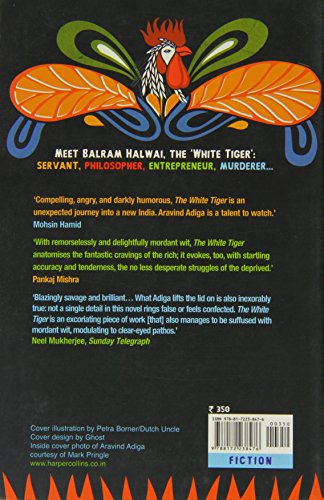



The White Tiger: Booker Prize Winner 2008 : Adiga, Aravind: desertcart.in: Books Review: Deserved to win the Booker Prize. A must read for every Indian. - Aravind Adiga's The White Tiger attempts to reveal the "real India" which is almost always hidden behind the façade of the "Incredible India" campaign put into motion by our government. The protagonist Balram Halwai alias Munna writes of his own experiences to the Chinese prime minister, the fictional Mr. Jiabao. In a span of seven nights Balram narrates his journey from the oppressive life he used to lead in a village near Dhanbad to how he became a successful entrepreneur, owning a travel agency business in Bangalore. The descriptions afforded in the novel are life like, true and original. Some may argue that Adiga sometimes exaggerates a few points. However after careful reflection, it is felt that Adiga does actually portray the truth, which becomes so unbelievable to us that we take it for an exaggeration. The novel is replete with glowing passages. For example, this is how Balram describes the demise of his father. Observe how brilliantly Adiga criticises the pathetic medical system in the Indian villages: "I came to Dhanbad after my father's death. He had been ill for some time, but there is no hospital in Laxmangarh, although there are three different foundation stones for a hospital, laid by three different politicians before three different elections. When he began spitting blood that morning, Kishan and I took him by boat across the river. We kept washing his mouth with water from the river, but the water was so polluted that it made him spit more blood. There was a rickshaw-puller on the other side of the river who recognized my father; he took the three of us for free to the government hospital. There were three black goats sitting on the steps to the large, faded white building; the stench of goat faeces wafted out from the open door. The glass in most of the windows was broken; a cat was staring out at us from one cracked window." As can be seen from the passage above, Adiga shows how difficult life is for the poor, especially in the villages. He brilliantly satirizes the tendency of politicians to promise social improvement before the brink of elections. He also takes on the pathetic condition of the rivers of India, the waters of which we consider sacred, holy and pure, using it for religious ceremonies. Yet these waters are the most polluted. What comes across powerfully in the novel is a tone of anger, frustration and protest. The language in which Balram the protagonist narrates the story is important to serve this purpose. Some people criticize Adiga's writing style in this novel saying that it is undeserving of the Man Booker Prize that he won in 2008. I strongly beg to differ. Rather I would say that it is this style of his writing, this note of frustration and seething anger, that makes the novel all the more worthwhile to read and appreciate. It is a book that serves as a mouthpiece for exposing the sufferings of the poor and the oppressed. Various issues that we see everyday in newspapers are brought to the fore: politicians bribing ministers, murderers escaping from policemen who don't even lodge an FIR, servants mistreated by their so called masters, the urge for the poor man to become rich and successful through unfair means, patients dying in hospitals for lack of treatment and so on on. The novel is essentially a satire on the shams and the hypocrisies of Indians and the tendency of the rich to look down upon the poor. Adiga believes that there are "two Indias", one of the rich and the other of the poor. Like Charles Dickens whose novels served as a mirror to reflect the darker side of Victorian England amidst its progressive outlook and modern worldview, Aravind Adiga through The White Tiger does the exact thing to expose the "real" India. Many people from the West have this mistaken notion that the poor people of this country are spiritually richer, that they find joys in their daily struggles. Adiga lays this discussion to rest. Through the sufferings of the people of Laxmangarh, and of Balram's brother Kishan and his father, the author shows that the poor do not want to be poor, but lead a comfortable life. Some readers complain that Adiga purposefully exposes the poverty of India since the West loves reading about the filth in our country. "Slumdog Millionaire" did this and won the Oscar while Adiga also bags the Booker Prize writing about the same issues. However, there is one significant difference. Adiga is not glorifying poverty or ridiculing India in front of the West. He is basically trying to protest the unfair divide between the rich and the poor that exists in this country. The novel thus is an angry outburst. In India, a man is not known by the company that he keeps but by the vehicle that he drives, or more precisely through his material possessions. Let me provide another example. Here the police commissioner conspires with the murderer to hide his crime, while the victim's brother helplessly leaves the police station: "The number plates will be changed tomorrow," the assistant commissioner said. "We'll say it was a hit-and-run. Another car will be substituted. We keep battered cars for this purpose here. You're very lucky that your Qualis hit a man on a bicycle". The author then observes: " A man on a bicycle getting killed- the police don't even have to register the case. A man on a motorbike getting killed- they would have to register that. A man in a car getting killed- they would have thrown me in jail. " Such is the condition in India. And the saddest part is it is true. Everyone should read This White Tiger. That's the least they can do. Review: A gripping tale - I'm a young college student, and with all your peers going on endlessly about the latest movies and TV shows, it's hard to put your mind to reading a book. So after a gap of nearly an entire semester, wrapped in the comfort of my blanket, I've resumed reading. And what a book for a restart! By far, Adiga's concept is nothing new. The story of a young boy from a downtrodden family in the poorest of villages rising through the ranks to finish at the top of the society, ignoring the means of this achievement, is something that has been explored before. Take for example, Chetan Bhagat's book, Revolution 2020, or maybe even Academy Award-winning movie Slumdog Millionaire (I reckon the latter's further apart), and you see that the lines running through the stories are parallel. Nevertheless, a prominent difference lies in the manner of story-telling. And this is what caught my eye right at the beginning. The picture of India that we see advertised on TV, websites and any other form of media accessible to you and me is a beautiful one. The question then that must be asked is, "Is it the real one?" Adiga lands a real sucker-punch in bringing you to the harsh realities of life in the lands of the country he calls 'The Darkness' and 'The Light'. With a no-nonsense approach, he thrusts you into life in the lands. Sarcasm is strewn through the pages as the narrator tackles menace after menace of 'modern' society. Though the book has no evident plot twist, it takes hold of you from the first page and doesn't let you go till you're done. The storyline is fast-paced and keeps moving ahead, only pausing at times of emotional thought-processing on the narrator's part. Truth be told, I began reading it barely 8 hours ago, and with a modest couple of breaks in between, here I am, completing this review. If you're looking for a quick read that will bring you right back to Earth when you've got your head in the clouds, this is it.
| Best Sellers Rank | #5,702 in Books ( See Top 100 in Books ) #103 in Indian Writing (Books) #257 in Contemporary Fiction (Books) |
| Country of Origin | India |
| Customer Reviews | 4.4 4.4 out of 5 stars (11,715) |
| Dimensions | 12.8 x 2.1 x 19.8 cm |
| ISBN-10 | 8172238479 |
| ISBN-13 | 978-8172238476 |
| Importer | Atlantic Publishers and Distributors (P) Ltd., 7/22, Ansari Road, Darya Ganj, New Delhi - 110002 INDIA, Email – [email protected], Ph – 011-47320500 |
| Item Weight | 245 g |
| Language | English |
| Net Quantity | 500.00 Grams |
| Paperback | 328 pages |
| Publisher | HarperCollins; Latest edition (3 November 2009); HarperCollins Publishers; Product Safety Manager; [email protected] |
T**S
Deserved to win the Booker Prize. A must read for every Indian.
Aravind Adiga's The White Tiger attempts to reveal the "real India" which is almost always hidden behind the façade of the "Incredible India" campaign put into motion by our government. The protagonist Balram Halwai alias Munna writes of his own experiences to the Chinese prime minister, the fictional Mr. Jiabao. In a span of seven nights Balram narrates his journey from the oppressive life he used to lead in a village near Dhanbad to how he became a successful entrepreneur, owning a travel agency business in Bangalore. The descriptions afforded in the novel are life like, true and original. Some may argue that Adiga sometimes exaggerates a few points. However after careful reflection, it is felt that Adiga does actually portray the truth, which becomes so unbelievable to us that we take it for an exaggeration. The novel is replete with glowing passages. For example, this is how Balram describes the demise of his father. Observe how brilliantly Adiga criticises the pathetic medical system in the Indian villages: "I came to Dhanbad after my father's death. He had been ill for some time, but there is no hospital in Laxmangarh, although there are three different foundation stones for a hospital, laid by three different politicians before three different elections. When he began spitting blood that morning, Kishan and I took him by boat across the river. We kept washing his mouth with water from the river, but the water was so polluted that it made him spit more blood. There was a rickshaw-puller on the other side of the river who recognized my father; he took the three of us for free to the government hospital. There were three black goats sitting on the steps to the large, faded white building; the stench of goat faeces wafted out from the open door. The glass in most of the windows was broken; a cat was staring out at us from one cracked window." As can be seen from the passage above, Adiga shows how difficult life is for the poor, especially in the villages. He brilliantly satirizes the tendency of politicians to promise social improvement before the brink of elections. He also takes on the pathetic condition of the rivers of India, the waters of which we consider sacred, holy and pure, using it for religious ceremonies. Yet these waters are the most polluted. What comes across powerfully in the novel is a tone of anger, frustration and protest. The language in which Balram the protagonist narrates the story is important to serve this purpose. Some people criticize Adiga's writing style in this novel saying that it is undeserving of the Man Booker Prize that he won in 2008. I strongly beg to differ. Rather I would say that it is this style of his writing, this note of frustration and seething anger, that makes the novel all the more worthwhile to read and appreciate. It is a book that serves as a mouthpiece for exposing the sufferings of the poor and the oppressed. Various issues that we see everyday in newspapers are brought to the fore: politicians bribing ministers, murderers escaping from policemen who don't even lodge an FIR, servants mistreated by their so called masters, the urge for the poor man to become rich and successful through unfair means, patients dying in hospitals for lack of treatment and so on on. The novel is essentially a satire on the shams and the hypocrisies of Indians and the tendency of the rich to look down upon the poor. Adiga believes that there are "two Indias", one of the rich and the other of the poor. Like Charles Dickens whose novels served as a mirror to reflect the darker side of Victorian England amidst its progressive outlook and modern worldview, Aravind Adiga through The White Tiger does the exact thing to expose the "real" India. Many people from the West have this mistaken notion that the poor people of this country are spiritually richer, that they find joys in their daily struggles. Adiga lays this discussion to rest. Through the sufferings of the people of Laxmangarh, and of Balram's brother Kishan and his father, the author shows that the poor do not want to be poor, but lead a comfortable life. Some readers complain that Adiga purposefully exposes the poverty of India since the West loves reading about the filth in our country. "Slumdog Millionaire" did this and won the Oscar while Adiga also bags the Booker Prize writing about the same issues. However, there is one significant difference. Adiga is not glorifying poverty or ridiculing India in front of the West. He is basically trying to protest the unfair divide between the rich and the poor that exists in this country. The novel thus is an angry outburst. In India, a man is not known by the company that he keeps but by the vehicle that he drives, or more precisely through his material possessions. Let me provide another example. Here the police commissioner conspires with the murderer to hide his crime, while the victim's brother helplessly leaves the police station: "The number plates will be changed tomorrow," the assistant commissioner said. "We'll say it was a hit-and-run. Another car will be substituted. We keep battered cars for this purpose here. You're very lucky that your Qualis hit a man on a bicycle". The author then observes: " A man on a bicycle getting killed- the police don't even have to register the case. A man on a motorbike getting killed- they would have to register that. A man in a car getting killed- they would have thrown me in jail. " Such is the condition in India. And the saddest part is it is true. Everyone should read This White Tiger. That's the least they can do.
N**E
A gripping tale
I'm a young college student, and with all your peers going on endlessly about the latest movies and TV shows, it's hard to put your mind to reading a book. So after a gap of nearly an entire semester, wrapped in the comfort of my blanket, I've resumed reading. And what a book for a restart! By far, Adiga's concept is nothing new. The story of a young boy from a downtrodden family in the poorest of villages rising through the ranks to finish at the top of the society, ignoring the means of this achievement, is something that has been explored before. Take for example, Chetan Bhagat's book, Revolution 2020, or maybe even Academy Award-winning movie Slumdog Millionaire (I reckon the latter's further apart), and you see that the lines running through the stories are parallel. Nevertheless, a prominent difference lies in the manner of story-telling. And this is what caught my eye right at the beginning. The picture of India that we see advertised on TV, websites and any other form of media accessible to you and me is a beautiful one. The question then that must be asked is, "Is it the real one?" Adiga lands a real sucker-punch in bringing you to the harsh realities of life in the lands of the country he calls 'The Darkness' and 'The Light'. With a no-nonsense approach, he thrusts you into life in the lands. Sarcasm is strewn through the pages as the narrator tackles menace after menace of 'modern' society. Though the book has no evident plot twist, it takes hold of you from the first page and doesn't let you go till you're done. The storyline is fast-paced and keeps moving ahead, only pausing at times of emotional thought-processing on the narrator's part. Truth be told, I began reading it barely 8 hours ago, and with a modest couple of breaks in between, here I am, completing this review. If you're looking for a quick read that will bring you right back to Earth when you've got your head in the clouds, this is it.
B**.
A Darkly Witty Journey Through India's Underbelly 🐅
Aravind Adiga’s The White Tiger offers a gripping, satirical look at modern India through the eyes of Balram Halwai, a man who rises from poverty to entrepreneurial success. Told in the form of letters to the Chinese Premier, Balram’s voice is sharp, darkly humorous, and unapologetically honest. The novel explores themes of class struggle, corruption, and ambition, painting a vivid picture of the stark contrasts within Indian society. A compelling read that challenges perceptions and leaves a lasting impression.
�**A
.. one of a kind is born. And as a real tiger or a human being he (or she...) will be the most extraordinary example of his or her kind. Here we follow the development of a poor 'half-baked' Indian boy named simply Gunna - Boy. Because no-one in his family had the time to give him a real name. His teacher finally names him. But he has changed now again, leaving the old name behind like a snake leaves its skin. Now he has become an entrepreneur - and his story is masterly told by Aravind Adiga. Who rightfully won the Man Booker Prize in 2008. And what a story it is! It will be given to us in form of letters our now adult protagonist is writing night after night to the Premier of China, in Beijing - by him called 'The Capital of the Freedom-Loving Nation of China'. From a extraordinary talented scholar in his village to an almost-slave in a tea-shop. Then to the high-rises of Delhi as a junior driver for a very rich, but also very malleable millionaire. And the whole family - with the roots in the same village our boy came from, plus one American spouse - see in him only a beast of burden. Only his Master has some limited form of human feelings for him. The boy sleeps in the basement with roaches and dreams the impossible dream. Contacts with other drivers in similar situations will teach him to find a way out of this one-way street. The Money his salary - which once rolled right into the hands of his odious grandmother in the dirty hometown - now he keeps it for his way out. But the corruption that surrounds him day by day will corrupt him too, and very soon. Now the question is: Will he really be able to commit murder to realize his dreams of a free - and before all - totally independent life? The answer comes very soon in the letters he writes from his new office, adorned with a lot of crystal chandeliers. He is an 'entrepreneur' now - and Jo's start-ups are very successful. He plans for the future, too. But he has lost almost all humanity. So he has finally become a real 'White Tiger' - merciless feeding on everything and everyone, and be sure to be the first on the meal. A very accurate picture of the India when Bangalore came up as the Silicon Valley of India. Our hero has found the right place to enlarge his activities into the sector of real-estate. Where there will be people they need places. I only wish that this very talented author writes a book like "10 Years Later" - to see if that White Tiger had survived the modern jungle of hyper-modern India... Have to read 2 books of Aravind Adiga, "Last Man in Tower" and "Between the Assassinations". Both are a clear mirror of the Indian Society and touch the themes of corruption and Hindus vs Muslims. I will review those books, too. But this one is a clear 5**** star, a wonderful example how a citizen is more than able to judge his 'Mother India' and the moral corruption without annoying an interested reader like me. Reccomended for those with an open mind, especially for foreign cultures and upcoming industrial giants.
H**N
For progress of English language skills
T**E
Libro totalmente nuevo, en excelente estado, llego 1 día antes de lo marcado
G**M
Das Buch ist echt aussergewöhnlich sowohl von der Erzählform und dem Stil her, als auch vom Inhalt. Muss man gelesen haben. Die Geschichte wird erzählt als eine Folge von E-Mails des Protagonisten an den chinesischen Premier, welcher in Kürze das Land besuchen wird. Dabei ist sowohl die Sprach-Mentalität -- das kann man nicht beschreiben, aber jeder, der schon regelmässig mit Indern kommuniziert hat, erkennt es sofort wieder -- umwerfend gut getroffen, als auch die ungeschönte Schilderung der Lebensumstände, der offenen Menschenverachtung und des offenen Rassismus, welche im größeren Teil der Welt vorherrschen. Auch der "Erfolg" zu jedem Preis, der in weiten Teilen der Welt vorherrscht ("erfolgreich sein" ist in einigen Ländern auch sprachlich synonym mit "Geld haben"). Mit dem Geld kommt automatisch Ansehen und rechtsfreiheit -- egal, wieviele Verbrechen man auf dem Weg begangen hat. Auch die tiefgreifende Verlogenheit und Korruption des angeblich sozialen/sozialdemokratischen Staatssystems, welches die Armen ausbeutet und die Reichen reicher macht -- mit "the Great Socialist" umschrieben -- die man ja eigentlich überall auf der Welt antrifft (auch bei uns, nur spricht nicht darüber) ist umwerfend gut geschildert -- inklusive Wahlbetrug und Handel mit Ämtern. Wer noch nicht in Indien gewesen ist (oder nur als Tourist im "Licht"), dem mag die Schilderung teilweise übertrieben oder sogar bösartig verleumderisch vorkommen. Wer aber Indien oder Südostasien generell schon "hautnah" erlebt hat, und auch erlebt hat wie wenig ein Leben wert ist, wenn einer kein Geld hat, und dass man andererseits mit 10 Euro so ziemlich alles und jeden kaufen kann, der wird beeindruckt sein von der Detailtreue sowie dem Mut des Autors, die Wahrheit tatsächlich so unverblümt aufzuschreiben. Gut für ihn, dass er in Australien wohnt, denn in Indien kann er sich wohl nicht mehr blicken lassen. Das mir gelieferte Exemplar war -- vom Inhalt abgesehen -- etwas schlecht gearbeitet, die Seiten teils nicht richtig geschnitten, und teils eingerissen. Schade, aber bei einem Taschenbuch für 6€ ist das verschmerzbar.
A**N
Well, it has now won the Man Booker prize for 2008. But how good is it? This is a book dowsed in cumin, the sour spice that provides the background to countless curries. The novel, as you probably know from other reviewers is about a young man from the 'Darkness', a metaphorical name for the ancient, rural, landlord-tyrannised, peasant India, who writes a series of letters to the premier of China in anticipation of his forthcoming visit to India. His aim is to tell the truth about an India bifurcated into darkness and light, but these letters largely succeed only in casting a grievous pall across both affluent, corrupt, urban India (the Light) and the Darkness, the traditional life of the villagers, painted as bigoted, often unpleasant and oppressed. If anything, the truth is an inversion: it is the darkness of the light that most shades this book. This is not a funny or easy book, despite what others say and the amusing touches, whose gleam in my opinion only highlight the darkness. Consider it against the tradition of tragedy: e.g. Sophocles, Shakespeare, Goethe and Dostoevsky. Aravind Adiga's book is a subversion of the entire tragic tradition. Here, hubris wins and the Furies visit the chorus, not the protagonist. Crime is not punished: indeed the theme of the book is that entrepreneurial India has achieved its leg up by sidelining morality. There are two justice systems: for the rich and the poor. There are two lifestyles: for the rich and the poor. There are two worlds of opportunity: for the rich and the poor. And corruption and vice are praised, indeed recommended for China to encourage entrepreneurship. Compare this contemporary dystopia with Shakespeare's Macbeth, an appropriate counterpoint since both works concern the killing of a master. Macbeth is indelibly touched; steeped in gore, he loses his way and ease of mind. In contrast, the brilliantly realised cynical protagonist, Balram Halwai, alias the White Tiger, basks in contentment and self-satisfaction. I think the strength of this book is the way that it can be read on the one hand as a half serious, half satirical revelation of modern India and its corruption and vice - a dark cesspit that blots the view of 'saintly India'; while it can also be seen as a mythic account of the loss of innocence, with a twist. For centuries, we are used tales drawing on the archetypal tragic loss, the Fall of Man, or on the moral and economic destruction that accompanies loss of discipline, such as the Rake's progress, or the plain and simple evil come-uppance that has given shape to countless westerns and other literature. So how should we read our times when this darkly subversive tale is so praised for its humour and refreshing outlook? The fact that such analogies and questions seem valid seems to me to prove its literary worth and importance. And it is very readable, despite being dowsed in fenugreek, tamarind and cumin. A sad and tragic masterpiece.
Trustpilot
3 weeks ago
2 days ago