
DOWNLOAD THE APP


Customer Services
Copyright © 2025 Desertcart Holdings Limited
DOWNLOAD THE APP
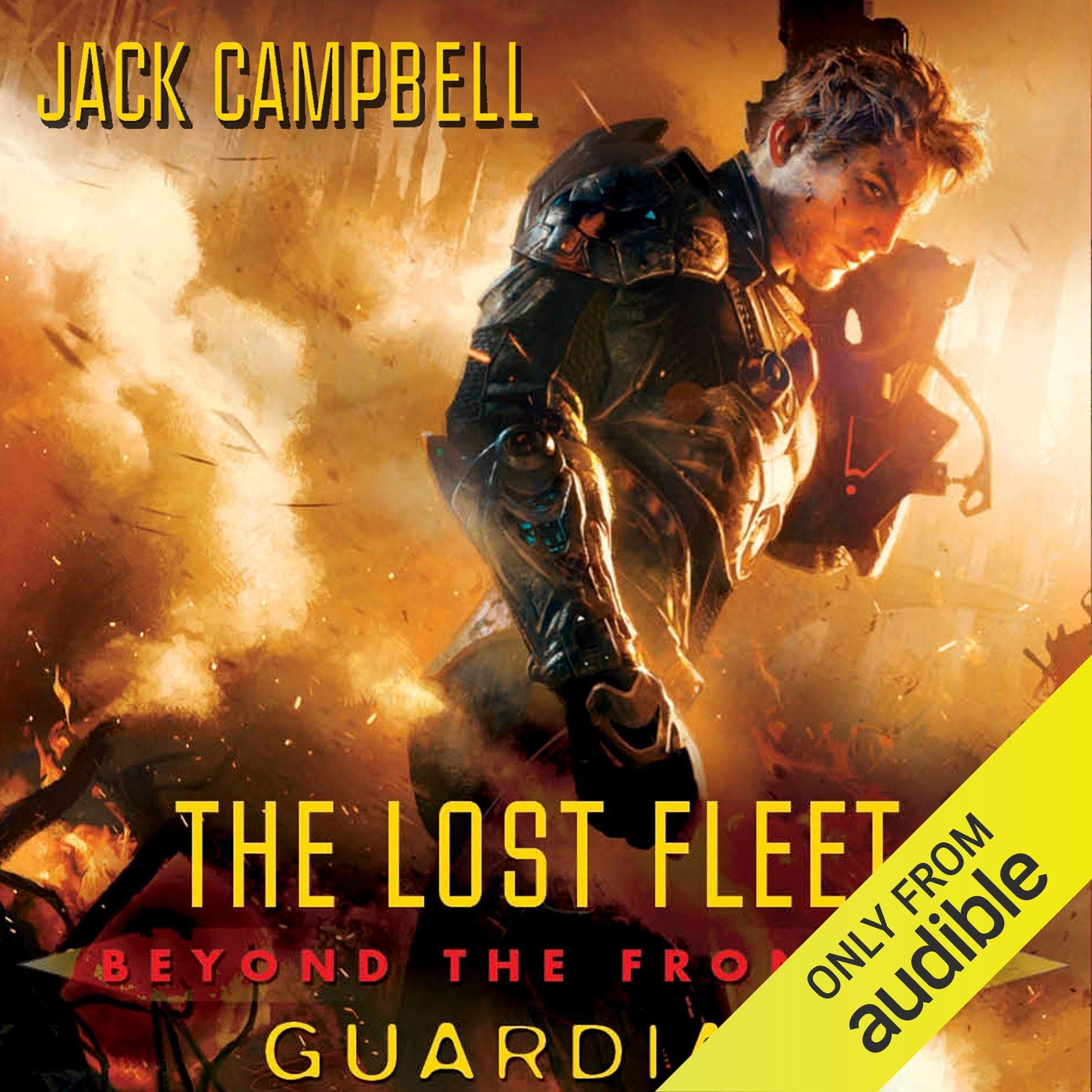
desertcart.com: Guardian: The Lost Fleet: Beyond the Frontier, Book 3 (Audible Audio Edition): Jack Campbell, Christian Rummel, Audible Studios: Books Review: ... the Frontier Guardian (2013) by Jack Campbell is a good read. The story is told third person past ... - The Lost Fleet Beyond the Frontier Guardian (2013) by Jack Campbell is a good read. The story is told third person past tense from Admiral John (Black Jack) Geary’s point of view. Every time I read the name Black Jack I thought of Black Jack Pershing, a famous American general from the first half of the Twentieth Century. I’ve read a couple of other Campbell books in The Lost Fleet series, Dreadnaught and Invincible. I liked Guardian the best. The thing I like best about this series is the use of CEO’s and syndicates as the bad guys, too many CEO’s are overpaid. The thing I like least in the series is the use of stimulants (drugs) by the good guys to stay awake instead of getting some sleep. I lost interest in the series after reading Perilous Shield, which is part of the follow on series The Lost Stars. It felt like a rehash of some of the story material from The Lost Fleet, told from a different point of view, Drakon’s POV instead of Black Jack’s POV. I decided to reread some Robert A. Heinlein instead of reading more of The Lost Stars. Starship Troopers (1959) (not like the movie) by Robert A. Heinlein is the book that got me started in sci-fi adventures, and has remained one of my top five favorite military science fiction adventure stories for decades. The Forever War (1974) by Joe Haldeman, Armor (1984) by John Steakley, Ender’s Game (1985) by Orson Scott Card and Old Man’s War (2005) by John Scalzi, round out my top five military sci-fi adventure stories. I haven’t seen any of the movies from the following series, but I did read the first books, Harry Potter and the Sorcerer’s Stone, Twilight, Outlander, Fifty Shades of Grey, The Long Earth, Divergent, etc. I sample a lot of first books, but I don’t read many complete series. (Who has that much time?) The Hunger Games series by Suzanne Collins, and The Song of Ice and Fire (Game of Thrones) by George Martin are a couple of exceptions. I’ve read both of those series more than once. If you like any of the above you might also like Taylor Anderson’s Destroyermen series, Andre Norton’s Star Soldiers, Andy Weir’s The Martian, or Frank Herbert’s Dune. Other sci-fi and fantasy authors I like include Douglas Adams, Isaac Asimov, Paolo Bacigalupi, Ray Bradbury, Arthur C. Clarke, Earnest Cline, Abe Evergreen, Hugh Howey, Larry Niven, George Orwell, Patrick Rothfuss, Brandon Sanderson, J.R.R. Tolkien, Jules Verne and H.G. Wells. Review: Great Military Science Fiction - I read this series when it was first published, and more than a decade later, I'm on my 2nd reading. It's still as good as I remember. The Lost Fleet (both the original pentalogy and this one) is a great example of military science fiction featuring phenomenally written space battles. I would love to see this turned into a TV series. The only thing I found annoying is the Desjani/Rione relationship. They are strong female characters who are too often written as catty high school girls. I especially found the unwillingness of Desjani to just move on especially annoying. Outside of that, this continues to be a great series. I look forward to finishing this series and moving on to the Outlands series.
O**!
... the Frontier Guardian (2013) by Jack Campbell is a good read. The story is told third person past ...
The Lost Fleet Beyond the Frontier Guardian (2013) by Jack Campbell is a good read. The story is told third person past tense from Admiral John (Black Jack) Geary’s point of view. Every time I read the name Black Jack I thought of Black Jack Pershing, a famous American general from the first half of the Twentieth Century. I’ve read a couple of other Campbell books in The Lost Fleet series, Dreadnaught and Invincible. I liked Guardian the best. The thing I like best about this series is the use of CEO’s and syndicates as the bad guys, too many CEO’s are overpaid. The thing I like least in the series is the use of stimulants (drugs) by the good guys to stay awake instead of getting some sleep. I lost interest in the series after reading Perilous Shield, which is part of the follow on series The Lost Stars. It felt like a rehash of some of the story material from The Lost Fleet, told from a different point of view, Drakon’s POV instead of Black Jack’s POV. I decided to reread some Robert A. Heinlein instead of reading more of The Lost Stars. Starship Troopers (1959) (not like the movie) by Robert A. Heinlein is the book that got me started in sci-fi adventures, and has remained one of my top five favorite military science fiction adventure stories for decades. The Forever War (1974) by Joe Haldeman, Armor (1984) by John Steakley, Ender’s Game (1985) by Orson Scott Card and Old Man’s War (2005) by John Scalzi, round out my top five military sci-fi adventure stories. I haven’t seen any of the movies from the following series, but I did read the first books, Harry Potter and the Sorcerer’s Stone, Twilight, Outlander, Fifty Shades of Grey, The Long Earth, Divergent, etc. I sample a lot of first books, but I don’t read many complete series. (Who has that much time?) The Hunger Games series by Suzanne Collins, and The Song of Ice and Fire (Game of Thrones) by George Martin are a couple of exceptions. I’ve read both of those series more than once. If you like any of the above you might also like Taylor Anderson’s Destroyermen series, Andre Norton’s Star Soldiers, Andy Weir’s The Martian, or Frank Herbert’s Dune. Other sci-fi and fantasy authors I like include Douglas Adams, Isaac Asimov, Paolo Bacigalupi, Ray Bradbury, Arthur C. Clarke, Earnest Cline, Abe Evergreen, Hugh Howey, Larry Niven, George Orwell, Patrick Rothfuss, Brandon Sanderson, J.R.R. Tolkien, Jules Verne and H.G. Wells.
A**R
Great Military Science Fiction
I read this series when it was first published, and more than a decade later, I'm on my 2nd reading. It's still as good as I remember. The Lost Fleet (both the original pentalogy and this one) is a great example of military science fiction featuring phenomenally written space battles. I would love to see this turned into a TV series. The only thing I found annoying is the Desjani/Rione relationship. They are strong female characters who are too often written as catty high school girls. I especially found the unwillingness of Desjani to just move on especially annoying. Outside of that, this continues to be a great series. I look forward to finishing this series and moving on to the Outlands series.
F**R
Just trying to get home. Epic Space Opera. Bad guys just won’t give up. Recommended.
This is the third book in the “The Lost Fleet Beyond the Frontiers” series which also includes “Dreadnaught” and “Invincible”. Admiral "Black Jack" Geary has taken the Alliance Fleet farther than any other human fleet and defeated three races (one human and 2 Alien) that had threatened humanity, now he just wants to get his fleet home. While the alien Enigma and Kicks (also called Bear-Cows) are behind him, the Syndics who are allegedly at peace with the Alliance, after getting their butts kicked by Black Jack, keep putting impediments in the way of Black Jack’s fleet. The most recent is apparently their ability to shut down the hypernet gates and force Black Jack to take a convoluted route home. This is something new to the Alliance fleet but what can he do ? Lots of space battles and once you add in some political interference you get a fast paced and vivid adventure. Will the fleet survive the surprises the Syndics apparently planted along his return route ? What are the real motives of the “Dancers”; another alien race who have attached themselves to his fleet ? Highly recommended.
D**B
Wonderful continuation of the Lost Fleet series.
We begin the series in a distant area of space and this book brings us back (briefly) to Earth and how far man has gone.
C**N
The Fleet Returns, and Returns
This is one of the truly great SF series, comparable to Honor Harrington and the best of Doc Smith and falling just short of the Foundation and Dune series. It combines the drama of a battered space fleet, still large and formidable to be sure, making its roundabout way home through perils of all sorts; and the assorted political fights among allies and within the governing Council. "Black Jack" Geary and his legend remain at the center of the action; he never has all the facts or resources needed, but he surmounts every problem with resolve and honor. He is surrounded by the usual cast, notably his flag captain/wife, Captain Desjani, and Envoy Rhione. OK. But series inevitably get repetitive, and "The Lost Fleet" is no exception. If it is a great series like this, the reader may even welcome the familiarity. I did. Without going into the plot developments, this iteration of the series starts with the task of escorting the invaluable Kick supership "Invincible" and the Dancers back to Alliance space, while the peace agreement with the Syndics proves less helpful than hoped. The Midway system is a great snapshot of what is happening to the Syndics. If you haven't started the series, immediately start with the first book. If you are already invested in it, you are not waiting for reviews to continue reading, but probably got this as soon as it came out and were not disappointed.
F**O
Great continuation to a great series
I have read the whole Lost Fleet series, with barely any interruption. I enjoyed it immensely and felt very sad when it finally ended. I am not going to write anything about the actual story (see other reviews, as well as my own reviews of previous installments) but the focus is on the difficulties of command, loyalty, loss and serious love. Beyond the Frontier brings new plot elements and situations into play, while maintaining the important characters and their complex relationships. Though the novelty of the story has worn off, some parts of the story has matured in a postive way, including the reduced focus on old-fashioned honor and religion (which I have found a bit annoying at times). I highly recommend anyone who enjoyed the first part of this series to read Beyond the Frontier as well.
D**K
Constant aggrandizement and moralizing
Overall, the Lost Fleet was an excellent series that I recommend, but this follow-up series is really starting to get tedious. *PROS* It's more Black Jack and more Lost Fleet! If you loved the first series, then you'll...mostly...enjoy this. *CONS* My cons largely revolve around immersion-breaking content, specifically, the portrayal of women. First, women in no country in human history (including countries where military service is mandatory for all citizens) occupy the military in the numbers that the Lost Fleet describes. As a result, this reduces immersion and kicks the reader out of the story periodically. Example: in the USA, even during times of peace, women can join the military, don't have to pass physical requirements, aren't required to go to war, are still called "soldiers", and still gain all the benefits of being a "veteran". AND YET despite this they still don't join the military (especially the Marines!) in anywhere remotely close to the numbers portrayed in these novels. Thus, one wonders why the heck they would voluntarily join the military in a time where they were guaranteed to die in an endless war AND they lacked all the additional benefits and freebies that women in the military enjoy today. Don't get me wrong, I definitely think there would be women in the Lost Fleet but the sheer quantity portrayed herein is frankly ridiculous. The reader endures it because the characters are generally interesting and the rest of the novel outweighs this less believable content. Second, aside from Black Jack, almost all the interesting, dominant, smart, skilled, etc. people in this second series are women. We get the political messaging bro, you can throttle down a bit. Third, I wish the author would stop ego-boosting so many female characters. What I mean is that when there's a skilled or talented man in the story, we know it by his actions. This is good! Authors should show, not tell. However, when it's a woman, we're shown AND told--typically several times. We're constantly being reminded that insert-woman-here is "strong", that men are "afraid" of her, that she's "potent", that she's "dangerous", that she's "brilliant" and so on. It's like the author thinks the reader isn't taking female characters seriously, so he has to lay it on super thick. Fourth, I'm starting to hope the Rione character exits stage left. While she's interesting and has a lot of potential, I'm getting tired of her fearful over-moralizing. She's been clutching her pearls since book #1 of the first series about Black Jack turning into a dictator and despite him NOT turning into a dictator after 8 novels, guess what? She's STILL wringing her hands and wailing about Black Jack turning into a dictator. Fifth, probably the most ridiculously hyped-up character is the green-haired girl. She's described as being able to "confuse" reports and data to make them harder to understand, filling them with fluff, and so on. We're told that this is some special ability. Seriously? She's a bureaucrat, that's all. We're also told that she can go the opposite way and make reports and data more comprehensible. These are not super powers, these are common traits that any given executive, executive assistant, and secretary possesses, and yet due to the author's borderline female-worship, every time she's mentioned we're forced to endure more gushing about her "abilities". The eye-rolling is strong. *CONCLUSION* You might think, given all my whining above, that I'd give this novel one star. However, as aforementioned, the other elements of the tale do help to carry the story along and it's largely enjoyable...you just might find yourself skipping sections.
S**E
Really hitting his stride strong......
The one missing element in Jack Campbell's series has been the science part of the SF. It's definetily coming into play now. I hope that he continues to develop this part of his work. I don't know if the author will ever reach the level of Larry Niven, and it's probably not even necessary, but that would be a worthy goal to pursue. As far as the plot thread and depth of individual characters, there is further growth evident as well. The more the storylines transcend their immediate settings and become parables that apply to any era and group of people, the better (the eternal nature of the tales in Star Trek TOS stories come to mind.) Keep going, Jack. It's been a real joy reading your books and watching you grow as an author. Thanks for your efforts, and may you be well rewarded for it. p.s. Somebody with sufficient vision and guts needs to come along and turn these books into either a film or TV series.
Trustpilot
1 week ago
2 weeks ago